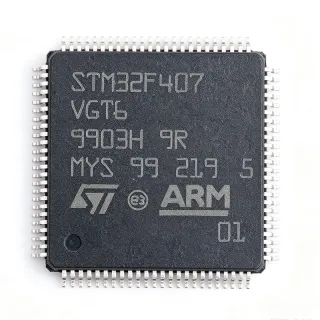
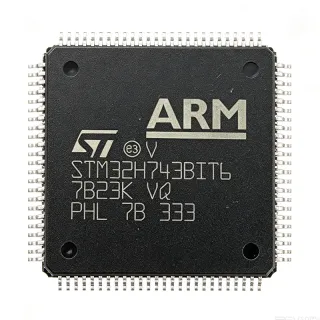
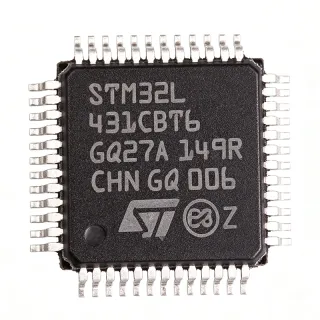
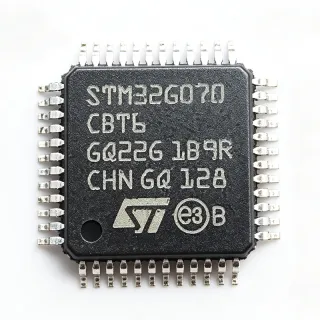
PIC18F45K80-E/PT - 64MHz 8-bit MCU, 32KB Flash, ECAN, TQFP-44 | Microchip
MPN: PIC18F45K80-E/PT ✓ פעילPIC18F45K80-E/PT סקירה
A microcontroller (MCU) is a single-chip computer containing a CPU core, program and data memory, programmable I/O peripherals, and various communication interfaces. Within the PIC® family hierarchy, the PIC18F45K80 belongs to the PIC18 8-bit advanced MCU class, which sits between 16-bit PIC24/dsPIC parts and the smaller pin-count PIC16 series. nanoWatt XLP™ (eXtreme Low Power) technology places it within Microchip's low-power portfolio, targeting battery and energy-harvesting applications.
Key features include a 12-bit ADC with up to 11 channels, a Charge Time Measurement Unit (CTMU) for capacitive touch sensing, three 16-bit timers, two comparators, and an Enhanced Universal Synchronous/Receiver/Transmitter (EUSART). The integrated ECAN module supports CAN 2.0B with six programmable receive/transmit buffers and three dedicated transmit buffers, making the device well suited to in-vehicle networking. The -E suffix denotes the extended operating temperature range of -40 °C to +125 °C.
Internal architecture combines a RISC-based PIC18 CPU core with a modified Harvard bus, allowing simultaneous instruction fetch and data access. The integrated ECAN hardware offloads message filtering and arbitration from software, reducing CPU load in multi-node automotive networks. Sleep current is rated in the nano-ampere range, allowing battery-powered nodes to remain dormant for years while still responding to CAN or timer wake-up events.
Typical applications include CAN-based automotive body and chassis ECUs, building automation controllers, elevator control systems, capacitive touch human-machine interfaces, industrial sensor nodes, and OBD-II diagnostic interfaces. The 64 MHz core provides sufficient throughput for sensor fusion and CAN message processing in real time. Designers should confirm decoupling (100 nF + bulk) is placed within a few millimeters of the supply pins, route the ECAN TX/RX traces as a differential pair with 120 Ω termination, and use the exposed pad for thermal relief even at modest clock speeds.
חלופות תחליף ישיר עבור PIC18F45K80-E/PT — אותו מארז, תואם פין-לפין. חלקים במארז שונה הדורשים עיבוד מחדש של ה-PCB אינם נכללים.
וריאנטים בסדרה זו
דגמים מאותה סדרה התואמים Drop-in עם PIC18F45K80-E/PT (אותו גורם צורה וטביעת רגל) — שונים ב Package, ADC, Timers, Core Architecture, MSL Level.
PIC18F45K80-I/PT
✅ Drop-Inצור קשר לקבלת מחיר
הצג גיליון נתונים ←PIC18F46K80-I/PT
✅ Drop-Inצור קשר לקבלת מחיר
הצג גיליון נתונים ←PIC18F45K80-E/ML
✅ Drop-In ⚠️ מפרטים לא מאומתיםצור קשר לקבלת מחיר
הצג גיליון נתונים ←PIC18F4580-I/PT
✅ Drop-In📋 חלופה להתייחסות (לא בקטלוג)
PIC18F45K42-I/PT
✅ Drop-Inצור קשר לקבלת מחיר
הצג גיליון נתונים ←PIC18F45K80-E/PT דירוגים מרביים ומאפיינים חשמליים
| Core | PIC18 8-bit RISC |
| Program Memory (Flash) | 32 KB (16K x 16) |
| RAM Size | 3.6 KB (3.6K x 8) |
| EEPROM Size | 1 KB (1K x 8) |
| Maximum CPU Speed | 64 MHz (16 MIPS) |
| Operating Voltage | 1.8 V to 5.5 V |
| Number of I/O Pins | 35 |
| ADC | 12-bit, up to 11 channels |
| Comparators | 2 |
| Timers | 3 x 16-bit, 1 x 8-bit |
| ECAN Module | CAN 2.0B, 6 RX/TX buffers, 3 dedicated TX buffers |
| EUSART | 1 |
| MSSP (SPI/I2C) | 1 |
| CTMU | Yes (Charge Time Measurement Unit for capacitive touch) |
| מארז | 44-pin TQFP (10x10 mm) with exposed pad |
| טמפרטורת פעולה | -40 °C to +125 °C (Extended, -E suffix) |
| סוג הרכבה | Surface Mount |
| רמת MSL | 3 |
| סטטוס RoHS | Compliant |
| Lead-Free | Yes |
תצורת פינים של PIC18F45K80-E/PT
| פין 1 | OSC1/CLKIN/RA7 — Oscillator input or digital I/O RA7 |
| פין 2 | OSC2/CLKOUT/RA6 — Oscillator output or digital I/O RA6 |
| פין 3 | RA0/AN0 — Digital I/O RA0 / analog input AN0 |
| פין 4 | RA1/AN1 — Digital I/O RA1 / analog input AN1 |
| פין 5 | RA2/AN2/Vref- — Digital I/O RA2 / analog input AN2 / ADC Vref- |
| פין 6 | RA3/AN3/Vref+ — Digital I/O RA3 / analog input AN3 / ADC Vref+ |
| פין 7 | RA4/T0CKI — Digital I/O RA4 / Timer0 clock input |
| פין 8 | RA5/AN4 — Digital I/O RA5 / analog input AN4 |
| פין 9 | RE0/AN5 — Digital I/O RE0 / analog input AN5 |
| פין 10 | RE1/AN6 — Digital I/O RE1 / analog input AN6 |
| פין 11 | RE2/AN7 — Digital I/O RE2 / analog input AN7 |
| פין 12 | VDD — Positive supply voltage |
| פין 13 | VSS — Ground |
| פין 14 | RB0/INT0/FLT0 — Digital I/O RB0 / external interrupt 0 / PWM fault |
| פין 15 | RB1/INT1 — Digital I/O RB1 / external interrupt 1 |
| פין 16 | RB2/INT2 — Digital I/O RB2 / external interrupt 2 |
| פין 17 | RB3/INT3 — Digital I/O RB3 / external interrupt 3 |
| פין 18 | RB4 — Digital I/O RB4 |
| פין 19 | RB5 — Digital I/O RB5 |
| פין 20 | RB6/PGC — Digital I/O RB6 / ICSP clock |
| פין 21 | RB7/PGD — Digital I/O RB7 / ICSP data |
| פין 22 | RC0/T1OSO/T1CKI — Digital I/O RC0 / Timer1 oscillator output / clock input |
| פין 23 | RC1/T1OSI/CCP2 — Digital I/O RC1 / Timer1 oscillator input / CCP2 |
| פין 24 | RC2/CCP1 — Digital I/O RC2 / CCP1 PWM |
| פין 25 | RC3/SCK/SCL — Digital I/O RC3 / SPI clock / I2C clock |
| פין 26 | RC4/SDI/SDA — Digital I/O RC4 / SPI data in / I2C data |
| פין 27 | RC5/SDO — Digital I/O RC5 / SPI data out |
| פין 28 | RC6/TX/CK — Digital I/O RC6 / EUSART TX / clock |
| פין 29 | RC7/RX/DT — Digital I/O RC7 / EUSART RX / data |
| פין 30 | RD0 — Digital I/O RD0 |
| פין 31 | RD1 — Digital I/O RD1 |
| פין 32 | RD2 — Digital I/O RD2 |
| פין 33 | RD3 — Digital I/O RD3 |
| פין 34 | RD4 — Digital I/O RD4 |
| פין 35 | RD5 — Digital I/O RD5 |
| פין 36 | RD6 — Digital I/O RD6 |
| פין 37 | RD7 — Digital I/O RD7 |
| פין 38 | C1OUT — Comparator 1 output |
| פין 39 | C2OUT — Comparator 2 output |
| פין 40 | MCLR/RE3 — Master clear reset / digital I/O RE3 |
| פין 41 | VSS — Ground |
| פין 42 | VDD — Positive supply voltage |
| פין 43 | AVDD — Analog supply voltage |
| פין 44 | AVSS — Analog ground |
יישומים טיפוסיים
PIC18F45K80-E/PT מתאים עבור 6 יישוםs: Automotive CAN Body and Chassis ECUs, Building Automation and HVAC Controllers, Elevator Control and Drive Modules, Capacitive Touch Human-Machine Interfaces, OBD-II Automotive Diagnostic Interfaces, Industrial Sensor Nodes with CAN Communication.
Automotive CAN Body and Chassis ECUs
The PIC18F45K80-E/PT is an ideal backbone for CAN-based automotive body and chassis ECUs because the integrated ECAN module handles CAN 2.0B arbitration and filtering in hardware, leaving CPU bandwidth free for sensor fusion and diagnostic tasks. The 64 MHz / 16 MIPS core is more than capable of processing 1 Mbit/s CAN traffic alongside PWM actuator control and switch scanning. The extended -40 °C to +125 °C operating range covers under-hood and cabin environments without a heatsink. A typical ECU places an MCP2551 or TJA1050 CAN transceiver between the MCU and the bus, with the MCU reading switches via the 12-bit ADC and driving actuators via the PWM modules. NanoWatt XLP sleep currents in the nanoampere range let the ECU remain quiescent while still waking on CAN traffic.
מומלץ
Building Automation and HVAC Controllers
Building automation controllers require reliable communication over long cable runs and the ability to handle multiple sensor inputs, both of which the PIC18F45K80-E/PT supports via ECAN and its 11-channel 12-bit ADC. With 32 KB of Flash it can host BACnet, Modbus, or CANopen protocol stacks alongside application logic. The 1.8 V to 5.5 V supply range simplifies integration with 3.3 V sensors and 5 V actuator drivers. EUSART and MSSP peripherals handle Modbus RTU, I2C sensor expansion, and SPI display drivers in parallel. Industrial -E temperature grade means rooftop and basement installations operate reliably year-round. Designers typically run the CPU at 16 MHz to balance power and latency for HVAC loop control.
מומלץ
Elevator Control and Drive Modules
Elevator control modules demand deterministic, fault-tolerant communication between car units, controllers, and door drives, which the PIC18F45K80-E/PT delivers through its hardware ECAN peripheral. The 32 KB Flash can store position control tables and safety state machines for door interlocks and braking. The 16 MIPS throughput keeps CAN message processing and motor PWM generation on schedule even under high traffic. The CTMU-based capacitive touch replaces mechanical buttons with sealed touch panels for the car operating panel. The extended temperature rating ensures operation in machine rooms without active cooling. Typical implementations include shaft encoder input via the EUSART and triac-controlled cabin lighting through PWM outputs.
מומלץ
Capacitive Touch Human-Machine Interfaces
The integrated Charge Time Measurement Unit (CTMU) makes the PIC18F45K80-E/PT well-suited for capacitive touch HMI panels. The CTMU generates precise current sources and measures charge times on touch electrodes, enabling sliders, buttons, and proximity sensing without external touch controllers. The 12-bit ADC captures touch data while the 32 KB Flash stores gesture recognition firmware. Designers can implement up to 11 touch channels on this device, with scan times in the microsecond range. CAN output sends touch events to a central controller, while the MSSP handles I2C-based display updates. Low sleep current lets battery-powered remote controls retain touch sensing for years.
מומלץ
OBD-II Automotive Diagnostic Interfaces
OBD-II scan tools and engine analyzers leverage the PIC18F45K80-E/PT's integrated ECAN controller to interface with modern vehicles' CAN bus alongside the legacy J1850 VPW/PWM protocols. The 64 MHz CPU handles ISO 15765 transport-layer framing, PIDs parsing, and USB bridging in real time. 3.6 KB of RAM buffers incoming diagnostic messages while the 32 KB Flash hosts the OBD-II stack. The 12-bit ADC supports analog signal acquisition for sensor diagnostics on legacy systems. Industrial -E grade allows continuous use in harsh garage environments. Typical designs pair the MCU with an MCP2515 stand-alone CAN controller and an FTDI USB bridge for PC connectivity.
מומלץ
Industrial Sensor Nodes with CAN Communication
Distributed industrial sensor nodes benefit from the PIC18F45K80-E/PT's combination of 12-bit ADC, ECAN, and nanoWatt XLP sleep modes. The MCU can wake on timer or CAN events, sample analog sensors, broadcast readings over CAN, and return to deep sleep drawing only nanoamperes. 35 I/O handle digital sensor inputs and outputs without external expanders. Industrial -40 °C to +125 °C operation suits factory-floor and outdoor deployments. The 3.6 KB RAM is enough to buffer multiple CAN frames during radio/CAN transmission gaps. Designers typically run at 4 MHz to minimize active current while still meeting 100 kbit/s CAN update rates.
מומלץ
סיכום מוצרים מומלצים
נתוני עזר הנדסיים עבור PIC18F45K80-E/PT — השוואה, הנחיות תכנון ומידע על תאימות.
מדריך בחירה
השוואה עם חלופות
| פרמטר | מוצר זה | PIC18F45K80-I/PT | PIC18F46K80-I/PT | PIC18F4580-I/PT |
|---|---|---|---|---|
| Brand | Microchip Technology | Microchip Technology | Microchip Technology | Microchip Technology |
| Package | 44-pin TQFP (10x10) | 44-pin TQFP (10x10) - same | 44-pin TQFP (10x10) - same | 44-pin TQFP (10x10) - same |
| Program Memory | 32 KB | 32 KB | 48 KB | 32 KB |
| RAM | 3.6 KB | 3.6 KB | 5 KB | 1.5 KB |
| Max CPU Speed | 64 MHz (16 MIPS) | 64 MHz (16 MIPS) | 64 MHz (16 MIPS) | 40 MHz (10 MIPS) |
| ECAN Module | Yes (CAN 2.0B) | Yes (CAN 2.0B) | Yes (CAN 2.0B) | Yes (older ECAN) |
| Operating Temperature | -40 to +125 C (Extended) | -40 to +85 C (Industrial) | -40 to +85 C (Industrial) | -40 to +85 C (Industrial) |
| nanoWatt XLP | Yes | Yes | Yes | No |
| CTMU (Capacitive Touch) | Yes | Yes | Yes | No |
מבדילים עיקריים
- Hardware ECAN with nanoWatt XLP low-power sleep (לעומתPIC18F4580-I/PT)
- CTMU capacitive touch peripheral integrated (לעומתPIC18F45K80-I/PT)
- 64 MHz / 16 MIPS core performance (לעומתPIC18F4580-I/PT)
הערות תכנון
Estimated: VDD current at 64 MHz and 5 V is typically 9-12 mA (active) and drops below 1 uA in sleep. Place a 100 nF ceramic decoupling capacitor within 5 mm of each VDD pin, plus a 10 uF bulk capacitor near the supply entry. A 10-100 ohm ferrite bead in series with VDD helps isolate digital switching noise from the ADC AVdd rail. Use a separate low-noise LDO such as the MCP1700 for AVdd if analog accuracy is critical.
Route the ECAN TX/RX pair as a differential microstrip with characteristic impedance of 120 ohms, matching the bus termination. Keep trace lengths matched within 5 mm and avoid 90-degree bends. The TQFP-44 exposed pad (EP) MUST be soldered to a continuous ground copper pour of at least 100 mm² for thermal relief and electrical ground. Place the MCP2551 CAN transceiver within 50 mm of the MCU ECAN pins to minimize EMI.
The MCLR pin (pin 40) requires a 10 kohm pull-up to VDD; omitting this prevents device start-up. The PGC/PGD pins (RB6/RB7) must not be pulled low during reset to avoid entering ICSP mode accidentally. The ADC requires the AVdd pin to be powered even if the ADC is unused, otherwise the analog inputs may float and cause quiescent current increase. Configuration bits must be set for the correct oscillator mode before code execution.
For high-speed SPI or EUSART communication, place 22-33 ohm series termination resistors at the driver output to dampen ringing. Keep digital traces away from analog inputs (AN0-AN7) and use a ground guard ring around sensitive analog pins. When using the CTMU for capacitive touch, route the touch electrode traces with minimal parasitic capacitance (less than 10 pF) and avoid running them parallel to noisy digital traces.
מידע על תאימות
RoHS and lead-free per Microchip product page. Not AEC-Q100 qualified by Microchip, though the extended -40 to +125 C temperature grade is intended for automotive-grade applications; consult Microchip for PPAP documentation. Halogen-free status not stated in web data.