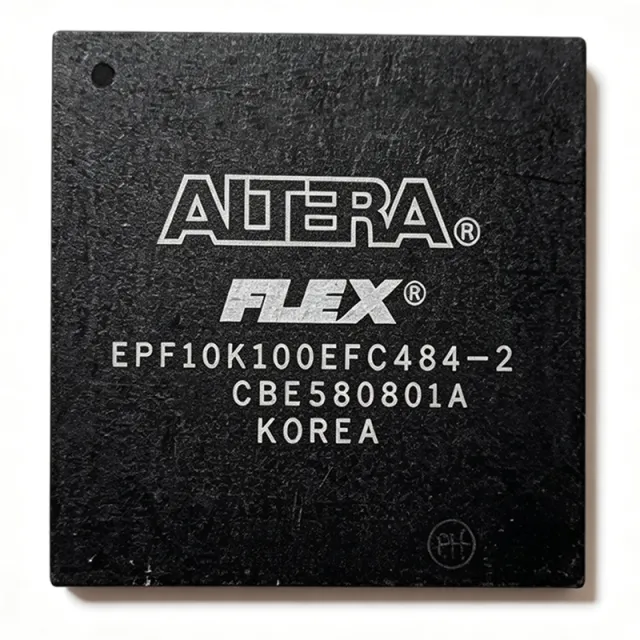
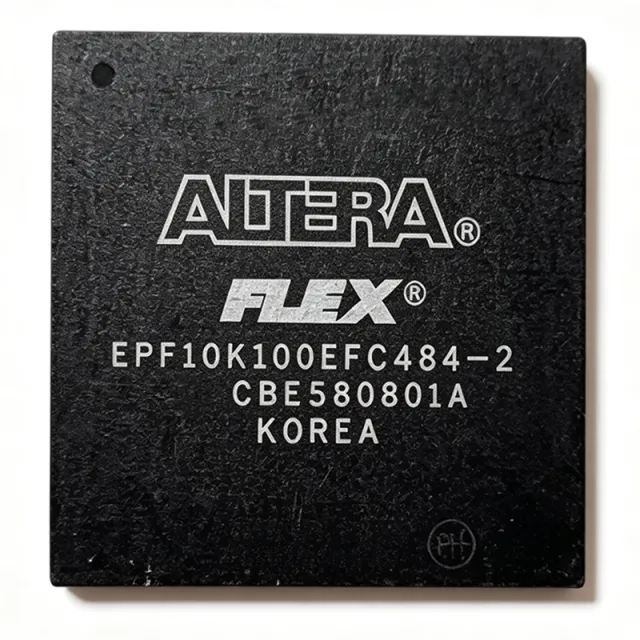
EPF10K100EBC356-2X
EPF10K100EBC356-2X - FLEX 10KE FPGA 100K Gates 356-BGA | Altera
The Altera (Intel Programmable Solutions Group) EPF10K100EBC356-2X is a high-density FLEX 10KE family Field Programmable Gate Array (FPGA) featuring 100,000 system gates, 4,992 logic elements/cells, 49,152 bits of embedded RAM, and 274 user I/Os in a 356-ball LBGA (35 mm x 35 mm) package. The device operates from a 2.375 V to 2.625 V core supply with a 3.3 V I/O supply and is rated for the commercial 0 °C to 70 °C temperature range. Per the FLEX 10KE datasheet, the EPF10K100EBC356-2X belongs to Altera's "-2X" speed grade with an internal propagation delay of approximately 0.6 ns and 624 Logic Array Blocks (LABs).
What is a FLEX 10KE FPGA? The FLEX 10KE family is a second-generation embedded programmable logic family that introduced the industry's first embedded array blocks (EABs) for implementing on-chip dual-port RAM, ROM, FIFO, and CAM functions alongside conventional logic. This hybrid "Logic + Embedded Array" architecture enables System-on-a-Programmable-Chip (SOPC) integration, sitting hierarchically under PLD → CPLD/FPGA → programmable logic device → semiconductor. The FLEX 10KE family is the precursor to modern SRAM-based FPGAs from Altera/Intel and remains in production for long-lifecycle industrial, telecom, and military customers.
Key features of the EPF10K100EBC356-2X include 12 embedded array blocks (EABs) providing up to 49,152 RAM bits, built-in JTAG boundary-scan test (IEEE 1149.1), 3.3 V PCI-compliant I/Os, multiVolt I/O supporting 2.5 V/3.3 V/5.0 V mixed-voltage interfacing, in-system programmability via the Altera ByteBlaster or BitBlaster download cables, and four dedicated clock input pins plus global clock networks. The SRAM-based configuration cells allow unlimited reconfiguration, while dedicated configuration circuitry supports serial and parallel configuration modes including passive serial (PS), passive parallel synchronous (PPS), passive parallel asynchronous (PPA), and JTAG-based configuration.
The architecture combines a fine-grained Look-Up Table (LUT)-based logic fabric with course-grained embedded array blocks, giving designers the ability to implement both random state machines and high-density memory functions on the same die. Each LAB contains 8 Logic Elements (LEs), each LE containing a 4-input LUT, a programmable register, and dedicated carry and cascade chains. The EABs can be configured as 256 x 8, 512 x 4, 1024 x 2, or 2048 x 1 memory blocks with optional parity.
Typical applications include telecom infrastructure (line-card controllers, glue logic for ATCA/cPCI backplanes), industrial automation (PLC scan engines, motor-control co-processors), military/aerospace systems requiring long-lifecycle Altera silicon, data-acquisition front-ends, and legacy designs that were migrated from FLEX 10K to FLEX 10KE to gain EAB-based embedded memory. Designers porting to newer Cyclone or MAX families will find the FLEX 10KE design flow familiar: Quartus II (legacy) or Quartus Prime Lite can target this device using compiled VHDL/Verilog netlists.
When designing with this device, observe that the 35 mm x 35 mm LBGA-356 package requires 4-layer or 6-layer PCB stack-up with 0.5 mm or 0.8 mm ball pitch and matched-length impedance control on clock and global nets. Decoupling must use at least 12 x 0.1 µF ceramic capacitors placed within 5 mm of the package, plus a 100 µF tantalum bulk capacitor on each supply rail. Configuration mode selection via MSEL pins must be hardwired before VCC ramps up, otherwise the device may enter an undefined configuration state. Designers should also budget at least 200 mA of peak inrush current during configuration, requiring a soft-start circuit on the 2.5 V regulator.
This page synthesizes distributor pricing, drop-in alternatives from the Site MPN catalog (same-package FLEX 10KE speed-grade and -1/-2N/-3 family variants), and practical design notes that are not assembled in the manufacturer datasheet PDF.
Permintaan RFG
Kontak