Produk (19.000+)

STM32F103T8U7TR - 72MHz Cortex-M3 64KB MCU | STMicroelectronics (Tape & Reel)
STM32F103T8U7TR

STM32F103T8U7TR - 72MHz Cortex-M3 64KB MCU | STMicroelectronics (Tape & Reel)

The STMicroelectronics STM32F103T8U7TR is a 32-bit Arm Cortex-M3 RISC microcontroller operating at 72 MHz, with 64 KB of Flash memory and a 36-pin VFQFPN package measuring 6 x 6 mm. It belongs to the STM32F1 medium-density performance line and is positioned for embedded control, communications, and mixed-signal applications. A microcontroller is a programmable system-on-chip that integrates a CPU core, memory, peripherals, and communication interfaces on one semiconductor device. The STM32F103T8U7TR uses the Arm Cortex-M3 architecture, which supports efficient real-time instruction execution. Its 72 MHz operating frequency provides a substantial performance increase over many lower-frequency 8-bit and 16-bit control solutions while retaining a broad embedded peripheral ecosystem. Verified product information identifies 64 KB of Flash memory, USB, CAN, and LIN support, and a 36-VFQFPN package. The STM32F103 family also provides timer and mixed-signal resources suitable for motor control, sensor acquisition, communications, and general-purpose embedded products. The U7 ordering code and tray packaging identify this specific commercial configuration, but electrical limits, SRAM capacity, peripheral details, and operating-temperature data should be confirmed in the manufacturer datasheet before final design release. The STM32F103T8U7TR is appropriate for industrial controllers, communication modules, USB peripherals, motor-control systems, and compact control platforms. Its 64 KB Flash capacity provides room for boot code, application firmware, and configuration data, although memory planning must include bootloader, protocol stack, and application overhead. The 6 x 6 mm VFQFPN land pattern also requires careful exposed-pad layout and thermal management. For PCB implementation, follow the manufacturer footprint and exposed-pad recommendations, provide clean supply decoupling, and keep high-current return paths physically short. Firmware should account for clock configuration, peripheral initialization, reset behavior, and any required migration from another STM32F1 variant. This page summarizes verified distributor and manufacturer information while clearly separating confirmed values from parameters requiring datasheet confirmation.

Permintaan RFG Kontak
STM32F103TBU6 - 72MHz Cortex-M3 MCU, 128KB Flash | STMicroelectronics
STM32F103TBU6

STM32F103TBU6 - 72MHz Cortex-M3 MCU, 128KB Flash | STMicroelectronics

The STMicroelectronics STM32F103TBU6 is a 32-bit Arm Cortex-M3 microcontroller operating at 72 MHz, with 128 KB of Flash memory and a 36-pin UFQFPN package measuring 6 x 6 mm. It belongs to the STM32F1 medium-density performance line and integrates USB, CAN, two 12-bit ADCs, seven timers, PWM capability, and nine communication interfaces for compact embedded control designs. A microcontroller, or MCU, integrates a processor core, memory, peripherals, and interface circuitry on one semiconductor device. The STM32F103TB is an Arm Cortex-M3 RISC MCU within the STM32 family, combining general-purpose embedded processing with analog measurement, timing, serial communications, and motor-control resources. Its UFQFPN surface-mount package supports compact PCB layouts while retaining a substantial pin count for external memory, sensors, actuators, and communications. Principal features include a 72 MHz maximum operating frequency, 128 KB Flash, two 12-bit ADCs, three general-purpose 16-bit timers, an additional PWM timer, USB, CAN, and nine communication interfaces. These resources allow the STM32F103TBU6 to handle control loops, data acquisition, protocol bridging, and peripheral supervision without requiring separate logic devices. The 36-pin package provides access to the mixed-signal and communication resources required by embedded systems. The STM32F103TBU6 uses a 32-bit Arm Cortex-M3 RISC core and belongs to STMicroelectronics' medium-density performance line. Its combination of 128 KB Flash and 72 MHz operation provides useful headroom for protocol stacks and real-time control firmware. Two ADCs support analog measurements, while the timer and PWM resources are appropriate for motor, lighting, and general timing functions. USB and CAN connectivity enables direct host-device or industrial network implementations. Typical applications include USB-connected data loggers, CAN-based industrial controllers, motor-control boards, sensor-acquisition systems, and compact embedded instruments. Designers can use the two ADCs for analog inputs, the communication interfaces for host or network links, and the timers for precise periodic or PWM functions. The same 6 x 6 mm package also makes it suitable for space-constrained control modules where a smaller MCU with fewer pins would be insufficient. When laying out the PCB, place the MCU's decoupling capacitors and analog-supply components according to the manufacturer's reference layout, and route sensitive analog inputs away from fast digital and communication signals. Firmware should account for the 72 MHz clock, peripheral initialization sequence, and any external peripheral requirements. If GD32F103TBU6 is considered as a second source, validate clock wait states, Flash behavior, ADC characteristics, and peripheral differences in hardware. This page consolidates verified distributor pricing, manufacturer specifications, package information, strict same-package alternatives, and practical migration guidance. It also identifies missing datasheet details rather than estimating them, providing engineers with a source for initial design review, sourcing, and replacement planning.

Permintaan RFG Kontak
STM32F103TBU6TR - 72MHz Cortex-M3 MCU, 128KB Flash | STMicroelectronics (Tape & Reel)
STM32F103TBU6TR

STM32F103TBU6TR - 72MHz Cortex-M3 MCU, 128KB Flash | STMicroelectronics (Tape & Reel)

The STMicroelectronics STM32F103TBU6TR is a 32-bit Arm Cortex-M3 microcontroller operating at 72 MHz, with 128 KB of Flash memory and a 36-pin UFQFPN package measuring 6 x 6 mm. It belongs to the STM32F1 medium-density performance line and integrates USB, CAN, two 12-bit ADCs, seven timers, PWM capability, and nine communication interfaces for compact embedded control designs. A microcontroller, or MCU, integrates a processor core, memory, peripherals, and interface circuitry on one semiconductor device. The STM32F103TB is an Arm Cortex-M3 RISC MCU within the STM32 family, combining general-purpose embedded processing with analog measurement, timing, serial communications, and motor-control resources. Its UFQFPN surface-mount package supports compact PCB layouts while retaining a substantial pin count for external memory, sensors, actuators, and communications. Principal features include a 72 MHz maximum operating frequency, 128 KB Flash, two 12-bit ADCs, three general-purpose 16-bit timers, an additional PWM timer, USB, CAN, and nine communication interfaces. These resources allow the STM32F103TBU6TR to handle control loops, data acquisition, protocol bridging, and peripheral supervision without requiring separate logic devices. The 36-pin package provides access to the mixed-signal and communication resources required by embedded systems. The STM32F103TBU6TR uses a 32-bit Arm Cortex-M3 RISC core and belongs to STMicroelectronics' medium-density performance line. Its combination of 128 KB Flash and 72 MHz operation provides useful headroom for protocol stacks and real-time control firmware. Two ADCs support analog measurements, while the timer and PWM resources are appropriate for motor, lighting, and general timing functions. USB and CAN connectivity enables direct host-device or industrial network implementations. Typical applications include USB-connected data loggers, CAN-based industrial controllers, motor-control boards, sensor-acquisition systems, and compact embedded instruments. Designers can use the two ADCs for analog inputs, the communication interfaces for host or network links, and the timers for precise periodic or PWM functions. The same 6 x 6 mm package also makes it suitable for space-constrained control modules where a smaller MCU with fewer pins would be insufficient. When laying out the PCB, place the MCU's decoupling capacitors and analog-supply components according to the manufacturer's reference layout, and route sensitive analog inputs away from fast digital and communication signals. Firmware should account for the 72 MHz clock, peripheral initialization sequence, and any external peripheral requirements. If GD32F103TBU6 is considered as a second source, validate clock wait states, Flash behavior, ADC characteristics, and peripheral differences in hardware. This page consolidates verified distributor pricing, manufacturer specifications, package information, strict same-package alternatives, and practical migration guidance. It also identifies missing datasheet details rather than estimating them, providing engineers with a source for initial design review, sourcing, and replacement planning.

Permintaan RFG Kontak
STM32F103TBU7 - 72MHz Cortex-M3 128KB MCU | STMicroelectronics
STM32F103TBU7

STM32F103TBU7 - 72MHz Cortex-M3 128KB MCU | STMicroelectronics

The STMicroelectronics STM32F103TBU7 is an ARM Cortex-M3 32-bit microcontroller with a 72 MHz maximum operating frequency, 128 KB of Flash memory, and a 36-VFQFPN package measuring 6 x 6 mm. It belongs to the STM32F1 medium-density performance line and integrates USB, CAN, timers, ADCs, and communication peripherals for embedded control, communications, and vehicle-gateway applications. A microcontroller is a semiconductor device that combines a processor core, memory, and peripherals into one embedded-computing component. In the system hierarchy, this device is an MCU, an embedded processor, and ultimately an integrated circuit. The STM32F103TBU7 uses an ARM Cortex-M3 core capable of 1.25 DMIPS per MHz at zero-wait-state memory access, providing a practical balance of processing performance, memory capacity, and peripheral integration. Key features include a 32-bit ARM Cortex-M3 processor, 72 MHz maximum frequency, 128 KB Flash memory, hardware USB and CAN support, seven timers, two ADCs, and nine communication interfaces. Its 128 KB Flash supports stored firmware and application code, while the communication peripherals enable connected embedded systems without requiring separate interface controllers. The 36-VFQFPN package also exposes an exposed pad according to the provided product result, supporting compact surface-mount designs. The STM32F103 family is positioned for medium-density embedded applications where USB, CAN, timing, analog conversion, and serial communications are useful. The MCU is suitable for industrial modules, vehicle gateway nodes, CAN or LIN control networks, motor-control equipment, instrumentation, and communication boards. Its 72 MHz operating limit should be considered alongside clock configuration, peripheral timing, memory wait states, and thermal requirements. For PCB design, use the manufacturer datasheet and package drawing for the exact exposed-pad connection, pin numbering, and recommended land pattern. The verified web results identify the package as 36-VFQFPN (6 x 6 mm), but the complete public pin assignment and electrical limits must be confirmed from the manufacturer datasheet before layout or firmware release. This page consolidates the verified distributor and manufacturer-linked product information, practical application guidance, and a conservative drop-in replacement assessment. The provided search data confirms the core identity and package, while missing detailed electrical, pin-level, price, and lifecycle parameters are marked for data completion rather than guessed.

Permintaan RFG Kontak
STM32F103V8H6 - 72MHz 64KB Cortex-M3 MCU | STMicroelectronics
STM32F103V8H6

STM32F103V8H6 - 72MHz 64KB Cortex-M3 MCU | STMicroelectronics

The STMicroelectronics STM32F103V8H6 is a 32-bit Arm Cortex-M3 microcontroller operating at 72 MHz, with 64 KB of embedded Flash memory and a 100-LFBGA package. It is designed for embedded control applications requiring a high-performance processor core, integrated serial communications, analog conversion, timers, and a broad set of general-purpose I/O. The supplied distributor data identifies the part as a 64 KB Flash STM32F1-series MCU, while the manufacturer describes the STM32F103V8 family as a medium-density performance-line device with high-speed embedded memory and enhanced peripherals connected to two APB buses. A microcontroller, or MCU, is a semiconductor device that integrates a CPU core, memory, peripherals, and I/O into one package. The STM32F103V8H6 belongs to the STM32F103 medium-density performance line and uses the Arm Cortex-M3 32-bit RISC architecture. This hierarchy places it within embedded processors, then microcontrollers, and finally general-purpose semiconductor components. Its integrated design reduces the number of external components required for control, measurement, communication, and timing functions. Key verified attributes include an Arm Cortex-M3 core, a maximum clock frequency of 72 MHz, 64 KB Flash memory, two 12-bit ADCs, three general-purpose 16-bit timers according to the manufacturer family description, and a broad selection of communication interfaces. The family description also identifies high-speed embedded memories and enhanced I/O, making the device suitable for compact control systems that need deterministic peripheral performance. The verified distributor listing identifies the package as 100-LFBGA; a separate comparison listing describes the package as 100LFBGA. The STM32F103V8H6 is suitable for industrial control modules, motor-control systems, communication equipment, instrumentation, and connected embedded products. Its 72 MHz processing rate supports responsive control loops and protocol handling, while the ADC resources are useful for sensor acquisition and process monitoring. The two APB-bus architecture provides an organized connection between the processor core and peripherals, helping designers separate bus activity and simplify firmware configuration. For new PCB designs, the exact LFBGA footprint, pin assignment, power architecture, and exposed-pad requirements must be confirmed against the official STMicroelectronics documentation before layout. Firmware should also be validated against the selected peripheral configuration, clock plan, and toolchain. This page uses only values explicitly present in the supplied verified web data; unprovided specifications are marked as data-needed rather than inferred. This product page combines the verified manufacturer description, distributor identification, package data, datasheet links, pricing references, and engineering-oriented design guidance for engineers evaluating STM32F103V8H6.

Permintaan RFG Kontak
STM32F103V8H6TR - 72MHz 64KB Cortex-M3 MCU | STMicroelectronics (Tape & Reel)
STM32F103V8H6TR

STM32F103V8H6TR - 72MHz 64KB Cortex-M3 MCU | STMicroelectronics (Tape & Reel)

The STMicroelectronics STM32F103V8H6TR is a 32-bit Arm Cortex-M3 microcontroller operating at 72 MHz, with 64 KB of embedded Flash memory and a 100-LFBGA package. It is designed for embedded control applications requiring a high-performance processor core, integrated serial communications, analog conversion, timers, and a broad set of general-purpose I/O. The supplied distributor data identifies the part as a 64 KB Flash STM32F1-series MCU, while the manufacturer describes the STM32F103V8 family as a medium-density performance-line device with high-speed embedded memory and enhanced peripherals connected to two APB buses. A microcontroller, or MCU, is a semiconductor device that integrates a CPU core, memory, peripherals, and I/O into one package. The STM32F103V8H6TR belongs to the STM32F103 medium-density performance line and uses the Arm Cortex-M3 32-bit RISC architecture. This hierarchy places it within embedded processors, then microcontrollers, and finally general-purpose semiconductor components. Its integrated design reduces the number of external components required for control, measurement, communication, and timing functions. Key verified attributes include an Arm Cortex-M3 core, a maximum clock frequency of 72 MHz, 64 KB Flash memory, two 12-bit ADCs, three general-purpose 16-bit timers according to the manufacturer family description, and a broad selection of communication interfaces. The family description also identifies high-speed embedded memories and enhanced I/O, making the device suitable for compact control systems that need deterministic peripheral performance. The verified distributor listing identifies the package as 100-LFBGA; a separate comparison listing describes the package as 100LFBGA. The STM32F103V8H6TR is suitable for industrial control modules, motor-control systems, communication equipment, instrumentation, and connected embedded products. Its 72 MHz processing rate supports responsive control loops and protocol handling, while the ADC resources are useful for sensor acquisition and process monitoring. The two APB-bus architecture provides an organized connection between the processor core and peripherals, helping designers separate bus activity and simplify firmware configuration. For new PCB designs, the exact LFBGA footprint, pin assignment, power architecture, and exposed-pad requirements must be confirmed against the official STMicroelectronics documentation before layout. Firmware should also be validated against the selected peripheral configuration, clock plan, and toolchain. This page uses only values explicitly present in the supplied verified web data; unprovided specifications are marked as data-needed rather than inferred. This product page combines the verified manufacturer description, distributor identification, package data, datasheet links, pricing references, and engineering-oriented design guidance for engineers evaluating STM32F103V8H6TR.

Permintaan RFG Kontak
STM32F103V8T6 - ARM Cortex-M3 72MHz MCU 64KB Flash | ST
STM32F103V8T6

STM32F103V8T6 - ARM Cortex-M3 72MHz MCU 64KB Flash | ST

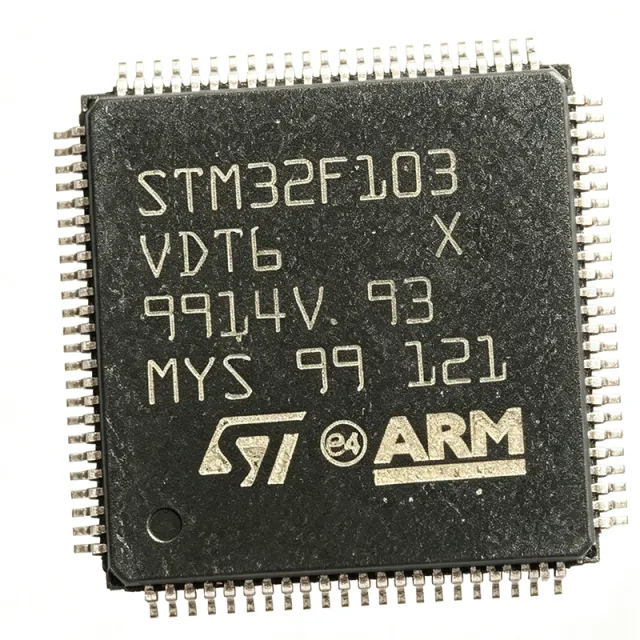
The STMicroelectronics STM32F103V8T6 is a 32-bit ARM Cortex-M3 microcontroller running at 72 MHz with 64 KB Flash and 20 KB SRAM, housed in a 100-pin LQFP (14 x 14 mm) package. A microcontroller (MCU) integrates a processor core, memory, and peripherals onto a single chip, forming the lowest layer of the embedded computing hierarchy below microprocessors and application processors. The STM32F1 Performance line belongs to ST's STM32 family of general-purpose MCUs, based on the ARM Cortex-M3 32-bit RISC core. Key features of the STM32F103V8T6 include the 72 MHz Cortex-M3 core, 64 KB on-chip Flash and 20 KB SRAM, two 12-bit ADCs, a USB 2.0 full-speed interface, a CAN 2.0B controller, and seven 16-bit timers per ST's official product description. The Cortex-M3 Harvard architecture delivers deterministic interrupt handling through the Nested Vectored Interrupt Controller, while the embedded Flash with prefetch buffer sustains full-speed core operation. The peripheral set spans multiple USART, SPI, and I2C interfaces, enabling rich connectivity within a single supply domain. Typical applications include industrial control boards, motor-control nodes, communication modules, and low-cost embedded platforms - markets where the STM32F103 line has been a default choice for over fifteen years. Designers should verify Flash wait-state configuration at 72 MHz (two wait states) and confirm second-source compatibility for clock and HAL settings when using drop-in substitutes. This page synthesizes distributor pricing, validated drop-in alternatives, and cross-reference guidance not found in the manufacturer datasheet, with pricing verified as of 2026-09-06.

Permintaan RFG Kontak
STM32F103V8T6TR - ARM Cortex-M3 72MHz MCU 64KB Flash | ST (Tape & Reel)
STM32F103V8T6TR

STM32F103V8T6TR - ARM Cortex-M3 72MHz MCU 64KB Flash | ST (Tape & Reel)

The STMicroelectronics STM32F103V8T6TR is a 32-bit ARM Cortex-M3 microcontroller running at 72 MHz with 64 KB Flash and 20 KB SRAM, housed in a 100-pin LQFP (14 x 14 mm) package. A microcontroller (MCU) integrates a processor core, memory, and peripherals onto a single chip, forming the lowest layer of the embedded computing hierarchy below microprocessors and application processors. The STM32F1 Performance line belongs to ST's STM32 family of general-purpose MCUs, based on the ARM Cortex-M3 32-bit RISC core. Key features of the STM32F103V8T6TR include the 72 MHz Cortex-M3 core, 64 KB on-chip Flash and 20 KB SRAM, two 12-bit ADCs, a USB 2.0 full-speed interface, a CAN 2.0B controller, and seven 16-bit timers per ST's official product description. The Cortex-M3 Harvard architecture delivers deterministic interrupt handling through the Nested Vectored Interrupt Controller, while the embedded Flash with prefetch buffer sustains full-speed core operation. The peripheral set spans multiple USART, SPI, and I2C interfaces, enabling rich connectivity within a single supply domain. Typical applications include industrial control boards, motor-control nodes, communication modules, and low-cost embedded platforms - markets where the STM32F103 line has been a default choice for over fifteen years. Designers should verify Flash wait-state configuration at 72 MHz (two wait states) and confirm second-source compatibility for clock and HAL settings when using drop-in substitutes. This page synthesizes distributor pricing, validated drop-in alternatives, and cross-reference guidance not found in the manufacturer datasheet, with pricing verified as of 2026-09-06.

Permintaan RFG Kontak
STM32F103VBH6 - 32-Bit 72MHz Cortex-M3 MCU | STMicroelectronics
STM32F103VBH6

STM32F103VBH6 - 32-Bit 72MHz Cortex-M3 MCU | STMicroelectronics

The STMicroelectronics STM32F103VBH6 is a 32-bit ARM Cortex-M3 microcontroller with a maximum clock frequency of 72 MHz, 128 KB of Flash memory, and 37 I/O ports, supplied in a 7 x 7 mm, 0.5 mm-pitch VFQFPN-48 package. It is a performance-line embedded MCU combining USB, CAN, seven 16-bit timers, two 12-bit ADCs, and multiple communication interfaces for compact control systems. A microcontroller is an integrated circuit that executes firmware, reads inputs, controls outputs, and manages embedded-system resources. The STM32F103VBH6 belongs to the MCU hierarchy: ARM Cortex-M3 microcontroller, 32-bit embedded processor, and programmable control device. Its combination of 72 MHz processing, 128 KB Flash, and USB and CAN support makes it suitable for industrial controls, communication equipment, data acquisition, and motor-control prototypes where several peripherals are required on one device. The verified device description identifies the part as a performance-line, ARM-based 32-bit MCU with Flash, USB, CAN, seven 16-bit timers, and two 12-bit, 1 microsecond ADC channels. The reported operating supply range is 2 V to 3.6 V, while one verified source also identifies RoHS compliance and an active lifecycle status. These features support low-voltage embedded designs that need high processing speed and integrated serial communications without requiring a separate external interface controller. The Cortex-M3 core and 72 MHz operating point provide a practical balance of control-loop performance, memory, and peripheral integration. USB and CAN support can reduce external component count in USB-connected control products and CAN-based industrial equipment. The two ADC channels and seven timers support sensor monitoring, timing, motor-control, and signal-generation functions, provided the selected peripheral pins and board-level analog circuitry are designed according to the manufacturer documentation. Typical applications include USB-to-digital monitoring systems, CAN-connected industrial controllers, embedded instrumentation, automation boards, and compact motor-control or timing platforms. The 48-pin package provides access to the MCU's available I/O, power, ground, analog, and communication functions, but pin assignments and exposed-pad requirements must be checked against the official STM32F103VBH6 datasheet before PCB release. A key design consideration is validating power, clock, decoupling, boot configuration, and signal routing on the selected board. Because the supplied verified data does not include complete electrical limits, pin names, or timing details, designers should not infer missing values; consult the manufacturer datasheet and package drawing for authoritative implementation requirements. This page combines verified distributor and source information with practical application context, procurement data, and replacement-source guidance. It is intended to help engineers identify the correct STM32 MCU, compare compatible sourcing options, and move quickly to datasheet-driven design validation.

Permintaan RFG Kontak
STM32F103VBH7 - 72MHz Cortex-M3 MCU 128KB LFBGA-100 | STMicroelectronics
STM32F103VBH7

STM32F103VBH7 - 72MHz Cortex-M3 MCU 128KB LFBGA-100 | STMicroelectronics

The STMicroelectronics STM32F103VBH7 is a 32-bit ARM Cortex-M3 microcontroller operating at 72 MHz with 128 KB of embedded Flash memory, packaged in a 100-ball LFBGA (10x10 mm). It integrates 1.25 DMIPS/MHz performance (90 DMIPS total), a single-cycle hardware multiplier and divider, and a rich peripheral set: two 12-bit ADCs (1 us conversion), seven 16-bit timers, USB Full-Speed, CAN 2.0B, two I2C, three SPI, two I2S, three USART, two UART, one SDIO, and an FSMC interface for external memory. The supply voltage is 2.0 V to 3.6 V and the device provides 80 general-purpose I/O pins with interrupt capability. An ARM Cortex-M3 microcontroller (often shortened to MCU or simply "Cortex-M3") is a 32-bit RISC processor designed by Arm that targets deterministic, real-time embedded applications. Within the broader taxonomy, it sits under MCU (microcontroller) -> embedded processor -> semiconductor IC. The Cortex-M3 family is widely used in industrial control, motor drives, consumer electronics, and USB peripherals because it combines deterministic interrupt latency (typically 12 cycles) with low power consumption and a Thumb-2 instruction set that keeps code density comparable to 8-bit MCUs. STMicroelectronics' STM32F103 sub-family further extends this with the high-speed peripherals listed above. Key features of the STM32F103VBH7 include support for Sleep, Stop, and Standby low-power modes, an internal 8 MHz RC oscillator with PLL multipliers up to 9x (yielding 72 MHz), an embedded real-time clock (RTC) with calendar and alarm functions, and a 96-bit unique device ID. The two 12-bit ADCs each offer up to 16 input channels (12 on the LFBGA-100 package variant) and can be triggered by timers for precise sampling in motor-control loops. The USB Full-Speed device interface requires an external 1.5 k pull-up and integrates a dedicated 48 MHz PLL. Architecturally, the STM32F103VBH7 uses a multi-AHB bus matrix that allows the DMA controller, CPU, and peripherals to operate in parallel without contention. The NVIC (Nested Vectored Interrupt Controller) accepts up to 43 maskable interrupt sources with 16 priority levels, enabling deterministic response time for time-critical applications such as USB isochronous transfers and motor PWM. A 7-channel DMA controller supports peripherals including the ADCs, SPIs, I2Cs, USARTs, and timers, offloading memory copies from the CPU and improving throughput. Typical applications include industrial motor control (BLDC, PMSM, and stepper drivers), USB HID peripherals (mice, keyboards, custom input devices), CAN-bus nodes for vehicle and industrial networks, point-of-sale terminals, and HVAC controllers. The 72 MHz speed and USB+CAN combination make it a frequent choice for gateways and protocol converters bridging CAN and USB or CAN and Ethernet-via-SPI. When designing with the LFBGA-100 package, ensure 4-layer PCB stack-up with controlled-impedance routing for USB DP/DM, since the 90-ohm differential pair must meet USB 2.0 Full-Speed signalling. Decouple each VDD/VSS pair with a 100 nF X7R ceramic placed within 3 mm of the ball, and add a 4.7 uF bulk capacitor near the regulator input. Configure unused I/O as analog inputs (high-impedance) to minimize quiescent current in Stop mode. This page aggregates distributor pricing, same-package drop-in alternatives, and practical design notes not found in the manufacturer datasheet alone.

Permintaan RFG Kontak
STM32F103VBI6 - 72MHz Cortex-M3 128KB MCU | STMicroelectronics
STM32F103VBI6

STM32F103VBI6 - 72MHz Cortex-M3 128KB MCU | STMicroelectronics

STMicroelectronics STM32F103VBI6 is an Arm Cortex-M3 32-bit microcontroller with a 72 MHz maximum CPU frequency, 128 KB of Flash memory, and a 100-UFBGA package measuring 7 x 7 mm. The device belongs to the STM32F1 mainstream performance line and supports operation from 2.5 V to 3.3 V according to the supplied distributor data. It is positioned for embedded control, communications, industrial automation, USB, and CAN-based designs that require dense peripheral integration in a compact surface-mount package. A microcontroller is a programmable semiconductor that integrates a processor core, nonvolatile program memory, working memory, peripherals, and interface logic on one device. The STM32F103 series combines an Arm Cortex-M3 core with dedicated timers, analog converters, communication interfaces, and general-purpose I/O. Within the product hierarchy, the STM32F103VBI6 is an Arm Cortex-M3 MCU, an embedded microcontroller, and a semiconductor designed for real-time embedded-control applications. Verified product features include a 72 MHz CPU, 128 KB of Flash, seven timers, two ADCs, nine communication interfaces, USB support, and CAN support. Its 100-pin UFBGA package allows access to a large pin count without the lead span of a conventional 100-pin through-hole or LQFP package. The 7 x 7 mm land pattern is intended for high-density PCB layouts, but exposed-pad routing, assembly capability, and thermal performance must be evaluated against the complete manufacturer documentation. The STM32F103VBI6 uses the Arm Cortex-M3 architecture with a 32-bit instruction set. Its 128 KB Flash provides on-chip program storage, while the peripheral mix supports common embedded-control tasks such as digital I/O, timing, analog measurement, serial communications, USB, and CAN. Exact SRAM capacity, ADC resolution, I/O voltage limits, timer channels, and electrical characteristics are not present in the supplied search data and therefore remain [DATA_NEEDED: SRAM capacity], [DATA_NEEDED: ADC resolution], and [DATA_NEEDED: detailed electrical characteristics]. Typical uses include industrial controllers, USB-connected embedded products, CAN network nodes, data-acquisition equipment, motor-control subsystems, and compact control boards. The seven timers and two ADCs make it relevant to systems combining periodic control functions with analog input conditioning. USB and CAN connectivity can reduce external interface hardware when the board already uses the STM32F1 ecosystem, although firmware, clocking, peripheral-equivalence, and qualification checks remain essential before redesigning an existing product. The principal design consideration is that the 100-UFBGA package demands fine-pitch PCB layout and careful assembly planning. A manufacturer-qualified pin map was not included in the supplied data, so engineers must verify all 100 terminals, exposed-pad requirements, recommended decoupling, and test-point access in the official STM32F103 documentation before schematic capture or PCB release. Pricing also was not exposed in the supplied results, making procurement cost and lifecycle planning dependent on a current distributor quotation. This product record consolidates the verified STM32F103VBI6 specifications, distributor availability, package information, interface features, sourcing links, and engineering caveats into one decision aid. It distinguishes documented facts from missing parameters and avoids presenting functional MCU alternatives as verified drop-in replacements, which is important because package, pin mapping, clock configuration, and peripheral compatibility must be confirmed independently.

Permintaan RFG Kontak

STM32F103VBI6TR - 72MHz Cortex-M3 128KB MCU | STMicroelectronics (Tape & Reel)
STM32F103VBI6TR

STM32F103VBI6TR - 72MHz Cortex-M3 128KB MCU | STMicroelectronics (Tape & Reel)

STMicroelectronics STM32F103VBI6TR is an Arm Cortex-M3 32-bit microcontroller with a 72 MHz maximum CPU frequency, 128 KB of Flash memory, and a 100-UFBGA package measuring 7 x 7 mm. The device belongs to the STM32F1 mainstream performance line and supports operation from 2.5 V to 3.3 V according to the supplied distributor data. It is positioned for embedded control, communications, industrial automation, USB, and CAN-based designs that require dense peripheral integration in a compact surface-mount package. A microcontroller is a programmable semiconductor that integrates a processor core, nonvolatile program memory, working memory, peripherals, and interface logic on one device. The STM32F103 series combines an Arm Cortex-M3 core with dedicated timers, analog converters, communication interfaces, and general-purpose I/O. Within the product hierarchy, the STM32F103VBI6TR is an Arm Cortex-M3 MCU, an embedded microcontroller, and a semiconductor designed for real-time embedded-control applications. Verified product features include a 72 MHz CPU, 128 KB of Flash, seven timers, two ADCs, nine communication interfaces, USB support, and CAN support. Its 100-pin UFBGA package allows access to a large pin count without the lead span of a conventional 100-pin through-hole or LQFP package. The 7 x 7 mm land pattern is intended for high-density PCB layouts, but exposed-pad routing, assembly capability, and thermal performance must be evaluated against the complete manufacturer documentation. The STM32F103VBI6TR uses the Arm Cortex-M3 architecture with a 32-bit instruction set. Its 128 KB Flash provides on-chip program storage, while the peripheral mix supports common embedded-control tasks such as digital I/O, timing, analog measurement, serial communications, USB, and CAN. Exact SRAM capacity, ADC resolution, I/O voltage limits, timer channels, and electrical characteristics are not present in the supplied search data and therefore remain [DATA_NEEDED: SRAM capacity], [DATA_NEEDED: ADC resolution], and [DATA_NEEDED: detailed electrical characteristics]. Typical uses include industrial controllers, USB-connected embedded products, CAN network nodes, data-acquisition equipment, motor-control subsystems, and compact control boards. The seven timers and two ADCs make it relevant to systems combining periodic control functions with analog input conditioning. USB and CAN connectivity can reduce external interface hardware when the board already uses the STM32F1 ecosystem, although firmware, clocking, peripheral-equivalence, and qualification checks remain essential before redesigning an existing product. The principal design consideration is that the 100-UFBGA package demands fine-pitch PCB layout and careful assembly planning. A manufacturer-qualified pin map was not included in the supplied data, so engineers must verify all 100 terminals, exposed-pad requirements, recommended decoupling, and test-point access in the official STM32F103 documentation before schematic capture or PCB release. Pricing also was not exposed in the supplied results, making procurement cost and lifecycle planning dependent on a current distributor quotation. This product record consolidates the verified STM32F103VBI6TR specifications, distributor availability, package information, interface features, sourcing links, and engineering caveats into one decision aid. It distinguishes documented facts from missing parameters and avoids presenting functional MCU alternatives as verified drop-in replacements, which is important because package, pin mapping, clock configuration, and peripheral compatibility must be confirmed independently.

Permintaan RFG Kontak
STM32F103VBT6 - 72MHz Cortex-M3 MCU 128KB Flash LQFP-100 | ST
STM32F103VBT6

STM32F103VBT6 - 72MHz Cortex-M3 MCU 128KB Flash LQFP-100 | ST

The STMicroelectronics STM32F103VBT6 is a 32-bit medium-density performance line ARM Cortex-M3 microcontroller running at 72 MHz with 128 KB Flash and 20 KB SRAM, housed in a 100-pin LQFP (14x14 mm) package. A microcontroller (MCU) is a single-chip computer that integrates a processor core, memory, and peripherals on one die, forming the lowest level of the embedded systems hierarchy: MCU -> microcontroller -> embedded processor -> semiconductor device. The STM32F1 series is built on the ARM Cortex-M3 architecture, which delivers 90 DMIPS at 1.25 DMIPS/MHz with single-cycle multiply and hardware division, making it one of the most widely adopted 32-bit MCU platforms in industrial and consumer electronics. Key features of the STM32F103VBT6 include seven timers (three general-purpose 16-bit timers plus one advanced PWM motor-control timer), two 12-bit ADCs with up to 16 external channels, and nine communication interfaces: five USART/UARTs, two I2C, two SPI, plus USB 2.0 full-speed device and CAN 2.0B. The 43-maskable interrupt nested vectored interrupt controller enables deterministic real-time response. Technically, the device operates from a 2.0 V to 3.6 V supply with a robust power architecture including POR/PDR, programmable voltage detector, and low-power run, sleep, stop, and standby modes. The Flash accelerator allows the CPU to achieve near zero-wait-state execution at 72 MHz. DMA controller support offloads data transfers between peripherals and memory. Typical applications include industrial motor control, PLC I/O modules, communication gateways using USB or CAN, medical handheld instruments, and consumer appliances. The combination of a PWM motor-control timer and dual ADC makes it a classic choice for three-phase inverter control. For design, note that GPIO output drive and 5 V tolerance rules differ per pin group; consult the datasheet pin definition table before connecting 5 V logic. Decouple VDD/VDDA pins with 100 nF ceramics placed close to each supply pair. This page synthesizes distributor pricing, drop-in alternatives including GD32F103 and APM32F103 cross-references, and practical design notes not found in the manufacturer datasheet.

Permintaan RFG Kontak
STM32F103VBT6TR - 72MHz Cortex-M3 MCU 128KB Flash LQFP-100 | ST (Tape & Reel)
STM32F103VBT6TR

STM32F103VBT6TR - 72MHz Cortex-M3 MCU 128KB Flash LQFP-100 | ST (Tape & Reel)

The STMicroelectronics STM32F103VBT6TR is a 32-bit medium-density performance line ARM Cortex-M3 microcontroller running at 72 MHz with 128 KB Flash and 20 KB SRAM, housed in a 100-pin LQFP (14x14 mm) package. A microcontroller (MCU) is a single-chip computer that integrates a processor core, memory, and peripherals on one die, forming the lowest level of the embedded systems hierarchy: MCU -> microcontroller -> embedded processor -> semiconductor device. The STM32F1 series is built on the ARM Cortex-M3 architecture, which delivers 90 DMIPS at 1.25 DMIPS/MHz with single-cycle multiply and hardware division, making it one of the most widely adopted 32-bit MCU platforms in industrial and consumer electronics. Key features of the STM32F103VBT6TR include seven timers (three general-purpose 16-bit timers plus one advanced PWM motor-control timer), two 12-bit ADCs with up to 16 external channels, and nine communication interfaces: five USART/UARTs, two I2C, two SPI, plus USB 2.0 full-speed device and CAN 2.0B. The 43-maskable interrupt nested vectored interrupt controller enables deterministic real-time response. Technically, the device operates from a 2.0 V to 3.6 V supply with a robust power architecture including POR/PDR, programmable voltage detector, and low-power run, sleep, stop, and standby modes. The Flash accelerator allows the CPU to achieve near zero-wait-state execution at 72 MHz. DMA controller support offloads data transfers between peripherals and memory. Typical applications include industrial motor control, PLC I/O modules, communication gateways using USB or CAN, medical handheld instruments, and consumer appliances. The combination of a PWM motor-control timer and dual ADC makes it a classic choice for three-phase inverter control. For design, note that GPIO output drive and 5 V tolerance rules differ per pin group; consult the datasheet pin definition table before connecting 5 V logic. Decouple VDD/VDDA pins with 100 nF ceramics placed close to each supply pair. This page synthesizes distributor pricing, drop-in alternatives including GD32F103 and APM32F103 cross-references, and practical design notes not found in the manufacturer datasheet.

Permintaan RFG Kontak
STM32F103VBT7 - 72MHz Cortex-M3 128KB MCU | STMicroelectronics
STM32F103VBT7

STM32F103VBT7 - 72MHz Cortex-M3 128KB MCU | STMicroelectronics

The STMicroelectronics STM32F103VBT7 is a 32-bit ARM Cortex-M3 microcontroller with a maximum 72 MHz operating frequency, 128 KB of Flash memory, and a 100-pin LQFP package measuring 14 mm by 14 mm. It belongs to the STM32F1 performance-line family and combines an embedded processor, memory, timers, analog conversion, and communication peripherals in one device. According to the verified manufacturer-linked data, the part includes USB, CAN, seven timers, two ADCs, and nine communication interfaces. A microcontroller is a programmable integrated circuit used as the central control element of an embedded system. This STM32 MCU follows the ARM Cortex-M3 real-time processor architecture and provides general-purpose I/O, serial communication, analog measurement, timing, and control functions. Its 32-bit architecture supports control workloads requiring more arithmetic capability than an 8- or 16-bit microcontroller, while its integrated peripherals reduce the need for separate interface chips. The STM32F103VBT7 combines a maximum CPU frequency of 72 MHz with 128 KB of programmable Flash. Other verified headline features include USB and CAN connectivity, two analog-to-digital converters, seven 16-bit timers, and nine communication interfaces. These resources make the device suitable for connected industrial controllers, USB peripherals, CAN nodes, data acquisition units, and compact embedded control systems. The Cortex-M3 core is designed for efficient embedded instruction execution and supports single-cycle multiplication and hardware division according to the retrieved technical summary. A maximum frequency of 1.25 DMIPS/MHz is stated at zero-wait-state memory access in the same summary. Designers must still select suitable clock, reset, boot, and memory-support circuitry according to the complete manufacturer documentation before finalizing an embedded design. Typical uses include USB-connected data loggers, CAN-based industrial modules, motor and motion controllers, sensor acquisition equipment, instrumentation, and CAN-to-UPS network bridges. The combination of USB, CAN, multiple timers, and dual ADC resources allows several communications and control functions to share one controller. Engineers should prioritize peripheral-pin availability and package routing over processor headline performance when assigning board functions. A critical design consideration is validating all pin multiplexing, alternate-function assignments, and peripheral dependencies against the manufacturer datasheet. The LQFP package exposes many signals, but simultaneous peripheral use may constrain I/O assignment. Board design should also provide stable power, decoupling, clock routing, a compatible programming interface, and a boot configuration appropriate for the intended firmware. This page combines verified distributor specifications, source links, application engineering guidance, and candidate compatibility information. It also distinguishes confirmed source data from parameters requiring additional verification, helping engineers move from part identification to design review without treating unverified details as guaranteed specifications.

Permintaan RFG Kontak
STM32F103VBT7TR - 72MHz Cortex-M3 128KB MCU | STMicroelectronics (Tape & Reel)
STM32F103VBT7TR

STM32F103VBT7TR - 72MHz Cortex-M3 128KB MCU | STMicroelectronics (Tape & Reel)

The STMicroelectronics STM32F103VBT7TR is a 32-bit ARM Cortex-M3 microcontroller with a maximum 72 MHz operating frequency, 128 KB of Flash memory, and a 100-pin LQFP package measuring 14 mm by 14 mm. It belongs to the STM32F1 performance-line family and combines an embedded processor, memory, timers, analog conversion, and communication peripherals in one device. According to the verified manufacturer-linked data, the part includes USB, CAN, seven timers, two ADCs, and nine communication interfaces. A microcontroller is a programmable integrated circuit used as the central control element of an embedded system. This STM32 MCU follows the ARM Cortex-M3 real-time processor architecture and provides general-purpose I/O, serial communication, analog measurement, timing, and control functions. Its 32-bit architecture supports control workloads requiring more arithmetic capability than an 8- or 16-bit microcontroller, while its integrated peripherals reduce the need for separate interface chips. The STM32F103VBT7TR combines a maximum CPU frequency of 72 MHz with 128 KB of programmable Flash. Other verified headline features include USB and CAN connectivity, two analog-to-digital converters, seven 16-bit timers, and nine communication interfaces. These resources make the device suitable for connected industrial controllers, USB peripherals, CAN nodes, data acquisition units, and compact embedded control systems. The Cortex-M3 core is designed for efficient embedded instruction execution and supports single-cycle multiplication and hardware division according to the retrieved technical summary. A maximum frequency of 1.25 DMIPS/MHz is stated at zero-wait-state memory access in the same summary. Designers must still select suitable clock, reset, boot, and memory-support circuitry according to the complete manufacturer documentation before finalizing an embedded design. Typical uses include USB-connected data loggers, CAN-based industrial modules, motor and motion controllers, sensor acquisition equipment, instrumentation, and CAN-to-UPS network bridges. The combination of USB, CAN, multiple timers, and dual ADC resources allows several communications and control functions to share one controller. Engineers should prioritize peripheral-pin availability and package routing over processor headline performance when assigning board functions. A critical design consideration is validating all pin multiplexing, alternate-function assignments, and peripheral dependencies against the manufacturer datasheet. The LQFP package exposes many signals, but simultaneous peripheral use may constrain I/O assignment. Board design should also provide stable power, decoupling, clock routing, a compatible programming interface, and a boot configuration appropriate for the intended firmware. This page combines verified distributor specifications, source links, application engineering guidance, and candidate compatibility information. It also distinguishes confirmed source data from parameters requiring additional verification, helping engineers move from part identification to design review without treating unverified details as guaranteed specifications.

Permintaan RFG Kontak
STM32F103VCH6 - 72MHz Cortex-M3 MCU | STMicroelectronics
STM32F103VCH6

STM32F103VCH6 - 72MHz Cortex-M3 MCU | STMicroelectronics

The STMicroelectronics STM32F103VCH6 is a 32-bit ARM Cortex-M3 microcontroller operating at up to 72 MHz, with 256 KB of flash memory and 100-LFBGA packaging measuring 10 x 10 mm. It belongs to the STM32F1 Performance Line and is positioned for embedded systems requiring extensive peripheral connectivity, compact packaging, and a 2.5 V or 3.3 V operating supply. A microcontroller is a programmable system-on-chip that integrates a processor core, memory, and peripherals such as timers, communication interfaces, and analog conversion blocks into one device. The STM32F1 family hierarchy includes the STM32 microcontroller product type, the STM32F1 series, the Performance Line, and the high-density STM32F103 platform. Within the broader semiconductor category, this device combines general-purpose control processing with dedicated embedded peripherals on a single IC. The verified product information identifies a 72 MHz ARM Cortex-M3 core, 32-bit RISC architecture, 256 KB flash organized as 256K x 8 bits, and a 100-LFBGA package. The STM32F1 Performance Line family is also described as supporting USB, CAN, 11 timers, three ADCs, and 13 communication interfaces. These resources support designs that combine control-loop processing with multiple external communication channels and analog measurements. At the architecture level, the Cortex-M3 processor provides a 32-bit execution environment suitable for embedded control, while the STM32F103 peripheral set integrates timing, conversion, and communications functions around that core. A 10 x 10 mm LFBGA substantially reduces PCB area compared with leaded packages, but it also requires careful PCB layout, fine-pitch assembly, and inspection because component pads cannot be visually inspected from the board edge. Typical applications include industrial controllers, CAN-connected motor equipment, USB-enabled data acquisition systems, communication gateways, and compact embedded instruments. The 100-pin package provides a high pin count for systems that need numerous external connections, while 256 KB of flash accommodates firmware, configuration data, and application routines. Its 72 MHz maximum frequency also provides useful control-loop and communications headroom. Designers should allocate the PCB footprint for the exact 100-LFBGA arrangement, verify the electrical requirements for every populated ball, and validate decoupling, clock, reset, and programming access. Because the verified snippets do not provide a complete public pin table, the pinout is left unpopulated rather than inferred. Firmware and board bring-up should also account for the STM32F103-specific startup sequence and peripheral configuration.

Permintaan RFG Kontak
STM32F103VCT6 - 256KB Flash Cortex-M3 MCU 72MHz | ST
STM32F103VCT6

STM32F103VCT6 - 256KB Flash Cortex-M3 MCU 72MHz | ST

The STMicroelectronics STM32F103VCT6 is a 32-bit ARM Cortex-M3 microcontroller running at up to 72 MHz with 256 KB Flash and 48 KB SRAM, housed in a 100-pin LQFP (14x14 mm) package. What is a microcontroller? A microcontroller (MCU) is a single-chip computer that integrates a processor core, memory, and programmable peripherals to govern a specific embedded operation. The STM32F103 series sits within the broader hierarchy of 32-bit Flash MCUs based on the Arm Cortex-M processor family and is one of the most widely deployed general-purpose MCU lines in industrial control, consumer electronics, and IoT devices. Key features include three 12-bit ADCs with up to 21 channels, two 12-bit DACs, and a rich communication set: three USARTs, two I2C, three SPI, one USB 2.0 full-speed device, one CAN 2.0B, and one SDIO interface. Advanced timers support PWM generation and motor control, while a 12-channel DMA controller offloads data movement from the CPU. The Cortex-M3 core executes the Thumb-2 instruction set with a hardware divide unit, delivering strong code density and deterministic interrupt handling through the nested vectored interrupt controller (NVIC). Debugging is supported via both JTAG and serial wire debug (SWD). The device operates from a 2.0 V to 3.6 V supply over an industrial -40C to +85C temperature range, with a real-time clock and low-power sleep, stop, and standby modes for battery-sensitive designs. Typical applications include motor control (advanced timers generate PWM while ADCs sample current feedback), industrial automation PLCs, and USB/CAN communication nodes in metering and gateways. Design consideration: configure BOOT0 correctly for the boot source and decouple every VDD/VSS pair with 100 nF capacitors; connect VDDA to a clean filtered analog supply for full ADC accuracy. This page adds value beyond the datasheet with verified drop-in alternatives, distributor pricing, and practical design notes.

Permintaan RFG Kontak
STM32F103VCT6TR - 256KB Flash Cortex-M3 MCU 72MHz | ST (Tape & Reel)
STM32F103VCT6TR

STM32F103VCT6TR - 256KB Flash Cortex-M3 MCU 72MHz | ST (Tape & Reel)

The STMicroelectronics STM32F103VCT6TR is a 32-bit ARM Cortex-M3 microcontroller running at up to 72 MHz with 256 KB Flash and 48 KB SRAM, housed in a 100-pin LQFP (14x14 mm) package. What is a microcontroller? A microcontroller (MCU) is a single-chip computer that integrates a processor core, memory, and programmable peripherals to govern a specific embedded operation. The STM32F103 series sits within the broader hierarchy of 32-bit Flash MCUs based on the Arm Cortex-M processor family and is one of the most widely deployed general-purpose MCU lines in industrial control, consumer electronics, and IoT devices. Key features include three 12-bit ADCs with up to 21 channels, two 12-bit DACs, and a rich communication set: three USARTs, two I2C, three SPI, one USB 2.0 full-speed device, one CAN 2.0B, and one SDIO interface. Advanced timers support PWM generation and motor control, while a 12-channel DMA controller offloads data movement from the CPU. The Cortex-M3 core executes the Thumb-2 instruction set with a hardware divide unit, delivering strong code density and deterministic interrupt handling through the nested vectored interrupt controller (NVIC). Debugging is supported via both JTAG and serial wire debug (SWD). The device operates from a 2.0 V to 3.6 V supply over an industrial -40C to +85C temperature range, with a real-time clock and low-power sleep, stop, and standby modes for battery-sensitive designs. Typical applications include motor control (advanced timers generate PWM while ADCs sample current feedback), industrial automation PLCs, and USB/CAN communication nodes in metering and gateways. Design consideration: configure BOOT0 correctly for the boot source and decouple every VDD/VSS pair with 100 nF capacitors; connect VDDA to a clean filtered analog supply for full ADC accuracy. This page adds value beyond the datasheet with verified drop-in alternatives, distributor pricing, and practical design notes.

Permintaan RFG Kontak
STM32F103VDH6 - 72MHz Cortex-M3 384KB MCU | STMicroelectronics
STM32F103VDH6

STM32F103VDH6 - 72MHz Cortex-M3 384KB MCU | STMicroelectronics

STMicroelectronics STM32F103VDH6 is a 32-bit ARM Cortex-M3 microcontroller with a 72 MHz maximum CPU frequency, 384 KB of Flash memory, and a 100-pin LFBGA package measuring 10 mm by 10 mm. It belongs to the STM32F1 high-density performance line and integrates USB, CAN, 11 timers, three ADCs, and 13 communication interfaces for connected embedded-control systems. A microcontroller is a programmable semiconductor that combines a processor core, memory, peripherals, and communication interfaces on one integrated circuit. The STM32F103VDH6 is an Arm Cortex-M3 microcontroller, placing it in the embedded processor hierarchy below application-specific MCUs while above general-purpose logic devices. Its combination of substantial Flash storage, numerous serial interfaces, and a high pin count supports complex control, communication, acquisition, and motor-control designs. Key features include the Cortex-M3 core operating at up to 72 MHz, 384 KB of Flash, USB and CAN connectivity, 11 timers, three analog-to-digital converters, and 13 communication interfaces. The high-density pin count provides access to these resources and supports integration with sensors, actuators, communication transceivers, and human-machine-interface electronics. The supplied listings identify the device as a 3.3 V, 100-LFBGA microcontroller. The STM32F1 architecture is suited to real-time embedded applications requiring deterministic peripheral access and a broad peripheral set. Multiple timers support motor-control, timing, and PWM tasks, while USB and CAN provide paths for host connectivity and industrial network communication. Three ADCs permit multiple analog input channels to be evaluated within the same control system, although detailed resolution, sampling rate, and channel mapping require confirmation in the manufacturer documentation. Typical applications include industrial automation controllers, USB-connected data-acquisition equipment, CAN-based motor systems, communication gateways, and compact embedded control platforms. Its 384 KB Flash capacity can hold a substantial firmware image, while the available USB, CAN, timer, and ADC resources reduce the need for external peripheral devices in designs that can operate from a single 3.3 V MCU. Designers must confirm the exact pin assignment, exposed-pad connection, decoupling requirements, clock configuration, and peripheral electrical limits in the STM32F103VD datasheet. The 100-ball BGA also requires assembly capability capable of handling the 10 mm by 10 mm land pattern and its fine-pitch ball array, so prototype assembly and production inspection should be considered before layout release. This page consolidates verified manufacturer and distributor information with application guidance, sourcing context, and an explicit distinction between the BGA target and incompatible alternative packages. It avoids presenting cross-package functional substitutes as drop-in replacements and identifies every unavailable engineering parameter that still requires datasheet confirmation.

Permintaan RFG Kontak
STM32F103VDH6TR - 72MHz Cortex-M3 384KB MCU | STMicroelectronics (Tape & Reel)
STM32F103VDH6TR

STM32F103VDH6TR - 72MHz Cortex-M3 384KB MCU | STMicroelectronics (Tape & Reel)

STMicroelectronics STM32F103VDH6TR is a 32-bit ARM Cortex-M3 microcontroller with a 72 MHz maximum CPU frequency, 384 KB of Flash memory, and a 100-pin LFBGA package measuring 10 mm by 10 mm. It belongs to the STM32F1 high-density performance line and integrates USB, CAN, 11 timers, three ADCs, and 13 communication interfaces for connected embedded-control systems. A microcontroller is a programmable semiconductor that combines a processor core, memory, peripherals, and communication interfaces on one integrated circuit. The STM32F103VDH6TR is an Arm Cortex-M3 microcontroller, placing it in the embedded processor hierarchy below application-specific MCUs while above general-purpose logic devices. Its combination of substantial Flash storage, numerous serial interfaces, and a high pin count supports complex control, communication, acquisition, and motor-control designs. Key features include the Cortex-M3 core operating at up to 72 MHz, 384 KB of Flash, USB and CAN connectivity, 11 timers, three analog-to-digital converters, and 13 communication interfaces. The high-density pin count provides access to these resources and supports integration with sensors, actuators, communication transceivers, and human-machine-interface electronics. The supplied listings identify the device as a 3.3 V, 100-LFBGA microcontroller. The STM32F1 architecture is suited to real-time embedded applications requiring deterministic peripheral access and a broad peripheral set. Multiple timers support motor-control, timing, and PWM tasks, while USB and CAN provide paths for host connectivity and industrial network communication. Three ADCs permit multiple analog input channels to be evaluated within the same control system, although detailed resolution, sampling rate, and channel mapping require confirmation in the manufacturer documentation. Typical applications include industrial automation controllers, USB-connected data-acquisition equipment, CAN-based motor systems, communication gateways, and compact embedded control platforms. Its 384 KB Flash capacity can hold a substantial firmware image, while the available USB, CAN, timer, and ADC resources reduce the need for external peripheral devices in designs that can operate from a single 3.3 V MCU. Designers must confirm the exact pin assignment, exposed-pad connection, decoupling requirements, clock configuration, and peripheral electrical limits in the STM32F103VD datasheet. The 100-ball BGA also requires assembly capability capable of handling the 10 mm by 10 mm land pattern and its fine-pitch ball array, so prototype assembly and production inspection should be considered before layout release. This page consolidates verified manufacturer and distributor information with application guidance, sourcing context, and an explicit distinction between the BGA target and incompatible alternative packages. It avoids presenting cross-package functional substitutes as drop-in replacements and identifies every unavailable engineering parameter that still requires datasheet confirmation.

Permintaan RFG Kontak
STM32F103VDT6 - 32-bit ARM Cortex-M3 MCU, 384KB Flash | STMicroelectronics
STM32F103VDT6

STM32F103VDT6 - 32-bit ARM Cortex-M3 MCU, 384KB Flash | STMicroelectronics

The STM32F103VDT6 is a high-performance 32-bit microcontroller from STMicroelectronics, based on the ARM Cortex-M3 core running at up to 72 MHz. It features 384 KB of Flash memory and 64 KB of SRAM, making it suitable for a wide range of embedded applications. The device is housed in a 100-pin LQFP package (LQFP100) and operates over a temperature range of -40°C to +85°C. An ARM Cortex-M3 microcontroller is a 32-bit RISC processor designed for embedded systems, offering a balance of performance, power efficiency, and rich peripheral integration. It is part of the ARM Cortex-M family, which is widely used in industrial control, consumer electronics, and IoT devices. The Cortex-M3 core includes a hardware multiply and divide unit, Nested Vectored Interrupt Controller (NVIC), and optional Memory Protection Unit (MPU), enabling deterministic and efficient real-time processing. Key features of the STM32F103VDT6 include a 72 MHz CPU with 1.25 DMIPS/MHz, 384 KB Flash, 64 KB SRAM, and a comprehensive set of peripherals: three 12-bit ADCs, four general-purpose 16-bit timers, two advanced-control timers, multiple communication interfaces (USART, SPI, I2C, CAN, USB), and a DMA controller. The device also includes a real-time clock (RTC), a CRC calculation unit, and a serial wire debug (SWD) interface. The STM32F103VDT6 is built on a 0.13 µm embedded Flash process, providing a good balance of performance and power consumption. It supports a wide supply voltage range of 2.0V to 3.6V, with multiple low-power modes (Sleep, Stop, Standby) to optimize energy usage. The rich peripheral set and large memory make it a versatile choice for complex applications. Typical applications include industrial control systems, motor drives, PLCs, medical devices, consumer electronics, and IoT gateways. The device's CAN interface and multiple timers make it particularly well-suited for automotive and industrial networking applications. When designing with this MCU, ensure proper decoupling of the power supply pins and a stable clock source. The internal RC oscillator can be used for basic operation, but an external crystal is recommended for applications requiring precise timing. The SWD interface should be brought out for programming and debugging.

USD $7,16 Kontak
STM32F103VDT6TR - 32-bit ARM Cortex-M3 MCU, 384KB Flash | STMicroelectronics (Tape & Reel)
STM32F103VDT6TR

STM32F103VDT6TR - 32-bit ARM Cortex-M3 MCU, 384KB Flash | STMicroelectronics (Tape & Reel)

The STM32F103VDT6TR is a high-performance 32-bit microcontroller from STMicroelectronics, based on the ARM Cortex-M3 core running at up to 72 MHz. It features 384 KB of Flash memory and 64 KB of SRAM, making it suitable for a wide range of embedded applications. The device is housed in a 100-pin LQFP package (LQFP100) and operates over a temperature range of -40°C to +85°C. An ARM Cortex-M3 microcontroller is a 32-bit RISC processor designed for embedded systems, offering a balance of performance, power efficiency, and rich peripheral integration. It is part of the ARM Cortex-M family, which is widely used in industrial control, consumer electronics, and IoT devices. The Cortex-M3 core includes a hardware multiply and divide unit, Nested Vectored Interrupt Controller (NVIC), and optional Memory Protection Unit (MPU), enabling deterministic and efficient real-time processing. Key features of the STM32F103VDT6TR include a 72 MHz CPU with 1.25 DMIPS/MHz, 384 KB Flash, 64 KB SRAM, and a comprehensive set of peripherals: three 12-bit ADCs, four general-purpose 16-bit timers, two advanced-control timers, multiple communication interfaces (USART, SPI, I2C, CAN, USB), and a DMA controller. The device also includes a real-time clock (RTC), a CRC calculation unit, and a serial wire debug (SWD) interface. The STM32F103VDT6TR is built on a 0.13 µm embedded Flash process, providing a good balance of performance and power consumption. It supports a wide supply voltage range of 2.0V to 3.6V, with multiple low-power modes (Sleep, Stop, Standby) to optimize energy usage. The rich peripheral set and large memory make it a versatile choice for complex applications. Typical applications include industrial control systems, motor drives, PLCs, medical devices, consumer electronics, and IoT gateways. The device's CAN interface and multiple timers make it particularly well-suited for automotive and industrial networking applications. When designing with this MCU, ensure proper decoupling of the power supply pins and a stable clock source. The internal RC oscillator can be used for basic operation, but an external crystal is recommended for applications requiring precise timing. The SWD interface should be brought out for programming and debugging.

USD $7,16 Kontak
STM32F103VDT7 - 72MHz Cortex-M3 384KB MCU | STMicroelectronics
STM32F103VDT7

STM32F103VDT7 - 72MHz Cortex-M3 384KB MCU | STMicroelectronics

STMicroelectronics STM32F103VDT7 is a 32-bit Arm Cortex-M3 microcontroller with a 72 MHz CPU, 384 KB of Flash memory, and a 100-pin LQFP package measuring 14 x 14 mm. It belongs to the STM32F1 high-density microcontroller family and is positioned for embedded motor-control, USB, CAN, and general-purpose industrial applications. The device provides a broad peripheral set for mixed-signal control, communications, timers, and data acquisition while maintaining broad ecosystem support from STMicroelectronics. A microcontroller is a programmable semiconductor that integrates a processor core, nonvolatile program memory, data memory, peripherals, and interface logic on one package. The STM32F103 platform combines the Arm Cortex-M3 architecture with the STM32 ecosystem of development tools, middleware, reference designs, and application notes. Its high-density configuration provides more I/O and communication resources than lower-density STM32F1 devices while retaining the familiar 72 MHz execution performance. Key features include an Arm Cortex-M3 core operating at 72 MHz, 384 KB of Flash, USB, CAN, motor-control capability, and an LQFP-100 package with 100 pins. The manufacturer identifies the STM32F103VD product line as Active and part of the Mainstream Performance line. The T7 ordering suffix distinguishes the industrial-temperature version, but exact temperature limits, RAM capacity, pin functions, electrical limits, and peripheral details were not included in the verified excerpts and therefore require confirmation from the manufacturer datasheet. The STM32F103VD architecture is suited to control systems that need deterministic embedded processing and extensive mixed-signal connectivity. USB and CAN support make it relevant to USB-connected peripherals and industrial network nodes, while its motor-control positioning supports motor-control boards, actuators, and embedded automation equipment. The 100-pin LQFP package also exposes substantially more I/O than small-outline packages, simplifying prototype assembly and offering a practical bridge between breadboard and surface-mount production. Typical applications include USB data acquisition, CAN-connected industrial controllers, brushless motor-control systems, instrument-control panels, and connected embedded modules. Development teams can use the MCU with USB-to-serial adapters such as CP2102N-A01-GQFN20R and communication transceivers such as TCAN332DR or TCAN330DR when those interface requirements match the selected system architecture. Firmware and peripheral validation remain necessary because alternate-source MCUs may differ in clock behavior and software support. When laying out an STM32F103VDT7 board, follow the manufacturer package pinout, provide decoupling across every supply pin, and route sensitive analog and communication interfaces away from high-current switching paths. USB differential routing requires controlled impedance and uninterrupted reference planes. Do not infer peripheral pin locations from the 100-pin package count alone; use the exact STMicroelectronics datasheet and verify every power, ground, reset, clock, boot, and communication connection before fabrication. This product record combines the verified manufacturer product positioning with distributor package, memory, frequency, pricing, and availability information. It also distinguishes genuine same-package alternatives from broader functional substitutes, highlights migration risks, and adds practical sourcing and layout guidance for engineers evaluating a second source.

Permintaan RFG Kontak