Produk (19.000+)

STM32F103VEH6 - 32-Bit 72MHz Cortex-M3 MCU | STMicroelectronics
STM32F103VEH6

STM32F103VEH6 - 32-Bit 72MHz Cortex-M3 MCU | STMicroelectronics

The STMicroelectronics STM32F103VEH6 is a 32-bit ARM Cortex-M3 microcontroller operating at up to 72 MHz, with 512 KB of Flash memory and USB, CAN, 11 timers, 3 ADCs, and 13 communication interfaces. The STM32F103VEH6 is supplied in a 100-pin LQFP package for high-density embedded control systems. Its combination of processing performance, analog peripherals, connectivity, and extensive I/O makes it suitable for industrial, communications, consumer, and mixed-signal applications where a single MCU can replace multiple discrete components. According to the manufacturer datasheet search result, the device belongs to the STM32F1 high-density performance line and supports 256 KB to 512 KB Flash configurations across the family. The part combines a 32-bit Cortex-M3 core with extensive serial peripherals and timing resources for real-time control. USB and CAN connectivity are especially useful for service interfaces, industrial links, diagnostics, and embedded network bridges. The 512 KB Flash capacity provides more room for application code, protocol stacks, bootloaders, and configuration data than smaller STM32F103 variants, while the 100-pin package exposes a broad set of GPIO and peripheral connections. Typical deployments include USB-to-serial bridges, industrial controllers, CAN nodes, sensor acquisition systems, motor-control platforms, and compact automation equipment. Designers should confirm the exact pin multiplexing, clock configuration, peripheral availability, and package dimensions against the official STM32F103xC, STM32F103xD, and STM32F103xE datasheet before final PCB release. This page combines manufacturer and distributor references, structured specifications, sourcing information, and design guidance.

Permintaan RFG Kontak
STM32F103VEH6TR - 32-Bit 72MHz Cortex-M3 MCU | STMicroelectronics (Tape & Reel)
STM32F103VEH6TR

STM32F103VEH6TR - 32-Bit 72MHz Cortex-M3 MCU | STMicroelectronics (Tape & Reel)

The STMicroelectronics STM32F103VEH6TR is a 32-bit ARM Cortex-M3 microcontroller operating at up to 72 MHz, with 512 KB of Flash memory and USB, CAN, 11 timers, 3 ADCs, and 13 communication interfaces. The STM32F103VEH6TR is supplied in a 100-pin LQFP package for high-density embedded control systems. Its combination of processing performance, analog peripherals, connectivity, and extensive I/O makes it suitable for industrial, communications, consumer, and mixed-signal applications where a single MCU can replace multiple discrete components. According to the manufacturer datasheet search result, the device belongs to the STM32F1 high-density performance line and supports 256 KB to 512 KB Flash configurations across the family. The part combines a 32-bit Cortex-M3 core with extensive serial peripherals and timing resources for real-time control. USB and CAN connectivity are especially useful for service interfaces, industrial links, diagnostics, and embedded network bridges. The 512 KB Flash capacity provides more room for application code, protocol stacks, bootloaders, and configuration data than smaller STM32F103 variants, while the 100-pin package exposes a broad set of GPIO and peripheral connections. Typical deployments include USB-to-serial bridges, industrial controllers, CAN nodes, sensor acquisition systems, motor-control platforms, and compact automation equipment. Designers should confirm the exact pin multiplexing, clock configuration, peripheral availability, and package dimensions against the official STM32F103xC, STM32F103xD, and STM32F103xE datasheet before final PCB release. This page combines manufacturer and distributor references, structured specifications, sourcing information, and design guidance.

Permintaan RFG Kontak
STM32F103VET6 - 512KB Flash 72MHz Cortex-M3 MCU | ST
STM32F103VET6

STM32F103VET6 - 512KB Flash 72MHz Cortex-M3 MCU | ST

The STMicroelectronics STM32F103VET6 is a high-density performance line 32-bit microcontroller based on the ARM Cortex-M3 RISC core running at up to 72 MHz, with 512 KB of Flash memory, 64 KB of SRAM, and a 100-pin LQFP (14x14 mm) surface-mount package. A microcontroller (MCU) is a compact integrated circuit that governs a specific operation in an embedded system by combining a processor core, memory, and programmable peripherals on one chip. The STM32F103VET6 sits in the embedded processing hierarchy as: MCU -> STM32F1 series -> STM32 family of ARM Cortex-M microcontrollers -> semiconductor device. It serves as the central control unit in industrial automation, motor control, and consumer electronics. Key features include the 72 MHz Cortex-M3 core delivering 1.25 DMIPS/MHz (Dhrystone 2.1), 512 KB Flash, 64 KB SRAM, and a rich peripheral set: three 12-bit ADCs, four general-purpose 16-bit timers plus two advanced PWM timers, and standard/advanced communication interfaces including USART, SPI, I2C, USB, CAN, and SDIO. Up to 80 GPIO lines, a DMA controller, and an RTC round out the integration. Technically, the high-density STM32F103xE devices integrate a Nested Vectored Interrupt Controller (NVIC) for deterministic interrupt latency, zero-wait-state Flash execution with prefetch buffer at 72 MHz, SWD and JTAG debug support, and multiple low-power modes (Sleep, Stop, Standby) for battery-sensitive designs. The 2.0V to 3.6V supply range supports 3.3V systems with 5V-tolerant IOs. Typical applications include industrial control systems, motor drives and inverters, medical instrumentation, POS/printing equipment, and IoT gateways where CAN, USB, and multiple ADC channels are required on a single chip. For design, provide 100 nF decoupling on each VDD/VSS pair plus a 4.7 uF bulk capacitor, keep the VCAP pins per datasheet guidance, and use the NRST pin with an external reset circuit for reliable in-field programming via SWD. This page synthesizes distributor pricing, drop-in alternatives (including GD32/CH32/APM32 cross-brand equivalents), and practical design notes not found in the STMicroelectronics datasheet.

USD $3,85 Kontak
STM32F103VET6TR - 512KB Flash 72MHz Cortex-M3 MCU | ST (Tape & Reel)
STM32F103VET6TR

STM32F103VET6TR - 512KB Flash 72MHz Cortex-M3 MCU | ST (Tape & Reel)

The STMicroelectronics STM32F103VET6TR is a high-density performance line 32-bit microcontroller based on the ARM Cortex-M3 RISC core running at up to 72 MHz, with 512 KB of Flash memory, 64 KB of SRAM, and a 100-pin LQFP (14x14 mm) surface-mount package. A microcontroller (MCU) is a compact integrated circuit that governs a specific operation in an embedded system by combining a processor core, memory, and programmable peripherals on one chip. The STM32F103VET6TR sits in the embedded processing hierarchy as: MCU -> STM32F1 series -> STM32 family of ARM Cortex-M microcontrollers -> semiconductor device. It serves as the central control unit in industrial automation, motor control, and consumer electronics. Key features include the 72 MHz Cortex-M3 core delivering 1.25 DMIPS/MHz (Dhrystone 2.1), 512 KB Flash, 64 KB SRAM, and a rich peripheral set: three 12-bit ADCs, four general-purpose 16-bit timers plus two advanced PWM timers, and standard/advanced communication interfaces including USART, SPI, I2C, USB, CAN, and SDIO. Up to 80 GPIO lines, a DMA controller, and an RTC round out the integration. Technically, the high-density STM32F103xE devices integrate a Nested Vectored Interrupt Controller (NVIC) for deterministic interrupt latency, zero-wait-state Flash execution with prefetch buffer at 72 MHz, SWD and JTAG debug support, and multiple low-power modes (Sleep, Stop, Standby) for battery-sensitive designs. The 2.0V to 3.6V supply range supports 3.3V systems with 5V-tolerant IOs. Typical applications include industrial control systems, motor drives and inverters, medical instrumentation, POS/printing equipment, and IoT gateways where CAN, USB, and multiple ADC channels are required on a single chip. For design, provide 100 nF decoupling on each VDD/VSS pair plus a 4.7 uF bulk capacitor, keep the VCAP pins per datasheet guidance, and use the NRST pin with an external reset circuit for reliable in-field programming via SWD. This page synthesizes distributor pricing, drop-in alternatives (including GD32/CH32/APM32 cross-brand equivalents), and practical design notes not found in the STMicroelectronics datasheet.

USD $3,85 Kontak
STM32F103VET7 - 72MHz 512KB Cortex-M3 MCU | STMicroelectronics
STM32F103VET7

STM32F103VET7 - 72MHz 512KB Cortex-M3 MCU | STMicroelectronics

The STMicroelectronics STM32F103VET7 is a high-density 32-bit ARM Cortex-M3 microcontroller with a 72 MHz operating frequency, 512 KB of Flash memory, and a 100-LQFP package measuring 14 mm by 14 mm. It combines an RISC core with USB, CAN, 11 timers, three ADCs, and 13 communication interfaces for embedded control systems. A microcontroller is a programmable semiconductor system that executes firmware, reads sensor data, controls outputs, and coordinates connected peripherals. The STM32F103VET7 belongs to the STM32F1 performance-line family and provides substantially more integration than a basic eight- or sixteen-bit controller. Its Cortex-M3 architecture supports efficient interrupt-driven control, while Flash storage provides room for application code, configuration data, and boot logic. The verified feature set includes 512 KB Flash, 13 communication interfaces, three ADCs, 11 timers, USB, and CAN. These resources make the device suitable for industrial controllers, USB-connected instruments, CAN network nodes, and motor-control systems. Its 72 MHz maximum operating frequency provides computational headroom for protocol handling, signal sampling, and supervisory control tasks. The STM32F103xE high-density device family uses an Arm Cortex-M3 RISC core and combines communication, analog, and timing resources in one package. USB and CAN support can reduce the need for separate interface controllers, while the ADC and timer blocks can acquire and process external signals. Exact peripheral ratings, voltage limits, memory-map details, and electrical characteristics must be confirmed in the manufacturer datasheet. Typical designs include USB data-acquisition equipment, CAN-based industrial modules, motor-control boards, communication gateways, and compact embedded instruments. Firmware reuse is practical within appropriately qualified STM32 variants, but clock, peripheral, bootloader, supply, and qualification requirements still need verification before substitution. When laying out the PCB, preserve the manufacturer's 100-LQFP land pattern, power decoupling, clock routing, reset design, and exposed thermal requirements. The LQFP package provides accessible leads for inspection and rework, while the 14 mm by 14 mm body supports compact industrial controller designs. This page consolidates manufacturer specifications, distributor availability, sourcing data, and replacement constraints into an engineering reference. It also distinguishes verified facts from missing electrical details so designers can assess fit before beginning layout or firmware deployment.

Permintaan RFG Kontak
STM32F103VET7TR - 72MHz 512KB Cortex-M3 MCU | STMicroelectronics (Tape & Reel)
STM32F103VET7TR

STM32F103VET7TR - 72MHz 512KB Cortex-M3 MCU | STMicroelectronics (Tape & Reel)

The STMicroelectronics STM32F103VET7TR is a high-density 32-bit ARM Cortex-M3 microcontroller with a 72 MHz operating frequency, 512 KB of Flash memory, and a 100-LQFP package measuring 14 mm by 14 mm. It combines an RISC core with USB, CAN, 11 timers, three ADCs, and 13 communication interfaces for embedded control systems. A microcontroller is a programmable semiconductor system that executes firmware, reads sensor data, controls outputs, and coordinates connected peripherals. The STM32F103VET7TR belongs to the STM32F1 performance-line family and provides substantially more integration than a basic eight- or sixteen-bit controller. Its Cortex-M3 architecture supports efficient interrupt-driven control, while Flash storage provides room for application code, configuration data, and boot logic. The verified feature set includes 512 KB Flash, 13 communication interfaces, three ADCs, 11 timers, USB, and CAN. These resources make the device suitable for industrial controllers, USB-connected instruments, CAN network nodes, and motor-control systems. Its 72 MHz maximum operating frequency provides computational headroom for protocol handling, signal sampling, and supervisory control tasks. The STM32F103xE high-density device family uses an Arm Cortex-M3 RISC core and combines communication, analog, and timing resources in one package. USB and CAN support can reduce the need for separate interface controllers, while the ADC and timer blocks can acquire and process external signals. Exact peripheral ratings, voltage limits, memory-map details, and electrical characteristics must be confirmed in the manufacturer datasheet. Typical designs include USB data-acquisition equipment, CAN-based industrial modules, motor-control boards, communication gateways, and compact embedded instruments. Firmware reuse is practical within appropriately qualified STM32 variants, but clock, peripheral, bootloader, supply, and qualification requirements still need verification before substitution. When laying out the PCB, preserve the manufacturer's 100-LQFP land pattern, power decoupling, clock routing, reset design, and exposed thermal requirements. The LQFP package provides accessible leads for inspection and rework, while the 14 mm by 14 mm body supports compact industrial controller designs. This page consolidates manufacturer specifications, distributor availability, sourcing data, and replacement constraints into an engineering reference. It also distinguishes verified facts from missing electrical details so designers can assess fit before beginning layout or firmware deployment.

Permintaan RFG Kontak
STM32F103VFT6 - 72MHz ARM Cortex-M3 768KB MCU | STMicroelectronics
STM32F103VFT6

STM32F103VFT6 - 72MHz ARM Cortex-M3 768KB MCU | STMicroelectronics

STMicroelectronics STM32F103VFT6 is an ARM Cortex-M3 32-bit microcontroller rated up to 72 MHz, with 768 KB of flash memory, in a 100-lead LQFP package measuring 14 mm by 14 mm. It belongs to STMicroelectronics' XL-density STM32F1 performance line and is designed for embedded systems requiring substantial on-chip flash, a high-performance ARM Cortex-M3 core, and integrated motor-control-oriented peripherals. A microcontroller is a programmable system-on-chip that combines a CPU core, nonvolatile program memory, data memory, peripherals, and communication interfaces on one package. The STM32F103 family follows the hierarchy microcontroller, embedded processor, 32-bit microcontroller, and ARM Cortex-M3 microcontroller. Its 768 KB flash capacity gives embedded engineers room for larger firmware images, boot logic, protocol stacks, and application code without relying on an external program-memory device. Key verified characteristics include an ARM Cortex-M3 core, 32-bit processing, a maximum operating frequency of 72 MHz, and 768 KB of flash. Distributor descriptions also identify the device as an XL-density performance-line part and associate the STM32F1 family with USB, CAN, timers, ADCs, and multiple communication interfaces. These resources make the MCU relevant to motor control, industrial automation, communications, and connected embedded equipment when supported by the complete manufacturer datasheet. The STM32F103VFT6 combines a conventional embedded microcontroller architecture with integrated analog and communications peripherals. Its 14 mm by 14 mm LQFP-100 package provides a substantial pin count compared with smaller MCU packages, allowing more externally accessible interfaces and mixed-signal functions. The Cortex-M3 architecture supports efficient event-driven control, while flash memory retains firmware without a separate external memory component. Exact RAM, ADC resolution, timer channels, operating voltage, and peripheral pin assignments require confirmation in the manufacturer datasheet. Typical applications include BLDC and brushless motor-control systems, industrial controllers, USB- or CAN-connected equipment, data acquisition modules, and general-purpose automation controllers. In these systems, the 72 MHz Cortex-M3 core can execute control loops and communication tasks, while the 768 KB flash accommodates application firmware and protocol libraries. Designers should confirm the selected peripheral pins, voltage domains, clock configuration, and startup requirements before schematic capture. The primary design consideration is package-level resource verification. Because STM32F103VFT6 uses an exposed 100-pin LQFP footprint, the PCB must accommodate its dimensions, pin pitch, thermal pad or exposed thermal area requirements, and all required power, ground, clock, reset, and programming connections. Decoupling, clock stability, boot configuration, and the correct STMicroelectronics programming and debug interface should be implemented according to the official device documentation. This product record combines verified distributor specifications, sourcing information, cross-reference evidence, and practical engineering guidance. It distinguishes the directly documented STM32F103VFT6 characteristics from parameters that remain unavailable in the supplied search data, helping engineers compare the MCU without mistaking family-level information for an unverified device-specific value.

Permintaan RFG Kontak
STM32F103VFT6TR - 72MHz ARM Cortex-M3 768KB MCU | STMicroelectronics (Tape & Reel)
STM32F103VFT6TR

STM32F103VFT6TR - 72MHz ARM Cortex-M3 768KB MCU | STMicroelectronics (Tape & Reel)

STMicroelectronics STM32F103VFT6TR is an ARM Cortex-M3 32-bit microcontroller rated up to 72 MHz, with 768 KB of flash memory, in a 100-lead LQFP package measuring 14 mm by 14 mm. It belongs to STMicroelectronics' XL-density STM32F1 performance line and is designed for embedded systems requiring substantial on-chip flash, a high-performance ARM Cortex-M3 core, and integrated motor-control-oriented peripherals. A microcontroller is a programmable system-on-chip that combines a CPU core, nonvolatile program memory, data memory, peripherals, and communication interfaces on one package. The STM32F103 family follows the hierarchy microcontroller, embedded processor, 32-bit microcontroller, and ARM Cortex-M3 microcontroller. Its 768 KB flash capacity gives embedded engineers room for larger firmware images, boot logic, protocol stacks, and application code without relying on an external program-memory device. Key verified characteristics include an ARM Cortex-M3 core, 32-bit processing, a maximum operating frequency of 72 MHz, and 768 KB of flash. Distributor descriptions also identify the device as an XL-density performance-line part and associate the STM32F1 family with USB, CAN, timers, ADCs, and multiple communication interfaces. These resources make the MCU relevant to motor control, industrial automation, communications, and connected embedded equipment when supported by the complete manufacturer datasheet. The STM32F103VFT6TR combines a conventional embedded microcontroller architecture with integrated analog and communications peripherals. Its 14 mm by 14 mm LQFP-100 package provides a substantial pin count compared with smaller MCU packages, allowing more externally accessible interfaces and mixed-signal functions. The Cortex-M3 architecture supports efficient event-driven control, while flash memory retains firmware without a separate external memory component. Exact RAM, ADC resolution, timer channels, operating voltage, and peripheral pin assignments require confirmation in the manufacturer datasheet. Typical applications include BLDC and brushless motor-control systems, industrial controllers, USB- or CAN-connected equipment, data acquisition modules, and general-purpose automation controllers. In these systems, the 72 MHz Cortex-M3 core can execute control loops and communication tasks, while the 768 KB flash accommodates application firmware and protocol libraries. Designers should confirm the selected peripheral pins, voltage domains, clock configuration, and startup requirements before schematic capture. The primary design consideration is package-level resource verification. Because STM32F103VFT6TR uses an exposed 100-pin LQFP footprint, the PCB must accommodate its dimensions, pin pitch, thermal pad or exposed thermal area requirements, and all required power, ground, clock, reset, and programming connections. Decoupling, clock stability, boot configuration, and the correct STMicroelectronics programming and debug interface should be implemented according to the official device documentation. This product record combines verified distributor specifications, sourcing information, cross-reference evidence, and practical engineering guidance. It distinguishes the directly documented STM32F103VFT6TR characteristics from parameters that remain unavailable in the supplied search data, helping engineers compare the MCU without mistaking family-level information for an unverified device-specific value.

Permintaan RFG Kontak
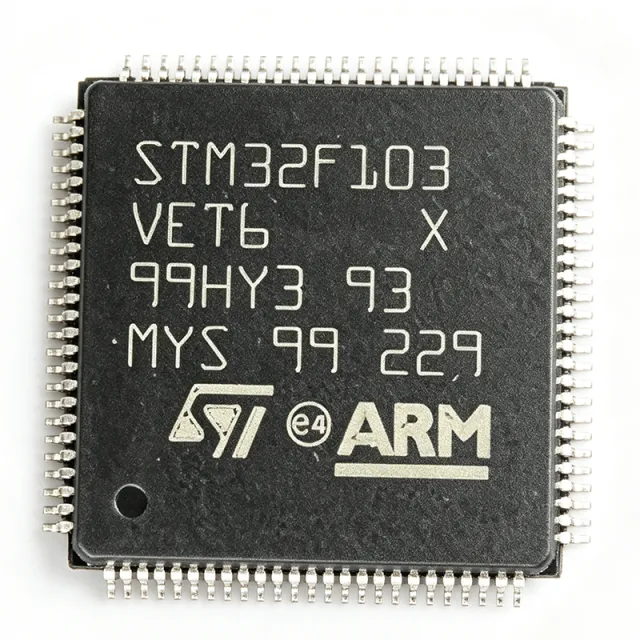
STM32F103VFT7 - 72MHz Cortex-M3 768KB MCU | STMicroelectronics
STM32F103VFT7

STM32F103VFT7 - 72MHz Cortex-M3 768KB MCU | STMicroelectronics

STMicroelectronics STM32F103VFT7 is a 32-bit ARM Cortex-M3 microcontroller operating at up to 72MHz, with 768KB of embedded Flash memory and a 100-pin LQFP package measuring 14mm by 14mm. The device is identified as part of the STM32F1 series XL-density performance line and operates from a 2.5V or 3.3V supply according to the available distributor data. A microcontroller is a programmable semiconductor that integrates a processor core, memory, and peripherals into one device. The STM32F103VFT7 belongs to the STM32 family of 32-bit microcontrollers and uses the ARM Cortex-M3 RISC core. Within the product hierarchy, it is an embedded microcontroller, embedded processor, and programmable control IC designed for compact systems requiring substantial local program storage and real-time control capability. The principal specifications visible in the verified product information are a 72MHz operating frequency, 768KB Flash memory, 32-bit architecture, and 100-pin LQFP construction. The 768KB Flash capacity is useful for firmware, bootloader code, configuration data, and application logic in industrial controllers, motor-control systems, communications equipment, and data-acquisition products. Its XL-density designation identifies a relatively high-memory member of the STM32F103 performance line. The STM32F1 architecture combines a high-performance Cortex-M3 processor with integrated embedded memory and a broad set of microcontroller peripherals. A 72MHz clock gives designers additional timing margin for interrupt handling, communication protocols, and control loops compared with slower general-purpose embedded controllers. The 100-pin LQFP package provides a comparatively high pin count for designs that need access to numerous I/O functions, although the complete pin assignment is not reproduced because a verified full pinout was not included in the supplied sources. Typical applications include industrial automation modules, brushless motor controllers, CAN or serial communication equipment, data loggers, and embedded instrumentation. In these systems, the MCU can execute real-time control software while storing application code and working data locally. The 768KB Flash capacity also makes the device suitable for gateways that require protocol stacks, update mechanisms, and condition-monitoring logic on one controller. Designers should treat the 2.5V or 3.3V supply requirement as central to board planning and verify every external interface voltage against the manufacturer data. Decoupling, clock configuration, boot mode, reset, and programming access must follow the STM32F103 hardware guidance. A complete migration should also account for peripheral differences, firmware startup behavior, and any alternative part's clock or flash-wait-state characteristics before production use. This page consolidates verified distributor specifications, manufacturer document access, package information, practical application guidance, and qualified drop-in comparisons. It also distinguishes basic pin compatibility from a production-ready replacement by calling out memory and clock differences that must be reviewed before schematic reuse or firmware deployment.

Permintaan RFG Kontak
STM32F103VGT6J - 72MHz Cortex-M3 1MB MCU | STMicroelectronics
STM32F103VGT6J

STM32F103VGT6J - 72MHz Cortex-M3 1MB MCU | STMicroelectronics

STMicroelectronics STM32F103VGT6J is a 32-bit ARM Cortex-M3 microcontroller with a 72 MHz maximum clock frequency, 1 MB of Flash memory, and a 100-pin LQFP package measuring 14 x 14 mm. It operates from a 3.3 V supply and belongs to the STM32F1 series of embedded microcontrollers, providing USB and CAN connectivity for motor-control and communication-oriented equipment. A microcontroller is an integrated circuit that combines a processor core, program memory, data memory, peripherals, and communication interfaces on one semiconductor device. In the product hierarchy, the STM32F103VGT6J is a 32-bit MCU based on the ARM Cortex-M3 core, forming part of the broader embedded-control and semiconductor category. Its combination of 1 MB Flash, USB, CAN, and numerous GPIO pins makes it suitable for compact control systems that require substantial firmware storage and wired network connectivity. Key features include a 72 MHz Cortex-M3 processor, 1 MB organized as 1M x 8 bits, a 3.3 V operating supply, and a 100-LQFP surface-mount package. The large pin count provides extensive peripheral access and practical board-space flexibility compared with smaller 32-pin and 48-pin devices. USB and CAN support are especially relevant to control panels, motor controllers, USB-to-serial equipment, industrial interfaces, and embedded gateways. The STM32F103 architecture combines a 32-bit ARM Cortex-M3 core with integrated Flash and SRAM resources and a broad peripheral set. A 72 MHz clock allows software-driven control loops, communications handling, and human-interface functions to execute on one device. The J ordering suffix identifies this specific STMicroelectronics ordering configuration, while the 100-LQFP outline supports conventional PCB assembly and inspection. Typical applications include industrial automation modules, USB-connected control boards, CAN-based motor controllers, data-acquisition systems, and compact embedded instruments. Its 1 MB Flash capacity accommodates bootloader logic, application firmware, communication stacks, and configuration data, while USB and CAN reduce the need for separate interface devices when those buses are required. Designers should verify the exact pin multiplexing, power requirements, clock configuration, decoupling, and exposed programming interfaces against the manufacturer datasheet before layout release. Because a 100-pin package exposes many signals, careful assignment of communications, timers, analog inputs, and debug functions is essential to avoid pin conflicts and provide test-point access. This page combines verified distributor specifications, documented cross-reference information, pricing references, and practical design guidance to support component selection. It also distinguishes same-family STMicroelectronics variants from a cross-brand candidate so engineers can review memory, clock, temperature-grade, and firmware implications before considering a drop-in substitution.

Permintaan RFG Kontak
STM32F103VGT7 - 72MHz Cortex-M3 MCU 1MB Flash 100-LQFP | ST
STM32F103VGT7

STM32F103VGT7 - 72MHz Cortex-M3 MCU 1MB Flash 100-LQFP | ST

The STMicroelectronics STM32F103VGT7 is a 32-bit ARM Cortex-M3 microcontroller from ST's XL-density performance line of the STM32F1 family, operating at up to 72 MHz with 1 MB of embedded Flash and 96 KB of SRAM, housed in a 100-pin LQFP (14x14 mm) package. The device integrates high-speed embedded memories and an extensive set of enhanced I/O peripherals, including USB full-speed, CAN 2.0B, three SPIs, two I2S, two I2C, three USARTs, an SDIO interface and a 12-bit ADC with up to 1 MSPS sampling on multiple channels. A microcontroller (MCU) is a single-chip computer that integrates a CPU core, memory and programmable I/O peripherals onto one die. Within the broader IC taxonomy, an MCU belongs to the microprocessor IC family, which sits above microcontrollers but below microprocessors in computational capability. The Cortex-M3 core inside this STM32 belongs to ARM's Cortex-M profile, designed for deterministic real-time embedded workloads; the Cortex-M3 line is one rung below Cortex-M4 in DSP capability and one rung above Cortex-M0+ in raw compute throughput. Key features of the STM32F103VGT7 include a 72 MHz maximum CPU clock with single-cycle multiply, two 12-bit ADCs (1 µs conversion), seven general-purpose 16-bit timers plus one PWM timer for motor control, three USARTs, two UARTs, two SPIs and one I2C, an FS-USB device, a CAN 2.0B interface, an SDIO interface, an FSMC for external memory, 80 GPIO lines and a -40 °C to +105 °C operating range. The XL-density die provides the largest Flash and SRAM footprint of the STM32F1 series, enabling sophisticated firmware with rich connectivity stacks. The architecture pairs a Harvard-bus Cortex-M3 with a multi-AHB bus matrix that lets CPU, DMA and peripherals operate concurrently with deterministic bus latency. The 72 MHz core drives a 1.25 DMIPS/MHz figure (1.25 DMIPS/MHz), yielding 90 DMIPS total performance. The chip supports JTAG and SWD debug, an embedded Cortex-M3 trace macrocell (ETM), and boundary-scan for production test. Typical uses include motor drives (BLDC, stepper), USB HID/COM bridges, industrial PLCs, CNC controllers, CNC and 3D-printer mainboards, data-acquisition modules, CAN-bus nodes, RFID readers and point-of-sale terminals. Designers favor the part for its mature firmware ecosystem (HAL, LL, StdPeriph), reference schematics and broad ST Nucleo board support. When laying out, place the VDD/VSS/VBAT/VDDA pins with 100 nF decoupling within 3 mm of each power pin, plus a 1 µF bulk on VDDA; keep the HSE crystal traces short and guarded to avoid EMI on USB. Make sure the BOOT0 strap on the part is hardware-defaulted for Flash boot when designing for field upgrades. This page consolidates distributor pricing (as of 2026-10-21), pin-to-pin same-brand and cross-brand drop-in alternatives (GD32F103 series) and practical design notes not found in the manufacturer datasheet.

Permintaan RFG Kontak
STM32F103VGT7TR - 72MHz Cortex-M3 MCU 1MB Flash 100-LQFP | ST (Tape & Reel)
STM32F103VGT7TR

STM32F103VGT7TR - 72MHz Cortex-M3 MCU 1MB Flash 100-LQFP | ST (Tape & Reel)

The STMicroelectronics STM32F103VGT7TR is a 32-bit ARM Cortex-M3 microcontroller from ST's XL-density performance line of the STM32F1 family, operating at up to 72 MHz with 1 MB of embedded Flash and 96 KB of SRAM, housed in a 100-pin LQFP (14x14 mm) package. The device integrates high-speed embedded memories and an extensive set of enhanced I/O peripherals, including USB full-speed, CAN 2.0B, three SPIs, two I2S, two I2C, three USARTs, an SDIO interface and a 12-bit ADC with up to 1 MSPS sampling on multiple channels. A microcontroller (MCU) is a single-chip computer that integrates a CPU core, memory and programmable I/O peripherals onto one die. Within the broader IC taxonomy, an MCU belongs to the microprocessor IC family, which sits above microcontrollers but below microprocessors in computational capability. The Cortex-M3 core inside this STM32 belongs to ARM's Cortex-M profile, designed for deterministic real-time embedded workloads; the Cortex-M3 line is one rung below Cortex-M4 in DSP capability and one rung above Cortex-M0+ in raw compute throughput. Key features of the STM32F103VGT7TR include a 72 MHz maximum CPU clock with single-cycle multiply, two 12-bit ADCs (1 µs conversion), seven general-purpose 16-bit timers plus one PWM timer for motor control, three USARTs, two UARTs, two SPIs and one I2C, an FS-USB device, a CAN 2.0B interface, an SDIO interface, an FSMC for external memory, 80 GPIO lines and a -40 °C to +105 °C operating range. The XL-density die provides the largest Flash and SRAM footprint of the STM32F1 series, enabling sophisticated firmware with rich connectivity stacks. The architecture pairs a Harvard-bus Cortex-M3 with a multi-AHB bus matrix that lets CPU, DMA and peripherals operate concurrently with deterministic bus latency. The 72 MHz core drives a 1.25 DMIPS/MHz figure (1.25 DMIPS/MHz), yielding 90 DMIPS total performance. The chip supports JTAG and SWD debug, an embedded Cortex-M3 trace macrocell (ETM), and boundary-scan for production test. Typical uses include motor drives (BLDC, stepper), USB HID/COM bridges, industrial PLCs, CNC controllers, CNC and 3D-printer mainboards, data-acquisition modules, CAN-bus nodes, RFID readers and point-of-sale terminals. Designers favor the part for its mature firmware ecosystem (HAL, LL, StdPeriph), reference schematics and broad ST Nucleo board support. When laying out, place the VDD/VSS/VBAT/VDDA pins with 100 nF decoupling within 3 mm of each power pin, plus a 1 µF bulk on VDDA; keep the HSE crystal traces short and guarded to avoid EMI on USB. Make sure the BOOT0 strap on the part is hardware-defaulted for Flash boot when designing for field upgrades. This page consolidates distributor pricing (as of 2026-10-21), pin-to-pin same-brand and cross-brand drop-in alternatives (GD32F103 series) and practical design notes not found in the manufacturer datasheet.

Permintaan RFG Kontak
STM32F103Z - 72MHz Cortex-M3 MCU, 144-LQFP | STMicroelectronics
STM32F103Z

STM32F103Z - 72MHz Cortex-M3 MCU, 144-LQFP | STMicroelectronics

The STMicroelectronics STM32F103Z is a high-density ARM Cortex-M3 32-bit microcontroller in the STM32F1 performance line, available in a 144-pin LQFP package. The Z-suffix family includes the STM32F103ZC (256 KB Flash), ZD (384 KB Flash), and ZE (512 KB Flash) variants, all running up to 72 MHz CPU clock and offering up to 1 MB of Flash in the broader F1 portfolio. This MCU integrates 64 KB SRAM, USB full-speed, CAN, multiple USART/SPI/I2C peripherals, a 12-bit ADC, and a 16-bit PWM timer block, making it a versatile choice for embedded applications. What is an ARM Cortex-M3 microcontroller? A Cortex-M3 MCU is a 32-bit processor core designed by ARM specifically for embedded deterministic real-time control. Within ST's product hierarchy, the Cortex-M3 sits between the Cortex-M0 (lowest cost/performance) and Cortex-M4 (DSP/FPU). The STM32F103Z belongs to ST's mainstream performance line, balancing cost, peripheral richness, and the 72 MHz speed grade against newer STM32F4/F7/H7 families that scale to 180-480 MHz. Key features include 72 MHz ARM Cortex-M3 core with single-cycle multiplication and hardware division, 512 KB Flash (ZE variant) with zero-wait-state execution, and 64 KB SRAM. The device supports 1.25 DMIPS/MHz performance, USB 2.0 full-speed with on-chip PHY, CAN 2.0B, three 12-bit ADCs with 1 µs conversion time, four 16-bit timers, and up to 112 general-purpose I/O pins. The 144-LQFP package provides extensive connectivity while remaining hand-solderable. Architecturally, the STM32F103Z uses a multi-AHB bus matrix that allows simultaneous CPU and DMA access to peripherals and memory, minimizing wait states. The integrated voltage regulator supports 2.0-3.6 V single-supply operation with internal 1.8 V core LDO. The 12-bit ADC group can be triggered by timers for synchronized motor-control sampling. Typical applications include industrial control and human-machine interfaces (HMIs), motor drives and inverters, USB peripherals and CAN-bus nodes, point-of-sale terminals, GPS data loggers, and barcode scanners. The wide peripheral set and large pin count also make it popular as a main controller for printers, 3D-printer boards, and mid-range IoT gateways. When designing with this MCU, prioritize decoupling: place 100 nF ceramic capacitors on every VDD/VDDA pin within 5 mm of the lead, and add a 4.7 µF bulk capacitor. For noise-critical ADC sampling, use a separate ferrite-isolated analog supply and enable the internal voltage-reference buffer. This page synthesizes pricing tiers, drop-in alternatives such as GD32F103, and PCB layout guidance beyond what is in the ST datasheet.

Permintaan RFG Kontak
STM32F103Z8T6 - 72MHz Cortex-M3 MCU 64KB LQFP-144 | STMicroelectronics
STM32F103Z8T6

STM32F103Z8T6 - 72MHz Cortex-M3 MCU 64KB LQFP-144 | STMicroelectronics

The STMicroelectronics STM32F103Z8T6 is a 32-bit ARM Cortex-M3 microcontroller running at 72 MHz with 64 KB Flash and 20 KB SRAM, housed in a 144-pin LQFP (T6, LQFP-144) package. It belongs to the medium-density performance line of the STM32F103 series and integrates USB 2.0 full-speed, CAN 2.0B, multiple USARTs, SPI, I2C, and dual 12-bit ADCs. A microcontroller (MCU) is a single-chip computer combining a processor core, memory, and peripherals, sitting at the lowest level of the embedded-system hierarchy: MCU -> embedded processor -> system-on-chip. The STM32F1 family was one of the first mainstream ARM Cortex-M families and remains one of the most widely deployed MCU platforms in industrial, consumer, and communication equipment worldwide. Key features of the STM32F103Z8T6 include the 72 MHz Cortex-M3 core with fast interrupt handling, 64 KB (64K x 8) Flash program memory with ECC-style write protection, 20 KB SRAM, two 12-bit 1 us ADCs, seven 16-bit timers including advanced motor-control PWM timers, and a rich I/O count enabled by the 144-pin package with up to 112 GPIOs. Per the ST STM32F103x8/B datasheet, the device operates from a 2.0 V to 3.6 V supply across -40C to +85C (temperature grade 6). Technically, the medium-density STM32F103 uses an ARMv7-M architecture with a 3-stage pipeline and Harvard bus structure, plus an embedded Flash accelerator that keeps performance close to zero-wait-state execution at 72 MHz. DMA over the bus matrix offloads data movement for ADC, USART, SPI, and I2C, minimizing CPU overhead in real-time control loops. Typical applications include industrial control and PLC I/O modules, motor control (BLDC/FOC via the advanced timers and dual ADC), communication and gateway boards using CAN and multiple UARTs, consumer appliances, and low-cost development platforms such as the well-known Blue Pill family (which uses the 48-pin sibling STM32F103C8T6). When designing with this part, verify Flash wait-state settings at 72 MHz (2 wait states), respect the 3.6 V absolute maximum on VDD, and remember the famous revision-Y errata affecting some early USB implementations - consult errata sheet ES096 for details. This page synthesizes distributor pricing context, verified drop-in alternatives (including GigaDevice GD32F103), and practical design notes not found in the manufacturer datasheet alone.

Permintaan RFG Kontak
STM32F103ZCH6 - 72MHz Cortex-M3 256KB MCU | STMicroelectronics
STM32F103ZCH6

STM32F103ZCH6 - 72MHz Cortex-M3 256KB MCU | STMicroelectronics

STMicroelectronics STM32F103ZCH6 is a 32-bit ARM Cortex-M3 microcontroller with a 72 MHz maximum clock, 256 KB of Flash memory, and a 144-LFBGA package measuring 10 mm by 10 mm. The device belongs to STMicroelectronics' STM32F1 high-density performance-line family, combining an embedded ARM processor core with extensive peripheral integration in a compact surface-mount package. A microcontroller is a semiconductor device that integrates a CPU core, program memory, data memory, peripherals, and communication interfaces into one package. Within the embedded-computing hierarchy, the STM32F103 belongs to the microcontroller and embedded-processor class, its Cortex-M3 core places it in the ARM-based 32-bit MCU category, and its mixed-signal and communications resources support industrial-control and embedded-system designs. The verified distributor information identifies a 72 MHz operating frequency, 256 KB of Flash storage and a 144-LFBGA package. Search results also describe the STM32F103 high-density family as supporting USB, CAN, multiple timers, analog-to-digital converters and numerous communication interfaces. These resources can distribute control logic across a single device while reducing the component count required for data acquisition, timing, serial communication and actuator control. Technically, the Cortex-M3 architecture provides a 32-bit processing interface for embedded control code, while the STM32F103 integration supports communication-oriented system designs. The exact 144-LFBGA ball assignment, peripheral electrical limits, operating-voltage range, RAM capacity, pin multiplexing and timing characteristics must be confirmed against the official STM32F103 datasheet before schematic capture or PCB layout approval. Typical uses include industrial automation controllers, USB-connected data-acquisition equipment, CAN network nodes, motor and motion-control systems, building-control interfaces, and compact consumer or communications products. The combination of a 72 MHz ARM Cortex-M3 core, 256 KB Flash and a compact 10 mm by 10 mm BGA package is especially relevant where processing density and board area are important. The primary design consideration is that the STM32F103ZCH6 is a high-pin-count BGA device. Its escape routing, via pattern, exposed-pad requirements, assembly process and PCB land pattern must follow the manufacturer's package drawing exactly. Clock configuration, decoupling, reset, boot-mode, USB and CAN routing also require application-specific schematic and signal-integrity review. This page consolidates verified distributor specifications, sourcing links and engineering-selection context. It distinguishes verified facts from parameters requiring confirmation, avoiding unsupported voltage, timing, pricing and pin-level claims while providing a practical basis for STM32F103ZCH6 evaluation.

Permintaan RFG Kontak
STM32F103ZCT6 - 72MHz Cortex-M3 256KB MCU | STMicroelectronics
STM32F103ZCT6

STM32F103ZCT6 - 72MHz Cortex-M3 256KB MCU | STMicroelectronics

The STMicroelectronics STM32F103ZCT6 is a high-density performance line 32-bit microcontroller with an ARM Cortex-M3 core running at 72 MHz, 256 KB Flash and 48 KB SRAM, housed in a 144-pin LQFP (20x20 mm) package. A microcontroller (MCU) is a single-chip embedded computer that integrates a processor core, program memory, data memory, and programmable peripherals. Within the voltage regulator-like hierarchy of embedded silicon, the MCU sits at the system level: microcontroller -> ARM Cortex-M processor -> STM32 family -> STM32F1 high-density performance line. The STM32F103 series is one of the most widely adopted Cortex-M3 families in industrial and consumer electronics because it pairs deterministic real-time performance with a rich peripheral set and long-term availability. Key features of the STM32F103ZCT6 include the 72 MHz Cortex-M3 core with single-cycle multiply and hardware divide, 256 KB of embedded Flash, 48 KB SRAM, and up to 13 communication interfaces. Peripherals include three 12-bit ADCs, 11 timers, USB 2.0 full-speed device, CAN 2.0B, and a DMA controller. These resources allow a single chip to handle motor control loops, protocol conversion, and USB connectivity simultaneously. Technically, the device is fabricated on a 130 nm process and includes a Nested Vectored Interrupt Controller (NVIC) for low-latency interrupt handling. Both JTAG and Serial Wire Debug (SWD) interfaces are supported, and the embedded bootloader enables Flash programming over USART, USB, or CAN without a dedicated programmer. The core operates from a 2.0V to 3.6V supply across a -40C to +85C temperature range. Typical applications include industrial control systems, motor drives, medical devices, consumer electronics, and IoT gateways, where multiple communication interfaces and three ADCs allow sensor acquisition, actuation, and networking on one device. A key design consideration: decouple every VDD/VDDA pin with 100 nF capacitors placed as close as possible to the pins, configure BOOT0 correctly for the boot mode, and fit an external reset network on NRST for reliable startup. This page adds distributor-sourced availability data, drop-in alternatives including GigaDevice GD32F103 cross-references, and practical design notes not found in the STMicroelectronics datasheet alone.

Permintaan RFG Kontak
STM32F103ZCT6TR - 72MHz Cortex-M3 256KB MCU | STMicroelectronics (Tape & Reel)
STM32F103ZCT6TR

STM32F103ZCT6TR - 72MHz Cortex-M3 256KB MCU | STMicroelectronics (Tape & Reel)

The STMicroelectronics STM32F103ZCT6TR is a high-density performance line 32-bit microcontroller with an ARM Cortex-M3 core running at 72 MHz, 256 KB Flash and 48 KB SRAM, housed in a 144-pin LQFP (20x20 mm) package. A microcontroller (MCU) is a single-chip embedded computer that integrates a processor core, program memory, data memory, and programmable peripherals. Within the voltage regulator-like hierarchy of embedded silicon, the MCU sits at the system level: microcontroller -> ARM Cortex-M processor -> STM32 family -> STM32F1 high-density performance line. The STM32F103 series is one of the most widely adopted Cortex-M3 families in industrial and consumer electronics because it pairs deterministic real-time performance with a rich peripheral set and long-term availability. Key features of the STM32F103ZCT6TR include the 72 MHz Cortex-M3 core with single-cycle multiply and hardware divide, 256 KB of embedded Flash, 48 KB SRAM, and up to 13 communication interfaces. Peripherals include three 12-bit ADCs, 11 timers, USB 2.0 full-speed device, CAN 2.0B, and a DMA controller. These resources allow a single chip to handle motor control loops, protocol conversion, and USB connectivity simultaneously. Technically, the device is fabricated on a 130 nm process and includes a Nested Vectored Interrupt Controller (NVIC) for low-latency interrupt handling. Both JTAG and Serial Wire Debug (SWD) interfaces are supported, and the embedded bootloader enables Flash programming over USART, USB, or CAN without a dedicated programmer. The core operates from a 2.0V to 3.6V supply across a -40C to +85C temperature range. Typical applications include industrial control systems, motor drives, medical devices, consumer electronics, and IoT gateways, where multiple communication interfaces and three ADCs allow sensor acquisition, actuation, and networking on one device. A key design consideration: decouple every VDD/VDDA pin with 100 nF capacitors placed as close as possible to the pins, configure BOOT0 correctly for the boot mode, and fit an external reset network on NRST for reliable startup. This page adds distributor-sourced availability data, drop-in alternatives including GigaDevice GD32F103 cross-references, and practical design notes not found in the STMicroelectronics datasheet alone.

Permintaan RFG Kontak
STM32F103ZCT7 - 72MHz 256KB Cortex-M3 MCU | STMicroelectronics
STM32F103ZCT7

STM32F103ZCT7 - 72MHz 256KB Cortex-M3 MCU | STMicroelectronics

The STMicroelectronics STM32F103ZCT7 is a 32-bit ARM Cortex-M3 microcontroller operating up to 72 MHz with 256 KB of Flash memory in a 144-pin LQFP package. It is designed for high-density embedded systems that need broad peripheral connectivity, deterministic control, and substantial on-chip program memory. What is an ARM Cortex-M3 microcontroller? An MCU combines a processor core, memory, and peripherals on one integrated circuit. The Cortex-M3 core provides a 32-bit instruction set and RISC-oriented embedded architecture, while the STM32F103 family integrates communication, timing, analog, and digital-control resources for applications spanning industrial equipment, communications, and mixed-signal control. The STM32F103ZCT7 combines 72 MHz operation, 256 KB Flash, and a high pin count in one device. Verified distributor material also identifies the part as a 144-pin MCU and highlights USB, CAN, timer, ADC, and communication-interface resources. These peripherals make it suitable for systems combining control logic with protocol handling and analog measurement. The STM32F103ZCT7 belongs to the STM32F103 high-density performance line. Its architecture supports connected embedded designs that need more GPIO and peripheral capacity than smaller STM32 packages. The 144-pin LQFP format provides extensive external connectivity, while the Cortex-M3 platform supports established embedded software tooling and real-time control workloads. Typical applications include industrial controllers, USB-connected peripherals, CAN-based equipment, data-acquisition systems, timer-driven control platforms, and embedded communications equipment. In these systems, the microcontroller can coordinate sensors, actuators, protocol transceivers, and human-interface or debug connections through its broad pin and peripheral set. A key design consideration is supply and decoupling planning. The verified data identifies 2.5 V and 3.3 V device variants, but detailed voltage ranges, pin-level electrical limits, clock configuration, memory map, and exact peripheral ratings were not supplied here and should be confirmed in the manufacturer datasheet before layout or firmware release. Firmware migration also requires validation of startup files, peripheral behavior, timing, and toolchain support. This page combines verified distributor specifications, practical application context, package constraints, and sourcing guidance for engineers evaluating the STM32F103ZCT7. It is designed to make technical comparisons faster while clearly separating confirmed data from parameters that require datasheet verification.

Permintaan RFG Kontak
STM32F103ZCT7TR - 72MHz 256KB Cortex-M3 MCU | STMicroelectronics (Tape & Reel)
STM32F103ZCT7TR

STM32F103ZCT7TR - 72MHz 256KB Cortex-M3 MCU | STMicroelectronics (Tape & Reel)

The STMicroelectronics STM32F103ZCT7TR is a 32-bit ARM Cortex-M3 microcontroller operating up to 72 MHz with 256 KB of Flash memory in a 144-pin LQFP package. It is designed for high-density embedded systems that need broad peripheral connectivity, deterministic control, and substantial on-chip program memory. What is an ARM Cortex-M3 microcontroller? An MCU combines a processor core, memory, and peripherals on one integrated circuit. The Cortex-M3 core provides a 32-bit instruction set and RISC-oriented embedded architecture, while the STM32F103 family integrates communication, timing, analog, and digital-control resources for applications spanning industrial equipment, communications, and mixed-signal control. The STM32F103ZCT7TR combines 72 MHz operation, 256 KB Flash, and a high pin count in one device. Verified distributor material also identifies the part as a 144-pin MCU and highlights USB, CAN, timer, ADC, and communication-interface resources. These peripherals make it suitable for systems combining control logic with protocol handling and analog measurement. The STM32F103ZCT7TR belongs to the STM32F103 high-density performance line. Its architecture supports connected embedded designs that need more GPIO and peripheral capacity than smaller STM32 packages. The 144-pin LQFP format provides extensive external connectivity, while the Cortex-M3 platform supports established embedded software tooling and real-time control workloads. Typical applications include industrial controllers, USB-connected peripherals, CAN-based equipment, data-acquisition systems, timer-driven control platforms, and embedded communications equipment. In these systems, the microcontroller can coordinate sensors, actuators, protocol transceivers, and human-interface or debug connections through its broad pin and peripheral set. A key design consideration is supply and decoupling planning. The verified data identifies 2.5 V and 3.3 V device variants, but detailed voltage ranges, pin-level electrical limits, clock configuration, memory map, and exact peripheral ratings were not supplied here and should be confirmed in the manufacturer datasheet before layout or firmware release. Firmware migration also requires validation of startup files, peripheral behavior, timing, and toolchain support. This page combines verified distributor specifications, practical application context, package constraints, and sourcing guidance for engineers evaluating the STM32F103ZCT7TR. It is designed to make technical comparisons faster while clearly separating confirmed data from parameters that require datasheet verification.

Permintaan RFG Kontak
STM32F103ZDH6 - 72MHz Cortex-M3 MCU | STMicroelectronics
STM32F103ZDH6

STM32F103ZDH6 - 72MHz Cortex-M3 MCU | STMicroelectronics

STMicroelectronics STM32F103ZDH6 is a 32-bit ARM Cortex-M3 microcontroller operating up to 72 MHz, with 384 KB of Flash memory and a 144-LFBGA package measuring 10 mm by 10 mm. It is designed for high-density embedded applications that require substantial program memory, extensive GPIO access, and a compact surface-mount footprint. The STM32F103 performance-line architecture combines a 32-bit processor, embedded Flash, SRAM, communication peripherals, timers, and analog functions on a single integrated circuit. A microcontroller is a programmable system-on-chip that integrates a CPU core, memory, and peripheral interfaces. The ARM Cortex-M3 is a 32-bit embedded processor architecture commonly used for real-time control because it provides deterministic instruction execution and broad support from embedded development tools. Within the product hierarchy, STM32F103ZDH6 is a high-density STM32F1-series microcontroller, an embedded controller, a semiconductor, and a component within the broader embedded-systems and industrial-control markets. The verified manufacturer and distributor data identify three headline characteristics: a maximum clock frequency of 72 MHz, 384 KB of Flash memory, and a 144-LFBGA package. Its high pin count provides access to a broad peripheral complement rather than the reduced interface set typical of smaller packages. The family documentation also describes support for memories from 256 KB to 512 KB of Flash and up to 64 KB of SRAM, while the specific STM32F103ZDH6 distributor listing confirms 384 KB of Flash. The STM32F1 high-density family is suitable for applications requiring multiple serial interfaces, general-purpose timers, analog-to-digital conversion, external memory connectivity, and control outputs. The 72 MHz Cortex-M3 core provides more than the processing bandwidth required for many supervisory, communications, data-acquisition, and motor-control tasks. The exact SRAM capacity, GPIO count, peripheral mix, voltage range, and temperature limits of this ordering code require confirmation from the manufacturer datasheet because they were not included in the supplied verification extracts. Typical implementations include industrial controllers, communications equipment, data loggers, programmable logic controllers, motor-control systems, and densely connected embedded products. The 144-LFBGA package is particularly useful where a reduced number of external connections would otherwise force a larger leaded package. Careful PCB layout is essential because densely spaced BGA pads require controlled escape routing, adequate ground-plane continuity, and assembly-process capability. The primary design tradeoff is compactness versus assembly accessibility. A 10 mm by 10 mm LFBGA supports extensive connections in a small area, but unlike a leaded package it cannot be hand-soldered with conventional through-hole techniques. Component placement, solder-paste control, reflow profile, via-in-pad policy, and X-ray or electrical inspection should therefore be coordinated with the board manufacturer before production release. This page consolidates the verified STM32F103ZDH6 specifications, current distributor references, datasheet access, procurement information, and design guidance. It also separates documented facts from unavailable parameters, preventing package, electrical, compliance, and lifecycle assumptions from being presented as confirmed manufacturer specifications.

Permintaan RFG Kontak
STM32F103ZDH6TR - 72MHz Cortex-M3 MCU | STMicroelectronics (Tape & Reel)
STM32F103ZDH6TR

STM32F103ZDH6TR - 72MHz Cortex-M3 MCU | STMicroelectronics (Tape & Reel)

STMicroelectronics STM32F103ZDH6TR is a 32-bit ARM Cortex-M3 microcontroller operating up to 72 MHz, with 384 KB of Flash memory and a 144-LFBGA package measuring 10 mm by 10 mm. It is designed for high-density embedded applications that require substantial program memory, extensive GPIO access, and a compact surface-mount footprint. The STM32F103 performance-line architecture combines a 32-bit processor, embedded Flash, SRAM, communication peripherals, timers, and analog functions on a single integrated circuit. A microcontroller is a programmable system-on-chip that integrates a CPU core, memory, and peripheral interfaces. The ARM Cortex-M3 is a 32-bit embedded processor architecture commonly used for real-time control because it provides deterministic instruction execution and broad support from embedded development tools. Within the product hierarchy, STM32F103ZDH6TR is a high-density STM32F1-series microcontroller, an embedded controller, a semiconductor, and a component within the broader embedded-systems and industrial-control markets. The verified manufacturer and distributor data identify three headline characteristics: a maximum clock frequency of 72 MHz, 384 KB of Flash memory, and a 144-LFBGA package. Its high pin count provides access to a broad peripheral complement rather than the reduced interface set typical of smaller packages. The family documentation also describes support for memories from 256 KB to 512 KB of Flash and up to 64 KB of SRAM, while the specific STM32F103ZDH6TR distributor listing confirms 384 KB of Flash. The STM32F1 high-density family is suitable for applications requiring multiple serial interfaces, general-purpose timers, analog-to-digital conversion, external memory connectivity, and control outputs. The 72 MHz Cortex-M3 core provides more than the processing bandwidth required for many supervisory, communications, data-acquisition, and motor-control tasks. The exact SRAM capacity, GPIO count, peripheral mix, voltage range, and temperature limits of this ordering code require confirmation from the manufacturer datasheet because they were not included in the supplied verification extracts. Typical implementations include industrial controllers, communications equipment, data loggers, programmable logic controllers, motor-control systems, and densely connected embedded products. The 144-LFBGA package is particularly useful where a reduced number of external connections would otherwise force a larger leaded package. Careful PCB layout is essential because densely spaced BGA pads require controlled escape routing, adequate ground-plane continuity, and assembly-process capability. The primary design tradeoff is compactness versus assembly accessibility. A 10 mm by 10 mm LFBGA supports extensive connections in a small area, but unlike a leaded package it cannot be hand-soldered with conventional through-hole techniques. Component placement, solder-paste control, reflow profile, via-in-pad policy, and X-ray or electrical inspection should therefore be coordinated with the board manufacturer before production release. This page consolidates the verified STM32F103ZDH6TR specifications, current distributor references, datasheet access, procurement information, and design guidance. It also separates documented facts from unavailable parameters, preventing package, electrical, compliance, and lifecycle assumptions from being presented as confirmed manufacturer specifications.

Permintaan RFG Kontak
STM32F103ZDT6 - 72MHz Cortex-M3 384KB MCU | STMicroelectronics
STM32F103ZDT6

STM32F103ZDT6 - 72MHz Cortex-M3 384KB MCU | STMicroelectronics

The STMicroelectronics STM32F103ZDT6 is a 32-bit Arm Cortex-M3 microcontroller with a 72 MHz CPU, 384 KB of Flash memory, USB and CAN connectivity, and a 144-pin LQFP package measuring 20 mm by 20 mm. It belongs to the STM32F103 high-density performance line and is positioned for embedded systems requiring extensive peripheral integration and a large package pin count. A microcontroller is an integrated circuit that combines a processor core, memory, peripherals, and communication interfaces on one semiconductor device. The STM32F103ZDT6 is an Arm Cortex-M3 MCU within the STM32 family, which sits under the broader embedded-processing and semiconductor hierarchy. Its combination of USB, CAN, analog conversion, timers, and serial communications makes it useful for industrial control, data acquisition, motor-control, and communications-oriented embedded equipment. The verified product information identifies a 72 MHz Arm Cortex-M3 core, 384 KB of Flash, 11 timers, three ADCs, and 13 communication interfaces. USB and CAN are explicitly listed as supported connectivity functions. The STM32F103 family covers 256 KB to 512 KB of Flash, while the STM32F103ZD device variant specifically provides 384 KB. These resources allow embedded firmware to combine control logic, peripheral management, and communication tasks within one device. The STM32F103ZDT6 belongs to STMicroelectronics' Active Mainstream Performance line and targets applications including motor control, USB, and CAN equipment. Its 144-pin LQFP (20 x 20 mm) construction exposes a substantially larger number of GPIO and peripheral resources than smaller MCU packages. That package size is an important engineering tradeoff because it simplifies access to extensive I/O while requiring a correspondingly large PCB footprint and careful high-density fanout routing. Typical uses include factory automation controllers, CAN-connected industrial nodes, USB data-acquisition equipment, motor-control peripherals, and communication gateways. In these systems, the three ADCs can support analog measurement channels, the 11 timers can support timing and motor-control functions, and USB or CAN can provide structured external connectivity. Developers should select peripheral functions and pin multiplexing against the device pinout and verify the complete operating requirements in the manufacturer documentation. The primary design consideration is package-level planning. A 144-pin LQFP requires adequate board area, escape routing for its dense perimeter leads, and attention to thermal performance during reflow and operation. Firmware development also depends on the exact STM32F103 device definition, clock configuration, peripheral mapping, and startup code; a board swap should therefore include electrical, timing, and software validation rather than relying only on connector compatibility. This page consolidates verified manufacturer and distributor information, package-specific alternatives, pricing references, comparison data, and practical sourcing guidance. It distinguishes confirmed characteristics from unavailable specifications and provides engineering context beyond a distributor listing, helping teams evaluate the STM32F103ZDT6 for embedded USB, CAN, analog, and control designs.

Permintaan RFG Kontak
STM32F103ZEH6 - 72MHz Cortex-M3 512KB MCU | STMicroelectronics
STM32F103ZEH6

STM32F103ZEH6 - 72MHz Cortex-M3 512KB MCU | STMicroelectronics

The STMicroelectronics STM32F103ZEH6 is a high-performance 32-bit ARM Cortex-M3 microcontroller operating at 72 MHz, with 512 KB of Flash memory and a 144-pin LQFP package. It belongs to the STM32F1 performance-line family and integrates USB, CAN, 11 timers, three ADCs, and 13 communication interfaces. These headline resources make it suitable for connected industrial controls, embedded data acquisition, communications gateways, and multi-protocol control systems. A microcontroller is a programmable system-on-chip that executes firmware, reads sensors, controls actuators, and manages digital interfaces. The STM32F103ZEH6 combines an ARM Cortex-M3 RISC core with Flash program memory, SRAM, direct-memory-access support, and multiple peripherals. Within the hierarchy, it is an embedded microcontroller, a 32-bit MCU, and a member of the STM32 family of ARM-based semiconductor devices. Verified manufacturer information identifies a maximum CPU frequency of 72 MHz, 512 KB of Flash, USB, CAN, 11 timers, three ADCs, and 13 communication interfaces. Its broad peripheral mix allows several communications protocols and time-sensitive functions to coexist without external expansion devices. The high pin count also provides more externally accessible GPIO and peripheral connections than smaller STM32 packages. The ARM Cortex-M3 core provides the instruction set and processing foundation, while the STM32 peripherals handle timers, analog conversion, serial communications, USB, and CAN. Multiple timers support periodic generation, input capture, encoder-related functions, and motor-control workflows. Three ADC channels groups permit analog measurements, while communication interfaces reduce demand for discrete protocol controllers. Typical applications include industrial automation equipment, CAN-connected control panels, USB data loggers, communications hubs, motor controllers, and instrumentation gateways. The STM32F103ZEH6 is especially appropriate when firmware requires substantial Flash space and a broad set of embedded peripherals while retaining the established STM32F103 software ecosystem. Designers should verify the complete pin assignment, power supply requirements, clock configuration, and peripheral multiplexing against the manufacturer datasheet before layout. A 144-pin LQFP package also demands careful escape routing and thermal-aware placement. Published pricing and stock conditions should be checked with authorized distributors because availability can change independently of technical suitability. This page consolidates manufacturer specifications, distributor references, documented same-family alternatives, and practical procurement guidance. It also distinguishes verified data from unprovided parameters so engineers can assess fit without relying on assumptions.

Permintaan RFG Kontak
STM32F103ZEH6TR - 72MHz Cortex-M3 512KB MCU | STMicroelectronics (Tape & Reel)
STM32F103ZEH6TR

STM32F103ZEH6TR - 72MHz Cortex-M3 512KB MCU | STMicroelectronics (Tape & Reel)

The STMicroelectronics STM32F103ZEH6TR is a high-performance 32-bit ARM Cortex-M3 microcontroller operating at 72 MHz, with 512 KB of Flash memory and a 144-pin LQFP package. It belongs to the STM32F1 performance-line family and integrates USB, CAN, 11 timers, three ADCs, and 13 communication interfaces. These headline resources make it suitable for connected industrial controls, embedded data acquisition, communications gateways, and multi-protocol control systems. A microcontroller is a programmable system-on-chip that executes firmware, reads sensors, controls actuators, and manages digital interfaces. The STM32F103ZEH6TR combines an ARM Cortex-M3 RISC core with Flash program memory, SRAM, direct-memory-access support, and multiple peripherals. Within the hierarchy, it is an embedded microcontroller, a 32-bit MCU, and a member of the STM32 family of ARM-based semiconductor devices. Verified manufacturer information identifies a maximum CPU frequency of 72 MHz, 512 KB of Flash, USB, CAN, 11 timers, three ADCs, and 13 communication interfaces. Its broad peripheral mix allows several communications protocols and time-sensitive functions to coexist without external expansion devices. The high pin count also provides more externally accessible GPIO and peripheral connections than smaller STM32 packages. The ARM Cortex-M3 core provides the instruction set and processing foundation, while the STM32 peripherals handle timers, analog conversion, serial communications, USB, and CAN. Multiple timers support periodic generation, input capture, encoder-related functions, and motor-control workflows. Three ADC channels groups permit analog measurements, while communication interfaces reduce demand for discrete protocol controllers. Typical applications include industrial automation equipment, CAN-connected control panels, USB data loggers, communications hubs, motor controllers, and instrumentation gateways. The STM32F103ZEH6TR is especially appropriate when firmware requires substantial Flash space and a broad set of embedded peripherals while retaining the established STM32F103 software ecosystem. Designers should verify the complete pin assignment, power supply requirements, clock configuration, and peripheral multiplexing against the manufacturer datasheet before layout. A 144-pin LQFP package also demands careful escape routing and thermal-aware placement. Published pricing and stock conditions should be checked with authorized distributors because availability can change independently of technical suitability. This page consolidates manufacturer specifications, distributor references, documented same-family alternatives, and practical procurement guidance. It also distinguishes verified data from unprovided parameters so engineers can assess fit without relying on assumptions.

Permintaan RFG Kontak
