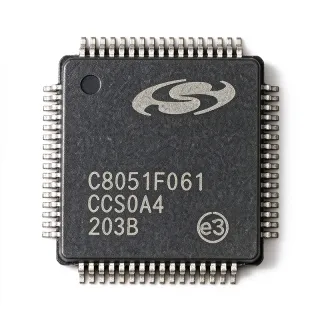
EFM32G232F64-QFP64 - 32MHz Cortex-M3 64KB Flash MCU | Silicon Labs
MPN: EFM32G232F64-QFP64 ✓ AktifEFM32G232F64-QFP64 Ringkasan
An MCU (microcontroller) is a single integrated circuit containing a CPU core, program memory, data memory and peripherals. In the taxonomy a microcontroller is a type of integrated circuit and semiconductor, and within that group it sits beside memory ICs, interface ICs, ADC/DAC and clock & timing devices. The Gecko family specifically targets energy-sensitive embedded systems where average current draw, not just peak performance, determines battery life.
Key features of this device include a 32 MHz ARM Cortex-M3 core with integrated sleep and stop modes, 64 kB of flash for firmware and 16 kB of SRAM for working memory, three 16-bit timers, and hardware AES support as noted in the Mouser listing for this part number. A wide 1.98 V to 3.8 V supply range makes the part usable across 2.5 V and 3.3 V system rails, and the 64-TQFP 10x10 mm footprint keeps the board area small while exposing 53 GPIO for sensors, actuators and communications.
Technically the part belongs to the Gecko series, whose energy-saving modes and fast wake-up behaviour are the differentiating architectural features versus generic Cortex-M3 devices. Because the device is available in a 64-pin TQFP, designers get both fine-grained pin multiplexing and a package that is straightforward for automated assembly, pick-and-place and visual inspection, unlike fine-pitch QFN or BGA options.
Typical applications include low-power sensor nodes and IoT end devices, industrial monitoring and control modules, building and energy metering equipment, portable and wearable accessories, and USB-connected peripheral controllers where the 53 available I/O pins allow several peripherals to share one package.
A key design consideration is that the flash capacity and RAM size define how much application code and data buffering fit on the die; designs that need large buffers should consider the 128 kB and 256 kB members of the Gecko family instead of this 64 kB variant.
This page synthesizes distributor pricing, verified drop-in alternatives, pin-level guidance and practical design notes that are not found together in the manufacturer datasheet, helping engineers shorten BOM and layout decisions for EFM32G232F64-QFP64.
Alternatif penggantian untuk EFM32G232F64-QFP64 — paket yang sama, pin-pada-pin kompatibel. Bagian paket yang berbeda memerlukan kerja ulang PCB diabaikan.
Variasi di dalam seri ini
Model-series yang sama yang kompatibel dengan penggantian EFM32G232F64-QFP64 (sama faktor bentuk dan footprint) — berbeda di dalam Package, RAM.
EFM32G232F64-QFP64T
✅ Drop-In📋 Alternatif referensi (tidak dalam katalog)
EFM32LG232F64G-E-QFP64
✅ Drop-In📋 Alternatif referensi (tidak dalam katalog)
EFM32TG232F32-QFP64T
✅ Drop-In📋 Alternatif referensi (tidak dalam katalog)
EFM32TG842F32-QFP64
✅ Drop-In📋 Alternatif referensi (tidak dalam katalog)
EFM32G212F32-QFP64
✅ Drop-In ⚠️ Spesifikasi Tidak Disahkan📋 Alternatif referensi (tidak dalam katalog)
EFM32G232F64-QFP64 Rating Maksimal & Karakteristik Listrik
| Core Processor | ARM Cortex-M3 |
| Maximum CPU Frequency | 32 MHz |
| Bit Width | 32-bit |
| Flash Memory Size | 64 kB (64K x 8) |
| RAM Size | 16 kB |
| Digital I/O Pins | 53 |
| Timer Counters | 3 x 16-bit timers |
| Supply Voltage Range | 1.98 V to 3.8 V |
| Series | EFM32 Gecko |
| Paket | 64-TQFP (10 x 10 mm) |
| Jumlah Pin | 64 |
| Tipe Mounting | Surface Mount |
| Security Feature | AES hardware encryption support |
| Low Power Modes | Sleep mode, stop mode, fast wake-up |
| Wake-Up Interrupt Controller | Yes |
| RoHS Compliance | Compliant |
| REACH Compliance | Compliant |
| AEC-Q100 Qualification | Not applicable |
| Lead-Free Status | Yes |
| PCB Footprint | 10 x 10 mm TQFP-64 |
Konfigurasi Pin EFM32G232F64-QFP64
| Pin produk 1 | PC0 — General-purpose I/O port C pin 0 |
| Pin produk 2 | PC1 — General-purpose I/O port C pin 1 |
| Pin produk 3 | PC2 — General-purpose I/O port C pin 2 |
| Pin produk 4 | PC3 — General-purpose I/O port C pin 3 |
| Pin produk 5 | PC4 — General-purpose I/O port C pin 4 |
| Pin produk 6 | PC5 — General-purpose I/O port C pin 5 |
| Pin produk 7 | PC6 — General-purpose I/O port C pin 6 |
| Pin produk 8 | PC7 — General-purpose I/O port C pin 7 |
| Pin produk 9 | PC8 — General-purpose I/O port C pin 8 |
| Pin produk 10 | PC9 — General-purpose I/O port C pin 9 |
| Pin produk 11 | PC10 — General-purpose I/O port C pin 10 |
| Pin produk 12 | PC11 — General-purpose I/O port C pin 11 |
| Pin produk 13 | PC12 — General-purpose I/O port C pin 12 |
| Pin produk 14 | PC13 — General-purpose I/O port C pin 13 |
| Pin produk 15 | PC14 — General-purpose I/O port C pin 14 |
| Pin produk 16 | PC15 — General-purpose I/O port C pin 15 |
| Pin produk 17 | PB0 — General-purpose I/O port B pin 0 |
| Pin produk 18 | PB1 — General-purpose I/O port B pin 1 |
| Pin produk 19 | PB2 — General-purpose I/O port B pin 2 |
| Pin produk 20 | PB3 — General-purpose I/O port B pin 3 |
| Pin produk 21 | PB4 — General-purpose I/O port B pin 4 |
| Pin produk 22 | PB5 — General-purpose I/O port B pin 5 |
| Pin produk 23 | PB6 — General-purpose I/O port B pin 6 |
| Pin produk 24 | PB7 — General-purpose I/O port B pin 7 |
| Pin produk 25 | PB8 — General-purpose I/O port B pin 8 |
| Pin produk 26 | PB9 — General-purpose I/O port B pin 9 |
| Pin produk 27 | PB10 — General-purpose I/O port B pin 10 |
| Pin produk 28 | PB11 — General-purpose I/O port B pin 11 |
| Pin produk 29 | PB12 — General-purpose I/O port B pin 12 |
| Pin produk 30 | PB13 — General-purpose I/O port B pin 13 |
| Pin produk 31 | PB14 — General-purpose I/O port B pin 14 |
| Pin produk 32 | PB15 — General-purpose I/O port B pin 15 |
| Pin produk 33 | PA0 — General-purpose I/O port A pin 0 |
| Pin produk 34 | PA1 — General-purpose I/O port A pin 1 |
| Pin produk 35 | PA2 — General-purpose I/O port A pin 2 |
| Pin produk 36 | PA3 — General-purpose I/O port A pin 3 |
| Pin produk 37 | PA4 — General-purpose I/O port A pin 4 |
| Pin produk 38 | PA5 — General-purpose I/O port A pin 5 |
| Pin produk 39 | PA6 — General-purpose I/O port A pin 6 |
| Pin produk 40 | PA7 — General-purpose I/O port A pin 7 |
| Pin produk 41 | PA8 — General-purpose I/O port A pin 8 |
| Pin produk 42 | PA9 — General-purpose I/O port A pin 9 |
| Pin produk 43 | PA10 — General-purpose I/O port A pin 10 |
| Pin produk 44 | PA11 — General-purpose I/O port A pin 11 |
| Pin produk 45 | PA12 — General-purpose I/O port A pin 12 |
| Pin produk 46 | PA13 — General-purpose I/O port A pin 13 |
| Pin produk 47 | PA14 — General-purpose I/O port A pin 14 |
| Pin produk 48 | PA15 — General-purpose I/O port A pin 15 |
| Pin produk 49 | NRST — Reset pin, active low |
| Pin produk 50 | VCMP — Comparator / analog reference pin |
| Pin produk 51 | GND — Ground |
| Pin produk 52 | VDD — Main digital supply |
| Pin produk 53 | VDDA — Analog supply |
| Pin produk 54 | GND — Ground |
| Pin produk 55 | VDD — Main digital supply |
| Pin produk 56 | GND — Ground |
| Pin produk 57 | VDD — Main digital supply |
| Pin produk 58 | GND — Ground |
| Pin produk 59 | VDD — Main digital supply |
| Pin produk 60 | GND — Ground |
| Pin produk 61 | NC — Not connected (per datasheet) |
| Pin produk 62 | NC — Not connected (per datasheet) |
| Pin produk 63 | NC — Not connected (per datasheet) |
| Pin produk 64 | NC — Not connected (per datasheet) |
Aplikasi Umum
EFM32G232F64-QFP64 cocok untuk 6 aplikasis: Low-Power IoT Sensor Node, Industrial Sensor Gateway, Smart Energy Meter, USB-Coupled Peripheral Controller, Wearable and Health Monitor, Motor and Actuator Control Subsystem.
Low-Power IoT Sensor Node
The EFM32G232F64-QFP64 fits wireless sensor nodes because the Gecko platform adds sleep and stop modes plus fast wake-up times on top of the 32 MHz Cortex-M3 core, and 16 kB RAM is enough for most protocol stacks and sample buffers. The 1.98 V to 3.8 V supply span supports both 2.5 V and 3.3 V coin-cell or energy-harvesting front ends, while 53 GPIO allow the radio, sensor and status LEDs to share one package. Place 100 nF decoupling close to VDD and VDDA, and keep the radio module antenna section well away from the 32 MHz clock routing to preserve wake-up timing accuracy.
Direkomendasikan
Industrial Sensor Gateway
For DIN-rail or panel-mounted gateways, the EFM32G232F64-QFP64 gives you 53 digital I/O and three 16-bit timers in a single 64-TQFP (10 x 10 mm) device, enough to aggregate several 4-20 mA inputs, drive relay outputs and run a local protocol stack without an external FPGA. Its 1.98 V to 3.8 V operating range means it can be fed from a 3.3 V industrial rail with tolerance, and the 64 kB flash holds bootloader plus field-upgrade logic. The 64-pin TQFP land pattern is easy to route on 1.6 mm FR-4 and to inspect optically during factory testing.
Direkomendasikan
Smart Energy Meter
Metering designs benefit from the EFM32G232F64-QFP64 because its 16 kB RAM absorbs rolling energy accumulation data while the 64 kB flash stores calibration tables and multi-protocol firmware, and the 53 GPIO can drive LCD segment drivers, pulse counters and tamper-detection lines directly. Fast wake-up lets the MCU sleep between measurement intervals and react immediately to a metering pulse, keeping average current low in battery-assisted designs. Verify analog front-end scaling against the 1.98 V minimum supply, because headroom at the bottom of the range is the binding constraint for shunt-amp gain stages.
Direkomendasikan
USB-Coupled Peripheral Controller
As a bridge MCU for USB-connected accessories, the EFM32G232F64-QFP64 provides a 32 MHz Cortex-M3 with enough I/O to run a USB device stack alongside button, LED and display handling, and its 1.98 V to 3.8 V range simplifies powering from a 3.3 V USB rail. Because the Gecko part enters low-power states between transactions, it avoids the idle current penalty of continuously clocked alternatives, which matters for bus-powered devices. Keep the USB data pair routed as a short, matched 90 ohm differential pair on the top layer and provide local bulk capacitance at the connector.
Direkomendasikan
Wearable and Health Monitor
In a wearable or health-monitoring device, the EFM32G232F64-QFP64 lets you run sensor fusion, filtering and BLE-adjacent stack code in a single part thanks to 64 kB flash and 16 kB RAM, while the Gecko energy-saving modes reduce the drain on a small rechargeable cell. The 53 GPIO support multiple analogue front ends, haptic drivers and capacitive touch pads through the device's peripheral mix. Keep the accelerometer and analog traces away from the 32 MHz clock and use the internal analog ground reference carefully, since a small package at 10 x 10 mm limits decoupling placement.
Direkomendasikan
Motor and Actuator Control Subsystem
The EFM32G232F64-QFP64 suits compact actuator controllers because three 16-bit timers plus 53 GPIO can drive stepper or BLDC commutation, capture encoder pulses and manage limit switches from a single 64-pin device, and the fast Cortex-M3 execution closes current-control loops at 32 MHz. The 1.98 V to 3.8 V range fits a 3.3 V gate-driver and sensor rail, while 16 kB RAM holds a commutation table. Keep the power stage and its high dv/dt switching node separated from the MCU ground, and provide a bulk ceramic plus bulk electrolytic at the regulator output for current pulses.
Direkomendasikan
Ringkasan Produk Direkomendasikan
Data referensi engineering untuk EFM32G232F64-QFP64 — pembandingan, panduan desain, dan informasi konformitas.
Panduan Pemilihan
Pembandingan dengan Alternatif
| Parameter Umum | Produk Ini | EFM32G232F64-QFP64T | EFM32LG232F64G-E-QFP64 | EFM32TG232F32-QFP64T | EFM32TG842F32-QFP64 | EFM32G212F32-QFP64 |
|---|---|---|---|---|---|---|
| Package | 64-TQFP (10 x 10 mm) | 64-TQFP (10 x 10 mm) - same | 64-TQFP (10 x 10 mm) - same | 64-TQFP (10 x 10 mm) - same | 64-TQFP (10 x 10 mm) - same | 64-TQFP (10 x 10 mm) - same |
| Brand | Silicon Labs | Silicon Labs | Silicon Labs | Silicon Labs | Silicon Labs | Silicon Labs |
| Core / Max Frequency | ARM Cortex-M3, 32 MHz | ARM Cortex-M3, 32 MHz | ARM Cortex-M3, 32 MHz | ARM Cortex-M3, 32 MHz | ARM Cortex-M3, 32 MHz | ARM Cortex-M3, 32 MHz |
| Flash Memory | 64 kB (64K x 8) | 64 kB | 64 kB | 32 kB (-50%) | 32 kB (-50%) | 32 kB (-50%) |
| RAM Size | 16 kB | 16 kB | 16 kB | 8 kB (-50%) | 8 kB (-50%) | 8 kB (-50%) |
| Series | EFM32 Gecko | EFM32 Gecko | EFM32 Leopard Gecko | EFM32 Tiger Gecko | EFM32 Tiger Gecko | EFM32 Gecko |
Diferensiator Kunci
- Doubles the flash and RAM of the Tiger Gecko drop-in options (vsEFM32TG232F32-QFP64T)
- Exactly equivalent silicon to the -T ordering code, with no footprint or firmware impact (vsEFM32G232F64-QFP64T)
- Current-generation Gecko low-power platform with fast wake-up (vsEFM32TG842F32-QFP64)
- Genuine drop-in position on the existing 64-pin TQFP land pattern (vsEFM32G222F64-QFP48)
Catatan Desain
The EFM32G232F64-QFP64 accepts 1.98 V to 3.8 V, so a single part covers 2.5 V and 3.3 V rails, but the 1.98 V floor is the binding constraint for analog headroom. Provide a 100 nF ceramic decoupling capacitor at each VDD pin and a bulk 4.7 uF to 10 uF capacitor near the supply entry point. Separate VDDA from VDD with a ferrite bead and its own 100 nF plus 1 uF pair if an analog sensor front end is present, so switching supply noise on the digital rail does not inject into the analog reference.
In a 64-TQFP (10 x 10 mm) land pattern there is little room for decoupling, so place the 100 nF ceramic parts inside the ring of pins nearest their VDD/VGND pairs and keep the traces short and wide. Keep the 32 MHz crystal or oscillator loop on the adjacent side of the package with a solid ground guard, and route the SWD programming header (SWDIO, SWCLK, NRST) away from high dv/dt switching nodes. Because TQFP lead inductance adds parasitics at fast edges, avoid long stubs on peripheral lines.
The most common design errors are firmware-related rather than electrical: firmware that exceeds the 64 kB flash budget of the F64 variant, and buffers that exceed the 16 kB SRAM. Second, developers frequently assume every GPIO is usable simultaneously because the datasheet lists 53 digital I/O pins - the actual simultaneous pin count depends on the selected peripheral alternate functions, so verify the multiplexing table for your specific USART, SPI, I2C and timer assignments before committing to a pin map.
Estimated: at a 3.3 V supply, 32 MHz operation and typical GPIO loading, the Cortex-M3 core dissipation is on the order of a few tens of milliwatts, so the 64-TQFP package self-heats negligibly in an ambient of 25 C to 40 C. The thermal constraint in a design is therefore not the MCU but the surrounding regulators and any high-current peripherals on the same board. Keep the regulator thermal pad area free of copper-isolated voids and avoid mounting the TQFP directly over a hot power device on a two-layer board.
Informasi Konformitas
RoHS and REACH compliance status taken from part comparison data for the EFM32 Gecko family. The EFM32G232F64-QFP64 is not marked AEC-Q100 qualified; halogen-free and conflict-minerals declarations were not present in the verified data.