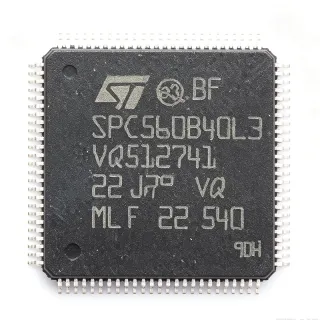
STM32L162VET6 - 512KB Flash Ultra-Low-Power MCU | STMicroelectronics
MPN: STM32L162VET6 ✓ AktifSTM32L162VET6 Ringkasan
An ultra-low-power microcontroller (MCU) is a system-on-chip that combines a processor core, memory, and peripherals while minimizing power consumption to extend battery life. The STM32L1 series is STMicroelectronics' flagship ultra-low-power family, positioned within the broader hierarchy of microcontrollers -> 32-bit MCUs -> ARM Cortex-M based MCUs -> STM32 family. These devices are essential in IoT, wearable, and portable medical devices where energy efficiency is critical.
Key features include multiple low-power modes (Sleep, Low-power Run, Low-power Sleep, Stop with RTC, Standby with RTC), a 12-bit ADC with hardware oversampling, a 12-bit DAC, an LCD driver supporting up to 8x40 segments, and an AES-128 hardware encryption engine. The device operates from 1.8V to 3.6V and supports a wide temperature range of -40°C to +85°C. Its ultra-low-power design achieves 230 µA/MHz in Run mode and 0.3 µA in Standby mode with RTC, making it ideal for energy-harvesting and long-life battery applications.
The STM32L162VET6 is built on a 130nm ultra-low-leakage process technology, enabling industry-leading power efficiency. The Cortex-M3 core includes a memory protection unit (MPU) and supports single-cycle multiplication and hardware division. The device features a flexible clock tree with multiple internal and external oscillators, including a 32 kHz RTC oscillator and a 16 MHz HSI RC oscillator, allowing designers to optimize performance versus power consumption.
Typical applications include smart meters, medical devices such as glucose monitors and hearing aids, industrial sensors, and portable consumer electronics. The integrated LCD controller and AES encryption make it particularly suitable for secure, display-equipped battery-powered devices. The USB 2.0 full-speed interface with internal PHY enables direct connectivity to hosts for data logging and firmware updates.
When designing with this MCU, careful attention to the power supply decoupling and clock configuration is essential. Use a 1 µF and 100 nF capacitor pair on each VDD pin, and select the appropriate low-power mode based on wake-up latency requirements. The STM32L162VET6 supports in-application programming (IAP) via USART, SPI, or USB, facilitating field firmware updates.
Alternatif penggantian untuk STM32L162VET6 — paket yang sama, pin-pada-pin kompatibel. Bagian paket yang berbeda memerlukan kerja ulang PCB diabaikan.
Variasi di dalam seri ini
Model-series yang sama yang kompatibel dengan penggantian STM32L162VET6 (sama faktor bentuk dan footprint) — berbeda di dalam Flash Memory, Package, Supply Voltage.
STM32L162VET6TR
✅ Drop-In📋 Alternatif referensi (tidak dalam katalog)
STM32L152VET6
✅ Drop-In📋 Alternatif referensi (tidak dalam katalog)
STM32L162VET6
✅ Drop-InKontak untuk harga
Lihat Datasheet →STM32L151VET6
✅ Drop-In ⚠️ Spesifikasi Tidak Disahkan📋 Alternatif referensi (tidak dalam katalog)
STM32L152VET6TR
✅ Drop-In ⚠️ Spesifikasi Tidak Disahkan📋 Alternatif referensi (tidak dalam katalog)
STM32L162VCT6
✅ Drop-In ⚠️ Spesifikasi Tidak DisahkanKontak untuk harga
Lihat Datasheet →STM32L162VET6 Rating Maksimal & Karakteristik Listrik
| Core | ARM Cortex-M3 |
| Max Clock Frequency | 32 MHz |
| Flash Memory | 512 KB |
| SRAM | 80 KB |
| Tegangan Pemuat | 1.8 V to 3.6 V |
| Suhu Kerja | -40°C to +85°C |
| Paket | LQFP-100 (14x14 mm) |
| GPIO Pins | 83 |
| ADC | 12-bit, 16 channels |
| DAC | 12-bit, 2 channels |
| LCD Controller | 8x40 segments |
| AES Encryption | 128-bit hardware |
| USB | 2.0 Full-speed device |
| Low-power Run Mode | 230 µA/MHz |
| Standby Mode with RTC | 0.3 µA |
| RoHS | Compliant |
Konfigurasi Pin STM32L162VET6
| Pin produk 1 | PE2 — GPIO / alternate functions |
| Pin produk 2 | PE3 — GPIO / alternate functions |
| Pin produk 3 | PE4 — GPIO / alternate functions |
| Pin produk 4 | PE5 — GPIO / alternate functions |
| Pin produk 5 | PE6 — GPIO / alternate functions |
| Pin produk 6 | VBAT — Battery backup supply |
| Pin produk 7 | PC13 — GPIO / RTC tamper |
| Pin produk 8 | PC14 — GPIO / OSC32_IN |
| Pin produk 9 | PC15 — GPIO / OSC32_OUT |
| Pin produk 10 | PF0 — GPIO / OSC_IN |
| Pin produk 11 | PF1 — GPIO / OSC_OUT |
| Pin produk 12 | NRST — Reset (active low) |
| Pin produk 13 | PC0 — GPIO / ADC input |
| Pin produk 14 | PC1 — GPIO / ADC input |
| Pin produk 15 | PC2 — GPIO / ADC input |
| Pin produk 16 | PC3 — GPIO / ADC input |
| Pin produk 17 | VDD — Power supply |
| Pin produk 18 | VSS — Ground |
| Pin produk 19 | PC4 — GPIO / ADC input |
| Pin produk 20 | PC5 — GPIO / ADC input |
| Pin produk 21 | PB0 — GPIO / ADC input |
| Pin produk 22 | PB1 — GPIO / ADC input |
| Pin produk 23 | PB2 — GPIO / BOOT1 |
| Pin produk 24 | PB10 — GPIO / I2C2_SCL |
| Pin produk 25 | PB11 — GPIO / I2C2_SDA |
| Pin produk 26 | VDD — Power supply |
| Pin produk 27 | VSS — Ground |
| Pin produk 28 | PB12 — GPIO / SPI2_NSS |
| Pin produk 29 | PB13 — GPIO / SPI2_SCK |
| Pin produk 30 | PB14 — GPIO / SPI2_MISO |
| Pin produk 31 | PB15 — GPIO / SPI2_MOSI |
| Pin produk 32 | PD8 — GPIO / USART3_TX |
| Pin produk 33 | PD9 — GPIO / USART3_RX |
| Pin produk 34 | PD10 — GPIO / USART3_CK |
| Pin produk 35 | PD11 — GPIO / USART3_CTS |
| Pin produk 36 | PD12 — GPIO / USART3_RTS |
| Pin produk 37 | PD13 — GPIO / TIM4_CH2 |
| Pin produk 38 | PD14 — GPIO / TIM4_CH3 |
| Pin produk 39 | PD15 — GPIO / TIM4_CH4 |
| Pin produk 40 | VDD — Power supply |
| Pin produk 41 | VSS — Ground |
| Pin produk 42 | PC6 — GPIO / TIM3_CH1 |
| Pin produk 43 | PC7 — GPIO / TIM3_CH2 |
| Pin produk 44 | PC8 — GPIO / TIM3_CH3 |
| Pin produk 45 | PC9 — GPIO / TIM3_CH4 |
| Pin produk 46 | PA0 — GPIO / ADC input / WKUP |
| Pin produk 47 | PA1 — GPIO / ADC input |
| Pin produk 48 | PA2 — GPIO / USART2_TX |
| Pin produk 49 | PA3 — GPIO / USART2_RX |
| Pin produk 50 | PA4 — GPIO / DAC_OUT1 |
| Pin produk 51 | PA5 — GPIO / DAC_OUT2 |
| Pin produk 52 | PA6 — GPIO / SPI1_MISO |
| Pin produk 53 | PA7 — GPIO / SPI1_MOSI |
| Pin produk 54 | VDD — Power supply |
| Pin produk 55 | VSS — Ground |
| Pin produk 56 | PC4 — GPIO / ADC input |
| Pin produk 57 | PC5 — GPIO / ADC input |
| Pin produk 58 | PB0 — GPIO / ADC input |
| Pin produk 59 | PB1 — GPIO / ADC input |
| Pin produk 60 | PB2 — GPIO / BOOT1 |
| Pin produk 61 | PB10 — GPIO / I2C2_SCL |
| Pin produk 62 | PB11 — GPIO / I2C2_SDA |
| Pin produk 63 | VDD — Power supply |
| Pin produk 64 | VSS — Ground |
| Pin produk 65 | PB12 — GPIO / SPI2_NSS |
| Pin produk 66 | PB13 — GPIO / SPI2_SCK |
| Pin produk 67 | PB14 — GPIO / SPI2_MISO |
| Pin produk 68 | PB15 — GPIO / SPI2_MOSI |
| Pin produk 69 | PD8 — GPIO / USART3_TX |
| Pin produk 70 | PD9 — GPIO / USART3_RX |
| Pin produk 71 | PD10 — GPIO / USART3_CK |
| Pin produk 72 | PD11 — GPIO / USART3_CTS |
| Pin produk 73 | PD12 — GPIO / USART3_RTS |
| Pin produk 74 | PD13 — GPIO / TIM4_CH2 |
| Pin produk 75 | PD14 — GPIO / TIM4_CH3 |
| Pin produk 76 | PD15 — GPIO / TIM4_CH4 |
| Pin produk 77 | VDD — Power supply |
| Pin produk 78 | VSS — Ground |
| Pin produk 79 | PC6 — GPIO / TIM3_CH1 |
| Pin produk 80 | PC7 — GPIO / TIM3_CH2 |
| Pin produk 81 | PC8 — GPIO / TIM3_CH3 |
| Pin produk 82 | PC9 — GPIO / TIM3_CH4 |
| Pin produk 83 | PA0 — GPIO / ADC input / WKUP |
| Pin produk 84 | PA1 — GPIO / ADC input |
| Pin produk 85 | PA2 — GPIO / USART2_TX |
| Pin produk 86 | PA3 — GPIO / USART2_RX |
| Pin produk 87 | PA4 — GPIO / DAC_OUT1 |
| Pin produk 88 | PA5 — GPIO / DAC_OUT2 |
| Pin produk 89 | PA6 — GPIO / SPI1_MISO |
| Pin produk 90 | PA7 — GPIO / SPI1_MOSI |
| Pin produk 91 | VDD — Power supply |
| Pin produk 92 | VSS — Ground |
| Pin produk 93 | PC4 — GPIO / ADC input |
| Pin produk 94 | PC5 — GPIO / ADC input |
| Pin produk 95 | PB0 — GPIO / ADC input |
| Pin produk 96 | PB1 — GPIO / ADC input |
| Pin produk 97 | PB2 — GPIO / BOOT1 |
| Pin produk 98 | PB10 — GPIO / I2C2_SCL |
| Pin produk 99 | PB11 — GPIO / I2C2_SDA |
| Pin produk 100 | VDD — Power supply |
Aplikasi Umum
STM32L162VET6 cocok untuk 6 aplikasis: Smart Meters, Medical Devices, Industrial Sensors, Portable Consumer Electronics, IoT Devices, Security Systems.
Smart Meters
The STM32L162VET6 is ideal for smart meters due to its ultra-low power consumption, integrated LCD controller for display, and AES-128 encryption for secure data communication. In a typical smart meter, the MCU reads sensor data, processes it, and communicates via wireless or wired interfaces while maintaining long battery life. The 512 KB Flash allows storing extensive metering data and firmware updates. The low-power modes enable the meter to run for years on a single battery, and the AES engine secures communication with the utility network.
Direkomendasikan
Medical Devices
The STM32L162VET6 is well-suited for portable medical devices such as glucose monitors, hearing aids, and pulse oximeters. Its ultra-low-power operation extends battery life, critical for wearable devices. The integrated ADC and DAC enable precise sensor signal conditioning, while the LCD controller can drive small displays for user feedback. The AES encryption ensures patient data security. The device's small footprint and low power make it ideal for continuous health monitoring.
Direkomendasikan
Industrial Sensors
In industrial environments, the STM32L162VET6 can be used in wireless sensor nodes for condition monitoring, temperature sensing, and pressure measurement. Its wide supply voltage range (1.8V-3.6V) allows operation from industrial power rails or batteries. The multiple communication interfaces (USART, SPI, I2C) enable connectivity to various sensors and actuators. The low-power modes are essential for battery-powered nodes that must operate for years without maintenance.
Direkomendasikan
Portable Consumer Electronics
The STM32L162VET6 is perfect for portable consumer devices like fitness trackers, smart watches, and remote controls. Its ultra-low-power consumption ensures long battery life, and the integrated LCD controller can drive small displays. The USB interface allows easy charging and data transfer. The AES encryption can secure user data. The device's small package and rich peripheral set make it a versatile choice for compact designs.
Direkomendasikan
IoT Devices
The STM32L162VET6 is an excellent choice for IoT edge devices that require low power and secure communication. Its AES-128 encryption engine ensures secure data transmission, and the ultra-low-power modes enable battery-powered operation for extended periods. The device can interface with various sensors and communication modules (Wi-Fi, BLE, LoRa) via USART, SPI, or I2C. The 512 KB Flash provides ample space for application code and data logging.
Direkomendasikan
Security Systems
The STM32L162VET6 is suitable for security systems such as access control panels, alarm systems, and surveillance cameras. Its AES encryption ensures secure communication with central monitoring stations. The LCD controller can display system status, and the multiple GPIOs can interface with sensors and actuators. The low-power modes allow battery backup operation during power outages.
Direkomendasikan
Ringkasan Produk Direkomendasikan
Data referensi engineering untuk STM32L162VET6 — pembandingan, panduan desain, dan informasi konformitas.
Panduan Pemilihan
Pembandingan dengan Alternatif
| Parameter Umum | Produk Ini | STM32L162VET6TR | STM32L152VET6 | STM32L151VET6 | STM32L162VCT6 |
|---|---|---|---|---|---|
| Package | LQFP-100 | LQFP-100 - same | LQFP-100 - same | LQFP-100 - same | LQFP-100 - same |
| Brand | STMicroelectronics | STMicroelectronics | STMicroelectronics | STMicroelectronics | STMicroelectronics |
| Core | ARM Cortex-M3 | ARM Cortex-M3 | ARM Cortex-M3 | ARM Cortex-M3 | ARM Cortex-M3 |
| Max Clock Frequency | 32 MHz | 32 MHz | 32 MHz | 32 MHz | 32 MHz |
| Flash Memory | 512 KB | 512 KB | 512 KB | 512 KB | 256 KB |
| SRAM | 80 KB | 80 KB | 80 KB | 80 KB | 32 KB |
| AES Encryption | Yes (128-bit) | Yes (128-bit) | No | No | Yes (128-bit) |
| LCD Controller | Yes (8x40) | Yes (8x40) | Yes (8x40) | No | Yes (8x40) |
| Supply Voltage | 1.8V - 3.6V | 1.8V - 3.6V | 1.8V - 3.6V | 1.8V - 3.6V | 1.8V - 3.6V |
| Standby Current | 0.3 µA | 0.3 µA | 0.3 µA | 0.3 µA | 0.3 µA |
Diferensiator Kunci
- Integrated AES-128 hardware encryption (vsSTM32L152VET6)
- Integrated LCD controller (vsSTM32L151VET6)
- Larger Flash and SRAM (vsSTM32L162VCT6)
Catatan Desain
Decouple each VDD pin with a 100 nF ceramic capacitor placed as close as possible to the pin, and add a 1 µF capacitor at the main power entry. For the VDDA pin, use a 1 µF and 100 nF pair to ensure stable ADC reference. The VBAT pin should be connected to a backup battery or tied to VDD through a diode to maintain RTC operation during main power loss.
For the LQFP-100 package, ensure a solid ground plane under the device. Route the crystal oscillator (OSC_IN/OSC_OUT) with short traces and keep them away from high-speed digital lines. Place the decoupling capacitors for the crystal as close as possible to the pins. Use a 4-layer PCB with dedicated power and ground planes for optimal EMC performance.
Do not leave unused GPIO pins floating; configure them as outputs or enable internal pull-ups/pull-downs to avoid excessive leakage. When using the LCD controller, ensure the LCD voltage (VLCD) is properly generated and decoupled. For low-power modes, disable unused peripherals and clocks to achieve the specified standby current. Also, note that the BOOT0 pin must be tied to a defined level to avoid accidental boot mode changes.
Informasi Konformitas
RoHS compliant per STMicroelectronics product page. Not AEC-Q100 qualified (not intended for automotive).