湿度センサ
製品 (4)

AS7331-AQFM-OLGA16-LF - UVA/UVB/UVC Spectral UV Sensor | ams OSRAM
The ams OSRAM AS7331-AQFM-OLGA16-LF is a low-power, low-noise integrated spectral UV sensor that measures UVA, UVB and UVC radiation in three separated channels, converting optical radiation via UV-optimized photodiodes into 24-bit digital results over an I2C interface, housed in a 16-pin OLGA package measuring 3.65 x 2.6 mm and operating from 2.7 V to 3.6 V over -40 C to +105 C. A spectral UV sensor is a type of optical sensor that resolves incoming ultraviolet radiation into specific wavelength bands rather than reporting a single total irradiance value. Within the sensor hierarchy (UV sensor -> spectral sensor -> optical sensor -> semiconductor sensor), the AS7331 belongs to ams OSRAM's ambient light, color, spectral and proximity sensor family. Unlike simple UV index sensors that only detect UVA plus some UVB, a true three-band spectral UV sensor separates UVA (roughly the 315-400 nm region), UVB and UVC (down to approximately 260 nm per DigiKey classification) so downstream firmware can distinguish sunlight exposure, germicidal irradiance and curing lamp output. Key features include the three separated UVA/UVB/UVC channels, 24-bit digital resolution per channel, and adjustable irradiance responsivity: gain, conversion time and internal clock frequency can be programmed to trade sensitivity against full-scale range and LSB size. Four low-power operating modes (including continuous and triggered measurement) support both always-on monitoring and battery-friendly event-driven sampling, as highlighted in the SparkFun and Adafruit breakout documentation. Technically, the AS7331 converts photocurrent from UV-optimized photodiodes through an integration-based ADC architecture, delivering high dynamic range without external optics. The I2C digital output eliminates analog-to-digital conversion burden on the host microcontroller, and the low-noise front end allows weak UVC signals to be resolved even in compact, unfiltered apertures. Typical applications include wearable UV index monitors and sun-exposure alerts (UVA/UVB), germicidal lamp verification and disinfection cabinet monitoring (UVC), UV curing process control, and agricultural UV dosing stations, as noted by Adafruit for human and agricultural UV alerts across all three bands. Design-wise, program the gain and conversion time so expected irradiance sits in the upper half of the 24-bit full scale for best SNR, and account for the 2.7-3.6 V supply budget in battery designs. This page synthesizes distributor pricing, cross-reference data and practical design notes not found in the manufacturer datasheet, with prices as of 2026-10-11.

HDC1080DMBR - ±2% RH Low-Power Digital Humidity & Temp Sensor | TI
The Texas Instruments HDC1080DMBR is a digital humidity and temperature sensor with integrated signal conditioning that provides ±2% RH typical relative-humidity accuracy and ±0.2°C typical temperature accuracy, factory calibrated, in a 6-pin WSON (DMB) surface-mount package. The device communicates over I2C (Fast Mode up to 400 kHz) and supports 14-bit measurement resolution, with a 100 nA sleep-mode current and an average supply current of 710 nA at 1 sample/second (11-bit RH). A humidity sensor is a transducer that converts the water-vapor content of ambient air into a quantifiable electrical signal. Digital humidity sensors integrate the sensing element, analog front-end, sigma-delta ADC, and calibration memory into a single IC, exposing a digital bus interface (typically I2C) for the host microcontroller. The HDC1080 belongs to the capacitive polymer humidity-sensor family, which sits within the broader class of MEMS environmental sensors and ultimately within the sensor and signal-conditioning IC hierarchy used in modern embedded designs. Key features include a wide supply range of 2.7V to 5.5V, on-chip heater for self-dehumidification, and excellent stability at high humidity thanks to a PTFE (polytetrafluoroethylene) hydrophobic membrane option. The integrated temperature sensor eliminates the need for a separate thermistor or external RTD, reducing BOM count and PCB area. A programmable measurement sequence lets the host read humidity-only, temperature-only, or both in a single I2C transaction. From an architectural standpoint, the HDC1080 uses a parallel capacitive polymer die and a precision bandgap-referenced temperature sensor, multiplexed into a single 14-bit sigma-delta ADC. Factory calibration coefficients stored in on-chip OTP memory are applied automatically, removing per-unit two-point calibration from the user's manufacturing flow and improving unit-to-unit consistency. Typical applications include battery-powered IoT environmental monitors, HVAC indoor-air-quality sensors, smart thermostats, respiratory/CPAP humidifier feedback, refrigerator and freezer dew-point control, and asset-tracking cold-chain loggers. The 100 nA sleep current makes the part especially attractive for energy-harvesting and coin-cell nodes where average system current must remain in the low microamp range. When designing with this device, place a 0.1 µF decoupling capacitor within 5 mm of VDD and avoid running I2C clock/data traces parallel to switching-node traces; exposed backside pad must be soldered to the ground pour for thermal and mechanical integrity. This page synthesizes distributor pricing, verified drop-in alternatives, and practical design notes not found in the manufacturer datasheet alone.
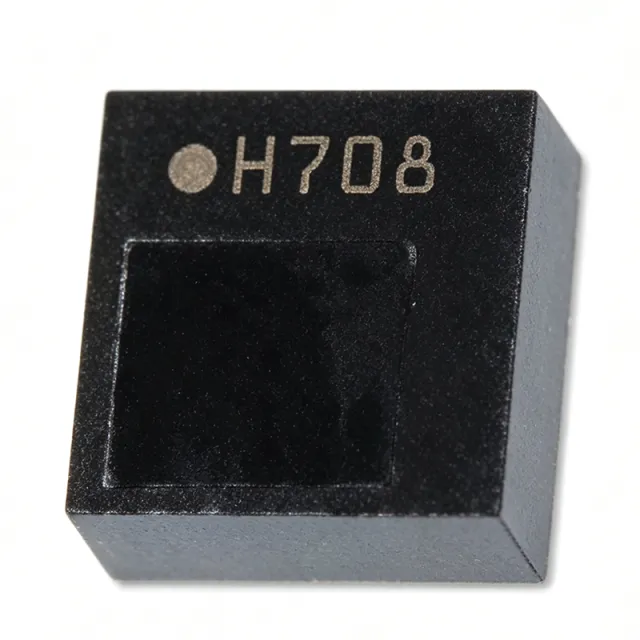
HTS221 - Capacitive Digital Humidity & Temperature Sensor | STMicroelectronics
The STMicroelectronics HTS221 is a compact, ultra-low-power capacitive digital humidity and temperature sensor designed for a wide range of applications including IoT, wearables, and environmental monitoring. It integrates a sensing element, analog front-end, and a 16-bit ADC in a single 2.0 x 2.0 x 0.9 mm HLGA package, providing accurate relative humidity and temperature measurements with minimal power consumption. A humidity and temperature sensor is a device that measures the amount of water vapor in the air and the ambient temperature, converting these physical quantities into digital signals for processing. In the system hierarchy, the HTS221 is a MEMS sensor that falls under the category of environmental sensors, which are part of the broader sensor family used in IoT, automotive, and industrial applications. Its role is to provide real-time environmental data that enables smart systems to react to changes in humidity and temperature. Key features of the HTS221 include a relative humidity accuracy of ±3.5% RH (20-80% RH), a temperature accuracy of ±0.5 °C (15-40 °C), and a humidity resolution of 0.004% RH. The sensor operates from a 1.7V to 3.6V supply, with a typical current consumption of 2 µA at 1 Hz output data rate, making it ideal for battery-powered devices. It communicates via I2C and SPI interfaces, and includes a programmable interrupt output for threshold detection. The HTS221 uses a capacitive sensing principle, where a polymer dielectric absorbs water vapor, changing the capacitance of the sensing element. This change is converted to a digital signal by a 16-bit ADC, providing high resolution and stability. The sensor also features an embedded heater for dew point measurement and condensation prevention, enhancing its versatility in demanding environments. Typical applications include smart home thermostats, HVAC systems, weather stations, and wearable health monitors. In smart thermostats, the HTS221 provides accurate humidity and temperature data to optimize comfort and energy efficiency. In wearables, its low power consumption extends battery life while enabling continuous environmental monitoring. When designing with the HTS221, ensure proper PCB layout with a clean ground plane and adequate decoupling capacitors (100 nF) near the VDD pin. The sensor should be placed away from heat sources and direct airflow to avoid measurement errors. For best performance, follow the recommended soldering profile and reflow conditions specified in the datasheet.
HTS221TR - Capacitive Digital Humidity & Temperature Sensor | STMicroelectronics
The HTS221TR is a compact, ultra-low-power capacitive digital humidity and temperature sensor from STMicroelectronics, packaged in a 3x3x0.9 mm HLGA (HLGA-6L) package. It integrates a sensing element and a mixed-signal interface, providing calibrated digital output over an I2C or SPI interface. The sensor measures relative humidity from 0% to 100% RH with an accuracy of ±3.5% RH (20-80% RH) and temperature from -40°C to +120°C with an accuracy of ±0.5°C (15-40°C). It operates from a 1.7V to 3.6V supply, drawing only 2 µA at 1 Hz sampling rate, making it ideal for battery-powered applications. A humidity sensor is a device that measures the amount of water vapor in the air, typically expressed as relative humidity (RH). The HTS221TR is a capacitive-type sensor, where the dielectric constant of a polymer layer changes with humidity, altering the capacitance of the sensing element. This change is converted to a digital signal via an internal ADC. In the broader system hierarchy, the HTS221TR is a MEMS environmental sensor, falling under the category of sensors, specifically temperature and humidity sensors, which are essential components in IoT, smart home, and industrial monitoring systems. Key features of the HTS221TR include its factory-calibrated output, eliminating the need for user calibration, and its programmable interrupt outputs for threshold detection. The sensor supports both I2C (up to 400 kHz) and SPI (up to 10 MHz) interfaces, providing flexibility in system integration. It also features a 16-bit resolution for both humidity and temperature, with a humidity resolution of 0.004% RH and temperature resolution of 0.01°C. The device includes an embedded heater for condensation prevention, which is useful in high-humidity environments. Technically, the HTS221TR uses a MEMS capacitive sensing element with a dedicated ASIC for signal conditioning. The sensor's low power consumption (2 µA at 1 Hz) and wide supply voltage range (1.7V to 3.6V) make it suitable for portable and wearable devices. The HLGA package is designed for surface mounting, with a small footprint of 3x3 mm, enabling compact PCB designs. The sensor's response time is typically 8 seconds for humidity and 5 seconds for temperature, ensuring real-time monitoring capabilities. Typical applications include smart home climate control, where the sensor monitors indoor humidity and temperature to optimize HVAC systems; industrial environmental monitoring, where it tracks conditions in warehouses or server rooms; and wearable devices, where it measures skin humidity and ambient temperature for health tracking. The sensor's accuracy and low power make it ideal for battery-operated IoT nodes. When designing with the HTS221TR, ensure proper PCB layout to minimize the influence of heat sources on temperature readings. Place the sensor away from components that generate heat, and provide adequate ventilation for humidity sensing. The sensor's I2C address is 0x5F, and it supports multiple devices on the same bus with different addresses.