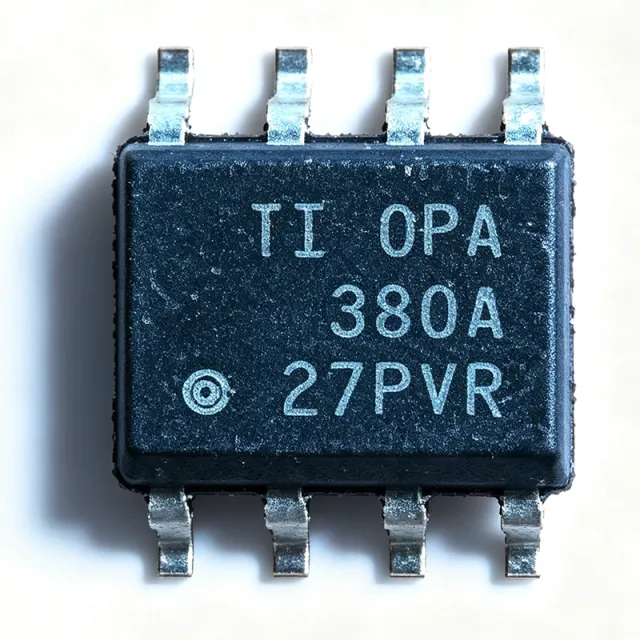
OPA345UA
OPA345UA - 3MHz RRIO Op Amp | Texas Instruments
Texas Instruments OPA345UA is a single-amplifier, rail-to-rail input and output operational amplifier designed for low-power, precision signal-conditioning applications. Its headline specifications are a 5.5 V maximum supply, 3 MHz gain-bandwidth product, and an 8-pin SOIC package. The device operates from a single 2.5 V to 5.5 V supply, while its input common-mode range extends approximately 300 mV beyond the supply rails.
An operational amplifier, commonly abbreviated op amp, is an analog active component that amplifies the voltage difference between two inputs. The OPA345 belongs to the rail-to-rail input and output, or RRIO, family, allowing its input and output voltages to approach the positive and negative supply limits. Within the broader hierarchy, it is an analog integrated circuit, an operational amplifier, and ultimately a semiconductor used for signal conditioning, sensing, buffering, and closed-loop control.
The 3 MHz gain-bandwidth product supports signal amplification where bandwidth is important but low power and small package size remain primary constraints. Its single-amplifier configuration makes it suitable for circuits needing one independently controlled amplifier rather than a multi-amplifier package. Rail-to-rail input capability improves usable signal range in low-voltage systems, particularly when sensor outputs can move close to the supply rails. The manufacturer describes the OPA345 as a low-power CMOS operational amplifier for precision, miniature applications.
OPA345UA operates from 2.5 V to 5.5 V and includes approximately 300 mV of input headroom beyond the supply rails. The 300 mV extension helps preserve common-mode operation when a driven signal approaches a rail, although designers must still verify the complete operating range under temperature, load, and output-voltage conditions. The 8-pin SOIC package provides a conventional surface-mount footprint compatible with standard assembly and inspection processes.
Typical uses include low-voltage sensor conditioning, portable instrumentation, audio signal paths, data acquisition, and general-purpose analog filtering. In an instrumentation design, the amplifier can buffer a high-impedance sensor before conversion by an ADC. In a portable instrument, the single-supply architecture simplifies rail planning. Designers should nevertheless confirm offset voltage, input bias current, noise density, slew rate, output-current capability, and stability requirements against the manufacturer datasheet before releasing a production design.
A key design consideration is the distinction between maximum specification and a usable design margin. The 5.5 V supply limit should not be treated as a target operating point, and signals should not be expected to reach the physical supply rails under every load. Decoupling, grounding, feedback-component selection, output loading, and the chosen noise-gain network all affect achievable accuracy and stability.
This product page combines the exact orderable-part details, package information, application context, design guidance, and replacement constraints for OPA345UA. It also identifies which operating characteristics still require confirmation from the manufacturer datasheet, helping engineers move from general amplifier selection to a board-level design more efficiently.
見積もり
お問い合わせ