Texas Instruments

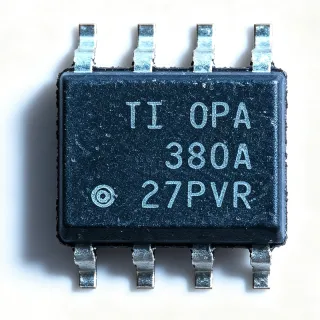
OPA380AID - 90MHz Precision Transimpedance Amplifier | TI

部品番号: OPA380AID ✓ 生産中
在庫あり 1〜3営業日以内に発送
25 uV Vdss 50 pA Id 8-SOIC (D) Package
開始価格 $1.95 USD / 個
MOQ: 1 |
価格更新日: 2026-08-30
ボリューム価格
数量 単価 小計
1 $3.29 $3.29
10 $2.96 $29.60
100 $2.56 $256.00
500 $2.23 $1,115.00
1,000 $1.95 $1,950.00
ℹ️ すべての価格はUSDです

OPA380AID 概要

The Texas Instruments OPA380AID is a precision, high-speed transimpedance amplifier delivered in an 8-pin SOIC package. It combines a 90MHz gain bandwidth (GBW) with extremely high DC precision, providing transimpedance bandwidth above 1MHz for photodiode currents up to 1mA.

A transimpedance amplifier (TIA) is a specialized operational amplifier circuit that converts a sensor current, most commonly from a photodiode, into a proportional output voltage. Within the signal-chain hierarchy, the TIA sits between the optical or current-output sensor and the ADC or comparator, and its bandwidth, input bias current, and offset voltage set the system's dynamic range. The OPA380 belongs to the wider family of precision amplifiers and analog front-end ICs in power management of optical receivers.

Key features include a maximum input bias current of 50pA, a maximum offset voltage of 25uV with only 0.1uV/degC drift, and 4 to 5 decades of dynamic range. These specs allow direct interface with high-impedance photodiodes without external cancellation circuitry.

Architecturally, the OPA380 results from an internal auto-zero amplifier combined with a high-speed amplifier. This composite topology delivers very low 1/f noise and excellent long-term VOS stability while TI's design improves overload recovery and settling time over a traditional discrete composite approach.

Typical applications include high-speed photodiode receivers for optical data links, photodiode-based instrumentation such as spectrophotometers and lab photoreceivers, and barcode or LiDAR-style pulse detection where >1MHz transimpedance bandwidth matters.

Design tip: the feedback resistor and photodiode capacitance set stability - use the datasheet's feedback capacitor guidance, and note the output swings to within millivolts of ground only on a single supply with load returned to a negative rail or virtual ground.

ドロップイン代替品: OPA380AID — 同一パッケージでピン互換。PCBの作り直しが必要な異なるパッケージの部品は除外されています。

クイック比較ツール — 並列比較する代替部品を選択:

OPA380AIDG4

✅ ドロップイン
📦 8-SOIC (D)
same die and SOIC-8 pinout, TI G4 RoHS designation variant

📋 参考代替品(カタログ未掲載)

OPA828IDR

⚡ 同一パッケージ
Texas Instruments
📦 8-SOIC (D)
JFET-input operational amplifier · 1 · 45 MHz · 150 V/us · 4 nV/√Hz at 1 kHz · 60 nVRMS · 1 pA (typical) · 50 uV

✓ 在庫あり

$1.75 / 個

データシートを見る →

OPA657

⚡ 同一パッケージ ⚠️ 仕様未検証
📦 8-SOIC (D)
same SOIC-8 footprint, FET-input decompensated 1.6GHz GBW amplifier for higher-speed TIA; different offset/bias specs and requires gain >= 7V/V stability criteria

📋 参考代替品(カタログ未掲載)

AD8015ARZ

⚡ 同一パッケージ ⚠️ 仕様未検証
📦 8-SOIC
cross-brand 155Mbps TIA in SOIC-8; pinout and biasing differ, board redesign required

📋 参考代替品(カタログ未掲載)

ℹ️ 1 異なるパッケージの部品は非表示 — パッケージが異なるとPCBの作り直しが必要で、真のドロップイン代替品ではありません。 お問い合わせ 異なるパッケージの提案が必要な場合。

OPA380AID 最大定格&電気的特性

機能 Precision High-Speed Transimpedance Amplifier
チャネル数 1
Gain Bandwidth (GBW) 90 MHz
Transimpedance Bandwidth > 1 MHz
Input Bias Current (max) 50 pA
Offset Voltage (max) 25 uV
Offset Voltage Drift (max) 0.1 uV/degC
Input Current Range up to 1 mA
Dynamic Range 4 to 5 decades
静止電流 6.5 mA
Noise Very low 1/f noise
動作温度 -40C to +125C
パッケージ 8-SOIC (D)
実装タイプ Surface Mount
Long-Term VOS Stability Excellent long-term stability

OPA380AID ピン構成

SOIC-8 Package Pinout Diagram SOIC-8 8-pin small outline IC, 3.9x4.9mm, P1.27mm, JEDEC MS-012. 1 8 2 7 3 6 4 5 SOIC-8
ピン 1 NC — No internal connection
ピン 2 IN- — Inverting input (photodiode node)
ピン 3 IN+ — Non-inverting input (reference/bias voltage)
ピン 4 V- — Negative supply
ピン 5 NC — No internal connection
ピン 6 OUT — Output voltage (transimpedance)
ピン 7 V+ — Positive supply
ピン 8 NC — No internal connection

主な用途

OPA380AID の用途: 6 件s: High-Speed Photodiode Receivers, Optical Power Metering and Photometry, Laboratory Photoreceivers, Barcode and Pulse Detection, Chemical and Bio-Sensor Photodiode Front Ends, Industrial Optical Sensing.

🌐

High-Speed Photodiode Receivers

The OPA380 is ideally suited for high-speed photodiode applications: its 90MHz GBW delivers >1MHz transimpedance bandwidth, while the 50pA maximum bias current preserves sensitivity at low optical power. Placed directly at the photodiode node with a feedback resistor sized per the datasheet stability curves, it converts photocurrent up to 1mA into a voltage with 4 to 5 decades of dynamic range. The auto-zero front end keeps offset error at 25uV maximum, so DC light-level measurements remain accurate without trimming.

💡

Optical Power Metering and Photometry

For instrumentation that measures optical power across decades of intensity, the OPA380's 0.1uV/degC maximum offset drift and excellent long-term VOS stability eliminate recalibration drift over time and temperature. The composite auto-zero architecture suppresses 1/f noise, improving accuracy on slow DC measurements, while the 90MHz GBW retains headroom for pulsed sources. A large feedback resistor (e.g., 1M-ohm to 100M-ohm) gives full-scale outputs from nanoamp photocurrents with the 25uV offset contributing negligible error.

🔧

Laboratory Photoreceivers

Laser optics labs build general-purpose photodiode amplifiers where the OPA380 is frequently chosen over faster parts like the OPA657 because DC precision matters as much as speed. Its 25uV max offset and 50pA bias current allow direct photodiode connection without guard circuitry, and TI's improved overload recovery quickly settles after beam interrupts. With switchable feedback networks, one OPA380 stage covers photocurrents from picoamps to 1mA, suiting beam-alignment and power-monitoring instruments.

🎥

Barcode and Pulse Detection

Optical barcode scanners and pulse receivers benefit from the OPA380's combination of bandwidth and precision: the >1MHz transimpedance bandwidth resolves fast pulses, while low 1/f noise protects small-signal fidelity in the baseline region. The improved settling and overload recovery over a traditional composite approach keeps recovery time short when a bright reflection saturates the photodiode, allowing rapid return to the quiescent operating point - critical for repeat-read reliability in scanning systems.

💊

Chemical and Bio-Sensor Photodiode Front Ends

Absorbance and fluorescence sensors (spectrophotometers, glucose and DNA detection systems) use photodiodes with currents spanning many decades. The OPA380's 4 to 5 decade dynamic range, 25uV max offset, and 0.1uV/degC drift enable a single gain range for quantitative measurement, while the auto-zero topology removes 1/f noise that would otherwise dominate low-frequency readings. Single 5V supply operation simplifies battery-powered portable instruments; drive the reference node with a precision reference for best DC accuracy.

🏭

Industrial Optical Sensing

Industrial proximity, presence, and break-beam sensors operate from -40C to +125C, exactly matching the OPA380's specified temperature range. The excellent long-term offset stability means field-installed sensors maintain calibration across years of thermal cycling, and 6.5mA quiescent current keeps loop-powered or 24V bus-fed designs within power budgets. Robust overload recovery handles transient exposure to ambient light, and the standard SOIC-8 package supports automated assembly in high-volume sensor modules.

おすすめ製品の概要

OPA2380 Dual-channel version for multi-channel receivers 使用用途: High-Speed Photodiode Receivers OPA657 Higher-bandwidth TIA option 使用用途: High-Speed Photodiode Receivers REF5030AIDGKR-Q1 Precision voltage reference for ADC scaling 使用用途: Optical Power Metering and Photometry ADS1115IDGSR-Q1 Texas Instruments 使用用途: Optical Power Metering and Photometry TS5A63157 Texas Instruments 使用用途: Laboratory Photoreceivers OPA828IDR Texas Instruments 使用用途: Laboratory Photoreceivers TLV3501 Fast comparator for pulse slicing 使用用途: Barcode and Pulse Detection SN74LVC1G17QDBVRQ1 Texas Instruments 使用用途: Barcode and Pulse Detection REF3030AIDBZR-Q1 Low-power voltage reference for biasing 使用用途: Chemical and Bio-Sensor Photodiode Front Ends ADS1220 Texas Instruments 使用用途: Chemical and Bio-Sensor Photodiode Front Ends MSP430FR5994IPMR Texas Instruments 使用用途: Industrial Optical Sensing TMP117-Q1 Temperature compensation sensor 使用用途: Industrial Optical Sensing
What is the gain bandwidth of the OPA380?
The OPA380 provides a 90MHz gain bandwidth (GBW), enabling transimpedance bandwidth above 1MHz in typical photodiode circuits. According to the TI datasheet, this high-speed performance is combined with 50pA maximum bias current and 25uV maximum offset voltage, making it suited for high-speed photodiode applications that also require DC precision.
What is the input bias current of OPA380AID?
The maximum input bias current of the OPA380 is 50pA. According to TI datasheet SBOS193, this very low bias current allows direct connection to high-impedance photodiodes while supporting input currents up to 1mA and 4 to 5 decades of dynamic range without external bias-cancellation circuitry.
Where can I download the OPA380 datasheet PDF?
The official OPA380 datasheet PDF is available directly from Texas Instruments at https://www.ti.com/lit/ds/symlink/opa380.pdf. This document covers specifications, typical characteristics, application circuits for photodiode transimpedance design, feedback network stability guidance, and package pinouts for the SO-8 and MSOP-8 package options.
What is the price of OPA380AID?
OPA380AID pricing typically starts around $3.29 for single units at authorized distributors, dropping to roughly $1.95 to $2.50 at 1000-piece quantities as of 2026-08-30. Prices vary by distributor and stock; check DigiKey and Mouser for live quotes, as the DigiKey listing (part number 639560) shows current availability and ships same day.
What is the difference between OPA380 and OPA2380?
The OPA380 is a single transimpedance amplifier available in MSOP-8 and SO-8 packages, while the OPA2380 is the dual-channel version in a miniature MSOP-8 package. Both share the same core performance: 90MHz GBW, 50pA max bias current, 25uV max offset, and -40C to +125C operation, but they are not pin-compatible.
OPA380 vs OPA657 - which is better for a photodiode TIA?
The OPA380 suits general-purpose precision TIA designs needing DC accuracy and >1MHz transimpedance bandwidth at low cost, while the OPA657 is a FET-input decompensated amplifier for very high bandwidth (1.6GHz GBW) applications. For laser-optics lab photoreceivers prioritizing offset stability and low 1/f noise, the OPA380 is usually the better fit; choose the OPA657 for multi-hundred-MHz links.
When should I choose OPA380 over a standard precision op amp for my TIA?
Choose the OPA380 when your photodiode application needs both DC precision and speed simultaneously. General-purpose precision op amps with microvolt offsets typically have sub-MHz bandwidths, and high-speed op amps often lack the auto-zeroed DC performance. The OPA380 delivers both: 25uV max offset, 0.1uV/degC drift, and >1MHz transimpedance bandwidth in one device.
Can OPA2380 replace OPA380 in my design?
Not as a drop-in. The OPA2380 is a dual amplifier in MSOP-8, so the pinout and footprint differ from the single OPA380 in SO-8. However, if board space permits and you need two channels, the OPA2380 offers identical per-channel performance (90MHz GBW, 50pA bias, 25uV offset) and the same -40C to +125C temperature range.
What is the best cross-brand equivalent for the OPA380?
There is no widely recognized pin-to-pin cross-brand drop-in for the OPA380 in SO-8. The AD8015 from Analog Devices is a comparable low-power transimpedance amplifier for optical receivers, but its pinout and biasing differ, so redesign is required. For TI-family alternatives, the OPA2380 (dual) provides the same performance per channel with a different package.
Is the OPA380 still in production and available?
Yes, the OPA380 family is an active product in Texas Instruments' catalog and is stocked by major distributors. The DigiKey product page for OPA380AID shows it available with same-day shipping, and Mouser lists the OPA380 series of transimpedance amplifiers with inventory and datasheets as of 2026-08-30.
Is OPA380 RoHS compliant?
Yes, current OPA380 orderable variants such as OPA380AID are RoHS-compliant and lead-free. TI markets the non-G4 suffix parts as the standard RoHS versions. Verify the specific ordering suffix on the TI product page, as legacy non-compliant stock may still exist in broker channels.
What are the key specifications of the OPA380 that engineers should know?
Key OPA380 specifications: 90MHz gain bandwidth, transimpedance bandwidth above 1MHz, 50pA maximum input bias current, 25uV maximum offset voltage, 0.1uV/degC maximum offset drift, input current range to 1mA, 4 to 5 decades of dynamic range, 6.5mA quiescent current, and -40C to +125C operation, per the TI datasheet.
Is the OPA380 suitable for high-speed photodiode applications?
Yes - the OPA380 is explicitly designed for high-speed photodiode applications. According to TI, its composite auto-zero plus high-speed amplifier architecture yields >1MHz transimpedance bandwidth with very low 1/f noise and excellent overload recovery, supporting 4 to 5 decades of photodiode current dynamic range from picoamps up to 1mA.

エンジニアリング参考データ: OPA380AID — 比較、設計ガイダンス、コンプライアンス情報。

選定ガイド

Choose the OPA380 when your photodiode or current-output sensor needs both DC precision and speed in one package: 25uV max offset, 0.1uV/degC drift, 50pA max bias, and >1MHz transimpedance bandwidth. Choose the OPA2380 if you need two channels - it offers identical per-channel performance in MSOP-8 but is not pin-compatible. Choose the OPA657 only when bandwidth requirements exceed ~10MHz transimpedance and you can tolerate worse DC specs and higher power (14mA). The OPA828 shares the SOIC-8 footprint but is a JFET op amp, not an auto-zeroed TIA, so it suits buffer/post-amplifier stages. Cross-brand parts like the AD8015 require board redesign. For most precision optical front ends up to a few MHz, the OPA380 remains the balanced choice.

代替品との比較

パラメータ この製品 OPA380AIDG4 OPA2380AID OPA657
Package 8-SOIC (D) 8-SOIC (D) - same MSOP-8 8-SOIC (D) - same footprint
Brand Texas Instruments Texas Instruments Texas Instruments Analog Devices
Gain Bandwidth 90 MHz 90 MHz 90 MHz (per channel) 1.6 GHz
Channels 1 1 2 1
Operating Temperature -40C to +125C -40C to +125C -40C to +125C -40C to +125C

主な差別化要因

  • Composite auto-zero + high-speed architecture (vs OPA657)
  • Dual-channel option for multi-beam systems (vs OPA380AIDG4)
  • Wide input current range with high dynamic range (vs AD8015ARZ)

設計ノート

TIA stability is set by the feedback resistor (RF) and total input capacitance (photodiode capacitance plus amplifier input capacitance). Size the feedback capacitor using the datasheet transimpedance design guidance: CF must create a pole below the noise-gain zero. Omitting CF is the most common cause of oscillation in photodiode front ends. Follow TI datasheet SBOS193 typical application circuits.

Keep the photodiode as close to pin 2 as possible and use a guard ring or ground plane cutout to minimize leakage currents - with a 50pA max bias current, PCB leakage of just a few pA becomes a measurable error. Place the feedback network with the shortest possible traces, and return the IN+ reference through a clean, low-noise node (ground or precision reference, not a digital rail).

The OPA380 draws 6.5mA quiescent current - budget for this in portable designs. Decouple V+ and V- with 0.1uF ceramics placed within 5mm of the pins plus a 2.2uF bulk capacitor. Output swing near 0V on a single supply requires the load referenced appropriately; if 0V output is needed, use a small negative rail or pull-down resistor per the TI product page guidance.

コンプライアンス情報

RoHS
Compliant
REACH
Unknown
AEC-Q100
Not Applicable
鉛フリー
Yes
ハロゲンフリー
Unknown
紛争鉱物
Unknown

Current TI orderable variants (e.g., OPA380AID) are RoHS-compliant and lead-free per TI product listings. REACH and halogen-free status not stated in provided data.

データ検証日: 2026-08-30 — データはXAIPARTの部品エンジニアリングチームによって検証・管理されています

関連検索

OPA380 datasheet OPA380AID price Texas Instruments OPA380 transimpedance amplifier OPA380 vs OPA657 photodiode TIA OPA380 vs OPA2380 difference OPA380 drop-in replacement equivalent high speed transimpedance amplifier SOIC-8 90MHz OPA380 photodiode amplifier circuit low noise TIA for optical receiver OPA380 pinout SO-8 what is the bias current of OPA380 buy OPA380AID in stock distributor

関連部品&用語

Texas Instruments OPA380 OPA380AID OPA2380 OPA657 OPA828 transimpedance amplifier TIA operational amplifier precision amplifier gain bandwidth product input bias current auto-zero amplifier photodiode 1/f noise SOIC-8 MSOP-8 RoHS optical receiver analog front end
関連技術ガイド
LMP7721MA/NOPB:3 fA バイアス高精度オペアンプ、17 MHz GBW — エンジニア向け完全ガイド、仕様、代替品、アプリケーション
TI の LMP7721MA/NOPB:標準入力バイアス電流 3 fA、17 MHz GBW、12.8 V/µs、1.8~5.5 V 電源、SOIC-8 絶縁ピン配置。2026-09-04 時点で 1,000 個あたり $2.02 から在庫あり。
8 分で読了
OPA380AID:90MHz 高精度トランスインピーダンスアンプ — エンジニア向け完全ガイド(2026)
TI の OPA380AID:90MHz GBW、最大バイアス電流 50pA、最大オフセット 25uV、TIA 帯域幅 >1MHz。在庫あり、2026-08-30 時点で 1k 個 $1.85 から。
6 分で読了
クイック見積RFQ
詳細をすべてご記入ください — 営業チームが24時間以内にご返信いたします
部品番号 メーカー パッケージ QTY 目標価格 小計
合計: $0.00 USD
✓
見積を送信しました!

24時間以内にメールでご返信いたします

1
RFQ送信済み
2
見積受領
3
注文済み
4
お支払い
5
発送済み
6
配達済み
RFQの詳細を表示