Texas Instruments

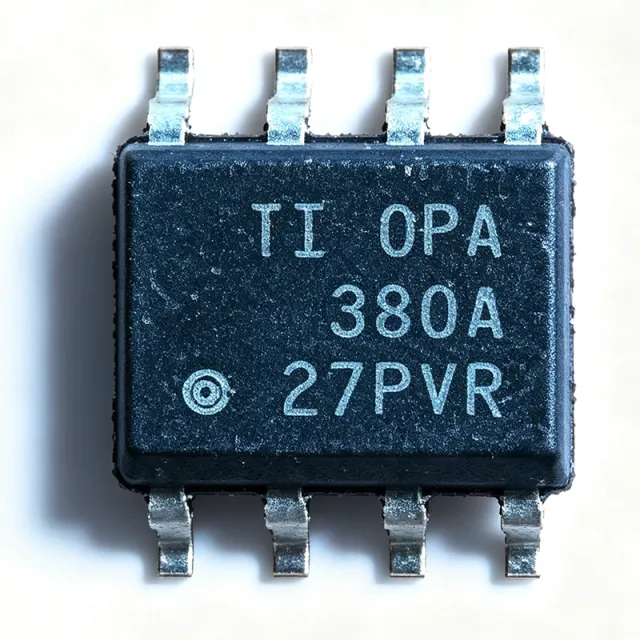
OPA380AID - 90MHz Precision Transimpedance Amplifier | TI

部品番号: OPA380AID ✓ 生産中
在庫あり 1〜3営業日以内に発送
25 uV (max) Vdss 50 pA (max) Id 8-SOIC (D) Package
開始価格 $1.85 USD / 個
MOQ: 1 |
価格更新日: 2026-08-30
ボリューム価格
数量 単価 小計
1 $3.15 $3.15
10 $2.84 $28.40
100 $2.45 $245.00
500 $2.1 $1,050.00
1,000 $1.85 $1,850.00
ℹ️ すべての価格はUSDです

OPA380AID 概要

The Texas Instruments OPA380AID is a precision, high-speed transimpedance amplifier in an 8-pin SOIC (D) package, combining a 90MHz gain bandwidth product with extremely high DC precision for fast photodiode applications. It converts photodiode currents up to 1mA into voltage signals with transimpedance bandwidth exceeding 1MHz.

A transimpedance amplifier (TIA) is a specialized current-to-voltage converter built on an operational amplifier with a feedback resistor, forming the analog front end of optical receivers, barcode scanners, and photodiode-based instruments. Within the signal-chain hierarchy, the TIA sits between the photodetector and the ADC or comparator, and its noise, bandwidth, and offset set the dynamic range of the whole optical link.

Key features include 50pA maximum input bias current, 25uV maximum offset voltage, and 0.1uV/C maximum drift, giving 4 to 5 decades of dynamic range. The very low 1/f noise and excellent long-term Vos stability result from an internal auto-zero amplifier cascaded with a high-speed amplifier, rather than a traditional composite approach, improving overload recovery and settling time.

The auto-zero plus high-speed composite architecture eliminates the usual precision-versus-speed trade-off: DC accuracy typical of chopper amplifiers is retained while delivering >1MHz transimpedance bandwidth. Quiescent current is 6.5mA per amplifier.

Typical applications include high-speed photodiode receivers for optical communications, laser rangefinders and LiDAR receivers, barcode and medical CT scanner photodiode front ends, and precision optical power meters.

For stable operation, keep the photodiode capacitance and feedback resistor within the datasheet stability region; a small feedback capacitor is usually required, and the output may need a pull-down resistor to include 0V in the output swing.

ドロップイン代替品: OPA380AID — 同一パッケージでピン互換。PCBの作り直しが必要な異なるパッケージの部品は除外されています。

クイック比較ツール — 並列比較する代替部品を選択:

OPA2380AID

dual-channel version of the same TIA in MSOP-8, not pin-compatible with SOIC-8

📋 参考代替品(カタログ未掲載)

OPA657ID

1.6GHz GBW FET-input TIA, much higher speed, different bias/spec profile; verify pinout and stability network

📋 参考代替品(カタログ未掲載)

OPA857ID

3.3GHz TIA optimized for optical receivers; higher speed and different feedback topology

📋 参考代替品(カタログ未掲載)

AD8015ARZ

cross-brand 155Mbps wideband TIA in SOIC-8; different pinout and offset performance - design review required

📋 参考代替品(カタログ未掲載)

OPA380AID 最大定格&電気的特性

Amplifier Type Transimpedance Amplifier (TIA)
Number of Channels 1
Gain Bandwidth Product 90 MHz
Transimpedance Bandwidth > 1 MHz
Input Bias Current 50 pA (max)
Input Offset Voltage 25 uV (max)
Offset Voltage Drift 0.1 uV/C (max)
Input Current Range up to 1 mA
Dynamic Range 4 to 5 decades
静止電流 6.5 mA
1/f Noise Very low (auto-zero architecture)
動作温度 -40C to +125C
パッケージ 8-SOIC (D)
実装タイプ Surface Mount
Architecture Auto-zero + high-speed composite

OPA380AID ピン構成

Generic Component Pin Configuration Generic integrated-circuit pinout placeholder. Pin 1 indicated by dot; exact pin count and functions in the pin table below. 1 N 2 N-1 3 N-2 4 N-3 Pin Configuration See pin table below for pin functions Package-specific diagram not available
ピン 1 OUT — Amplifier output (transimpedance output voltage)
ピン 2 -IN — Inverting input - connects to photodiode cathode/anode node
ピン 3 +IN — Non-inverting input - reference/bias voltage
ピン 4 V- — Negative supply rail
ピン 8 V+ — Positive supply rail
ピン 5-7 N/C or internal nodes — [DATA_NEEDED: exact pin functions 5-7 per datasheet pin configuration]

主な用途

OPA380AID の用途: 6 件s: High-Speed Photodiode Optical Receiver, Laser Rangefinder and LiDAR Receiver, Precision Optical Power Meter, Barcode Scanner Photodiode Front End, Medical CT Detector Channel, Industrial Optical Sensor and Photogate.

🌐

High-Speed Photodiode Optical Receiver

The OPA380 is ideally suited for high-speed photodiode applications: its >1MHz transimpedance bandwidth and 90MHz GBW convert fast photocurrents up to 1mA into voltage with minimal distortion, while the 50pA maximum bias current keeps dark-current offset negligible across 4 to 5 decades of dynamic range. Placed directly at the photodiode with a single feedback resistor and small stabilizing capacitor, the auto-zero architecture adds no switching artifacts and preserves very low 1/f noise, improving detection of weak optical signals in fiber and free-space links.

✈️

Laser Rangefinder and LiDAR Receiver

LiDAR receivers need to resolve echo amplitudes spanning decades within nanosecond-to-microsecond windows. The OPA380's high-speed composite architecture improves overload recovery and settling time over traditional approaches, letting the TIA recover quickly after the strong transmit leakage or near-field reflection, then accurately amplify weak distant returns. With 25uV maximum offset and 0.1uV/C drift, threshold decisions remain stable over temperature, extending detection range without periodic recalibration in fielded rangefinder and LiDAR modules.

🔧

Precision Optical Power Meter

Optical power measurement depends on DC precision across wide dynamic range. The OPA380's 4 to 5 decades of dynamic range, 25uV maximum offset, and excellent long-term Vos stability allow a single transimpedance gain setting to cover photocurrents from picoamps to 1mA, simplifying instrumentation design. The very low 1/f noise floor improves reading stability at the lowest light levels, and the SOIC-8 package fits compact handheld meter front ends without the cost of auto-ranging relay or analog-switch gain networks.

🏭

Barcode Scanner Photodiode Front End

Barcode scanners combine fast modulation with wide amplitude variation as the scan spot crosses labels of differing reflectivity. The OPA380's >1MHz transimpedance bandwidth preserves edge fidelity for high scan rates, while 4 to 5 decades of dynamic range capture both glossy-white and matte-black reflectance in a single gain setting. The auto-zero input stage maintains 50pA bias and low 1/f noise so weak signals from low-contrast labels remain above the noise floor, improving first-pass decode reliability in retail and industrial scanners.

💊

Medical CT Detector Channel

CT detector channels place hundreds of photodiode TIAs side by side, making per-channel power and thermal drift critical. The OPA380's 6.5mA quiescent current and 0.1uV/C maximum drift keep heat and offset drift manageable across dense detector arrays, while its excellent long-term Vos stability reduces recalibration frequency. The >1MHz bandwidth supports fast readout of rotating detector elements, and the single SOIC-8 footprint enables compact multi-channel analog boards in medical imaging front ends.

💡

Industrial Optical Sensor and Photogate

Industrial optical sensors monitor part presence, position, and speed using photodiode receivers exposed to wide temperature swings and ambient light. The OPA380 operates from -40C to +125C with only 0.1uV/C maximum offset drift, keeping detection thresholds stable on the factory floor. Its 1mA input current range and 4 to 5 decades of dynamic range tolerate both dim reflective sensing and strong direct-beam interruption, while the SOIC-8 package supports compact sensor head designs integrated near the photodiode.

What is the gain bandwidth product of OPA380?
The OPA380 has a 90MHz gain bandwidth product and delivers more than 1MHz of transimpedance bandwidth. According to the TI datasheet (SBOS226), this high-speed performance is achieved by combining an internal auto-zero amplifier with a high-speed amplifier while maintaining 25uV maximum offset voltage and 50pA maximum bias current.
What is the input bias current of the OPA380?
The OPA380 has a maximum input bias current of 50pA. This very low bias current, combined with a 25uV maximum offset voltage and 0.1uV/C maximum drift, enables 4 to 5 decades of dynamic range, which is critical for photodiode receivers that must detect currents from picoamps up to 1mA.
What is the difference between OPA380 and OPA2380?
The OPA380 is a single transimpedance amplifier available in SO-8 and MSOP-8 packages, while the OPA2380 is the dual-channel version in the miniature MSOP-8 package. Both share identical performance specifications, including 90MHz GBW, 50pA bias current, and -40C to +125C operation, but their pinouts and packages differ, so they are not drop-in replacements.
Is OPA380 suitable for high-speed photodiode applications?
Yes, the OPA380 is specifically designed for high-speed photodiode applications. Its >1MHz transimpedance bandwidth, 90MHz gain bandwidth, and low input bias current of 50pA max allow it to convert fast photodiode currents up to 1mA with excellent precision, making it ideal for optical receivers, laser rangefinders, and barcode scanners.
What is the best drop-in replacement for OPA380?
There is no widely published exact drop-in cross-reference for the OPA380AID. Closest same-brand alternatives include the OPA2380 (dual version, different package) and faster TI TIAs such as OPA657 or OPA857, which require design review. Cross-brand candidates such as the AD8015 (Analog Devices, SOIC-8 TIA) must be verified for pinout and parametric compatibility before use.
Where can I download the OPA380 datasheet PDF?
The official OPA380 datasheet PDF is available on the Texas Instruments website at https://www.ti.com/lit/ds/symlink/opa380.pdf. The document, titled Precision, High-Speed Transimpedance Amplifier, includes the complete specification table, typical performance curves, stability analysis for photodiode capacitance and feedback resistor selection, and application circuits.
How much does the OPA380AID cost?
The OPA380AID typically costs around $3.15 at single-unit quantity, dropping to approximately $1.85 per unit at 1000-piece volume, as of 2026-08-29 from authorized distributor pricing. Prices vary by distributor and stock position; check DigiKey or Mouser for current real-time pricing and availability.
Where to buy OPA380AID online?
The OPA380AID can be purchased online from authorized Texas Instruments distributors including DigiKey and Mouser Electronics, which list the part as an 8-SOIC transimpedance amplifier in stock and available for immediate shipment. Purchase only from authorized channels to guarantee genuine, RoHS-compliant parts with full traceability.
When should I choose OPA380 over OPA657?
Choose the OPA380 when DC precision matters most: its 25uV offset and 0.1uV/C drift suit precision optical power measurement. Choose the OPA657 (1.6GHz GBW, FET input) when you need much higher transimpedance bandwidth for fast optical links. The OPA380 offers better long-term Vos stability and lower cost; the OPA657 offers far higher speed at higher price.
Is OPA380 the same as OPA2380?
No. The OPA380 is a single-channel transimpedance amplifier, while the OPA2380 integrates two channels in an MSOP-8 package. Both share the same auto-zero plus high-speed architecture and identical key specifications (90MHz GBW, 50pA max bias current, 25uV max offset), but package and pinout differences mean one cannot directly replace the other on an existing PCB.
What is the best TI equivalent for OPA380 in a different speed class?
For higher bandwidth, Texas Instruments offers the OPA857 and OPA657 TIAs; for lower-speed, lower-cost needs, consider general-purpose precision amplifiers. Within the same family, the OPA2380 provides dual-channel OPA380 performance. As of 2026-08-29, all are active products specified from -40C to +125C per TI product pages.
What are the key specifications of OPA380 that engineers should know?
The OPA380 is a precision high-speed transimpedance amplifier with 90MHz gain bandwidth, >1MHz transimpedance bandwidth, 50pA maximum input bias current, 25uV maximum offset voltage, 0.1uV/C maximum drift, 1mA input current range, 4 to 5 decades of dynamic range, and 6.5mA quiescent current, in SO-8 and MSOP-8 packages rated -40C to +125C.
Why does the OPA380 output not reach 0V and how do I fix it?
The OPA380 output stage cannot swing all the way to the negative rail on a single supply, so low photocurrent signals near 0V are compressed. Per the TI product documentation, adding an external pull-down resistor to -5V extends the output voltage range to include 0V, restoring accurate measurement of very low light levels near zero output.
Is OPA380 RoHS compliant?
Yes, the OPA380AID offered by authorized distributors is RoHS compliant and lead-free, consistent with Texas Instruments standard green packaging. As of 2026-08-29, the product is active. For AEC-Q100 automotive requirements, verify the specific orderable suffix, since the standard OPA380 is an industrial-grade part rather than an automotive-qualified variant.

エンジニアリング参考データ: OPA380AID — 比較、設計ガイダンス、コンプライアンス情報。

選定ガイド

Choose the OPA380 when your photodiode receiver needs both DC precision and >1MHz transimpedance bandwidth: its 25uV offset, 0.1uV/C drift, 50pA bias current, and 4-to-5-decade dynamic range fit precision optical power meters, barcode scanners, CT detectors, and rangefinders. Choose OPA2380AID when two channels are needed in minimal board area, accepting the MSOP-8 package change. Choose OPA657 or OPA857 only when bandwidth requirements exceed the OPA380's >1MHz transimpedance capability - they trade DC precision and cost for multi-hundred-MHz or GHz speed and require redesign of the stability network. Cross-brand alternatives such as AD8015 target specific data-rate links and differ in pinout and offset performance, so they need full requalification. There is no true same-package drop-in replacement for the OPA380AID; plan designs around availability or dual-source at schematic level.

代替品との比較

パラメータ この製品 OPA2380AID OPA657ID AD8015ARZ
Brand Texas Instruments Texas Instruments Texas Instruments Analog Devices
Package 8-SOIC (D) MSOP-8 (different) SOIC-8 (same family) SOIC-8 (pinout differs)
Channels 1 2 1 1
Drop-in Compatible - No (dual, MSOP-8) No - design review required No - pinout differs

主な差別化要因

  • Precision auto-zero input stage (vs OPA657ID)
  • Faster overload recovery than composite TIAs (vs traditional composite TIA designs)
  • Single-channel SOIC-8 vs dual MSOP-8 (vs OPA2380AID)

設計ノート

Stability of a TIA depends on the ratio of feedback resistance to photodiode capacitance. With the OPA380's 90MHz GBW, large photodiode capacitance with large feedback resistors can push the loop toward instability - select the feedback capacitor using the datasheet stability region, trading a small bandwidth reduction for robust phase margin. Keep the photodiode-to-inverting-input trace as short as possible to minimize stray capacitance and noise pickup.

The OPA380 draws 6.5mA quiescent current per channel. For battery-powered optical instruments, budget this in total power. On single-supply designs the output cannot reach 0V; per TI documentation, add an external pull-down resistor to -5V (or bias +IN above ground) if the output range must include 0V for low-light measurements.

The OPA380 combines an auto-zero amplifier with a high-speed amplifier. Auto-zero clocks can intermodulate with out-of-band signals, so filter the output bandwidth to the signal of interest. Also, the 1mA maximum input current implies a minimum allowed feedback resistance at full-scale output - verify the full-scale photocurrent times Rf stays within the output swing range over temperature.

コンプライアンス情報

RoHS
Compliant
REACH
Unknown
AEC-Q100
鉛フリー
ハロゲンフリー
Unknown
紛争鉱物
Unknown

RoHS/lead-free status per standard TI green packaging as listed by distributors. Other compliance fields not stated in provided data.

データ検証日: 2026-08-29 — データはXAIPARTの部品エンジニアリングチームによって検証・管理されています

関連検索

OPA380 datasheet OPA380AID price buy Texas Instruments OPA380 transimpedance amplifier OPA380 vs OPA2380 difference OPA380 vs OPA657 photodiode TIA OPA380 equivalent substitute 90MHz transimpedance amplifier SOIC-8 high speed photodiode amplifier 1MHz bandwidth OPA380 pinout SOIC-8 what is the input bias current of OPA380 best drop-in replacement for OPA380 OPA380 laser rangefinder receiver

関連部品&用語

Texas Instruments OPA380 OPA380AID OPA2380 OPA657 OPA857 transimpedance amplifier TIA operational amplifier photodiode auto-zero amplifier gain bandwidth product input bias current input offset voltage 1/f noise SOIC-8 MSOP-8 RoHS LiDAR optical receiver Analog Devices AD8015
関連技術ガイド
LMP7721MA/NOPB:3 fA バイアス高精度オペアンプ、17 MHz GBW — エンジニア向け完全ガイド、仕様、代替品、アプリケーション
TI の LMP7721MA/NOPB:標準入力バイアス電流 3 fA、17 MHz GBW、12.8 V/µs、1.8~5.5 V 電源、SOIC-8 絶縁ピン配置。2026-09-04 時点で 1,000 個あたり $2.02 から在庫あり。
8 分で読了
OPA380AID:90MHz 高精度トランスインピーダンスアンプ — エンジニア向け完全ガイド(2026)
TI の OPA380AID:90MHz GBW、最大バイアス電流 50pA、最大オフセット 25uV、TIA 帯域幅 >1MHz。在庫あり、2026-08-30 時点で 1k 個 $1.85 から。
6 分で読了
クイック見積RFQ
詳細をすべてご記入ください — 営業チームが24時間以内にご返信いたします
部品番号 メーカー パッケージ QTY 目標価格 小計
合計: $0.00 USD
✓
見積を送信しました!

24時間以内にメールでご返信いたします

1
RFQ送信済み
2
見積受領
3
注文済み
4
お支払い
5
発送済み
6
配達済み
RFQの詳細を表示