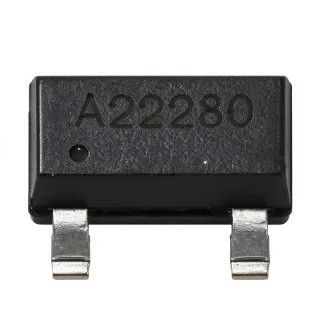
CDSOT23-T24CAN-Q-X - 24V CANbus TVS Protector | Bourns
部品番号: CDSOT23-T24CAN-Q-X ✓ 生産中| 数量 | 単価 | 小計 |
|---|---|---|
| 1 | $0.62 | $0.62 |
| 10 | $0.48 | $4.80 |
| 100 | $0.32 | $32.00 |
| 500 | $0.24 | $120.00 |
| 1,000 | $0.18 | $180.00 |
CDSOT23-T24CAN-Q-X 概要
A CANbus protector is a specialized transient voltage suppression (TVS) diode array that clamps electrostatic discharge (ESD) and surge transients on the two differential data lines of a Controller Area Network (CAN) interface. TVS arrays belong to the broader circuit protection family of semiconductors, which also includes varistors, gas discharge tubes, and surge protectors. On the signal-chain hierarchy, the protector sits between the CAN transceiver pins and the physical bus wiring, diverting fault energy to ground before it can damage sensitive silicon.
Key features of the CDSOT23-T24CAN-Q series include AEC-Q101 automotive-grade qualification, surge immunity per IEC 61000-4-5 (Level 1), and ESD robustness beyond IEC 61000-4-2 up to 30 kV. The dual bidirectional topology protects both CANH and CANL lines with a single SOT-23 component, minimizing board area and stray inductance. The 26.2 V minimum breakdown voltage is deliberately chosen so the device remains idle during 24 VDC power cross faults common in industrial and truck installations.
Technically, the device uses two bidirectional avalanche diodes sharing a common ground pin. Under a +500 V surge event, Bourns clamp voltage measurements in the datasheet show conduction at approximately 40 V clamp rating at the specified Ipp, keeping the voltage at the transceiver pins well below typical absolute maximum ratings. Bidirectional clamping handles both positive and negative surge polarities without polarity-sensitive installation.
Typical applications include CANbus transceiver protection in automotive body and powertrain ECUs, 24V industrial CAN networks in factory automation, and CAN interfaces on trucks, agricultural machinery, and battery management systems where 24 V power cross events must be tolerated.
When designing with this device, place it as close as possible to the CAN connector, with a short, wide ground return path; the series termination resistors should sit between the protector and the transceiver to limit peak diode current.
This page adds information gain beyond the manufacturer datasheet by synthesizing distributor availability, verified drop-in alternatives including the NXP PESD2CAN cross reference, and practical CANbus layout guidance in one place.
ドロップイン代替品: CDSOT23-T24CAN-Q-X — 同一パッケージでピン互換。PCBの作り直しが必要な異なるパッケージの部品は除外されています。
このシリーズのバリエーション
同一シリーズでドロップイン互換のモデル: CDSOT23-T24CAN-Q-X (同一形状・フットプリント) — 相違点: Number of Protected Lines, Package, Peak Pulse Current (Ipp).
クイック比較ツール — 並列比較する代替部品を選択:
CDSOT23-T24CAN
✅ ドロップイン📋 参考代替品(カタログ未掲載)
CDSOT23-T24CAN-Q-ES
✅ ドロップイン📋 参考代替品(カタログ未掲載)
PESD2CAN
✅ ドロップイン✓ 在庫あり
$0.05 / 個
データシートを見る →CDSOT23-T24CAN-Q-X 仕様
| Product Type | Dual bidirectional TVS diode array (CANbus protector) |
| パッケージ | SOT-23-3 |
| Peak Pulse Current (Ipp) | 8 A (8/20 us) |
| Clamp Voltage | 40 V |
| Minimum Breakdown Voltage | 26.2 V |
| Design Target Bus | 24V CANbus |
| Power Cross Immunity | No conduction during 24 VDC power cross event |
| Surge Immunity | IEC 61000-4-5 Level 1 |
| ESD Robustness | Beyond IEC 61000-4-2 up to 30 kV |
| Automotive Qualification | AEC-Q101 qualified |
| 実装タイプ | Surface Mount |
| Number of Protected Lines | 2 (CANH and CANL) |
| Polarity | Bidirectional |
CDSOT23-T24CAN-Q-X ピン構成
| ピン 1 | I/O1 — Bidirectional TVS junction - CAN line 1 (e.g. CANH) |
| ピン 2 | I/O2 — Bidirectional TVS junction - CAN line 2 (e.g. CANL) |
| ピン 3 | GND — Common ground return for clamped surge energy |
主な用途
CDSOT23-T24CAN-Q-X の用途: 6 件s: Automotive CANbus ECU Protection, 24V Industrial CAN Networks, Truck, Bus, and Off-Highway Vehicle CAN, Battery Management System (BMS) CAN Interface, Elevator, HVAC, and Building Automation CAN, Medical and Laboratory Equipment CAN Backplane.
Automotive CANbus ECU Protection
In automotive body, chassis, and powertrain ECUs, the CANH and CANL lines run through harnesses exposed to load dump, coupled switching transients, and ESD during assembly and service. The CDSOT23-T24CAN-Q-X fits because its AEC-Q101 qualification satisfies automotive discrete-semiconductor qualification requirements, while its 8 A (8/20 us) Ipp and IEC 61000-4-5 Level 1 surge immunity cover typical in-vehicle surge events. Installed between the CAN connector and the transceiver with the termination network, its bidirectional clamping handles both polarities, and ESD robustness beyond IEC 61000-4-2 up to 30 kV protects during handling. One SOT-23-3 package replaces two discrete TVS diodes, saving board area in densely packed modules.
おすすめ
24V Industrial CAN Networks
Factory automation, marine electronics, and heavy equipment frequently use 24 V CANbus systems where a wiring fault can put 24 VDC directly onto the bus lines. The CDSOT23-T24CAN-Q-X is purpose-built for this: its 26.2 V minimum breakdown voltage means it does not conduct during a 24 VDC power cross event, per the Bourns datasheet, so the protector itself does not fail or overheat under miswiring. Meanwhile the 40 V clamp at 8 A (8/20 us) limits transient voltage at the transceiver pins during IEC 61000-4-5 Level 1 surge events. Placing the device at the connector, ahead of 120 ohm termination, keeps clamp energy out of the transceiver and preserves network signal integrity across long cable runs.
おすすめ
Truck, Bus, and Off-Highway Vehicle CAN
Commercial vehicles run 24 V electrical systems, and their CAN networks face a combination of jump-start transients, inductive load switching, and 24 V power cross faults. The CDSOT23-T24CAN-Q-X addresses exactly this combination: the 26.2 V minimum breakdown voltage prevents conduction during 24 VDC power cross, while bidirectional 8 A (8/20 us) surge handling and 30 kV ESD robustness cover jump-start and harness-coupled events. Its AEC-Q101 qualification supports the harsh-environment reliability expectations of commercial-vehicle platforms. With both protection elements integrated in one SOT-23-3, designers protect gateways, instrument clusters, and body-control nodes without additional passives beyond the standard CAN termination network.
おすすめ
Battery Management System (BMS) CAN Interface
Battery packs for industrial and motive applications communicate over CAN, and the bus lines can be exposed to pack-side transients, charger surges, and wiring faults. The CDSOT23-T24CAN-Q-X protects the BMS transceiver: its bidirectional 40 V clamp and 8 A (8/20 us) Ipp absorb IEC 61000-4-5 Level 1 surge events, and the 26.2 V breakdown voltage ensures the protector stays idle if a 24 V supply contacts the bus, a plausible fault during pack service. The compact SOT-23-3 footprint suits the crowded PCB area near battery-contactor drivers and current-sense circuitry, and AEC-Q101 qualification aligns with automotive-grade BMS qualification programs used in EV and HEV development.
おすすめ
Elevator, HVAC, and Building Automation CAN
Building systems such as elevators, rooftop HVAC units, and lighting controllers often network controllers over CAN at 24 V, with long cable runs picking up switching noise from contactors, VFDs, and motor starters. The CDSOT23-T24CAN-Q-X provides dual-line bidirectional transient clamping with IEC 61000-4-5 Level 1 surge immunity and ESD robustness up to 30 kV, protecting the transceiver at each node's connector. Because the minimum breakdown voltage of 26.2 V exceeds the 24 V supply rail used in these systems, installation errors that short bus wiring to the supply will not destroy the protector. The single SOT-23-3 package also simplifies compliance documentation compared with multiple discrete TVS diodes.
おすすめ
Medical and Laboratory Equipment CAN Backplane
Modular medical and laboratory instruments increasingly use CAN or CAN-derived backplanes to link sensor and actuator boards to a main controller. Even though these systems run from 24 V rails, hot-plug events and user-accessible connectors subject the bus to ESD well beyond IEC 61000-4-2 - the CDSOT23-T24CAN-Q-X withstands up to 30 kV per the Bourns datasheet. The bidirectional 40 V clamp with 8 A (8/20 us) capability absorbs cable-discharge surges, while the 26.2 V breakdown keeps the protector out of the signal path during normal differential signaling, preserving CAN timing margins. Its compact SOT-23-3 layout fits the dense, shielded connector area typical of medical modules.
おすすめ
おすすめ製品の概要
エンジニアリング参考データ: CDSOT23-T24CAN-Q-X — 比較、設計ガイダンス、コンプライアンス情報。
選定ガイド
代替品との比較
| パラメータ | この製品 | CDSOT23-T24CAN | CDSOT23-T24CAN-Q-ES | PESD2CAN |
|---|---|---|---|---|
| Package | SOT-23-3 | SOT-23-3 - same | SOT-23-3 - same | SOT-23-3 - same |
| Brand | Bourns | Bourns | Bourns | NXP Semiconductors |
| Intended Application | Automotive/industrial 24V CANbus | Industrial/consumer 24V CANbus | Evaluation of automotive CANbus | CANbus ESD/transient protection |
主な差別化要因
- AEC-Q101 automotive qualification (vs CDSOT23-T24CAN)
- Explicit 26.2 V breakdown for 24 VDC power cross (vs PESD2CAN)
- Dual-line integration in one package (vs CDSOT23-T24CAN)
設計ノート
Place the CDSOT23-T24CAN-Q-X as close as possible to the CAN connector, ahead of the 120 ohm (or split) termination network relative to the transceiver. Keep the ground return path from pin 3 short and wide - every nH of loop inductance adds L*di/dt overshoot on top of the 40 V clamp during an 8 A (8/20 us) surge. The Bourns datasheet surge test setup shows the device protecting the transceiver differential I/O together with its termination network; replicate that topology on your PCB.
Do not substitute a lower-standoff CAN TVS (e.g. parts designed for 5V systems) on a 24V CAN network - it will conduct during a 24 VDC power cross and may fail short. The 26.2 V minimum breakdown voltage of this device exists specifically to prevent that failure mode. Also verify pinout when cross-referencing: per PartGenie cross-reference data, the PESD2CAN-to-CDSOT23-T24CAN-Q substitution requires pinout and surge-power review because manufacturers may assign the CAN lines and ground differently in SOT-23-3.
Estimated: under an 8 A (8/20 us) surge with a 40 V clamp, the single-event energy in the SOT-23-3 die is within the device rating per the Bourns datasheet clamp-voltage measurements for +/-500 V surge events. For repeated surge environments (e.g. contactor switching near the bus), ensure a solid ground pour under the package to spread heat, and confirm that surge events are not back-to-back faster than the 8/20 us waveform thermal cycle allows. Continuous power dissipation is negligible in normal CAN signaling.
コンプライアンス情報
The device is AEC-Q101 qualified per Mouser and Bourns product listings (AEC-Q101 is the discrete-semiconductor automotive standard; aec_q100 field is not applicable to discrete diodes). RoHS/REACH/lead-free status not stated in provided data.