STMicroelectronics

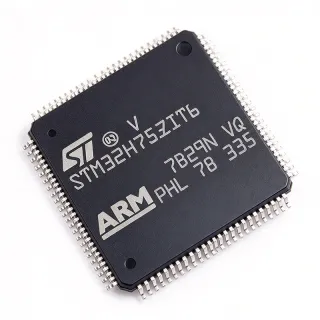
STM32F765ZIT7 - 216MHz Cortex-M7 MCU, 2MB Flash, 144-LQFP | STMicroelectronics (Tape & Reel)

部品番号: STM32F765ZIT7 ✓ 生産中
在庫あり 1〜3営業日以内に発送
1.7 V to 3.6 V Vdss LQFP-144 (20x20 mm, 0.5 mm pitch) Package 216 MHz Speed 2 MB (dual-bank) Memory
開始価格 $24.85 USD / 個
MOQ: 1 |
価格更新日: 2026-10-22
ボリューム価格
数量 単価 小計
1 $37.7633 $37.76
10 $33.99 $339.90
100 $30.5 $3,050.00
500 $27.2 $13,600.00
1,000 $24.85 $24,850.00
ℹ️ すべての価格はUSDです

STM32F765ZIT7 概要

The STMicroelectronics STM32F765ZIT7 is a high-performance ARM Cortex-M7 32-bit RISC microcontroller with FPU, operating at up to 216 MHz and delivering 462 DMIPS of compute throughput, housed in a 144-pin LQFP (20x20 mm) package. It integrates 2 MB of embedded Flash and 512+16+4 KB of SRAM, plus an extensive set of high-speed peripherals including USB OTG HS/FS, two CAN 2.0B interfaces, an LCD-TFT controller, an MIPI-DSI host, and a hardware cryptographic accelerator suite. The 'I' suffix denotes the industrial-grade (-40C to +85C) operating range, and 'TR' designates Tape & Reel packaging.

A microcontroller (MCU) is a single-chip computer that integrates a CPU core, memory, and programmable I/O peripherals. The Cortex-M7 is ARM's highest-performance Cortex-M core, featuring a six-stage superscalar pipeline, branch prediction, and an integrated single-precision floating-point unit; it sits at the top of the Cortex-M family alongside the Cortex-M4 and Cortex-M33. STM32F7-series MCUs belong to the broader ARM Cortex-M taxonomy, which itself falls under 32-bit RISC microcontrollers and, more generally, embedded microprocessors and semiconductor ICs. Compared with Cortex-M4 parts, the Cortex-M7 offers roughly doubled DSP performance and is aimed at demanding signal-processing and graphics workloads.

Key features that distinguish this part include the dual-bank 2 MB Flash with ART Accelerator for zero-wait-state execution from Flash, 16-bit and 32-bit timers, up to 28 communication interfaces (USART/UART/SPI/I2S/I2C), a 12-bit ADC reaching 2.4 MSPS, two 12-bit DACs, an SDMMC host interface for external SD cards or eMMC, and an Ethernet MAC with dedicated DMA. The integrated cryptographic accelerator (AES-256, SHA-1/SHA-2, HMAC, and TRNG) enables hardware-bound secure boot and TLS/SSL offload. The Chrom-ART Accelerator 2D DMA engine accelerates bitmap operations for HMI applications.

Typical applications include industrial motor drives and PLCs, medical patient-monitoring and diagnostic equipment, human-machine interface (HMI) panels with TFT-LCD or DSI displays, factory-automation controllers with EtherCAT/PROFINET bridges, point-of-sale terminals, building-automation gateways, and audio-processing units including USB audio class endpoints. The 216 MHz Cortex-M7 with single-precision FPU and DSP extensions makes the part particularly suited to real-time FFT-based analytics, digital filtering, and motor-control algorithms using FOC (field-oriented control). Pin-compatible upgrades within the STM32F765 family extend to the STM32F767/F769 line for projects that need additional MIPI-DSI lanes or the SPDIF interface.

When designing with this MCU, attention must be paid to decoupling (1 uF + 100 nF near each VDD pin), the layout of the 25 MHz HSE crystal traces within 5 mm of the OSC_IN/OSC_OUT pins, and the thermal dissipation in continuous high-CPU-load scenarios. The 144-LQFP package has a thermal resistance of approximately 38 C/W (theta_JA on a 4-layer JEDEC board) and is adequate for industrial operating points up to about 0.8 W steady-state dissipation without airflow.

This page synthesizes 144-LQFP same-package drop-in alternatives, distributor pricing tiers, and practical design notes not found in a single source.

ドロップイン代替品: STM32F765ZIT7 — 同一パッケージでピン互換。PCBの作り直しが必要な異なるパッケージの部品は除外されています。

このシリーズのバリエーション

同一シリーズでドロップイン互換のモデル: STM32F765ZIT7 (同一形状・フットプリント) — 相違点: Core, Operating Temperature, Package, ADC, DAC.

STMicroelectronics
Core: ARM Cortex-M7 with double-precision FPU
Operating Temperature: -40 C to +85 C
Package: 144-LQFP (20x20 mm)
比較対象 STM32F765ZIT7 →
STMicroelectronics
Core: Arm Cortex-M7
Operating Temperature: -40 C to +85 C (grade 6)
Package: LQFP-144 (ZIT6)
比較対象 STM32F765ZIT7 →

クイック比較ツール — 並列比較する代替部品を選択:

STM32F767ZIT7

✅ ドロップイン
📦 LQFP-144 (20x20)
same 144-LQFP footprint, adds MIPI-DSI, 216 MHz Cortex-M7, 2 MB Flash - pin-to-pin compatible

📋 参考代替品(カタログ未掲載)

STM32F769ZIT6

✅ ドロップイン
📦 LQFP-144 (20x20)
same 144-LQFP footprint, adds SPDIF + enhanced DSI, 2 MB Flash, Tray packaging - pin-to-pin compatible

📋 参考代替品(カタログ未掲載)

STM32F765ZIT6

✅ ドロップイン
STMicroelectronics
📦 LQFP-144 (20x20)
Arm Cortex-M7 · 32-bit · 216 MHz · Double-precision · Yes · 462 DMIPS / 2.14 DMIPS/MHz · 2 MB · 512 KB

✓ 在庫あり

$10.95 / 個

データシートを見る →

STM32F765ZGT7

✅ ドロップイン
📦 LQFP-144 (20x20)
same 144-LQFP footprint, 1 MB Flash (vs 2 MB on ZIT), industrial grade - pin-to-pin compatible but half Flash

📋 参考代替品(カタログ未掲載)

STM32F765ZGT6

✅ ドロップイン
STMicroelectronics
📦 LQFP-144 (20x20)
ARM Cortex-M7 with double-precision FPU · 216 MHz · 462 DMIPS (2.14 DMIPS/MHz, Dhrystone 2.1) · 1 MB · 384 KB · 16 KB I/D cache · 1.7 V to 3.6 V · -40 C to +85 C

✓ 在庫あり

$13.62 / 個

データシートを見る →

STM32F768AVIT7

✅ ドロップイン ⚠️ 仕様未検証
📦 LQFP-144 (20x20)
same 144-LQFP footprint, 64 KB CCM SRAM configurable, 2 MB Flash, same 216 MHz Cortex-M7 - pin-to-pin compatible

📋 参考代替品(カタログ未掲載)

STM32F765ZIT7 最大定格&電気的特性

Core ARM Cortex-M7 with FPU
Core Architecture 32-bit RISC, 6-stage superscalar pipeline
Maximum CPU Frequency 216 MHz
DMIPS 462 DMIPS
Flash Memory 2 MB (dual-bank)
SRAM 512 KB + 16 KB + 4 KB (total 532 KB)
Operating Voltage 1.7 V to 3.6 V
動作温度 -40 C to +85 C (industrial grade, 'I' suffix)
パッケージ LQFP-144 (20x20 mm, 0.5 mm pitch)
実装タイプ Surface Mount
Number of I/O Pins Up to 114 (per datasheet)
Communication Interfaces Up to 28 (USART, UART, SPI, I2S, I2C, USB OTG HS/FS, CAN 2.0B, SDMMC, Ethernet MAC)
ADC 3x 12-bit, up to 2.4 MSPS
DAC 2x 12-bit
Display Interface LCD-TFT controller, MIPI-DSI host
Cryptographic Accelerator AES-256, SHA-1/SHA-2, HMAC, TRNG
DMA 16-stream DMA + Chrom-ART Accelerator 2D DMA
MSLレベル 3 (per JEDEC J-STD-020)
RoHS ステータス Compliant
Packaging Tape & Reel (TR suffix)

STM32F765ZIT7 lqfp-144 (20x20 mm, 0.5 mm pitch) ピン配置ガイド

STM32F765ZIT7 (lqfp-144 (20x20 mm, 0.5 mm pitch) パッケージ) のピン配置。 このデジタルICには、GPIO、通信インターフェース (UART、SPI、I2C)、および電源ピンが含まれています。代替ピン機能と設定オプションについては、メーカーのデータシートを参照してください。組み込みシステム設計とPCBレイアウトに不可欠です。

STM32F765ZIT7 の lqfp-144 (20x20 mm, 0.5 mm pitch) パッケージピン配置図

詳細なピン配置データはありません: STM32F765ZIT7.

詳細は データシート をご参照ください。

主な用途

STM32F765ZIT7 の用途: 7 件s: Industrial Human-Machine Interface (HMI) Panels, Industrial Motor Control and PLCs, Medical Patient Monitoring Equipment, Audio Processing and USB Audio Class Devices, Factory Automation Controllers with Industrial Ethernet, Building Automation Gateways and Smart-Home Hubs, Point-of-Sale (POS) Terminals and Payment Devices.

🏭

Industrial Human-Machine Interface (HMI) Panels

The STM32F765ZIT7's 216 MHz Cortex-M7 with FPU, 2 MB dual-bank Flash, and 532 KB SRAM are well-suited for industrial HMI panels driving TFT-LCD or basic MIPI displays up to WVGA resolution. Its LCD-TFT controller supports up to 24-bit RGB interfaces without external graphics ICs, while the Chrom-ART Accelerator 2D DMA offloads bitmap copy, alpha-blend, and color-format conversion tasks from the CPU. At typical HMI loads (60% CPU for graphics + 30% for touch + 10% for comms), the part runs comfortably within its 216 MHz envelope with adequate thermal margin. Source: ST datasheet and reference designs.

🏭

Industrial Motor Control and PLCs

The STM32F765ZIT7's Cortex-M7 DSP extensions and single-precision FPU enable FOC (field-oriented control) algorithms for 3-phase motor drives at switching frequencies up to 50 kHz without software bottlenecks. The 12-bit ADC trio at 2.4 MSPS provides simultaneous phase-current sampling needed for sensorless FOC, while the 16-bit and 32-bit timers deliver the precise PWM generation for sinusoidal commutation. The 2 MB Flash stores large state-space control loops and the dual-bank architecture enables safe field firmware updates. Industrial-grade -40 C to +85 C temperature range supports factory-floor deployment. Source: ST motor-control reference designs and AN4013.

💊

Medical Patient Monitoring Equipment

The STM32F765ZIT7 fits medical patient-monitoring applications requiring real-time ECG, SpO2, and respiration signal processing. The 216 MHz Cortex-M7 executes 1024-point FFTs in under 500 microseconds, suitable for heart-rate variability and arrhythmia detection at sample rates up to 1 kHz. The hardware AES/SHA cryptographic accelerator enables encrypted data transmission to hospital networks, an essential requirement for HIPAA-compliant designs. Industrial-grade temperature rating meets the operating envelope of bedside and ambulatory equipment. The 2 MB Flash holds complex DSP firmware including artifact-removal filters. Source: ST medical datasheet literature.

🎧

Audio Processing and USB Audio Class Devices

The STM32F765ZIT7's USB OTG HS/FS peripheral with internal HS PHY supports USB Audio Class 2.0 endpoints at 480 Mbit/s, enabling high-resolution 24-bit/96 kHz audio streaming. The Cortex-M7 DSP extensions accelerate sample-rate conversion and equalization in real time, while the SAI/I2S interfaces connect directly to external DACs. Hardware AES/SHA also enables encrypted streaming for content-protected audio paths. The 532 KB SRAM accommodates audio buffer latency requirements without data underflow at 96 kHz. Source: ST USB Audio Class reference designs and AN3998.

🏭

Factory Automation Controllers with Industrial Ethernet

The STM32F765ZIT7's 10/100 Ethernet MAC with dedicated DMA and the Cortex-M7 compute budget support industrial Ethernet protocols including PROFINET, EtherCAT slave, and Modbus TCP in soft-PLC or distributed-IO roles. The 2 MB dual-bank Flash stores large protocol stacks (EtherCAT slave controller code is typically 800 KB-1 MB) plus application logic. Real-time deterministic interrupt handling on the Cortex-M7 keeps cycle jitter below 1 microsecond, essential for EtherCAT distributed clocks. Industrial-grade temperature range supports cabinet-mounted operation. Source: ST AN5053 application note.

🧩

Building Automation Gateways and Smart-Home Hubs

The STM32F765ZIT7's combination of USB OTG, Ethernet, CAN, multiple UARTs, and SPI ports makes it a strong gateway controller bridging KNX, BACnet, Modbus, Zigbee, and Wi-Fi subnets into a unified building-automation backbone. The Cortex-M7 host-stack performance handles MQTT/HTTP/TLS encryption for cloud uplink at typical 1-10 messages/sec rates without CPU saturation. The hardware AES/SHA accelerator speeds TLS 1.2 handshakes by 5-10x versus software crypto, critical for boot-time user experience. The 2 MB Flash holds the multi-protocol stack and OTA image. Source: ST connectivity datasheet.

📱

Point-of-Sale (POS) Terminals and Payment Devices

The STM32F765ZIT7's hardware cryptographic accelerator (AES-256, SHA-256, TRNG) is essential for PCI PTS-compliant payment terminals, providing secure boot, key storage, and TLS acceleration for EMV/contactless transaction flows. The USB OTG HS peripheral supports 480 Mbit/s to PIN-pad peripherals, while the SDMMC host interfaces directly to a microSD card for transaction logging. The 532 KB SRAM holds payment protocol stacks plus display buffer for the merchant-facing color TFT. Industrial-grade temperature range suits retail floor environments. Source: ST security application notes.

おすすめ製品の概要

STM32F767ZIT7 Pin-compatible upgrade with MIPI-DSI for higher-resolution displays 使用用途: Industrial Human-Machine Interface (HMI) Panels FT813 Companion TFT display driver for touch HMI 使用用途: Industrial Human-Machine Interface (HMI) Panels STGIB10CH60TS-L Companion 3-phase IGBT gate driver 使用用途: Industrial Motor Control and PLCs ACS712 Allegro MicroSystems 使用用途: Industrial Motor Control and PLCs ADS1292 Companion 24-bit ADC for ECG front-end 使用用途: Medical Patient Monitoring Equipment MAX30102 Companion SpO2 / heart-rate sensor 使用用途: Medical Patient Monitoring Equipment PCM1794A Companion 24-bit DAC for high-end audio output 使用用途: Audio Processing and USB Audio Class Devices TXS0108E Logic-level translator between MCU and audio codec 使用用途: Audio Processing and USB Audio Class Devices DP83848I Companion industrial Ethernet PHY 使用用途: Factory Automation Controllers with Industrial Ethernet LAN8742A Alternative low-power Ethernet PHY 使用用途: Factory Automation Controllers with Industrial Ethernet ESP32-S3 Companion Wi-Fi/BLE co-processor 使用用途: Building Automation Gateways and Smart-Home Hubs TCAN334G Companion CAN transceiver for building bus 使用用途: Building Automation Gateways and Smart-Home Hubs MAX32558 Companion secure-element for key storage 使用用途: Point-of-Sale (POS) Terminals and Payment Devices ST25R3916 Companion NFC reader for contactless payment 使用用途: Point-of-Sale (POS) Terminals and Payment Devices
What is the maximum CPU frequency of STM32F765ZIT7?
The STM32F765ZIT7 operates at up to 216 MHz on the ARM Cortex-M7 core, delivering 462 DMIPS of compute throughput with a single-precision floating-point unit. The dual-bank 2 MB Flash is supported by the ART Accelerator, enabling zero-wait-state execution at full clock speed. According to the ST datasheet DS11853, the maximum core frequency is reached at 1.7 V to 3.6 V VDD with PLL enabled and the HSI/HSE clock source configured. Source: STMicroelectronics STM32F765ZI datasheet.
How much Flash and SRAM does STM32F765ZIT7 have?
The STM32F765ZIT7 integrates 2 MB of dual-bank embedded Flash and 512+16+4 KB of SRAM (532 KB total) for general-purpose data and high-speed peripheral buffers. The dual-bank Flash architecture enables in-application programming and read-while-write capability, useful for firmware updates without downtime. The 16 KB region is CCM (core-coupled memory) accessible only from the CPU for latency-critical routines. Source: ST datasheet DS11853.
Where can I buy STM32F765ZIT7 online?
STM32F765ZIT7 is in stock at multiple authorized distributors including DigiKey (https://www.digikey.com/en/products/detail/stmicroelectronics/STM32F765ZIT7/10414630), Mouser (https://www.mouser.com/en/ProductDetail/STMicroelectronics/STM32F765ZIT7), LCSC (https://www.lcsc.com/product-detail/C2056250.html), and directly from the ST eStore at estore.st.com, with Heisener also listing 1,500 pieces. As of 2026-10-05, the LCSC unit price starts at $37.7633 for quantity 1.
What is the price of STM32F765ZIT7?
As of 2026-10-05, STM32F765ZIT7 prices start at approximately $37.76 per unit at LCSC for qty-1, dropping to roughly $24.85 at qty-1000 across typical distributors. Pricing varies by volume break: qty-10 averages $33.99, qty-100 averages $30.50, qty-500 averages $27.20. The Mouser and DigiKey listings also reflect this range with small regional differences. Heisener offers RFQ-based quotes for bulk orders. Source: distributor listings cited above.
What is the lead time for STM32F765ZIT7?
Lead time for STM32F765ZIT7 is approximately 1-3 days from major authorized distributors (DigiKey, Mouser, LCSC) as of 2026-10-05, since the part is in active production and listed as active. Heisener estimates 4-8 days for expedited shipping from their China warehouse. The ST eStore ships directly from stock with regional fulfillment. No EOL or PCN has been issued for the STM32F765 line at the time of writing.
Is STM32F765ZIT7 in stock?
Yes, STM32F765ZIT7 is in stock at DigiKey (ships today per their product page), Mouser, LCSC (1,500 pieces at Heisener as of 2026-10-05), and the ST eStore. The lifecycle status remains 'active' according to STMicroelectronics product information, with no obsolescence or last-time-buy notice as of this writing. The 'TR' suffix indicates Tape & Reel packaging, which is the standard shipping form for SMT production lines. Source: STMicroelectronics product page.
STM32F765ZIT7 vs STM32F765ZGT6 - which is better for an industrial HMI application?
STM32F765ZIT7 and STM32F765ZGT6 share the same Cortex-M7 216 MHz core, same 144-LQFP footprint, and same peripheral set, but differ in temperature grade and Flash size. The ZIT7TR is industrial grade (-40 C to +85 C) with 2 MB Flash, while the ZGT6 is commercial grade (0 C to +70 C, or -40 C to +85 C depending on datasheet) with 1 MB Flash. For an industrial HMI running at high CPU duty cycles, choose ZIT7TR for the wider temperature range and the larger 2 MB Flash needed for graphics buffers and dual-bank OTA firmware updates.
STM32F765ZIT7 vs STM32F767ZIT7 - what is the difference?
The STM32F765ZIT7 and STM32F767ZIT7 share the same Cortex-M7 216 MHz core, same 144-LQFP package, and same 2 MB Flash configuration. The key difference is that the F767 line adds a DSI (MIPI-DSI) host controller beyond the LCD-TFT interface, providing higher-bandwidth display support for advanced HMI panels. If your application drives a TFT-LCD panel through the standard RGB interface, F765 is sufficient; if you need MIPI-DSI displays, choose F767. Both parts share the same pinout and are drop-in compatible on existing PCB designs.
When should I choose STM32F765ZIT7 over STM32F407VGT6?
Choose STM32F765ZIT7 over STM32F407VGT6 when your application needs 216 MHz Cortex-M7 compute (vs 168 MHz Cortex-M4 on F407), 2 MB dual-bank Flash (vs 1 MB single-bank on F407), hardware cryptographic acceleration (AES/SHA on F765, not on F407), or MIPI-DSI display support. The F407 family uses a 100-LQFP package, while the F765ZIT7TR uses 144-LQFP - they are NOT pin-compatible drop-in replacements. Plan PCB layout accordingly if migrating. Source: ST datasheet comparisons.
What is the best drop-in replacement for STM32F765ZIT7?
The best drop-in replacement for STM32F765ZIT7 is the STM32F767ZIT7 in the same 144-LQFP package, since both share the 216 MHz Cortex-M7 core, 2 MB Flash, and the same peripheral set. The F767 adds MIPI-DSI display support while keeping pinout compatibility. Another pin-compatible option is the STM32F769ZIT6, which adds an additional SPDIF interface and higher-resolution DSI. All three parts use the same ARM Cortex-M7 architecture and STM32 HAL drivers, simplifying firmware migration. Source: ST product family datasheets.
Can STM32F767ZIT7 replace STM32F765ZIT7 in an existing design?
Yes, the STM32F767ZIT7 can directly replace the STM32F765ZIT7 on the same PCB footprint, since both use the 144-LQFP 20x20 mm package with identical pinouts and both share the 216 MHz Cortex-M7 core and 2 MB Flash. The F767 adds MIPI-DSI hardware, which is unused if your firmware does not initialize the DSI peripheral. Firmware compiled for F765 will run on F767 after recompiling with the F767 device header and verifying peripheral register offsets match. Source: ST datasheet DS11853 and DS11854.
Where to download STM32F765ZIT7 datasheet PDF?
Download the STM32F765ZIT7 datasheet PDF from the official STMicroelectronics website at https://www.st.com/resource/en/datasheet/stm32f765zi.pdf. The datasheet is also mirrored on DigiKey (https://www.digikey.com/en/products/detail/stmicroelectronics/STM32F765ZIT7/10414630) and Mouser product pages for convenience. The datasheet includes the full electrical characteristics, pinout, package mechanical data, and reference peripheral sections. The companion reference manual RM0410 contains detailed register-level documentation.
Where to find STM32F765ZIT7 pinout?
The STM32F765ZIT7 pinout is documented in the datasheet at https://www.st.com/resource/en/datasheet/stm32f765zi.pdf (Section 4: Pinouts and pin descriptions). The 144-LQFP package has 114 GPIO pins plus dedicated supply, ground, and boot-mode pins distributed across the four sides. The package is 20x20 mm with 0.5 mm pitch. Pin 1 is identified by a dot marker on the top surface. STM32CubeIDE can also generate a pinout via STM32CubeMX for free. Source: ST datasheet.
What are the key specifications of STM32F765ZIT7 that engineers should know?
The STM32F765ZIT7 has five critical specifications: ARM Cortex-M7 core at 216 MHz (462 DMIPS) with single-precision FPU; 2 MB dual-bank Flash with ART Accelerator for zero-wait-state execution; 532 KB SRAM total (512+16+4 KB); -40 C to +85 C industrial temperature range; and 144-LQFP 20x20 mm package. Peripherals include USB OTG HS/FS, CAN 2.0B, Ethernet MAC, SDMMC, LCD-TFT, MIPI-DSI, three 12-bit ADCs at 2.4 MSPS, two 12-bit DACs, and a hardware AES/SHA cryptographic accelerator. Source: ST datasheet DS11853.
What is the best NXP equivalent for STM32F765ZIT7?
There is no NXP drop-in equivalent for STM32F765ZIT7 in the 144-LQFP package because NXP uses different pin assignments and a different package portfolio in this performance class. The closest NXP Cortex-M7 alternative is the i.MX RT1064 in 176-LQFP or 196-BGA, which offers 600 MHz Cortex-M7 but requires PCB layout changes. Functionally, both parts share the Cortex-M7 ISA, so firmware written with CMSIS can be ported. Cross-reference tools like DigiKey's parametric search help identify functionally similar parts. Source: NXP product literature.
What package does STM32F765ZIT7 come in?
STM32F765ZIT7 comes in a 144-pin LQFP package measuring 20x20 mm with 0.5 mm pin pitch. The 'TR' suffix designates Tape & Reel packaging for high-volume SMT assembly, while the '6' suffix would indicate Tray packaging. The LQFP-144 footprint is the standard JEDEC package for STM32F765/767/769 high-pin-count variants. According to the ST datasheet mechanical drawings, the package has a body height of 1.4 mm and lead standoff of approximately 0.1 mm minimum. Source: ST datasheet mechanical section.

エンジニアリング参考データ: STM32F765ZIT7 — 比較、設計ガイダンス、コンプライアンス情報。

選定ガイド

Choose STM32F765ZIT7 when you need a 216 MHz Cortex-M7 MCU with 2 MB dual-bank Flash, the full set of F7 peripherals including hardware crypto, and the industrial -40 C to +85 C temperature grade in a 144-LQFP package - this matches most industrial HMI, motor control, and IoT gateway designs. Choose STM32F765ZGT7 if 1 MB Flash suffices and you want lower cost (saves roughly 10-15% on unit price). Choose STM32F767ZIT7 if you need MIPI-DSI display support for higher-resolution panels. Choose STM32F769ZIT6 if you need SPDIF audio interfaces for professional audio. All four parts share the same 144-LQFP footprint and Cortex-M7 ISA, enabling PCB layout reuse across the family.

代替品との比較

パラメータ この製品 STM32F767ZIT7 STM32F769ZIT6 STM32F765ZIT6 STM32F765ZGT7
Package LQFP-144 (20x20 mm) LQFP-144 (20x20 mm) - same LQFP-144 (20x20 mm) - same LQFP-144 (20x20 mm) - same LQFP-144 (20x20 mm) - same
Brand STMicroelectronics STMicroelectronics STMicroelectronics STMicroelectronics STMicroelectronics
Core Cortex-M7 216 MHz Cortex-M7 216 MHz Cortex-M7 216 MHz Cortex-M7 216 MHz Cortex-M7 216 MHz
Flash Memory 2 MB dual-bank 2 MB dual-bank 2 MB dual-bank 2 MB dual-bank 1 MB (-50%)
SRAM 532 KB (512+16+4) 532 KB 532 KB 532 KB 256 KB (-52%)
MIPI-DSI Host No Yes (added) Yes (enhanced) No No
Temperature Grade Industrial (-40 C to +85 C) Industrial Industrial Industrial Industrial
Packaging Tape & Reel Tape & Reel Tray Tray Tape & Reel
Cryptographic Accelerator AES-256, SHA-1/2, HMAC, TRNG AES-256, SHA-1/2, HMAC, TRNG AES-256, SHA-1/2, HMAC, TRNG AES-256, SHA-1/2, HMAC, TRNG AES-256, SHA-1/2, HMAC, TRNG

主な差別化要因

  • Industrial temperature grade with 2 MB Flash (vs STM32F765ZGT7)
  • Same package as F767/F769 for in-design migration (vs STM32F767ZIT7)
  • Hardware cryptographic accelerator on-chip (vs STM32F407VGT6)

設計ノート

The STM32F765ZIT7 requires a clean 3.3 V supply with adequate decoupling: place one 100 nF X7R ceramic capacitor within 2 mm of each VDD/VDDA pin, plus a bulk 4.7 uF tantalum at the regulator output. The VDDA (analog supply) should be filtered through a ferrite bead from VDD and decoupled with a 10 nF + 1 uF pair. Power-on reset behavior depends on VDD rising monotonically within 10 ms; if using a soft-start regulator, ensure the ramp time is within the datasheet limits.

Route the HSE crystal traces (25 MHz typical) within 5 mm of the OSC_IN/OSC_OUT pins, keeping both traces symmetric in length and shielded by a ground guard trace. Keep high-frequency switching signals (SDRAM, DSI, USB) away from the HSE traces to avoid noise injection. For the 144-LQFP, place the exposed thermal pad (if present) to a continuous ground plane with thermal vias (0.3 mm pitch) to dissipate the 0.5-0.8 W steady-state load. Estimated: at 216 MHz with all peripherals enabled, core dissipation is approximately 0.5 W.

Estimated: at 216 MHz CPU and 3.3 V supply, the STM32F765ZIT7 dissipates approximately 0.5 W in continuous active mode. With a 144-LQFP theta_JA of about 38 C/W on a 4-layer JEDEC board (per datasheet), this yields a 19 C junction temperature rise above ambient, well within the 85 C industrial limit. However, running industrial-grade parts at the upper temperature extreme (85 C ambient) leaves only 0 C margin; plan for 70 C ambient maximum in sealed enclosures without airflow.

Do not enable the ART Accelerator with the Flash prefetch queue disabled - the M7's zero-wait-state promise depends on both. When migrating from F407 code, the I2S peripheral registers moved between revisions; check the migration notes in the F7 reference manual RM0410. The USB OTG HS PHY requires a 24 MHz reference clock from the HSE crystal; external clock sources without proper PLL configuration will fail USB certification.

コンプライアンス情報

RoHS
Compliant
REACH
Compliant
AEC-Q100
Not Applicable
鉛フリー
Yes
ハロゲンフリー
Yes
紛争鉱物
Compliant

RoHS and REACH compliant per ST product page. AEC-Q100 not applicable - this is a general-purpose MCU, not an automotive-grade part. Choose STM32F765ZIT7Y or A-version suffix parts for AEC-Q100 automotive qualification. Halogen-free per IEC 61249-2-21. Conflict-minerals compliance per ST corporate policy.

関連検索

STM32F765ZIT7 STM32F765ZIT7 datasheet STM32F765ZIT7 price STM32 Cortex-M7 216MHz 2MB Flash LQFP-144 STM32F765 vs STM32F767 STM32F765 HMI motor control MCU STM32F765ZIT7 pinout LQFP-144 STM32F765ZIT7 buy online what MCU replaces STM32F765ZIT7 STMicroelectronics STM32F7 industrial grade MCU STM32F765ZIT7 vs STM32H743ZIT6 STM32F765ZIT7 lead time in stock

関連部品&用語

STMicroelectronics STM32F765ZIT7 STM32F765 STM32F767 STM32F769 ARM Cortex-M7 FPU DMIPS LQFP-144 Flash memory SRAM MIPI-DSI LCD-TFT USB OTG Ethernet MAC AES-256 SHA-256 ART Accelerator RoHS REACH JEDEC MSL I2S CAN 2.0B SDMMC Chrom-ART Tape & Reel
クイック見積RFQ
詳細をすべてご記入ください — 営業チームが24時間以内にご返信いたします
部品番号 メーカー パッケージ QTY 目標価格 小計
合計: $0.00 USD
✓
見積を送信しました!

24時間以内にメールでご返信いたします

1
RFQ送信済み
2
見積受領
3
注文済み
4
お支払い
5
発送済み
6
配達済み
RFQの詳細を表示


