DRAM
제품 (62)

MT40A512M16JY-083E - 8Gb DDR4 SDRAM 2400MT/s x16 | Micron
The Micron Technology MT40A512M16JY-083E is an automotive-grade 8Gb DDR4 SDRAM organized as 512M x16, operating at a 1.2 GHz clock (DDR4-2400 class) in a 96-ball FBGA (8x14 mm) package. It runs from VDD = VDDQ = 1.2V +/-60mV with a separate VPP of 2.5V (-125mV/+250mV) for the word-line charge pump. DDR4 SDRAM (Double Data Rate fourth-generation synchronous dynamic random-access memory) is the dominant main-memory technology for embedded processors, industrial controllers, and automotive computing platforms. Within the memory hierarchy it sits below cache (SRAM) and above storage (NAND flash), providing high-bandwidth, low-cost-per-bit working memory. The x16 organization suits processors with 16-bit or 32-bit memory controllers. Key features include the -083E speed grade (tCK = 0.83 ns, 1.2 GHz clock, 2400 MT/s data rate), on-die internal adjustable VREFDQ generation that eliminates external reference resistors, and a 1.2V pseudo open-drain I/O structure that lowers I/O power versus DDR3. Automotive qualification targets the extended temperature range demanded by in-vehicle applications. Architecturally, the device uses an 8-bank DDR4 core with bank-group burst access, 8n prefetch, and programmable CAS latency. Refresh is 8192-cycle per refresh window: 64ms at TC of -40C to 85C, 32ms above 85C to 95C, and 16ms above 95C, enabling reliable operation in hot automotive cabins. Typical applications include automotive ADAS and infotainment main memory, industrial HMI and edge-AI platforms, networking line-card buffers, and test-and-measurement systems. Design consideration: honor the separate 2.5V VPP rail in your power tree; omitting it or tying it to 1.2V prevents proper word-line biasing and can prevent boot. Follow Micron's DDR4 layout guidelines for fly-by routing with on-die termination. This page synthesizes distributor pricing, drop-in alternatives, and practical design notes not found in the manufacturer datasheet.

MT40A512M8SA-062E - 4Gb DDR4 SDRAM x8, 3200 | Micron
The Micron Technology MT40A512M8SA-062E is a 4Gb DDR4 SDRAM memory IC organized as 512M x 8, operating at a clock frequency of 1.6 GHz (DDR4-3200 class) with VDD/VDDQ of 1.2V +/-60mV, packaged in a 78-ball FBGA (7.5 x 11 mm, Z10B) surface-mount package. DDR4 SDRAM (Double Data Rate 4 Synchronous Dynamic Random Access Memory) is the fourth generation of the DDR DRAM family, sitting within the hierarchy of DRAM components -> SDRAM -> DDR4 SDRAM -> volatile memory ICs. Compared to DDR3, DDR4 lowers the core supply voltage to 1.2V, doubles bank groups, and raises data rates up to 3200 MT/s, making it the dominant main-memory technology for computing platforms from embedded controllers to servers. Key features of this device include VDD = VDDQ = 1.2V +/-60mV with a separate VPP supply of 2.5V (-125mV/+250mV) for the word-line driver, on-die internal adjustable VREFDQ generation that eliminates an external reference rail, a pseudo open-drain 1.2V I/O interface, and TC maximum operation to 95 degrees C. The x8 organization supports the standard DDR4 feature set including bank groups and on-die termination. Technically, the device uses an 8n-prefetch architecture with two or four bank groups; data is transferred on both clock edges at up to 1600 MHz clock rate for 3200 MT/s effective bandwidth on the 8-bit data bus. The :F suffix denotes the lead-free/RoHS package flow with a commercial operating range; IT, AIT and AUT grade variants extend the range for industrial and automotive platforms. Typical applications include desktop and notebook main memory, embedded computing modules, industrial controllers, networking equipment, and replacement sourcing for DDR4-based designs. Design consideration: DDR4 routing requires length-matched, on-die-terminated data lines; PCB trace matching to the die, correct VPP decoupling, and address/command termination per the Micron datasheet layout guidance are essential for reliable operation at 3200 MT/s. This page synthesizes distributor pricing, drop-in alternatives across speed and temperature grades, and practical design notes not consolidated in the manufacturer datasheet.
MT41K256M16 - 4Gb DDR3L SDRAM 1.35V x16 | Micron Technology
The Micron Technology MT41K256M16 is a 4Gb (256M x 16) DDR3L SDRAM memory IC operating from a 1.35V supply, housed in a 96-ball FBGA package. It is the low-voltage version of DDR3 (1.5V) SDRAM and remains pin- and protocol-compatible when run in 1.5V DDR3 mode, per the Micron 4Gb x4/x8/x16 DDR3L datasheet. DDR3L SDRAM is a class of synchronous dynamic random-access memory that transfers data on both clock edges (double data rate) and uses a source-synchronous strobe-based interface. Within the memory hierarchy, the MT41K256M16 sits at the component level of DRAM main memory, below DIMM modules and above the raw DRAM core, serving as the primary working memory for processors, FPGAs, and SoCs. Key features of the MT41K256M16 family include the 4Gbit single-die density organized as 256 megawords x 16 bits, an internal 8-bank architecture for improved parallelism, and a 1.35V VDD supply with 1.5V-compatible operation. The x16 organization reduces external component count in 16-bit or 32-bit bus systems compared with x4/x8 parts, which use a different 78-ball outline. Speed grades in the family span DDR3L-1066 through DDR3L-2133 (for example -125 and -093/-107 suffices), with the exact speed grade encoded in the full ordering MPN such as MT41K256M16TW-107:P or MT41K256M16RE-125. On-die termination (ODT), DLL-based timing, and programmable CAS latency provide signal-integrity and latency tuning options for FPGA and processor memory controllers. Typical applications include embedded processor memory for Xilinx Zynq and Artix/Kintex FPGA platforms, industrial controllers, networking equipment, automotive infotainment, and consumer electronics where a 512 MB single-chip address space at 1.35V is required. Design considerations: DDR3L Fly-by routing, VTT termination, and ZQ calibration resistor placement dominate layout quality. Always derate address/command timing at elevated temperature, and confirm the JEDEC-required initialization sequence in the memory controller. This page synthesizes distributor sourcing data, cross-brand drop-in equivalents (Samsung, Nanya), and practical DDR3L design notes not found in the standard Micron datasheet, with pricing as of 2026-10-11.
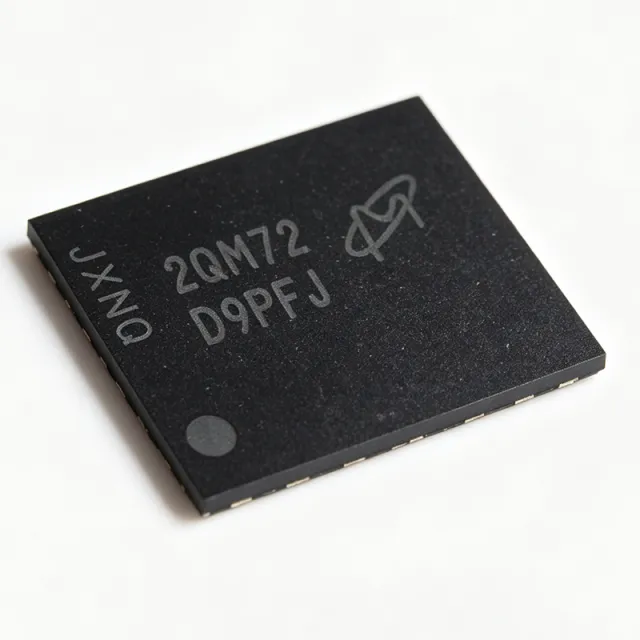
MT41K256M8DA-125 - 2Gb DDR3L SDRAM x8 800MHz | Micron
The Micron Technology MT41K256M8DA-125 is a 2Gbit DDR3L SDRAM memory IC organized as 256M x 8, operating at a data rate of 800 MT/s (400 MHz clock, CL=11 at 13.75 ns) from a 1.35V supply, housed in a 78-ball FBGA (8 mm x 10.5 mm) package. DDR3L SDRAM is a low-voltage version of the JEDEC-standard DDR3 SDRAM. DDR3 doubles the data rate of DDR2 by using an 8-bit prefetch architecture and fly-by-terminated signal routing, while DDR3L further reduces core power by operating at 1.35V instead of 1.5V. It is also backward compatible with 1.5V DDR3 operation per Micron documentation. DRAM components like this device form the main-memory tier of the memory hierarchy, sitting between CPU caches and storage, and are managed by a DDR memory controller on the host processor or chipset. Key features include 8 internal banks, programmable CAS latency, two fixed burst lengths (BL8 and BC4 via mode register or on-the-fly), auto self-refresh and auto precharge, an asynchronous reset pin for fast initialization, data mask (TDQS/DM) support, dynamic on-die termination (ODT), ZQ output driver calibration, and write leveling for fly-by topology signal integrity. Technically, the device uses an 8n-bit prefetch architecture with a SSTL-15 compatible I/O interface (1.35V nominal) and supports derated timing at elevated temperature. The -125 speed grade corresponds to 13.75 ns CL=11 timing at 800 MT/s. The industrial-grade IT variant extends operation to -40C to +95C. Typical applications include embedded systems main memory, industrial PCs, networking equipment, set-top boxes, and test instrumentation requiring compact, low-power DRAM in a space-saving FBGA footprint. Design consideration: DDR3L fly-by routing requires per-device write leveling in the memory controller; verify ODT settings and ZQ calibration resistor placement per the Micron datasheet layout guidelines. This page synthesizes distributor pricing, drop-in alternatives, and practical design notes not found in the manufacturer datasheet.
MT41K512M16VRP-107 - 8Gb DDR3L SDRAM 933MHz | Micron
The Micron Technology MT41K512M16VRP-107 IT:P is an 8Gbit automotive DDR3L SDRAM organized as 512M x 16, operating at 933 MHz (DDR3-1866) with 20 ns access time, housed in a 96-ball FBGA (8 x 14 mm) package. It is a TwinDie device that combines two Micron 4Gb DDR3L x8 die in a single package to form a 2-byte wide x16 memory. DDR3L SDRAM (Low-Voltage Double Data Rate 3 Synchronous DRAM) is a type of volatile dynamic random-access memory that operates at 1.35V nominal, while remaining backward-compatible with 1.5V DDR3 operation. Within the memory hierarchy, SDRAM components sit at the DRAM level, providing the main system memory for processors, and DDR3L occupies the mid-generation position between DDR2 and DDR4. This TwinDie construction doubles density without requiring larger packages or finer process nodes at the module level. Key features of the MT41K512M16VRP-107 include the wide industrial-plus operating temperature range of -40C to +95C (the IT suffix), automotive-grade screening (the :P designation), 1.35V low-voltage core operation for reduced power, and an asynchronous reset function for reliable initialization. Additional capabilities include auto self-refresh, auto precharge, data mask, dynamic on-die termination (ODT), and write leveling, which simplifies high-speed signal-integrity tuning on DDR3 controller interfaces. The TwinDie architecture uses two 4Gb DDR3L x8 die internally; according to Micron, specifications for the base part MT41K512M8 correlate to the TwinDie manufacturing base part MT41K512M16, and the manufacturer datasheet should be read together with the 4Gb x8 data sheet for parameters not covered in the 16-page TwinDie document. Typical applications include automotive infotainment and telematics main memory, ADAS sensor fusion platforms, industrial gateways and embedded controllers, and rugged networking equipment that requires high-density DRAM across extended temperatures. The automotive qualification makes this part particularly suited to designs where AEC-grade component selection is a system requirement. A key design consideration: the TwinDie device presents two chip-select domains internally, so controller configuration and address mapping must match the datasheet dual-die organization, and 96-ball FBGA solder profiles must follow automotive reflow requirements. This page synthesizes distributor pricing, drop-in alternatives, and practical design notes not found in the manufacturer datasheet, with pricing as of 2026-09-10.
MT41K64M16TW-107 AAT:J - 1Gbit DDR3L SDRAM 933MHz | Micron
The Micron Technology MT41K64M16TW-107 AAT:J is a 1Gbit DDR3L SDRAM memory IC organized as 64M x 16, operating at 933 MHz clock frequency (DDR3L-1866) with a 20 ns access time and 1.35 V supply, housed in a 96-ball FBGA (8x14 mm) package. It is an automotive-grade, AEC-Q100 qualified DRAM targeted at demanding embedded platforms. DDR3L SDRAM (Double Data Rate 3 Low Voltage) is a synchronous dynamic random-access memory that transfers data on both clock edges, doubling effective bandwidth relative to SDR DRAM. Within the memory hierarchy, DRAM sits between CPU caches and storage, serving as main system memory or frame-buffer memory in processors, SoCs, FPGAs, and multimedia platforms. Key features include the wide 64M x 16 organization that simplifies 16-bit memory buses, the 1.35 V low-voltage core that cuts dynamic power versus 1.5 V DDR3, a 933 MHz clock rate delivering up to 1866 MT/s of data rate, and the compact 96-FBGA (8x14) ball-grid package suited to dense multilayer PCBs. The 'A' grade prefix and 'AAT' temperature suffix denote automotive qualification for extended environmental stress. Architecturally, the device uses an 8-internal-bank DDR3L core with standard burst-length-8 operation, on-die termination (ODT), and JEDEC-standard DDR3L command interface, allowing use with mainstream memory controllers from Texas Instruments, NXP, Xilinx/AMD, and STMicroelectronics. Typical applications include automotive infotainment and instrument clusters, industrial programmable-logic and vision systems, and networking line-card buffer memory where AEC-Q100 qualification is mandatory. Design consideration: DDR3L signal integrity requires length-matched, impedance-controlled routing (40-60 ohm traces), VTT termination, and careful fly-by address routing per Micron's DDR3 system design guidance. This page synthesizes distributor pricing, drop-in same-footprint alternatives, and practical DDR3L layout notes not found on the manufacturer product page.

MT42L16M32D1HE-18 - 512Mb LPDDR2 SDRAM 134-VFBGA | Micron
The Micron Technology MT42L16M32D1HE-18 is a 512Mbit Mobile LPDDR2 SDRAM memory IC organized as 16M x 32, operating from a 1.2V supply at data rates up to 1066 MT/s (533 MHz clock) and housed in a 134-ball VFBGA package measuring 10 x 11.5 mm. LPDDR2 (Low Power Double Data Rate 2) is a JEDEC-defined memory standard derived from the DDR SDRAM family, optimized for battery-powered and thermally constrained systems. As a class of DRAM (itself a subclass of volatile memory within the broader power-management-aware memory hierarchy), LPDDR2 reduces core and I/O voltage, adds low-power states such as self-refresh and deep power-down, and integrates initialization and calibration features on-die. Key features of the MT42L16M32D1HE include its x32 bus width for high peak bandwidth per package, 1.2V VDD and VDDQ operation that minimizes dynamic power, and support for clock-stop, power-down, and self-refresh modes that cut standby consumption. The -18 speed grade corresponds to a 533 MHz clock / 1066 MT/s data rate, and the die-level LPDDR2 command interface (CA bus) reduces pin count versus conventional DDR interfaces. Architecturally, the device uses an internal bank organization with on-chip DLL-off operation support and voltage-temperature derating logic, allowing reliable operation across automotive-grade temperature ranges. Micron implements the LPDDR2 S2 die (1.2V core) with AC timing tuned for the -18 bin; signal integrity is supported by on-die termination strategies defined in the JEDEC LPDDR2 specification. Typical applications include smartphone and tablet application-processor memory, automotive infotainment and ADAS buffering (with the AUT:E AEC-Q100 variant), industrial HMI buffers, and networking line-card frame buffers. The 16M x 32 organization suits systems needing wide bursts per row activation. Design consideration: LPDDR2 fly-by-free point-to-point routing still requires length-matched CA/DQ traces and careful VDDQ decoupling; always confirm the speed-grade derating tables at your maximum junction temperature. This page synthesizes distributor availability, same-package family alternatives, and practical design notes not found in the manufacturer datasheet. Pricing references are as of 2026-09-02.
MT53B128M32D1DS-053 AUT:A - 4Gbit LPDDR4 1.866GHz | Micron
The Micron Technology MT53B128M32D1DS-053 AUT:A is a 4Gbit automotive-grade LPDDR4 SDRAM memory IC organized as 128M x 32, operating at up to 1.866 GHz (1866 MHz data rate, 3.5 ns clock cycle) from a 1.1V core supply, housed in a 200-ball WFBGA (10 mm x 14.5 mm) package rated from -40C to +125C. LPDDR4 (Low Power Double Data Rate 4) is a JEDEC-defined mobile DRAM standard optimized for low operating voltage and low power consumption. Within the memory hierarchy, LPDDR4 SDRAM sits under the volatile DRAM family as the power-optimized branch of synchronous DRAM, widely used where battery life and thermal budgets dominate design decisions. Unlike DDR4 for servers, LPDDR4 reduces interface voltage and adds deep power-down and per-bank refresh features. Key features of this device include the 4Gbit density in a x32 organization suited to processors without 16-bit memory controllers, the -053 speed bin supporting 1866 MHz operation, and automotive AEC-Q100 qualification indicated by the AUT prefix with a -40C to +125C operating range. Micron characterizes the LPDDR4 family for ultra-low power consumption to extend battery life. Architecturally, the device uses a dual-channel-capable LPDDR4 interface with dynamic frequency scaling support, low-voltage swing termination (LVSTL) I/O, and programmable drive strengths. The 1.1V VDD core with a separate 1.1V VDDQ interface minimizes I/O switching power, and self-refresh modes retain data during system idle states. Typical applications include automotive infotainment and ADAS platforms, industrial HMI and edge-compute modules, and high-performance embedded processors requiring 32-bit wide memory buses. Design consideration: LPDDR4 requires controller-side training of read/write leveling and DQS oscillator counts during initialization; verify your SoC memory controller supports the -053 (1866 MHz) speed bin timing parameters before layout. This page synthesizes distributor availability, same-family drop-in speed-grade and temperature-grade alternatives, and practical design notes not consolidated in the manufacturer part catalog.
MT53B256M32D1NP-062 - 8Gb LPDDR4 SDRAM 1.6GHz | Micron
The Micron Technology MT53B256M32D1NP-062 is a Mobile LPDDR4 SDRAM memory IC delivering 8Gbit density organized as 256M x 32, running at 1.6 GHz (LPDDR4-3200 data rate), housed in a 200-ball WFBGA package measuring 10 x 14.5 mm with a 0.5 mm ball pitch. LPDDR4 (Low Power Double Data Rate 4) is a type of synchronous DRAM standardized by JEDEC and optimized for mobile and embedded systems, offering higher bandwidth and lower power than standard DDR4. Within the memory hierarchy - LPDDR3, LPDDR4, LPDDR5 - the LPDDR4 generation balances performance and efficiency, making it the mainstream choice for smartphones, tablets, AI edge devices, and embedded computing modules that require fast access to large working sets. Key features of the MT53B256M32D1NP-062 include a wide 32-bit data bus, dual supply rails of 1.1V (VDD1) and 1.8V (VDD2) with 1.1V I/O, and support for deep power-down and self-refresh modes that minimize standby current in battery-powered designs. Bank group architecture improves random-access performance, while on-die features and JEDEC LPDDR4 compliance ensure interoperability with a broad range of SoC memory controllers. Technically, this device uses Micron's advanced DRAM process technology to achieve high data rates at low active power. The -062 speed grade supports 1.6 GHz operation. The device operates over a case temperature range of -30C to +85C (WT speed/temp variant), suiting both consumer and industrial environments. The 200-WFBGA package provides a compact, low-profile footprint that facilitates high-density PCB designs in space-constrained products. Typical applications include flagship smartphone and tablet main memory, AI edge inference accelerators, automotive infotainment, industrial controllers, and embedded logging/computing modules where real-time video processing and machine learning workloads demand high memory bandwidth per watt. When designing with this device, place decoupling capacitors close to the VDD1/VDD2 power balls and follow Micron's datasheet layout guidelines: length-match and route the high-speed CA and DQ buses with controlled impedance to preserve signal integrity at 3200 MT/s. This page synthesizes distributor pricing, drop-in alternative analysis, and practical design notes not found in the manufacturer datasheet.

MT53E512M32D1ZW-046BAUT:B - 16Gbit LPDDR4X SDRAM | Micron
The Micron Technology MT53E512M32D1ZW-046BAUT:B is a 16 Gbit mobile LPDDR4X SDRAM memory IC organized as 512M x 32, operating at 2.133 GHz with a 3.5 ns access time, housed in a 200-ball TFBGA (10 mm x 14.5 mm) package. LPDDR4X SDRAM (Low Power Double Data Rate 4X synchronous dynamic random access memory) is a class of volatile DRAM optimized for mobile and embedded systems. Within the memory hierarchy it sits at the main-system-memory level, below CPU caches and above storage, and belongs to the broader JEDEC DDR SDRAM family. Compared with standard LPDDR4, the LPDDR4X variant lowers the I/O interface voltage (VDDQ) to approximately 0.6V, significantly reducing I/O power consumption, which is the dominant power draw at multi-gigabit data rates. Key features of this device include the 16 Gbit (2 GB) capacity in a single 32-bit-wide component, a parallel interface clocked at 2.133 GHz, and an automotive-grade AUT suffix designation. According to Microchip USA product data, the part is AEC-Q100 qualified and operates from a supply voltage range of 1.06V to 1.17V on the core rail, supporting the low-power behavior expected of the LPDDR4X family. Architecturally, the device is organized as 512M x 32 with internal banks accessed through a double-data-rate interface, allowing commands and data to be transferred on both clock edges for an effective 4266 MT/s class data rate. Deep power-down, self-refresh, and partial-array self-refresh style power management modes typical of Micron's MT53E mobile DRAM family minimize standby current in battery-operated systems. Typical applications include automotive infotainment and advanced driver assistance (ADAS) platforms, where AEC-Q100 qualification is mandatory, as well as high-performance embedded computing, industrial gateways, and networking equipment requiring dense DRAM in a compact footprint. A key design consideration is signal integrity: at 2.133 GHz operation, trace length matching, on-die termination (ODT) configuration, and VDDQ decoupling dominate the layout effort, and the memory controller must be configured for the LPDDR4X timing tables in the manufacturer datasheet. This page synthesizes distributor inventory data, drop-in alternatives, and practical design notes not found in the manufacturer datasheet alone.
MT53E768M32D4DT-053 - 24Gbit LPDDR4 4266Mbps x32 | Micron
The Micron MT53E768M32D4DT-053 is a 24Gbit (3GB) Mobile LPDDR4 SDRAM memory IC organized as 768M x32, operating at up to 1.866 GHz clock frequency (4266 Mbps/pin data rate) in a 200-ball VFBGA (10 x 14.5 mm) package. This quad-die package (QDP) LPDRAM targets flagship smartphones, tablets, automotive infotainment, and high-performance embedded systems requiring maximum density in a mobile-optimized footprint. LPDDR4 (Low Power Double Data Rate 4) is a JEDEC-defined synchronous DRAM interface standard optimized for mobile and low-power computing. Within the memory hierarchy, it sits below DDR4 server memory in absolute bandwidth but delivers superior performance-per-watt, lower operating voltage (VDDQ = 1.1 V), and a smaller ball pitch, making it the dominant DRAM type for battery-powered SoC platforms. Key features include 24Gbit density in a single component, 32-bit data width, 1.866 GHz maximum clock, low-voltage 1.1 V I/O signaling, and Micron's quad-die package construction that stacks four 6Gbit dice to achieve density without enlarging the footprint. Temperature-grade suffix options (WT commercial, AIT industrial, AUT automotive) let designers qualify one layout across multiple environments. The LPDDR4 architecture uses bank-group based 8n prefetch, on-die termination, and DBI (data bus inversion) to reduce power and improve signal integrity at 4266 Mbps. DPD (deep power down) and self-refresh modes minimize standby current in always-on mobile designs. The -053 speed grade supports the highest LPDDR4 bin, enabling full-rate operation with flagship SoCs. Typical applications include smartphone and tablet application processor memory, automotive infotainment and ADAS domain controllers, networking appliances, and industrial HMI platforms where 3GB of DRAM in a compact 10 x 14.5 mm VFBGA is required. When designing with this part, follow JEDEC LPDDR4 routing practice: length-match the 32-bit data bus, use on-die termination settings from the mode register programming guide, and verify ZQ calibration resistor placement per the Micron datasheet. This page synthesizes verified distributor listings, drop-in speed/temp-grade alternatives, and practical design notes not found in the manufacturer part catalog.
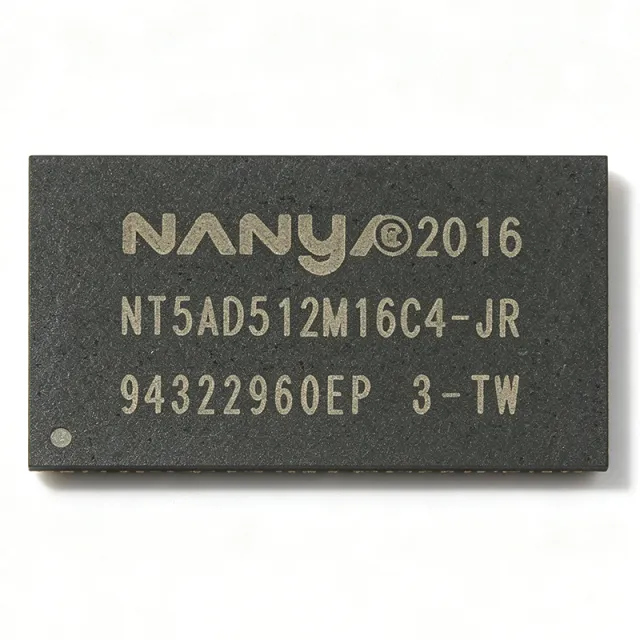
NT5AD512M16C4-JRU - DDR4 8Gb 512Mx16 Industrial SDRAM | Nanya
The Nanya Technology NT5AD512M16C4-JRU is an 8 Gbit DDR4 SDRAM organized as 512M x 16, operating at 1600 MHz (3200 Mbps data rate) with CL22 latency, powered from a 1.2 V VDD supply and housed in a 96-ball FBGA (PBGA96) surface-mount package. The U suffix denotes the industrial temperature grade of -40 C to +95 C with auto self-refresh support. DDR4 SDRAM (Double Data Rate 4 Synchronous Dynamic Random Access Memory) is the fourth generation of DDR DRAM, a class of volatile memory that stores each bit in a capacitor-based cell and transfers data on both clock edges. Within the memory hierarchy, DDR4 sits in the main-memory tier between cache SRAM and storage, and functions as the primary working memory for CPUs, MPUs, FPGAs, and ASICs in embedded and enterprise systems. Key features include auto self-refresh with a built-in temperature sensor, auto precharge, asynchronous reset, data mask (DM), write leveling, dynamic on-chip termination (ODT), ZQ calibration, and CRC functions. These capabilities reduce controller burden and improve signal integrity at high data rates, making the device reliable in wide-temperature industrial environments. Technically, the NT5AD512M16C4-JRU uses a CMOS core with a bank-group architecture supporting burst, interleaved, and 8n prefetch operations. The 16-bit I/O width simplifies 32-bit and 64-bit bus designs by reducing the number of components per bus compared with x4/x8 parts. Speed bins from 800 Mbps up to 3200 Mbps are supported across the JR family, with CL values scaling from CL12 to CL22 per the frequency table in the Nanya DDR4 8Gb datasheet. Typical applications include industrial automation controllers, networking and communication equipment, smart IoT gateways, office and enterprise systems, and automotive-adjacent industrial platforms where -40 C to +95 C operation is mandatory. When designing with this component, follow JEDEC DDR4 routing practice for length matching, ODT settings, and ZQ resistor placement, and verify controller compatibility with the 512M x16 organization and industrial speed bin. This page synthesizes distributor pricing, drop-in alternatives from Nanya and cross-brand sources, and practical design notes not found in the manufacturer datasheet.
YZ38F16SBB-9MFD-M - 4Gb DDR3L Industrial DRAM | Loongtion
The Loongtion YZ38F16SBB-9MFD-M is a 4Gb DDR3L SDRAM organized as 256M x 16, designed for industrial and embedded systems requiring wide-temperature operation. It comes in a 96-ball FBGA package and supports dual voltage operation at 1.35V (DDR3L) and 1.5V (DDR3), with a speed grade of -9 (DDR3-1866). The device is pin-to-pin compatible with major DDR3/DDR3L parts from Micron, Samsung, SK hynix, and others, making it a drop-in replacement for EOL or hard-to-source memory. DDR3 SDRAM (Double Data Rate 3 Synchronous Dynamic Random-Access Memory) is a type of volatile memory that transfers data on both edges of the clock, achieving high bandwidth. It is the third generation of DDR memory, succeeding DDR2, and is widely used in computing, networking, and embedded systems. DDR3L is a low-voltage variant that operates at 1.35V, reducing power consumption by about 20% compared to standard 1.5V DDR3, making it ideal for power-sensitive applications. Key features include a 4Gb density (256M x 16), 96-ball FBGA package, industrial temperature range of -40°C to +85°C, and support for both 1.35V and 1.5V operation. The device meets JEDEC standards for DDR3 and DDR3L, including ZQ calibration with an external 240Ω ±1% resistor. It is designed for reliable operation in harsh environments, with wide-temperature screening and testing. The YZ38F16SBB-9MFD-M is manufactured using a domestic (Chinese) supply chain, offering a secure and controllable source for critical applications. It is compatible with domestic platforms such as Fudan Micro, Phytium, Loongson, and Rockchip, and is available with development boards for evaluation. The device is also certified with ZZKK (domestic autonomous controllable) and WBK (pseudo-empty package) certifications, ensuring authenticity and quality. Typical applications include industrial automation, embedded computing, networking equipment, and military/aerospace systems where long-term availability and wide-temperature operation are critical. The pin-to-pin compatibility with industry-standard DDR3 parts simplifies BOM management and reduces supply chain risk. When designing with this device, ensure proper decoupling and signal integrity practices are followed, including placing 0.1µF and 10µF capacitors near the power pins and maintaining controlled impedance for the data and address lines. The device supports standard DDR3 termination and calibration schemes, so follow the JEDEC guidelines for layout and routing.
YZ48G16V-F9HPI-M - 8Gb DDR4 SDRAM x16 FBGA96 | Loongtion
The Loongtion YZ48G16V-F9HPI-M is an industrial-grade DDR4 SDRAM device with a density of 8Gb, organized as 512M x 16 bits. It is housed in a 96-ball FBGA package (FBGA96) and supports data rates up to 3200 MT/s. This memory chip is designed for wide-temperature operation from -40°C to +85°C, making it suitable for harsh environments such as oil & gas, outdoor telecom, and industrial edge computing. DDR4 SDRAM (Double Data Rate 4 Synchronous Dynamic Random-Access Memory) is a type of volatile memory that transfers data on both rising and falling edges of the clock signal, effectively doubling the data rate. It is the fourth generation of DDR memory, succeeding DDR3, and offers higher speed, lower power consumption, and increased density. DDR4 operates at a standard voltage of 1.2V, compared to 1.5V for DDR3, reducing power consumption by up to 40%. In the memory hierarchy, DDR4 SDRAM sits as the main system memory, directly interfacing with the memory controller on the CPU or SoC, and is essential for storing active data and instructions. Key features of the YZ48G16V-F9HPI-M include its 8Gb density, x16 organization, and FBGA96 package, which is pin-to-pin compatible with Samsung K4A8G165WC-BCWE and Micron MT40A512M16JY-07EAIT:B. The device supports a wide temperature range of -40°C to +85°C, ensuring reliable operation in extreme conditions. It also offers high-speed data transfer up to 3200 MT/s, enabling high-bandwidth applications. The industrial-grade qualification ensures robust performance and longevity in demanding environments. Technically, the YZ48G16V-F9HPI-M utilizes advanced DDR4 architecture with on-die ECC and data bus inversion to enhance signal integrity. The FBGA96 package provides a compact footprint while maintaining excellent thermal and electrical characteristics. The device is designed to meet JEDEC DDR4 standards, ensuring compatibility with standard memory controllers. The wide-temperature operation is achieved through rigorous testing and selection of components, making it a reliable choice for industrial applications. Typical applications include embedded systems, networking equipment, industrial PCs, and edge computing devices that require high-capacity, high-speed memory in harsh environments. The YZ48G16V-F9HPI-M is particularly suited for outdoor telecom base stations, oil & gas monitoring systems, and industrial automation controllers where temperature extremes are common. When designing with this device, ensure proper decoupling capacitors are placed near the power pins to minimize noise. Also, verify the memory controller supports the x16 organization and FBGA96 package. The wide-temperature range should be considered in thermal design to ensure the device operates within its specified limits.