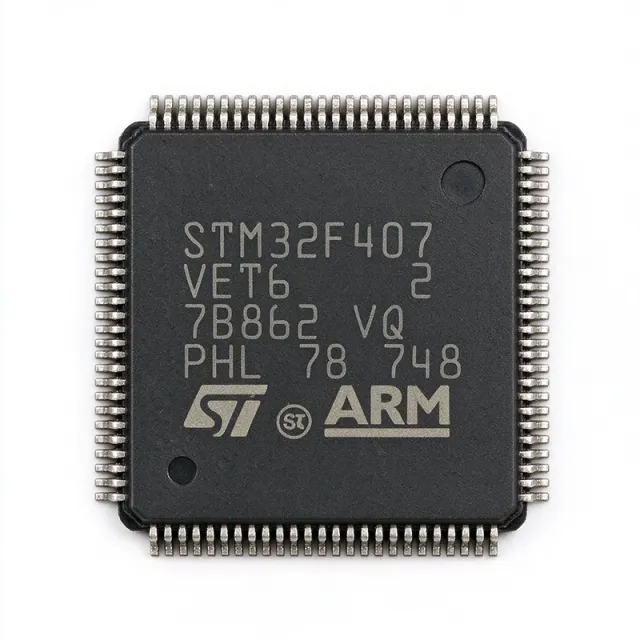
STM32F407IGH7
STM32F407IGH7 - 168MHz Cortex-M4 MCU | STMicroelectronics
The STMicroelectronics STM32F407IGH7 is a 32-bit Arm Cortex-M4 microcontroller with a 168 MHz maximum CPU frequency, 1 MB of Flash memory, and a 176-ball plus 25-ball UFBGA package measuring 10 mm by 10 mm. It combines the Cortex-M4 processor with floating-point capability, extensive connectivity, and substantial embedded memory for demanding control and communications systems. The verified distributor listing identifies the device as an STM32F4-series MCU with a 1 M x 8 Flash organization.
A microcontroller is a programmable system-on-chip that integrates a processor core, memory, peripherals, and communication interfaces into one component. Within the embedded-computing hierarchy, this device combines an Arm Cortex-M4 core, STM32F4 performance peripherals, embedded Flash and RAM, and industrial connectivity functions. Its 168 MHz operating point supports real-time control workloads, while the integrated networking and communications peripherals reduce the need for external interface devices.
Key verified features include the 32-bit Arm Cortex-M4 core, operation up to 168 MHz, 1 MB Flash, and the stated 210 DMIPS performance class in the retrieved family documentation. The family description also identifies an adaptive real-time accelerator, a memory protection unit, DSP capability, three ADCs, 17 timers, USB, Ethernet, and multiple communication interfaces. These features position the part for networked gateways, industrial equipment, motor-control systems, data acquisition, and embedded audio applications.
The device uses a compact 176+25 UFBGA package, making board-layout and assembly planning more demanding than a leaded package. Its dense ball array requires careful PCB escape routing, controlled power distribution, and inspection during manufacture. Verify the exact pin allocation, exposed-ball functions, electrical limits, and package drawing from the manufacturer datasheet before layout or a replacement decision.
Typical designs use the MCU as the central controller for Ethernet-connected equipment, sensor aggregation, motor control, USB peripherals, camera or image-related control, and industrial automation. The 168 MHz core is useful when the control loop or communications workload exceeds the requirements of a simpler microcontroller, while the 1 MB Flash capacity provides room for application code and data. Interface count and memory availability should still be checked against the exact ordering code.
A key design consideration is that a pin-compatible-looking alternative is not automatically a drop-in replacement. Confirm the BGA ball map, power pins, peripheral mapping, clock configuration, memory organization, and package drawing. Also account for software compatibility, peripheral differences, and any changes in electrical characteristics.
This page consolidates verified distributor specifications, a strict data-authenticity assessment, practical application guidance, and drop-in alternative qualification. The exact electrical limits, pin map, lifecycle details, pricing tiers, and regulatory declarations are explicitly marked when the supplied evidence does not establish them.
견적 요청
재고 있음