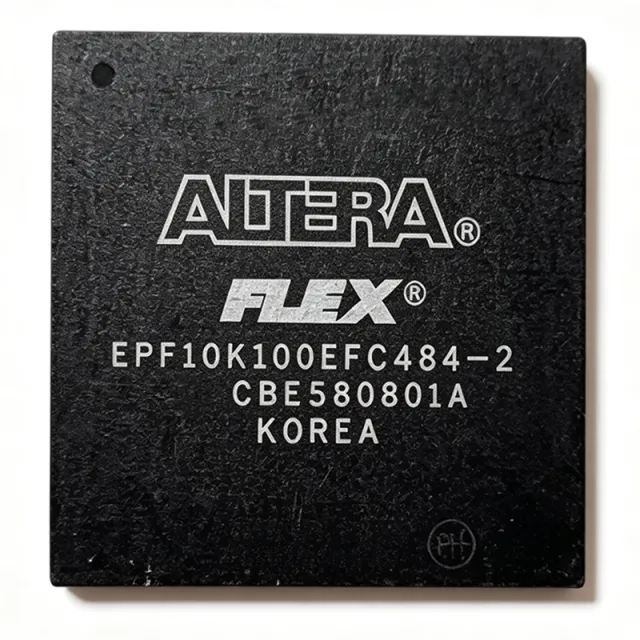
EPF10K100EQC240-2X
EPF10K100EQC240-2X - 100K Gate FLEX-10KE FPGA, 240-BQFP | Intel / Altera
The Intel / Altera EPF10K100EQC240-2X is a 100,000-gate FLEX-10KE family Field-Programmable Gate Array (FPGA) housed in a 240-pin BQFP (PQFP 32x32 mm) package, with 189 user I/Os and 49,152 logic elements built from 4,992 Look-Up Tables (LUTs) plus 624 Logic Array Blocks (LABs). Core supply is 2.375 V to 2.625 V, and the device is offered in a -2 speed grade with industrial-grade temperature rating suitable for commercial and industrial environments. The 'X' suffix denotes lead-free / extended-temperature processing per legacy Altera ordering nomenclature, and the part is part of the FLEX-10KE family that targets glue-logic, bus-bridging, and low-to-mid-density state-machine integration.
What is an FPGA? An FPGA (Field-Programmable Gate Array) is a programmable logic device containing an array of configurable logic blocks (LUTs), programmable interconnect, and I/O cells, all user-defined via a hardware description language (HDL) and a vendor toolchain. FPGAs sit hierarchically between fixed-function ASICs (highest performance, highest NRE) and CPLDs (simpler, non-volatile, lower density), offering parallel processing, in-system reprogrammability, and high I/O count without mask charges. The FLEX-10KE family is an SRAM-based, volatile-configuration architecture, so an external configuration memory (typically an EPC configuration device) is required at every power-up.
Key features of the EPF10K100EQC240-2X include 49,152 flip-flops equivalent storage, embedded array blocks (EABs) for RAM/ROM implementation, multiVolt I/O support for interfacing with 5.0 V / 3.3 V / 2.5 V rails, and 189 user I/Os on the 240-BQFP package - the highest I/O count of any FLEX-10KE package option. The device supports in-system programmability via the IEEE 1149.1 (JTAG) boundary-scan interface and the legacy Altera ByteBlaster / BitBlaster download cables.
Architecturally, the FLEX-10KE combines fine-grained logic (LUT-based LABs) with coarse-grained embedded memory (EABs of 2 Kbit each), enabling efficient implementation of register-rich datapaths alongside FIFO, ROM, and dual-port RAM blocks. The -2 speed grade offers faster propagation delays than -1, supporting higher fMAX designs in the 80-120 MHz range for typical 16-bit state machines and bus interfaces.
Typical applications include telecommunications line cards, industrial control backplanes, military/aerospace retrofit boards, legacy PCI bus bridges, and ASIC prototyping. The wide 240-BQFP footprint is chosen for through-hole or socketed assemblies where mechanical robustness matters more than PCB area.
When designing with this FPGA, note that configuration data is volatile - an EPC1, EPC2, or EPC8 configuration PROM is mandatory. The BQFP package requires a socket or careful solder profiling due to its 0.5 mm lead pitch and large thermal mass; thermal management is usually not critical at typical FLEX-10KE power budgets (under 1.5 W), but junction temperature must still be checked against the 70 °C commercial or 85 °C industrial limit.
This page synthesizes distributor pricing, FLEX-10KE family cross-references, drop-in alternatives, and practical design notes not consolidated in the manufacturer datasheet, sourced from DigiKey, Mouser, Octopart, and Altera legacy product documentation as of 2026-09-11.
견적 요청
문의하기