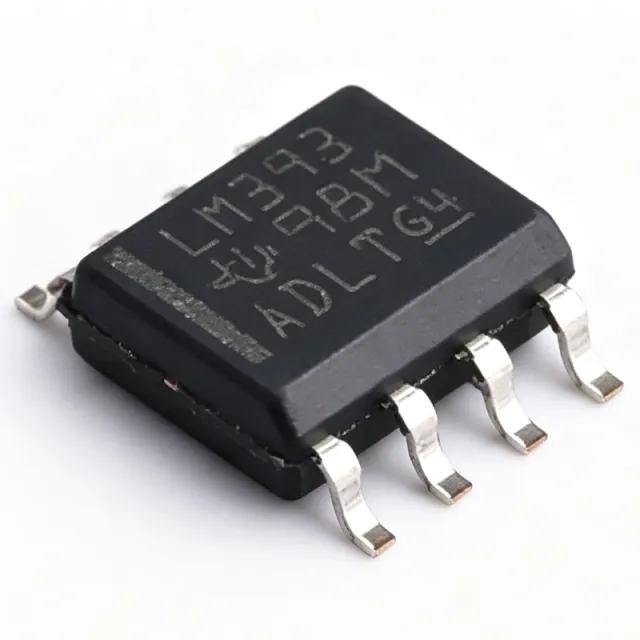
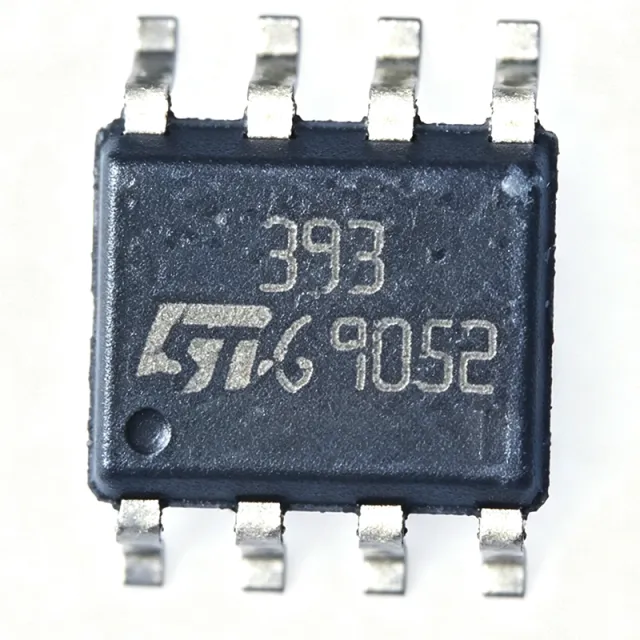
LM393P3
LM393P3 - Dual Open-Collector Comparator | Texas Instruments
Texas Instruments LM393P3 is a dual differential voltage comparator in an 8-pin plastic dual in-line package (8-PDIP). The device provides two independent comparison channels with open-collector outputs, allowing each output to be pulled up to a compatible logic supply and to drive multiple wired-open-collector loads. According to the supplied manufacturer and distributor records, the LM393 family is intended for commercial-grade applications and operates from a 2 V to 30 V supply range, with a 0 °C to 70 °C operating-temperature classification.
A comparator is a linear integrated circuit that evaluates two input voltages and produces a logic-level result indicating which input is higher. In the LM393, two comparators share a common supply and ground while retaining separate non-inverting, inverting, and output connections. This dual-channel architecture belongs to the comparator IC hierarchy, where the LM393 occupies the general-purpose, low-power, open-collector segment of the broader analog and power-management semiconductor category.
The principal engineering benefit is the open-collector output architecture. Unlike a totem-pole output, an open collector does not actively drive the output high, allowing a pull-up resistor to establish the high logic level. This supports wired-open-collector or wired-AND behavior, permits different supply domains for the pull-up rail, and requires an external pull-up on every output used in a design. The two channels can therefore implement independent threshold decisions, window detection, or complementary comparisons.
The LM393P3 uses the standard LM393 differential-comparator architecture rather than rail-to-rail input stages. Input behavior must therefore be evaluated against the device's common-mode and differential input limits in the manufacturer datasheet, especially when comparing signals near either supply rail. Because the verified records do not provide numerical input-offset, response-time, input-bias-current, output-sink-current, or channel-separation figures, those values require confirmation in the official LM393 datasheet before precision timing or sensing decisions are finalized.
Typical uses include industrial sensor thresholding, overvoltage and undervoltage detection, battery monitoring, control-loop signal comparison, and digital-interface adaptation. A practical application places the signal under test on one input and a reference voltage from a divider on the other; the open-collector output then changes state when the relation between the two voltages changes. A pull-up resistor converts the output state to a valid logic voltage, while hysteresis can reduce repeated switching when a slowly changing input crosses the reference.
For a new design, verify the required output current, input range, temperature grade, and logic compatibility against the datasheet before releasing the schematic. Do not omit the output pull-up resistors, and do not assume that the open collector can source current. Check whether a logic-family or application-specific comparator offers lower offset, faster response, rail-to-rail input operation, push-pull outputs, or automotive qualification. This page combines the verified product records with package, sourcing, comparison, and design guidance focused on drop-in replacement decisions.
견적 요청
문의하기