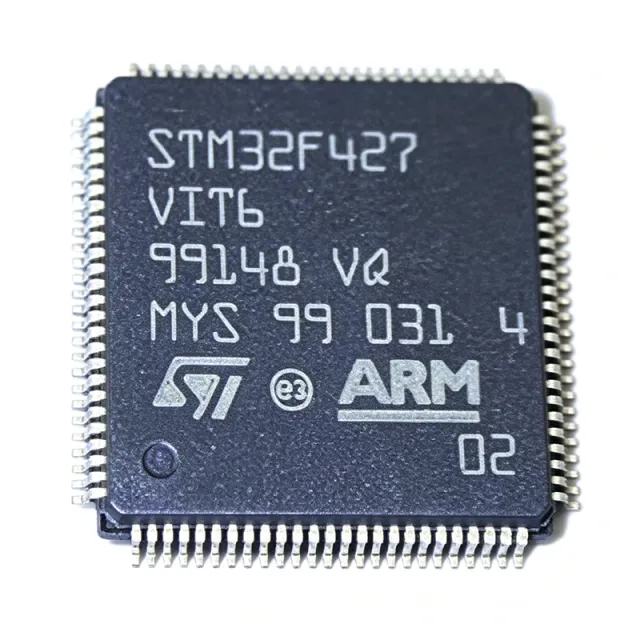
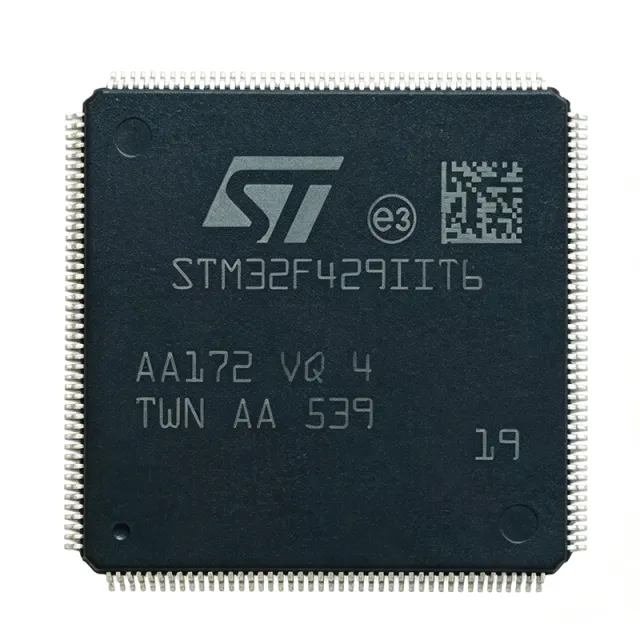
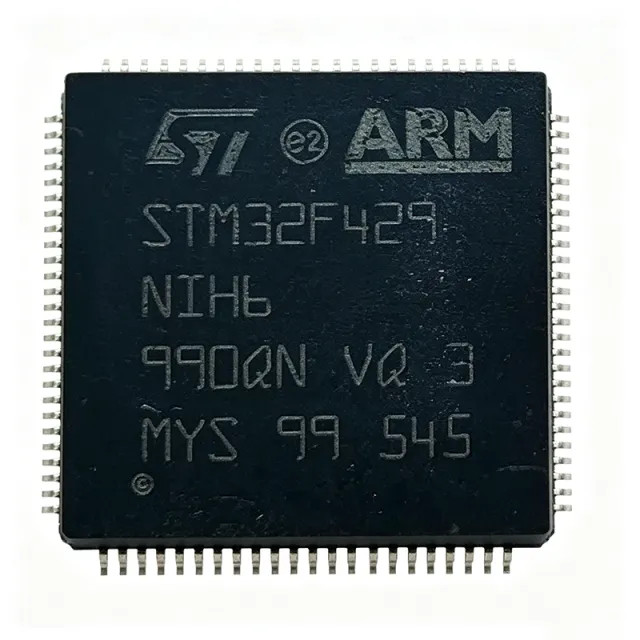
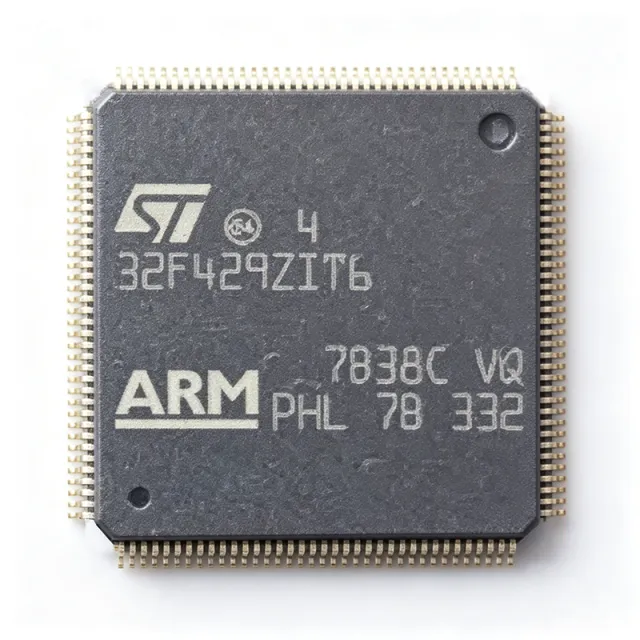
STM32F429IGT6
STM32F429IGT6 - 180MHz Cortex-M4 MCU | STMicroelectronics
The STMicroelectronics STM32F429IGT6 is a 32-bit Arm Cortex-M4 microcontroller operating up to 180 MHz, with 1 MB of Flash memory, 256 KB of system SRAM, 4 KB of backup SRAM, and 17 timers in a 176-pin LQFP package. The Cortex-M4 core includes a single-precision FPU and DSP instructions, while the ART Accelerator supports zero-wait-state execution from Flash. Its integrated connectivity includes USB OTG HS/FS, Ethernet, and numerous serial and display interfaces.
A microcontroller is an integrated semiconductor that executes firmware, controls peripherals, and provides the central processing element for embedded equipment. The STM32F4 family belongs to the MCU hierarchy and combines a RISC processor core, embedded nonvolatile Flash, SRAM, timers, analog converters, communication controllers, and GPIO into one device. This integration reduces component count and supports deterministic control for industrial, communications, audio, and human-machine-interface equipment.
Key features include 225 DMIPS at up to 180 MHz, an adaptive real-time accelerator, three ADCs, LCD-TFT controller, full-speed USB interfaces, Ethernet connectivity, and 17 timers. The snippet identifies USB OTG HS/FS, Ethernet, 3 ADCs, and 20 communication interfaces as major capabilities. Depending on the exact ordering code and device variant, exposed memory and peripheral resources must be reconciled with the manufacturer datasheet before PCB release.
The Cortex-M4 architecture combines a 32-bit RISC instruction set, single-precision floating-point hardware, DSP instructions, an MPU, and adaptive Flash acceleration. This supports high-throughput control and signal-processing workloads without requiring a separate processor. The IGT6 ordering code specifically provides 1 MB of Flash rather than the upper 2 MB capacity available across the broader STM32F427xx and STM32F429xx family.
Typical applications include industrial HMIs, connected industrial equipment, data acquisition, USB- or Ethernet-connected controllers, audio processing, and high-performance embedded control. Parallel LCD support is particularly relevant to human-machine interfaces, while Ethernet and USB permit network management, firmware updating, and host connectivity when the board design supplies the required clocks, transceiver connections, protection, and routing.
Designers should allocate the complete 176-pin LQFP footprint, follow the manufacturer package and pin definitions, and preserve adequate decoupling near every supply pin. Firmware must be validated for clock-tree limits, peripheral pin multiplexing, external memory requirements, and unused-pin treatment. A hardware drop-in replacement should be approved only after comparing the exact pinout, memory size, electrical limits, peripheral population, and firmware assumptions.
견적 요청
재고 있음