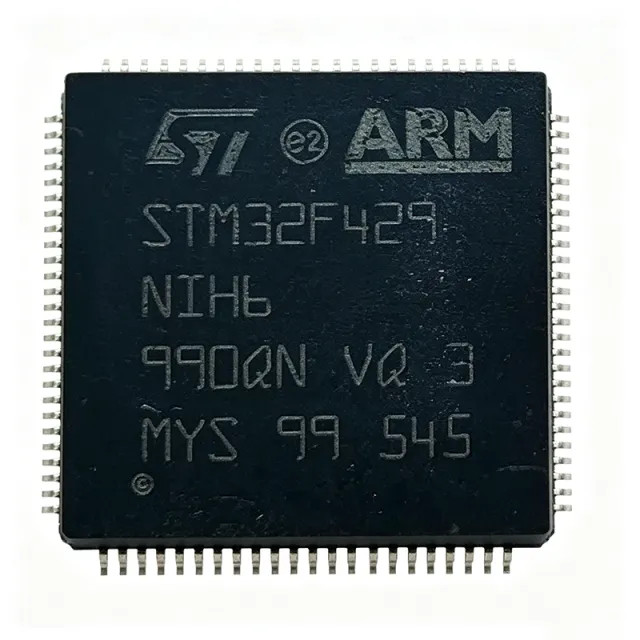
STM32F429NIH6 - 180MHz ARM Cortex-M4 MCU 2MB Flash | STMicroelectronics
부품 번호: STM32F429NIH6 ✓ 활성| 수량 | 단가 | 합계 |
|---|---|---|
| 1 | $13.42 | $13.42 |
| 10 | $12.18 | $121.80 |
| 100 | $10.95 | $1,095.00 |
| 500 | $9.74 | $4,870.00 |
| 1,000 | $8.63 | $8,630.00 |
STM32F429NIH6 개요
What is a microcontroller (MCU)? A microcontroller is a compact integrated circuit that integrates a processor core, non-volatile Flash memory, volatile SRAM, and programmable input/output peripherals on a single die. Microcontrollers are the backbone of embedded systems, ranging from simple household appliances to complex industrial automation. The STM32F429NIH6 sits in the STM32F4 series of the broader STM32 family of 32-bit ARM Cortex-M MCUs; within that hierarchy it is a Cortex-M4 device with DSP and FPU, enabling efficient signal processing and floating-point math for real-time applications.
Key features include the ARM 32-bit Cortex-M4 core with adaptive real-time (ART) accelerator that enables 0-wait state execution from Flash at 180 MHz, a TFT-LCD controller with Chrom-ART, a parallel camera interface, a cryptographic/hash processor, a true random number generator (TRNG), and an external memory controller (FMC) that supports SDRAM. Communication interfaces include USB OTG HS/FS, 10/100 Ethernet MAC, multiple USART/UART, SPI, I2C, CAN, and SDIO instances. Three 12-bit ADCs and two 12-bit DACs support mixed-signal designs, and 17 timers plus an RTC cover nearly any timing requirement.
From a technical depth perspective, the dual-bank Flash architecture allows read-while-write, enabling in-field firmware upgrades without halting the application. The ART accelerator prefetches and caches instructions to remove the Flash wait-state penalty at full CPU speed, so the device can sustain 225 DMIPS without external memory. The integrated TFT-LCD controller drives up to 24-bit parallel RGB interfaces without an external controller, while the FMC permits glueless external SDRAM/NOR/NAND expansion for buffer-rich graphics or data-logging designs.
Typical applications include high-end industrial control systems, human-machine interfaces (HMIs) with rich graphical user interfaces, point-of-sale terminals, medical devices, consumer electronics with TFT displays, IoT gateways requiring Ethernet/USB, and building automation. The combination of 2 MB code room and 256 KB SRAM lets designers run large graphical stacks (TouchGFX, emWin, LVGL) plus real-time control loops on a single chip.
When designing with this device, ensure proper decoupling on every supply pin, a continuous low-impedance ground plane beneath the TFBGA, and at least a 4-layer PCB to fan out the 0.8 mm pitch. Verify thermal performance since the 216-ball TFBGA exposes most of the heat through the inner balls and vias; a thermal pad or copper-in-paste array on the center balls is recommended for high-utilization designs. Take advantage of Sleep, Stop, and Standby modes to minimize power in battery-backed applications.
드롭인 대체품: STM32F429NIH6 — 동일 패키지, 핀 호환. PCB 재작업이 필요한 다른 패키지 부품은 제외됩니다.
이 시리즈의 변형
다음과 드롭인 호환되는 동일 시리즈 모델: STM32F429NIH6 (동일 폼 팩터 및 풋프린트) — 차이점: Package, Operating Temperature, SRAM, Flash Memory, Timers.
빠른 비교 도구 — 나란히 비교할 대체 부품을 선택하십시오:
STM32F429NIH6G
✅ 드롭인📋 참조 대체품 (카탈로그에 없음)
STM32F429NIH7
✅ 드롭인📋 참조 대체품 (카탈로그에 없음)
STM32F439NIH6
✅ 드롭인📋 참조 대체품 (카탈로그에 없음)
STM32F429IIT6
✅ 드롭인✓ 재고 있음
$8.3523 / 개
데이터시트 보기 →STM32F469NIH6
✅ 드롭인✓ 재고 있음
$9.2 / 개
데이터시트 보기 →STM32F479NIH6
✅ 드롭인✓ 재고 있음
$11.75 / 개
데이터시트 보기 →STM32F437IIH6
✅ 드롭인✓ 재고 있음
$10.6 / 개
데이터시트 보기 →STM32F429NIH6 최대 정격 & 전기적 특성
| Core Architecture | ARM 32-bit Cortex-M4 with FPU and DSP instructions |
| Maximum CPU Frequency | 180 MHz |
| DMIPS | 225 DMIPS (1.25 DMIPS/MHz, Dhrystone 2.1) |
| Flash Memory | 2 MB dual-bank |
| SRAM | 256 KB |
| 패키지 | 216-TFBGA (13x13 mm), 0.8 mm pitch |
| 공급 전압 | 1.8 V to 3.6 V (typ. 2.5 V / 3.3 V) |
| 동작 온도 | -40C to +85C (industrial grade) |
| USB | USB 2.0 OTG Full-Speed and High-Speed |
| Ethernet | 10/100 MAC (IEEE 802.3) |
| CAN | 2x CAN 2.0B |
| Display Controller | TFT-LCD up to 24-bit parallel RGB |
| ADCs | 3x 12-bit, up to 2.4 MSPS |
| DACs | 2x 12-bit |
| Timers | 17 (including 12-bit timers, PWM, low-power timers) |
| Cryptography | AES 128/192/256, hash (SHA-1/MD5), TRNG |
| 실장 유형 | Surface Mount (BGA) |
| MSL 레벨 | 3 (per JEDEC J-STD-020) |
| RoHS 상태 | Compliant |
STM32F429NIH6 216-tfbga (13x13 mm), 0.8 mm pitch 핀 구성 가이드
STM32F429NIH6(216-tfbga (13x13 mm), 0.8 mm pitch 패키지)의 핀 구성입니다. 이 디지털 IC에는 GPIO, 통신 인터페이스(UART, SPI, I2C), 전원 핀이 포함되어 있습니다. 대체 핀 기능과 구성 옵션은 제조사 데이터시트를 참조하십시오. 임베디드 시스템 설계와 PCB 레이아웃에 필수적입니다.

다음에 대한 상세 핀아웃 데이터 없음: STM32F429NIH6.
다음을 참조하십시오: 데이터시트 전체 핀 구성은 다음을 참조하십시오.
일반적인 애플리케이션
STM32F429NIH6 적합 용도: 7 애플리케이션s: Industrial Human-Machine Interface (HMI), Point-of-Sale (POS) Terminals, Medical Patient Monitoring Devices, Industrial IoT Gateways, Smart Home Control Panels, Building Automation Controllers, Audio Playback and Mixing Consoles.
Industrial Human-Machine Interface (HMI)
The STM32F429NIH6 fits industrial HMI panels because the integrated TFT-LCD controller drives RGB panels up to 24-bit directly without an external controller, while the 2 MB dual-bank Flash and 256 KB SRAM support TouchGFX, emWin, or LVGL graphical stacks at 180 MHz. Designers and engineers can run multi-page UIs with anti-aliased fonts, transparent widgets, and real-time data overlays. The on-chip FMC connects SDRAM for buffer-rich animations, and 17 timers drive backlight PWM, touch sampling, and UI refresh. Compared to a discrete MCU plus external LCD controller, the F429 reduces BOM, PCB area, and EMI. The 216-TFBGA package exposes the wide bus and high pin count needed for parallel RGB and capacitive touch I2C.
추천
Point-of-Sale (POS) Terminals
The STM32F429NIH6 is well-suited to POS terminals that combine a color TFT, touchscreen, EMV card reader, thermal printer, Ethernet, and USB peripherals on a single board. The 180 MHz Cortex-M4 core runs the UI stack plus transaction logic, while 2 MB Flash stores fonts, logos, and the application image with dual-bank support for safe firmware updates. The USB OTG HS/FS enables host-mode peripherals (printers, scanners) plus device-mode PC sync. The 10/100 Ethernet MAC connects the terminal to payment networks with low BOM cost, and the TRNG plus AES accelerate tokenized transactions. Designers and engineers can use the SDIO to log transactions locally on microSD.
추천
Medical Patient Monitoring Devices
The STM32F429NIH6 powers bedside patient monitors that display vital signs (ECG, SpO2, NIBP, capnography) on a color TFT and log to internal storage. The Cortex-M4 DSP instructions accelerate FFT-based heart-rate variability and respiratory analysis, while the three 12-bit ADCs sample multiple sensor channels at high rates. The TFT controller drives the bedside display without external graphics hardware, and the FMC ties to SDRAM for waveform buffers. Designers and engineers can use the CAN interfaces to talk to ventilator or infusion-pump modules, and the Ethernet MAC streams waveforms to a hospital EMR system. The TRNG plus AES hardware (via drop-in F439) supports secure communications for medical IoT.
추천
Industrial IoT Gateways
The STM32F429NIH6 is a strong fit for industrial IoT gateways that bridge Modbus, CAN, RS-485, and Ethernet to MQTT or OPC-UA clouds. The Cortex-M4 with FPU handles TLS 1.2/1.3 cipher suites and JSON/XML serialization without an external MPU. The on-chip Ethernet MAC plus USB OTG HS/FS gives two networking paths, and the dual-bank Flash supports secure firmware updates over the air. Designers and engineers can use the SDIO to log telemetry to microSD for offline replay. Compared with an MCU plus external Ethernet PHY, the F429 simplifies the BOM and lowers EMI.
추천
Smart Home Control Panels
The STM32F429NIH6 drives wall-mounted smart-home control panels that combine lighting, HVAC, security, and audio controls behind a color TFT. The TFT controller and Chrom-ART accelerator deliver smooth UI animations, while the dual-bank 2 MB Flash holds multilingual UI assets and over-the-air updates. The on-chip Ethernet plus Wi-Fi (via SDIO/SPI) connect to home routers, and the touch controller I2C supports projected-capacitive panels. Designers and engineers can use the low-power RTC plus Standby mode for always-on scheduling. The same 216-TFBGA package offers a long-term migration path to F469 (MIPI-DSI) or F479 (with crypto) on the same PCB.
추천
Building Automation Controllers
The STM32F429NIH6 powers building automation controllers for HVAC, lighting, and access control, combining KNX, BACnet, Modbus, and CAN on a single device. The Cortex-M4 core runs scheduling, PID loops, and a color TFT status display simultaneously. The dual-bank 2 MB Flash supports field upgrades across thousands of deployed units, while the 256 KB SRAM handles protocol buffers and UI frames. Designers and engineers can use the Ethernet MAC plus USB for commissioning laptops, and the SDIO for local trend logging. Compared with separate MCU + LCD controller designs, the F429 cuts BOM cost and simplifies long-term supply for high-volume commercial installations.
추천
Audio Playback and Mixing Consoles
The STM32F429NIH6 suits digital audio mixers and high-resolution music players with TFT interfaces. The Cortex-M4 DSP instructions accelerate FFT, FIR, and IIR filters for parametric EQ and dynamics, while the three 12-bit ADCs sample analog inputs and the two 12-bit DACs drive monitor outputs. The TFT controller displays meters and menus, the SDIO reads WAV/FLAC libraries, and the USB OTG HS streams audio from a PC. Designers and engineers can use the I2S peripherals plus external CODECs like the SGTL5000 or WM8994 FM (SMD). The 216-TFBGA package exposes the wide bus needed for parallel RGB status displays plus I2S/USB.
추천
추천 제품 요약
엔지니어링 참조 데이터: STM32F429NIH6 — 비교, 설계 지침 및 규정 준수 정보.
선택 가이드
대체품과의 비교
| 파라미터 | 이 제품 | STM32F429NIH6G | STM32F429NIH7 | STM32F439NIH6 | STM32F469NIH6 | STM32F479NIH6 |
|---|---|---|---|---|---|---|
| Brand | STMicroelectronics | STMicroelectronics | STMicroelectronics | STMicroelectronics | STMicroelectronics | STMicroelectronics |
| Package | 216-TFBGA (13x13) | 216-TFBGA (13x13) - same | 216-TFBGA (13x13) - same | 216-TFBGA (13x13) - same | 216-TFBGA (13x13) - same | 216-TFBGA (13x13) - same |
| Core | Cortex-M4 with FPU | Cortex-M4 with FPU | Cortex-M4 with FPU | Cortex-M4 with FPU | Cortex-M4 with FPU | Cortex-M4 with FPU |
| Max Frequency | 180 MHz | 180 MHz | 180 MHz | 180 MHz | 180 MHz | 180 MHz |
| Flash Memory | 2 MB dual-bank | 2 MB dual-bank | 2 MB dual-bank | 2 MB dual-bank | 2 MB dual-bank | 2 MB dual-bank |
| SRAM | 256 KB | 256 KB | 256 KB | 256 KB | 256 KB | 256 KB |
| Hardware Crypto | None (software AES/SHA) | None | None | AES 128/192/256, SHA, MD5, TRNG | None | AES 128/192/256, SHA, MD5, TRNG |
| Display Interface | Parallel RGB up to 24-bit | Parallel RGB | Parallel RGB | Parallel RGB | MIPI-DSI + Parallel RGB | MIPI-DSI + Parallel RGB |
| Operating Temperature | -40C to +85C | -40C to +85C | -40C to +105C | -40C to +85C | -40C to +85C | -40C to +85C |
주요 차별점
- Integrated TFT-LCD controller with Chrom-ART accelerator (vs STM32F427NIH6)
- 216-TFBGA footprint with 0.8 mm pitch enables the widest peripheral set (vs STM32F429VIT6 (LQFP-100))
- Dual-bank Flash supports in-field firmware upgrades (vs GD32F450 (GigaDevice cross-brand))
설계 노트
The 216-TFBGA at 0.8 mm pitch requires a 4-layer PCB minimum with micro-via or laser-drilled via fanout to break out the inner balls. Designers and engineers should follow ST's 'STM32F4 PCB design guidelines' reference manual, including stitching vias around the package perimeter and a continuous ground plane beneath the BGA. The center balls should be connected to a thermal copper pour with vias-in-pad to dissipate the 5-7 W typical dissipation during peak CPU + display activity.
The STM32F429NIH6 integrates a 1.2 V LDO voltage regulator that supplies the core; however the user must place decoupling capacitors as close as possible to every VDD/VSS ball pair. Designers and engineers should use a 100 nF X7R per VDD pin plus 4.7 uF bulk caps on each regulator domain (VDD, VDDA, VDDUSB). Power-on reset requires VDD to rise monotonically; if a battery backup domain (VBAT) is used, add a Schottky diode to prevent reverse supply.
A common mistake is treating the FB502/BGA pinout as if it were the LQFP-176 version - the inner balls carry different functions and remapping is impossible. Designers and engineers must verify their schematic against the TFBGA-216 ball map (alphanumeric grid A1-U14) before layout. Another pitfall is failing to enable the ART accelerator in the FLASH ACR register - without it the core stalls waiting for Flash, capping performance well below 180 MHz. Always configure wait states per the datasheet clock tree table.
Estimated: at 180 MHz CPU, 3.3 V supply, and 60% peripheral activity, core dissipation reaches ~250 mW. With the 216-TFBGA theta_JA of ~28 C/W on a 4-layer JEDEC test board, junction temperature rises ~7 C above ambient. Designers and engineers planning sealed enclosures should add a center-ball thermal pad or copper-in-paste array to drop theta_JA below 20 C/W, keeping Tj below 125 C at 70 C ambient.
규정 준수 정보
RoHS and REACH compliance per ST product page. Industrial -40C to +85C temperature grade; for AEC-Q100 choose STM32F429NIH7 or contact ST for automotive part numbers.







