제품 (20,000+)

TMS320F206PZ - Digital Signal Processor | Texas Instruments
TMS320F206PZ

TMS320F206PZ - Digital Signal Processor | Texas Instruments

The Texas Instruments TMS320F206PZ is a TMS320C20x-generation digital signal processor fabricated with high-performance static CMOS technology and optimized for low-power operation. It is packaged in a 100-pin LQFP measuring 14 mm by 14 mm and combines a specialized signal-processing instruction set, Harvard-style architecture, on-chip peripherals, and on-chip memory. The device is intended for embedded systems that require deterministic real-time signal processing, including digital audio, industrial control, communications, and instrumentation. A digital signal processor, or DSP, is a specialized microprocessor architecture optimized for arithmetic operations on continuously changing signals. Unlike a general-purpose processor, a DSP emphasizes predictable execution of filtering, Fourier-analysis, convolution, and waveform-shaping algorithms. In the broader semiconductor hierarchy, the TMS320F206PZ is a digital signal processor within the embedded processor and microcontroller family, combining controller integration with dedicated real-time computational hardware. The supplied manufacturer information identifies the processor as a member of the TMS320C2xLP core CPU and the TMS320C20x generation. Its static CMOS implementation combines the architectural benefits of a dedicated DSP with low-power characteristics. On-chip memory and peripherals reduce the need for external components in compact embedded systems, while the source-code compatibility stated for the TMS320C25 generation can simplify migration of suitable legacy signal-processing software. A principal advantage is the device's integration of a specialized instruction set with real-time processing resources. The TMS320C20x architecture is designed around the computational demands of digital filtering and other mathematically intensive tasks rather than general desktop-style software execution. This makes it appropriate when predictable processing throughput, compact integration, and legacy software continuity are more important than broad ecosystem size or a conventional microcontroller pin count. Typical uses include audio and communications signal conditioning, industrial motor and process control, data acquisition, spectrum analysis, and embedded instrumentation. In these systems, the processor can execute filtering and control algorithms while its integrated peripherals manage data movement and external interfaces. The 100-pin LQFP package is comparatively substantial for a low-power embedded device, but it provides enough physical connection capacity for a larger legacy DSP system with multiple peripheral and bus signals. Designers should verify the complete electrical, timing, memory, and pin-assignment information from the manufacturer datasheet before schematic capture or PCB layout. In particular, legacy DSP designs require careful attention to clocking, memory-interface timing, analog-interface requirements, decoupling, and signal-conditioning components. Because the verified source set does not provide numerical clock, memory-capacity, I/O, voltage-range, or thermal limits, those values must be confirmed rather than inferred. This page organizes the verified distributor and manufacturer information, highlights the role of the TMS320F206PZ in embedded signal-processing systems, and separates documented facts from parameters that still require datasheet confirmation. It also provides application guidance and sourcing links, while explicitly identifying the absence of verified drop-in alternatives and exact current pricing rather than presenting unsupported substitutions.

견적 요청 문의하기
TMS320F240PQA - 20MHz 16-Bit Flash DSP | TI
TMS320F240PQA

TMS320F240PQA - 20MHz 16-Bit Flash DSP | TI

The Texas Instruments TMS320F240PQA is a 16-bit fixed-point digital signal processor and DSP controller with a 20 MHz maximum clock frequency, 32 KB of flash program memory organized as 16K × 16 words, and a 132-pin BQFP package measuring 24.13 × 24.13 mm. Its industrial temperature rating covers −40 °C to +85 °C. A digital signal processor is a specialized microprocessor architecture optimized for arithmetic-intensive operations on sampled signals. Within the semiconductor hierarchy, the TMS320F240 belongs to the 16-bit fixed-point DSP controller family, combines a DSP core with embedded control peripherals, and provides deterministic execution for motor-control, power-conversion, and industrial signal-processing systems. Its C2xx-class architecture is object compatible with the TMS320C2xx family and source-code compatible with the TMS320C25 family. The device includes 32 KB of on-chip flash memory, allowing control code and constant data to be stored locally without an external program-memory device. The 16-bit data architecture supports efficient fixed-point arithmetic, while the 20 MHz operating frequency provides a 50 ns instruction-cycle reference. The 132-pin plastic quad flat package exposes the processor, memory, control, communications, and power-management resources required by a standalone DSP controller. The TMS320F240 architecture is designed around a high-performance static CMOS implementation. Its fixed-point processing core is intended for deterministic control loops and real-time signal transformation, where predictable arithmetic throughput and direct hardware control are more important than general-purpose operating-system support. The flash-enabled F240 variant simplifies standalone system development compared with ROM-based C2xx controllers that require external program storage. Typical applications include digital motor control, inverter and power-converter control, industrial automation, communications signal processing, and embedded control systems with deterministic timing requirements. The combination of a 20 MHz DSP core, 32 KB of flash memory, and a broad set of embedded control peripherals allows the processor to combine control-law execution and signal conditioning in a single device. Designers should preserve the pin assignment, power-supply requirements, and external clock arrangement specified by the manufacturer datasheet. Because this is a 132-pin legacy quad flat package, PCB layout must account for its large body size and fine-pitch lead geometry. Firmware should also be validated for timing, peripheral sharing, and interrupt behavior before production deployment. This product page consolidates the verified device identity, memory organization, package data, operating limits, sourcing guidance, pin-compatible family information, and practical design considerations needed to evaluate the TMS320F240PQA before starting an embedded DSP design.

견적 요청 문의하기
TMS320F241FNS - 16-Bit 20MHz DSP with 16KB Flash | Texas Instruments
TMS320F241FNS

TMS320F241FNS - 16-Bit 20MHz DSP with 16KB Flash | Texas Instruments

The Texas Instruments TMS320F241FNS is a 16-bit fixed-point digital signal processor with a 20 MHz clock, 16 KB of on-chip flash memory, and a 68-pin PLCC package. It belongs to the TMS320C2xx family and uses the TMS320C2xx CPU core, with 8K x 16 words organized in flash memory. The device is intended for embedded control, industrial automation, communications, and signal-processing systems where deterministic fixed-point execution is required. A digital signal processor is a specialized microprocessor architecture optimized for repetitive mathematical operations such as filtering, Fourier analysis, control-loop calculations, and waveform processing. Unlike a general-purpose microcontroller, the TMS320F241FNS places multiply-accumulate operations, dedicated memory interfaces, and interrupt-driven peripherals around a highly parallel fixed-point CPU core. The 50 ns instruction cycle time listed for the TMS320F241 family supports predictable control-loop execution at a 20 MHz system clock. Key device characteristics include 16 KB of flash memory, a 5 V supply, a 16-bit arithmetic datapath, and compatibility with the TMS320C2xx instruction set and development environment. The flash-based configuration consolidates program storage on the device, while the PLCC package provides a leaded, socket-compatible mechanical option for industrial control equipment and legacy upgrades. The package measures 24.23 mm by 24.23 mm according to the distributor listing. TMS320F241FNS is suitable for motor-control loops, digital power conversion, industrial data acquisition, communications front ends, and embedded audio or measurement systems. Its fixed-point architecture allows designers to implement deterministic filters and control algorithms without floating-point hardware. The C2xx-compatible instruction set also supports source-level migration paths from earlier TMS320C25-family designs, while the flash-memory version simplifies standalone system deployment. When designing a new board, verify the complete pin configuration, peripheral multiplexing, and clocking requirements in the manufacturer datasheet before layout release. The 68-pin PLCC footprint is not interchangeable with leaded PQFP packages, so socketed legacy systems and new SMT designs require different PCB land patterns. This page consolidates the device specifications, drop-in replacement candidates, and design guidance engineers need when planning a controlled substitution or repair.

견적 요청 문의하기
TMS320F241PG - 16-Bit 20MHz DSP with Flash | Texas Instruments
TMS320F241PG

TMS320F241PG - 16-Bit 20MHz DSP with Flash | Texas Instruments

The Texas Instruments TMS320F241PG is a 16-bit fixed-point digital signal processor with a 20 MHz C2xx CPU, 16 KB of on-chip flash memory, and a 64-pin QFP package measuring 14 mm by 20 mm. It combines fixed-point signal-processing performance with embedded flash memory in a surface-mount controller package designed for real-time control and DSP applications. A digital signal processor, or DSP, is a semiconductor optimized to execute mathematical operations on sampled data efficiently. A fixed-point DSP represents numerical values as integers and scaled fractional quantities, making it well suited to control loops, filtering, waveform generation, motor regulation, and industrial automation. The TMS320F241 belongs to the C2000 family of DSP controllers, which combines signal-processing capability with embedded control peripherals. The verified device description identifies a 16-bit architecture operating at 20 MHz, with 16 KB of flash organized as 8K by 16 words. Its 64-QFP package supports compact surface-mount assembly while providing a larger pin count than the QFP packages commonly used for small microcontrollers. The exact instruction-cycle time is stated in the retrieved technical material as 50 ns, which is consistent with a 20 MHz operating rate. The C2xx CPU core provides the computational foundation for digital filtering, control calculations, and fixed-point algorithms. Because the device includes embedded flash, a complete application can store its program code on the DSP itself rather than depending on an external program-memory device. This integration can simplify hardware and firmware organization in dedicated control equipment, although memory-intensive, multi-stage signal-processing designs must still evaluate the available 16 KB capacity carefully. Typical applications include digital motor control, industrial power conversion, servo and position control, embedded instrumentation, and real-time signal conditioning. Its 20 MHz rate and fixed-point architecture are especially useful in control loops where deterministic arithmetic and compact embedded code are more important than floating-point performance or a large general-purpose software ecosystem. Designers should review the manufacturer datasheet for the exact pin assignments, peripheral allocation, electrical limits, timing requirements, and external interface configuration. PCB layout should provide suitable decoupling at the supply pins and preserve clean signal routing, particularly when the DSP drives converters, sensors, or communication interfaces. Legacy software and peripheral differences must also be evaluated before migration to a newer C2000 device. This page combines the verified distributor and manufacturer references with practical guidance for controller selection, replacement assessment, PCB reuse, and real-time DSP implementation. It distinguishes confirmed specifications from data that still requires confirmation, helping engineers make sourcing and design decisions without relying on unverified parametric claims.

견적 요청 문의하기
TMS320F241PGA - 20MHz 16-Bit DSP | Texas Instruments
TMS320F241PGA

TMS320F241PGA - 20MHz 16-Bit DSP | Texas Instruments

Texas Instruments TMS320F241PGA is a 16-bit fixed-point digital signal processor with a 20 MHz clock, 16 KB of flash memory, and a 64-QFP (14x20 mm) package. It combines the TMS320C2xx-compatible core with on-chip flash memory for a compact standalone control solution. A digital signal processor is a specialized microprocessor architecture optimized for arithmetic-intensive operations on streams of sampled data. The TMS320F240 family extends the TMS320C2xx CPU into the C2000 digital signal controller class, combining real-time signal processing with embedded control functions. Its fixed-point architecture supports efficient implementation of filtering, control, communications, and measurement algorithms. The device executes at 20 MHz with a 50 ns instruction cycle time, while its 16 KB flash program memory provides room for embedded firmware without an external program-memory device. The 5 V operating supply, 16-bit data width, and 64-QFP package make the TMS320F241PGA suitable for industrial control equipment where computational throughput, deterministic execution, and external memory or peripheral expansion are important. The CPU is object-compatible with the TMS320C2xx core and source-code-compatible with TMS320C25 software. This compatibility can simplify migration of qualifying control algorithms from older fixed-point DSP designs. External memory and peripheral interfaces expand the device beyond its internal flash, allowing designers to connect additional storage, communication controllers, analog interfaces, and application-specific peripherals when required. Typical uses include digital motor control, power-converter control, industrial automation, audio and communications signal processing, instrumentation, and embedded real-time control. The fixed-point format is particularly effective when algorithm scaling is well understood because integer and fractional operations can provide predictable execution time and efficient use of the 16-bit arithmetic architecture. PCB design should preserve a short return path for the 5 V supply, place decoupling capacitors close to the power pins, route clock and reset signals away from switching nodes, and use the manufacturer's pin and layout guidance for external memory interfaces. Signal integrity and electromagnetic-emission performance should be evaluated together because the 20 MHz processing requirement does not require high-speed external memory unless additional interfaces are enabled. This page combines the manufacturer's core device characteristics with package-aware alternatives, commercial guidance, application analysis, and practical design considerations. It also distinguishes confirmed same-footprint family parts from unsupported cross-brand substitutions, helping engineers make a replacement decision without assuming that merely similar DSP specifications guarantee pin-level compatibility.

견적 요청 문의하기
TMS320F243PGE - 20MHz 16-Bit C24x DSP | Texas Instruments
TMS320F243PGE

TMS320F243PGE - 20MHz 16-Bit C24x DSP | Texas Instruments

Texas Instruments TMS320F243PGE is a 16-bit C24x digital signal processor with a 20 MHz clock, 16 KB of flash memory, and a 144-pin LQFP package measuring 20 mm by 20 mm. It belongs to the TMS320C24x family of fixed-point digital signal processors and combines a DSP controller with embedded flash memory for standalone control and signal-processing designs. A digital signal processor is a specialized microprocessor architecture optimized for arithmetic-intensive operations on continuously sampled or generated signals. The C24x architecture combines a 16-bit fixed-point DSP core with embedded control functions, allowing the same device to implement filters, controllers, communications processing, and motor-control algorithms. Its position in the hierarchy is digital signal processor, then microprocessor, embedded controller, and semiconductor. The TMS320F243PGE operates from a fixed 5 V supply and executes at 20 MHz. Its 16 KB flash memory is organized as 8K by 16 bits, while the 144-LQFP package exposes the device's digital and analog control interfaces in a surface-mount format. The 20 mm by 20 mm package provides ample routing area for a complex mixed-signal DSP system and is suitable for industrial control boards, instrumentation, communications equipment, and embedded power-conversion systems. The 16-bit C24x core uses fixed-point arithmetic, making it well suited to digital filters, proportional-integral-derivative control, signal conditioning, and communications algorithms where integer execution speed and deterministic control are important. Embedded flash reduces the need for an external program-memory device in designs that fit entirely within the 16 KB program-memory capacity. Typical uses include digital power conversion, industrial motor control, measurement and signal-conditioning systems, communications front ends, and compact embedded control platforms. In each case, the device can execute control and signal-processing tasks in one programmable component, reducing the coordination burden associated with separate processor and controller architectures. PCB design should preserve clean analog and digital return paths, provide local bypass capacitance at the 5 V supply pins, and route high-current or switching outputs separately from sensitive measurement inputs. The 144-pin LQFP footprint requires careful fanout and soldering control, while the 20 MHz operating rate allows conservative clock routing with attention to return-path continuity. This page organizes the confirmed electrical, memory, package, and sourcing characteristics of the TMS320F243PGE, then adds application guidance, design checks, a same-footprint family alternative, and structured comparisons to support initial component selection and PCB planning.

견적 요청 문의하기
TMS320F2800152-Q1 - 100MHz C2000 MCU, 64KB Flash | TI
TMS320F2800152-Q1

TMS320F2800152-Q1 - 100MHz C2000 MCU, 64KB Flash | TI

The Texas Instruments TMS320F2800152-Q1 is an automotive-qualified C2000 real-time microcontroller featuring a 32-bit TMS320C28x core running at 100 MHz, 64 KB (32K x 16) of on-chip flash memory, integrated CAN-FD, and lockstep functional-safety capability rated ASIL B. It is offered in a 32-pin VQFN (5x5 mm) package (ordering part F2800152QRHBRQ1). A real-time microcontroller (MCU) is a single-chip embedded processor that executes control loops with deterministic, ultra-low latency. Within the power-management hierarchy, the C2000 family sits above generic MCUs by pairing a DSP-class C28x core with dedicated control peripherals such as high-resolution PWM, fast ADCs, and comparators, making it the de facto standard for digital power conversion and motor control. Key features include the cost-optimized F280015x architecture designed for power electronics, CAN-FD for automotive networking, lockstep core operation supporting ASIL B safety integrity levels, and AEC-Q100 automotive qualification (Q1). The 64 KB flash suits compact control firmware, while the C28x pipeline delivers deterministic interrupt latency essential for current-loop control at switching frequencies of 100 kHz and above. The device integrates the characteristic C2000 control-law accelerator ecosystem: ePWM modules, on-chip analog comparators, and serial communication peripherals. Combined with TI's C2000Ware and MotorControl SDK, engineers can deploy field-oriented motor control, LLC/PFC digital power supplies, and solar inverter control with minimal external components. Typical applications include automotive onboard chargers and DC-DC converters, traction-inverter auxiliary supplies, industrial servo drives, and high-density AC-DC power supplies where ASIL-rated safety and CAN-FD connectivity are required. Design consideration: budget the 64 KB flash carefully - C2000 math libraries and FOC stacks can exceed this footprint, so verify code size against the larger F280015x flash variants if your algorithm set grows.

견적 요청 문의하기
TMS320F2800153-Q1 - 120MHz C2000 MCU, ASIL-B | TI
TMS320F2800153-Q1

TMS320F2800153-Q1 - 120MHz C2000 MCU, ASIL-B | TI

The Texas Instruments TMS320F2800153-Q1 is an automotive-qualified C2000 real-time 32-bit microcontroller running at 120 MHz with 64 KB (32K x 16) of on-chip flash, HRPWM, CAN-FD, and lockstep CPU safety architecture rated ASIL B, housed in a 48-pin HTQFP (7x7 mm) package. It belongs to the cost-optimized F280015x family of ultra-low latency real-time MCUs designed for power electronics control. A real-time MCU is a class of 32-bit microcontroller that executes control-loop code deterministically with microsecond-scale interrupt latency. Within the power-management semiconductor hierarchy, it sits above analog controllers and below application processors, dedicated to closing high-frequency control loops such as digital power conversion and motor commutation. Key features include the C28x DSP core at 120 MHz, 64 KB flash with ECC, high-resolution PWM (HRPWM) for fine duty-cycle control in LLC and phase-shifted converters, CAN-FD for in-vehicle networking, and a lockstep CPU core with integrated safety mechanisms meeting ASIL B requirements of ISO 26262. The family is scalable: F2800152 through F2800157 share the same die, package, and pinout, differing mainly in flash memory size. Architecturally, the device combines the fixed-point C28x CPU with dedicated trigonometric math unit (TMU), CLA-style acceleration options, 12-bit ADCs, and ePWM modules that enable single-chip closure of current, voltage, and speed loops in digital power supplies, on-board chargers, and traction inverters. Typical applications include automotive on-board chargers (OBC), DC-DC converters, HEV/EV traction motor control, solar micro-inverters, and servo drives, where deterministic 100 kHz+ control loops and functional safety are mandatory. The CAN-FD interface connects directly to vehicle body and powertrain networks. Design tip: budget flash headroom of at least 20% above initial firmware size, or select the pin-compatible F2800154/155/156/157 variants with larger flash so an PCB respin is never needed. Prices as of 2026-08-28; see FAQ for current tier pricing.

견적 요청 문의하기
TMS320F2800154-Q1 - 100MHz C2000 MCU | Texas Instruments
TMS320F2800154-Q1

TMS320F2800154-Q1 - 100MHz C2000 MCU | Texas Instruments

The TMS320F2800154-Q1 is an automotive-grade C2000 real-time microcontroller from Texas Instruments, combining a 100-MHz C28x DSP core with 128 KB of embedded flash memory. It features CAN-FD for high-speed communication and lockstep architecture for ASIL B functional safety, making it suitable for safety-critical power electronics and motor control systems. The device is offered in the VQFN-40 (RHB) package with an exposed pad for thermal performance. A microcontroller (MCU) is a compact integrated circuit that contains a processor core, memory, and programmable peripherals. The C2000 family specifically targets real-time control applications, merging digital signal processing with MCU peripherals like PWM and ADC. This hierarchy places the C2000 in the broader category of embedded processors, bridging MCU and DSP design. Key features include a 128 KB flash for application code, a 100 MHz C28x core capable of controlling power conversion loops, and CAN-FD for automotive networking. The lockstep safety mechanism detects faults, enabling ASIL B compliance. AEC-Q100 qualification ensures operation in harsh vehicle environments. The F2800154-Q1 is ideal for applications requiring deterministic, low-latency control. Its high-resolution PWM and analog front-end support precise current and voltage regulation in converters. The device supports multiple communication interfaces, and the VQFN-40 package offers a compact footprint. Typical use cases include automotive motor drives, digital power supplies, battery management, and on-board chargers. The MCU's dual-role as a DSP and MCU simplifies designs by handling both math-intensive control and system management. When designing with this MCU, use proper decoupling and thermal via placement to ensure stability. The CAN-FD bus requires correct termination to maintain signal integrity.

견적 요청 문의하기
TMS320F2800155-Q1 - 120MHz C2000 Automotive MCU | Texas Instruments
TMS320F2800155-Q1

TMS320F2800155-Q1 - 120MHz C2000 Automotive MCU | Texas Instruments

The Texas Instruments TMS320F2800155-Q1 is an automotive C2000™ 32-bit real-time microcontroller built on the C28x core, running at 120 MHz with 128 KB of embedded flash memory. It comes in a 48-pin HTQFP (7x7) package and is designed for motor control, power conversion, and automotive safety applications. The device integrates high-resolution PWM (HRPWM) and CAN-FD interfaces, and features lockstep ASIL B capability for functional safety. A C2000 microcontroller is a family of 32-bit real-time MCUs optimized for control-loop processing. It sits between digital signal processors and general-purpose MCUs, offering the deterministic performance needed for closed-loop control in power electronics and motor drives. The TMS320F2800155-Q1 belongs to the C2000 real-time control platform, which is widely accepted in industrial drives, electric vehicles, and renewable energy systems. Key features include the 120 MHz C28x core with a floating-point unit, 128 KB flash, HRPWM for high-resolution pulse generation, CAN-FD for robust communication, and lockstep ASIL B safety. The 48-pin HTQFP package provides a compact solution while maintaining thermal performance. The device also supports multiple serial interfaces, including UART, SPI, I2C, and CAN-FD, enabling flexible system integration. The C28x core is a Harvard-architecture processor with a unified memory map. Its floating-point unit accelerates complex control algorithms. The HRPWM module supports high-resolution duty cycles up to 150 ps, enabling precise control in power converters. CAN-FD supports higher data rates and larger payloads for automotive networks. The lockstep ASIL B feature enhances system safety by detecting faults in the CPU, making it suitable for ISO 26262 applications. Typical applications include traction motor control in electric vehicles, on-board chargers, power factor correction, industrial servo drives, battery management systems, and solar inverters. The combination of HRPWM and CAN-FD makes it suitable for real-time control with communication. Its wide operating temperature range ensures reliability in harsh automotive environments. When designing, decouple the supply pins with ceramic capacitors and use a dedicated ground plane. The HRPWM outputs should be routed away from sensitive analog signals to minimize noise coupling. It is also important to provide proper thermal management through the exposed pad and vias, especially at high ambient temperatures.

견적 요청 문의하기
TMS320F2800156-Q1 - 100MHz C2000 Automotive MCU | TI
TMS320F2800156-Q1

TMS320F2800156-Q1 - 100MHz C2000 Automotive MCU | TI

The TMS320F2800156-Q1 is an automotive-grade 32-bit microcontroller from Texas Instruments' C2000 real-time control platform. It features a 100 MHz CPU, 256 KB of flash memory, and supports CAN-FD, lockstep ASIL B functional safety, and AEC-Q100 grade 0 or 1 operation. It is designed for cost-optimized, ultra-low latency control in power electronics. What is a C2000 real-time microcontroller? A C2000 MCU is a specialized 32-bit DSP-based microcontroller optimized for real-time control algorithms such as motor control, digital power conversion, and inverter control. It combines a high-performance CPU with dedicated PWM, ADC, and comparator peripherals to achieve low interrupt latency and deterministic behavior. C2000 devices are widely used in automotive and industrial applications where real-time performance is critical. Key features include 100-MHz operation, 256-KB flash, CAN-FD connectivity, lockstep ASIL B safety, and grade 0 and 1 temperature operation. The device also includes an enhanced control interrupt structure and a wide range of digital and analog peripherals for closed-loop control. Technically, the C2000 architecture uses a 32-bit fixed-point CPU with hardware multiply-accumulate, enabling efficient execution of control algorithms. The device includes a comparator subsystem for trip handling, a 12-bit ADC, and multiple PWM channels. The lockstep CPU ensures safety-critical functions meet ASIL B requirements. Typical applications include motor control, on-board chargers, DC-DC converters, traction inverters, and other automotive power electronics. The 100-MHz performance and CAN-FD interface make it suitable for high-speed closed-loop control in noisy automotive environments. When designing, ensure proper decoupling of the VDD and VCCA pins with 0.1 uF and 10 uF capacitors, and use a thermal via-in-pad to improve heat dissipation in high-temperature automotive applications.

견적 요청 문의하기
TMS320F2800157-Q1 - Automotive C2000 MCU 120-MHz 256-KB Flash | TI
TMS320F2800157-Q1

TMS320F2800157-Q1 - Automotive C2000 MCU 120-MHz 256-KB Flash | TI

The TMS320F2800157-Q1 is an automotive-grade C2000™ 32-bit real-time microcontroller from Texas Instruments, operating at 120 MHz with 256 KB of embedded flash memory in a 100-pin LQFP package. It integrates a C28x CPU core with a Control Law Accelerator (CLA) for concurrent control-loop execution, plus high-resolution PWM (HRPWM) and CAN-FD for advanced motor control and digital power conversion applications. A C2000 real-time microcontroller is a specialized MCU family from TI designed for closed-loop control applications such as motor drives, power converters, and industrial automation. These devices combine a high-performance CPU with dedicated control peripherals (PWMs, ADCs, comparators) to execute control algorithms with deterministic timing. Key features include 120 MHz C28x CPU, 256 KB flash, 256 KB RAM, 4 high-resolution PWM channels, 12-bit ADC with 3.46 MSPS, CAN-FD interface, and lockstep ASIL B functional safety capability for automotive Grade 0 and Grade 1 operation. The device supports up to 2MB of external memory via XINTF. Architecture: The C28x core uses a modified Harvard architecture with unified memory map, executing up to 6 instructions per cycle. The CLA co-processor offloads math-intensive control loops. The HRPWM block provides 150 ps resolution, enabling precise power-stage control in interleaved converters. Typical applications include automotive traction inverter control, DC-DC converters, on-board chargers (OBC), and integrated starter-generators. The CAN-FD interface supports vehicle network integration, while the functional safety features enable ASIL B certification in safety-critical systems. Design consideration: For CAN-FD connectivity, use appropriate isolation - the ISO6442-Q1 digital isolator (available on XAIPART) pairs well. Ensure decoupling capacitors (0.1 uF and 10 uF) on all VDD pins for reliable 120-MHz operation.

견적 요청 문의하기
TMS320F280021-Q1 - Automotive C2000 MCU, 100MHz | TI
TMS320F280021-Q1

TMS320F280021-Q1 - Automotive C2000 MCU, 100MHz | TI

TMS320F280021-Q1 is an automotive-grade C2000 real-time microcontroller from Texas Instruments, featuring a 32-bit CPU running at 100 MHz with floating-point unit (FPU) and trigonometric math unit (TMU). It integrates 32 KB of flash memory and is available in an LQFP-48 package. The C2000 family of microcontrollers is specifically designed for real-time control applications in power electronics, offering ultra-low latency and high performance. The TMS320F280021-Q1 belongs to the TMS320F28002x series, which supports high power density, high switching frequencies, and is optimized for use with GaN and SiC technologies. Key features include 100 MHz CPU speed, FPU for efficient floating-point computation, and TMU for fast trigonometric calculations, essential for complex control algorithms. The automotive qualification (-Q1) ensures operation in harsh environments and compliance with AEC-Q100 requirements, making it suitable for automotive applications such as motor control, DC-DC converters, and onboard chargers. The device is designed to deliver deterministic, low-latency performance for closed-loop control systems. The C2000 architecture includes specialized hardware for real-time control, enabling precise PWM generation, high-resolution ADC sampling, and fast interrupt handling. The TMU accelerates trigonometric operations used in space vector modulation (SVM) and other motor control algorithms, reducing CPU load. Typical applications include industrial motor drives, automotive HEV/EV power electronics, solar inverters, server power supplies, and other power conversion systems. The TMS320F280021-Q1's combination of real-time performance, automotive-grade quality, and support for wide-bandgap semiconductors (SiC and GaN) makes it a robust choice for modern power electronics. When designing with this MCU, ensure proper power supply decoupling and consider thermal management for high-frequency switching applications. The C28x core requires careful handling of the boot mode pins to configure the startup sequence. Additionally, the TMU and FPU enable efficient implementation of advanced control algorithms, but memory constraints (32 KB flash) should be planned accordingly.

견적 요청 문의하기
TMS320F280023-Q1 - Automotive C2000 MCU 100MHz 64KB | TI
TMS320F280023-Q1

TMS320F280023-Q1 - Automotive C2000 MCU 100MHz 64KB | TI

The TMS320F280023-Q1 is an automotive-grade C2000 32-bit real-time microcontroller from Texas Instruments, operating at 100 MHz with an integrated floating-point unit (FPU) and trigonometric math unit (TMU). It features 64 KB of embedded flash memory, making it suitable for demanding control applications in power electronics. The device is part of the TMS320F28002x family, designed to deliver ultra-low latency and high efficiency for high-power-density systems. A C2000 real-time microcontroller is a specialized MCU architecture optimized for closed-loop control applications, such as motor control and digital power conversion. It combines the versatility of a microcontroller with the deterministic execution required for real-time algorithms. The C2000 family sits within the broader power management and embedded control hierarchy, offering precise PWM generation, fast ADC conversion, and hardware math acceleration. Key features include a 100 MHz C28x CPU, FPU for single-precision floating-point calculations, TMU for accelerating trigonometric functions, and 64-KB flash. The automotive qualification (-Q1) ensures compliance with AEC-Q100 standards for use in harsh vehicle environments. The device supports multiple PWM channels and communication interfaces, enabling complex control loops with minimal latency. The architectural design of the F28002x family focuses on real-time performance, with a Harvard bus architecture and dedicated hardware accelerators. The FPU and TMU offload intensive math from the CPU, allowing higher control frequencies and more complex algorithms. The flash memory is tightly coupled to the CPU to minimize wait states, ensuring deterministic execution. Typical applications include automotive motor control, digital power supplies, solar inverters, EV charging systems, industrial drives, and battery management. These applications benefit from the MCU's high-speed PWM, low-latency ADC, and robust thermal performance. The device is also compatible with GaN and SiC power devices, supporting next-generation high-efficiency designs. When designing with this MCU, ensure proper power supply decoupling and consider the thermal budget at 100 MHz. The automotive qualification makes it an ideal choice for safety-critical systems, though designers should still perform worst-case analysis for temperature and voltage transients.

견적 요청 문의하기
TMS320F280034-Q1 - Automotive C2000 MCU 120MHz | TI
TMS320F280034-Q1

TMS320F280034-Q1 - Automotive C2000 MCU 120MHz | TI

The TMS320F280034-Q1 is an automotive-qualified C2000 32-bit real-time microcontroller from Texas Instruments, operating at 120 MHz with 128 KB flash memory. It combines a C28x DSP core with FPU, TMU, CLA, AES encryption, and CAN-FD connectivity in a compact 48-pin LQFP package. This device is designed for high-efficiency power electronics and real-time control applications, supporting GaN and SiC technologies. A real-time microcontroller (MCU) is a specialized processing unit optimized for deterministic, low-latency control of electrical and electromechanical systems. The C2000 family extends the traditional MCU concept by integrating a digital signal processor (DSP) architecture with control peripherals such as high-resolution PWM, ADCs, and communication interfaces. This allows the MCU to execute complex control algorithms in a single clock cycle, enabling faster loop rates and higher power density in converters and inverters. C2000 devices are widely used in motor drives, EV powertrain, renewable energy systems, and digital power supplies where predictable timing is critical. Key features of the TMS320F280034-Q1 include a 120-MHz C28x CPU with floating-point unit (FPU), trigonometric math unit (TMU), control law accelerator (CLA), 128-KB flash, hardware AES acceleration, and CAN-FD. The device includes a CRC engine and multiple timers, and supports a 3.3-V supply. The automotive qualification ensures operation over the extended temperature range and compliance with AEC-Q100 requirements. The architecture of the C2000 MCU is centered on the C28x DSP core, which combines the math capabilities of a DSP with the peripheral set of an MCU. The FPU accelerates floating-point control algorithms, while the TMU accelerates trigonometric operations used in motor control. The CLA is an independent coprocessor that can execute real-time control tasks in parallel, offloading the main CPU. The AES module provides hardware-accelerated security, and CAN-FD supports higher bandwidth automotive networking. Typical applications include electric vehicle traction inverters, industrial motor drives, digital power supplies, and solar inverters. The high switching frequency support and low-latency control loop make this MCU suitable for GaN and SiC power stages, where fast response is essential for efficiency and reliability. Designers should note that precise supply decoupling and a clean ground plane are critical for reliable ADC operation and deterministic performance. Refer to the TI TMS320F28003x datasheet and application notes for recommended PCB layout, PLL configuration, and flash wait-state setup.

견적 요청 문의하기
TMS320F280036-Q1 - 120MHz C2000 MCU | Texas Instruments
TMS320F280036-Q1

TMS320F280036-Q1 - 120MHz C2000 MCU | Texas Instruments

The TMS320F280036-Q1 is an automotive-grade C2000 real-time microcontroller from Texas Instruments, featuring a C28x 32-bit CPU running at 120 MHz, 256 KB of flash memory, and advanced math acceleration. It integrates a floating-point unit (FPU), a trigonometric math unit (TMU), a control law accelerator (CLA), AES encryption, and CAN-FD communication, making it ideal for real-time control in power electronics, motor drives, and automotive systems. The C2000 family is a scalable microcontroller platform specifically designed for efficiency in power electronics, with ultra-low latency loops that enable high switching frequencies and support for GaN and SiC technologies. This MCU sits at the core of digital power conversion and motor control systems, where deterministic execution and hardware-based accelerators reduce CPU load and ensure reliable performance. Key features include a 120 MHz C28x core with FPU and TMU for rapid trig and math operations, 256 KB flash for application code, and a control law accelerator (CLA) that can run control loops autonomously without CPU intervention. AES and CAN-FD provide secure communication and support modern automotive networking. The device is AEC-Q100 qualified for use in harsh automotive environments and comes in a compact 64-LQFP (10x10 mm) package. The architecture leverages a real-time control subsystem including multiple high-resolution PWM timers, ADCs, and communication interfaces, enabling single-chip solutions for complex control algorithms. The CLA offloads time-critical tasks, freeing the CPU for system management and communication. The TMU accelerates trigonometric calculations used in motor control and power factor correction. Typical applications include hybrid and electric vehicle powertrain, motor drives for industrial and automotive use, solar inverters and power converters, and home appliances requiring high-efficiency control. The wide operating temperature range and AEC-Q100 qualification ensure reliability in demanding environments. When designing with this device, consider thermal management of the LQFP package, and proper decoupling of supply rails. The integrated features minimize external components, but careful PCB layout is essential for high-power switching designs. The device supports a comprehensive development ecosystem including Code Composer Studio and various reference designs.

견적 요청 문의하기
TMS320F280036C-Q1 - C2000 32-bit MCU 120MHz 256KB | TI
TMS320F280036C-Q1

TMS320F280036C-Q1 - C2000 32-bit MCU 120MHz 256KB | TI

The TMS320F280036C-Q1 is an automotive-grade 32-bit C2000 real-time microcontroller from Texas Instruments, designed for high-performance control applications. It operates at a clock speed of 120 MHz and features 256 KB of flash memory, along with a floating-point unit (FPU) and a trigonometric math unit (TMU) for fast computation. The device includes a Control Law Accelerator (CLA) and a Configurable Logic Block (CLB), enabling hardware-accelerated control loops and custom logic functions. With integrated AES encryption and CAN-FD communication, it is well-suited for secure, connected power electronics applications. The C2000 family of real-time microcontrollers is specifically engineered for efficiency in power electronics, supporting high switching frequencies with GaN and SiC technologies. These devices are optimized for closed-loop control, using accelerators to offload the CPU and reduce latency. The TMS320F280036C-Q1 is a key member of this family, delivering ultra-low latency for motor control, power conversion, and inverter systems. Key features include a 120 MHz C2000 CPU core, 256 KB on-chip flash, 100 KB of RAM (as per datasheet), a Viterbi and complex math unit, and enhanced pulse-width modulator (PWM) outputs. The CLA runs in parallel to the CPU, allowing simultaneous execution of control loops and communication tasks. The CLB provides reconfigurable logic for custom PWM protection and sequencing. The device also includes a high-speed 12-bit ADC and an internal temperature sensor. Architecturally, the TMS320F280036C-Q1 utilizes a Harvard bus structure with separate program and data buses, enabling parallel fetches and data accesses. The FPU and TMU reduce computational cycle counts for trigonometric and transcendental functions, which is critical in flux-weakening motor control and PFC algorithms. The AES hardware accelerator supports secure boot and encrypted firmware updates, enhancing system security. Typical applications include automotive motor control, digital power supplies, traction inverters, solar inverters, industrial drives, and on-board chargers. Its automotive qualification (AEC-Q100) ensures reliable operation over a wide temperature range. The wide operating voltage and low-power modes make it suitable for battery-powered systems. When designing with this device, ensure proper decoupling and power sequencing. The dual-rail core (1.2V) and I/O (3.3V) supplies must be managed correctly. The CLA's code is stored in shared RAM, so allocate sufficient memory. For high-switching-frequency applications, pay attention to PWM dead-band settings and ADC trigger timing to prevent phase lag.

견적 요청 문의하기
TMS320F280037-Q1 - 120MHz Automotive C2000 MCU | TI
TMS320F280037-Q1

TMS320F280037-Q1 - 120MHz Automotive C2000 MCU | TI

The Texas Instruments TMS320F280037-Q1 is an automotive-grade C2000 32-bit real-time microcontroller built around the C28x core, operating at 120 MHz with 256 KB of flash memory. It integrates a floating-point unit (FPU), a trigonometric math unit (TMU), a control law accelerator (CLA), hardware AES encryption, and CAN-FD support. This device is designed for high-performance control in power electronics, motor drives, and automotive powertrain systems. What is a real-time microcontroller? It is a specialized MCU that executes control algorithms deterministically with minimal latency, making it essential for applications like motor control and power conversion. The C2000 family sits between general-purpose MCUs and digital signal processors, offering the flexibility of a microcontroller with the computational power of a DSP for real-time feedback loops. Key differentiators of the TMS320F280037-Q1 include its 120-MHz C28x core with FPU and TMU, enabling efficient single-cycle execution of trigonometric math for field-oriented control. The CLA acts as an independent parallel co-processor, allowing simultaneous control loops. Hardware AES ensures secure communication, while CAN-FD provides high-speed data links. The device is offered in a 100-pin LQFP (PZ) package, suitable for compact automotive electronic control units. The C28x architecture provides an optimized instruction set for real-time signal processing, with a Harvard architecture and deep pipelining. The TMU significantly accelerates sine, cosine, and square-root operations, reducing the computational load for inverter control. The CLA operates on its own memory and can run critical control loops without relying on the main CPU, improving system reliability and response. Typical applications for this device include motor drives (such as industrial servo drives), power factor correction, three-phase inverters, hybrid/electric vehicle powertrain control, and high-efficiency appliances. Its automotive qualification (AEC-Q100) ensures reliable operation in harsh environments. When designing with this MCU, ensure a stable supply voltage with adequate decoupling near the supply pins, and use an external crystal or oscillator for precise timing. Pay attention to the thermal management of the package, especially at high ambient temperatures in automotive systems. For robust power sequencing, follow the recommended reset circuitry in the TI datasheet.

견적 요청 문의하기
TMS320F280037C-Q1 - 120MHz C2000 MCU | Texas Instruments
TMS320F280037C-Q1

TMS320F280037C-Q1 - 120MHz C2000 MCU | Texas Instruments

TMS320F280037C-Q1 is an automotive-grade C2000 32-bit real-time microcontroller from Texas Instruments, operating at 120 MHz with 256 KB of on-chip flash memory. It features an integrated floating-point unit (FPU) and trigonometric math unit (TMU) for fast control-loop calculations, along with a control law accelerator (CLA), configurable logic block (CLB), AES hardware encryption, and CAN-FD connectivity. A real-time microcontroller (MCU) is a class of microcontrollers optimized for latency-critical applications, such as motor control, digital power conversion, and industrial automation. Unlike general-purpose MCUs, these devices implement hardware accelerators and deterministic interrupt handling to ensure precise execution of time-sensitive tasks. The C2000 family from Texas Instruments is a prominent example, designed specifically for closed-loop control systems where predictable latency is essential. The FPU and TMU offload complex math operations, enabling higher control bandwidth without sacrificing performance. The CLA is a second processor that runs control algorithms in parallel, offloading the CPU for system-level tasks. The CLB allows the creation of custom hardware logic, reducing software overhead. AES provides secure communication for automotive or industrial networks. This device is qualified for automotive applications (AEC-Q100), making it suitable for powertrain, body control, and safety-related systems. With CAN-FD, it supports high-bandwidth vehicle networks. The 256 KB flash allows storing complex firmware and software updates over the air. Typical applications include electric vehicle (EV) motor control, on-board chargers, digital power supplies, servo drives, and solar inverters. The 120-MHz clock ensures fast response to fault conditions, while the integrated comparators and analog-to-digital converters support accurate current and voltage sensing. When designing with this MCU, ensure proper decoupling and use a multi-layer PCB to minimize noise. The integrated hardware accelerators reduce the CPU load, allowing more time for system diagnostics and communication.

견적 요청 문의하기
TMS320F280040-Q1 - 100MHz C2000 MCU | Texas Instruments
TMS320F280040-Q1

TMS320F280040-Q1 - 100MHz C2000 MCU | Texas Instruments

The Texas Instruments TMS320F280040-Q1 is an automotive C2000 32-bit microcontroller designed for real-time control applications. It features a C28x CPU running at 100 MHz, a floating-point unit (FPU), a trigonometric math unit (TMU), and the VCU-I extended instruction set. The device integrates 128 KB of embedded flash memory, programmable gain amplifiers (PGAs), and a sigma-delta filter module (SDFM), making it ideal for precise sensing and control in harsh environments. The MCU is available in an LQFP-48 (PM) package, which is suitable for space-constrained automotive and industrial designs. The C2000 family of microcontrollers is optimized for processing, sensing, and driving in closed-loop systems. The C28x CPU provides 100 MHz of signal processing performance, boosted by the TMU which accelerates trigonometric operations commonly found in transforms and torque loop calculations. The FPU enables fast single-precision floating-point math, while the VCU-I extends the instruction set for complex vector operations, reducing latency in control loops. Key features include 128 KB flash for code and data storage, PGAs for programmable analog signal conditioning, and SDFM for direct interface with sigma-delta modulators in isolated current sensing. The device also supports a wide range of communication peripherals, including CAN, SPI, and UART, facilitating system integration. With AEC-Q100 qualification, the TMS320F280040-Q1 meets stringent automotive reliability standards. Technical depth: The real-time control subsystem includes enhanced PWM timers, analog-to-digital converters, and a sophisticated interrupt structure. The TMU and VCU-I instructions improve algorithm efficiency, allowing tighter control loops and increased power conversion frequency. The device is typically used in industrial motor drives, automotive traction inverters, power factor correction, and photovoltaic inverters. When designing with this MCU, pay attention to power supply decoupling and thermal management. The core requires stable power for reliable operation at 100 MHz. Use the TMU to optimize control algorithms and leverage the PGAs and SDFM for accurate analog front-end designs. Refer to the TI datasheet for detailed pinout and peripheral configuration.

견적 요청 문의하기
TMS320F280040C-Q1 - Automotive C2000 100MHz | TI
TMS320F280040C-Q1

TMS320F280040C-Q1 - Automotive C2000 100MHz | TI

The TMS320F280040C-Q1 is an automotive-qualified C2000 32-bit real-time microcontroller from Texas Instruments, designed for demanding closed-loop control applications. It features a C28x CPU running at 100 MHz with integrated floating-point unit (FPU) and trigonometric math unit (TMU) to accelerate complex algorithms. The device provides 128 KB of on-chip flash memory, along with a configurable logic block (CLB), programmable gain amplifiers (PGAs), and a sigma-delta filter module (SDFM) for flexible analog front-end integration. What is a real-time microcontroller? A real-time MCU is a specialized microcontroller optimized for deterministic, low-latency execution of control loops, typically used in motor drives, power converters, and other applications where timing predictability is critical. The C2000 family sits in the power management and embedded control hierarchy, bridging general-purpose MCUs and dedicated DSPs for real-time signal processing. Key features include InstaSPIN-FOC support for sensorless field-oriented control, an automotive AEC-Q100 qualification, and a 100 MHz CPU with FPU and TMU. The CLB enables custom digital logic to offload the CPU, while PGAs and SDFM provide signal conditioning and isolated sensing capabilities. The TMS320F280040C-Q1 is packaged in an LQFP-64 (PM) form factor, offering a compact footprint for automotive control units. Its real-time performance makes it suitable for industrial motor drives, solar inverters, digital power supplies, and electric vehicle powertrains. In a typical application, the MCU reads current and voltage through integrated ADCs, computes control efforts using the FPU/TMU, and drives power stages via PWM peripherals. Designers should decouple the supply rails with ceramic capacitors and pay attention to the exposed thermal pad for proper heat spreading.

견적 요청 문의하기
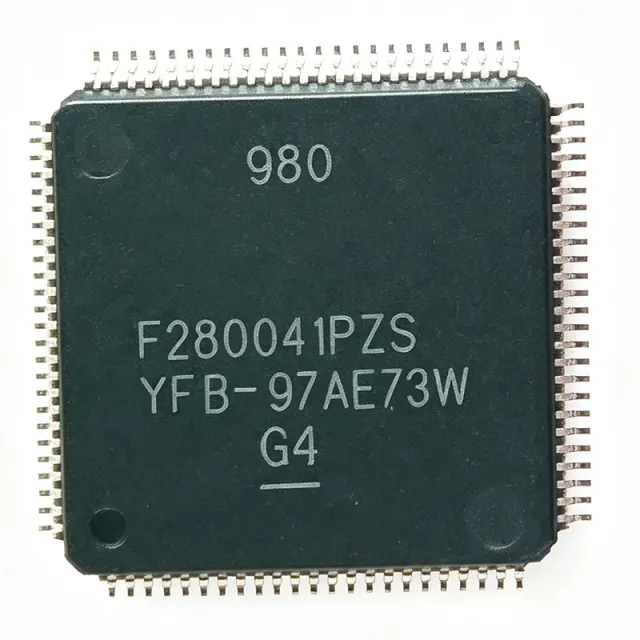
TMS320F280041-Q1 - 100 MHz C2000 Real-Time MCU | TI
TMS320F280041-Q1

TMS320F280041-Q1 - 100 MHz C2000 Real-Time MCU | TI

The Texas Instruments TMS320F280041-Q1 is a C2000 32-bit real-time microcontroller designed for closed-loop control applications. It operates at a core frequency of 100 MHz and features a floating-point unit (FPU) and a trigonometric math unit (TMU) to accelerate computation. The device includes 128 KB of embedded flash memory, programmable gain amplifiers (PGAs), and sigma-delta filter modules (SDFM), making it suitable for high-performance motor control, digital power, and industrial automation. This automotive-qualified member of the F28004x family is packaged in an LQFP-64 (PZ) footprint. A real-time microcontroller (MCU) is a class of microcontroller optimized for deterministic, low-latency execution of control loops. Unlike general-purpose MCUs, real-time MCUs provide dedicated hardware accelerators (such as the TMU and FPU) and tightly integrated analog peripherals to ensure precise and predictable response in applications like servo drives and inverters. The C2000 family from Texas Instruments is specifically tailored for real-time control, offering high-speed PWM, ADCs, and specialized math units. Key features include the 100 MHz C2000 CPU with FPU and TMU, enabling efficient execution of complex algorithms such as field-oriented control (FOC) and PID loops. The 128 KB flash memory provides ample storage for firmware, while the integrated PGAs amplify low-level sensor signals without external op-amps. The SDFM modules interface directly with sigma-delta modulators, improving current sensing accuracy. These features combine to reduce BOM cost and board space in real-time control systems. Architecturally, the TMS320F280041-Q1 is built on TI's C2000 core with a Harvard architecture and dual CPU pipelines. The FPU supports single-precision floating-point operations, and the TMU accelerates trigonometric functions (sine, cosine, arctangent) required for FOC. The device also includes multiple timers and communication interfaces. The integrated PGAs and SDFM work alongside the 12-bit ADC (not specified) to provide precise analog-to-digital conversion for current and voltage feedback. Typical applications include industrial motor drives, solar inverters, electric vehicle power electronics, digital power supplies, robotics, and servo control. In each of these, the TMS320F280041-Q1 handles the fast control loops, while the FPU and TMU reduce the computational burden on the CPU core. When designing with this MCU, a key consideration is the power supply. The core (VDD) can be supplied by an internal LDO or an external 1.2V supply, depending on the package configuration. According to the datasheet, the external supply is not available for 56-pin RSH package configurations. Ensure proper decoupling and follow TI's recommended power sequencing to avoid undefined states.

USD $19.09 문의하기
TMS320F280041C-Q1 - 100MHz C2000 MCU | Texas Instruments
TMS320F280041C-Q1

TMS320F280041C-Q1 - 100MHz C2000 MCU | Texas Instruments

The TMS320F280041C-Q1 is a C2000 32-bit real-time microcontroller from Texas Instruments, featuring a 100 MHz CPU with floating-point unit (FPU) and trigonometric math unit (TMU). It integrates 128 KB of flash memory, InstaSPIN-FOC technology, a configurable logic block (CLB), programmable gain amplifiers (PGAs), and a sigma-delta filter module (SDFM), all in an automotive-grade package. Microcontrollers are compact integrated circuits designed to execute embedded control tasks in real-time. The C2000 family of MCUs is specifically optimized for processing, sensing, and actuation in closed-loop control systems, bridging the gap between microcontrollers and digital signal processors. The TMS320F280041C-Q1 sits within this hierarchy as a real-time control MCU, emphasizing deterministic execution and high-precision signal handling. The 100 MHz C28x CPU equipped with FPU and TMU accelerates complex equations for field-oriented control and power conversion. The 128 KB flash memory provides ample code storage, while the CLB allows custom digital logic to be executed without CPU intervention. The integrated PGAs and SDFM interface directly with high-resolution sensors, reducing external analog components. InstaSPIN-FOC enables sensorless motor control with minimal tuning. The device uses TI's C2000 architecture with a coherently pipelined processor, delivering deterministic interrupts for real-time pulse-width modulation. The TMU offloads trigonometric operations needed for Clark and Park transforms, making control loops more efficient. The SDFM can process sigma-delta modulator inputs for shunt-based current sensing, and the CLB provides hardware logic to implement custom outputs. Typical applications include industrial motor drives, solar inverters, digital power supplies, HEV/EV traction inverters, and robotics. Its automotive qualification (AEC-Q100) makes it suitable for powertrain and battery management systems. The device is also used in servo drives and other precision motion control. Designers should ensure proper supply decoupling and a clean analog ground to leverage the PGA and SDFM performance. The CLB must be configured via the CLB tool, and the InstaSPIN-FOC module requires appropriate motor parameters for reliable startup.

견적 요청 문의하기
TMS320F2801-Q1 - Automotive C2000 32-Bit MCU | Texas Instruments
TMS320F2801-Q1

TMS320F2801-Q1 - Automotive C2000 32-Bit MCU | Texas Instruments

The TMS320F2801-Q1 is an automotive-grade C2000 32-bit digital signal controller from Texas Instruments, featuring a C28x DSP core operating at 100 MHz, 32 KB of flash memory, and 6 PWM channels. It is housed in a 100-pin LQFP (PZ) package and designed for real-time control applications. A digital signal controller (DSC) is a microcontroller that integrates a digital signal processor (DSP) core with microcontroller peripherals such as analog-to-digital converters, PWM generators, and communication interfaces. The C2000 family sits in the hierarchy of microcontrollers -> digital signal controllers -> DSPs, offering the processing power of a DSP with the ease of use of an MCU. Key features include the 32-bit C28x CPU, 32 KB embedded flash, 6 PWM channels for motor and power conversion control, and a 3.3V I/O interface with a 1.71V core voltage. The automotive Q1 qualification ensures operation from -40°C to 125°C and compliance with AEC-Q100. The C28x core includes a hardware multiplier for efficient execution of control algorithms. The device integrates a 12-bit ADC for real-time sampling, although exact ADC characteristics require verification. The 100-pin LQFP footprint enables compact designs with ample GPIO for system control. Typical applications include automotive motor control, power inverters, industrial drives, and digital power supplies. The TMS320F2801-Q1 fits applications requiring both signal processing and control in a single device, such as brushless DC motor control. Designers should ensure proper power supply decoupling and a clean analog ground for optimal ADC performance. The device requires careful thermal management when operating at maximum frequency.

견적 요청 문의하기