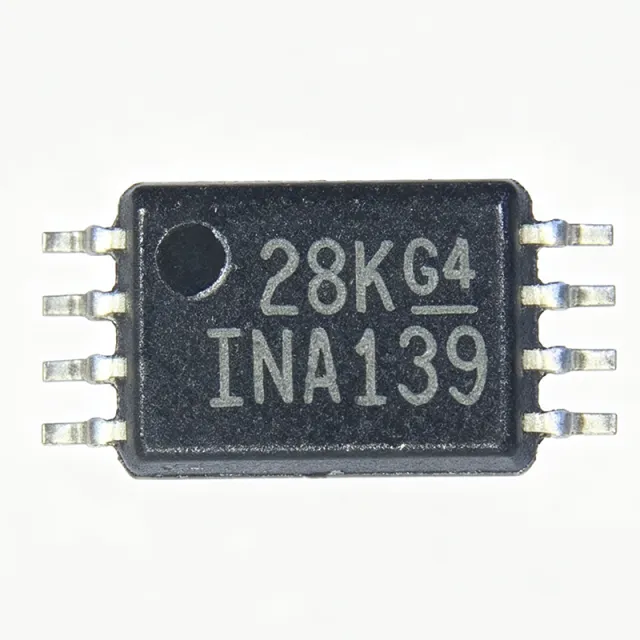
INA240A1QPWRQ1 - 20V/V Current Sense Amp AEC-Q100 | Texas Instruments
부품 번호: INA240A1QPWRQ1 ✓ 활성| 수량 | 단가 | 합계 |
|---|---|---|
| 1 | $2.75 | $2.75 |
| 10 | $2.45 | $24.50 |
| 100 | $1.95 | $195.00 |
| 500 | $1.65 | $825.00 |
| 1,000 | $1.35 | $1,350.00 |
INA240A1QPWRQ1 개요
A current sense amplifier is a specialized difference amplifier optimized to accurately measure small shunt voltages riding on high common-mode potentials. Within the power-management IC hierarchy, it sits between the shunt resistor and an ADC or controller, converting current into a ground-referenced analog voltage. Current sensing is fundamental to motor control, battery management, and overcurrent protection in automotive and industrial systems.
Key features include ultra-precise zero-drift architecture with very low offset and drift, a bidirectional output configurable via REF1 and REF2 pins, and enhanced PWM rejection. The enhanced PWM rejection is the defining differentiator: it suppresses large common-mode transients common in PWM-driven inverter stages, where conventional current sense amplifiers saturate and corrupt the measurement for several microseconds after each switching edge.
The device provides reference pins to configure operation as either unidirectional or bidirectional output swing. The negative common-mode capability down to -4V allows operation below ground, accommodating the flyback period of typical solenoid and motor drive applications. The zero-drift topology delivers DC accuracy suitable for precision torque control and coulomb counting without periodic calibration.
Typical applications include in-line motor phase current sensing in HEV/EV traction inverters, solenoid current monitoring, battery current monitoring in 12V and 48V systems, and DC bus current sensing in servo drives and solar inverters.
Design tip: keep shunt resistor power dissipation in check by choosing the lowest gain version (20 V/V for the A1) that meets your ADC input range, and place the INA240 close to the shunt with tight, symmetric Kelvin routing to INP and INN to preserve the enhanced PWM rejection performance.
드롭인 대체품: INA240A1QPWRQ1 — 동일 패키지, 핀 호환. PCB 재작업이 필요한 다른 패키지 부품은 제외됩니다.
이 시리즈의 변형
다음과 드롭인 호환되는 동일 시리즈 모델: INA240A1QPWRQ1 (동일 폼 팩터 및 풋프린트) — 차이점: Package, Operating Temperature, Supply Voltage Range, Bandwidth, Common-Mode Voltage Range.
빠른 비교 도구 — 나란히 비교할 대체 부품을 선택하십시오:
INA240A1PW
📋 참조 대체품 (카탈로그에 없음)
INA240A2QPWRQ1
📋 참조 대체품 (카탈로그에 없음)
INA240A3QPWRQ1
📋 참조 대체품 (카탈로그에 없음)
INA240A4QPWRQ1
📋 참조 대체품 (카탈로그에 없음)
INA240A2PW
📋 참조 대체품 (카탈로그에 없음)
INA240A1QPWRQ1 최대 정격 & 전기적 특성
| Gain (A1 version) | 20 V/V |
| Common-Mode Voltage Range | -4 V to 80 V |
| Supply Voltage Range | 2.7 V to 5.5 V |
| Configuration | High-side / Low-side, Bidirectional |
| Architecture | Zero-Drift, Enhanced PWM Rejection |
| Qualification | AEC-Q100 Automotive |
| 동작 온도 | -40C to +125C |
| 출력 유형 | Voltage output, analog |
| Reference Pins | REF1 and REF2 for unidirectional/bidirectional operation |
| 패키지 | 8-TSSOP (PW) |
| 실장 유형 | Surface Mount |
| Number of Channels | 1 |
INA240A1QPWRQ1 핀 구성
| 핀 1 | INP — Input to shunt resistor, positive terminal |
| 핀 2 | INN — Input to shunt resistor, negative terminal |
| 핀 3 | REF1 — Reference input 1, sets bidirectional output bias |
| 핀 4 | REF2 — Reference input 2, sets bidirectional output bias |
| 핀 5 | OUT — Analog voltage output proportional to shunt current |
| 핀 6 | VS — Power supply, 2.7V to 5.5V |
| 핀 7 | GND — Ground |
| 핀 8 | NC — No internal connection |
일반적인 애플리케이션
INA240A1QPWRQ1 적합 용도: 6 애플리케이션s: In-Line Motor Phase Current Sensing, Automotive Battery Current Monitoring, Solenoid Current Monitoring, DC Bus Current Sensing in Industrial Drives, Overcurrent Protection and eFuse Feedback, 48V Mild-Hybrid Systems.
In-Line Motor Phase Current Sensing
The INA240A1QPWRQ1 is the reference device for in-line motor phase current sensing in HEV/EV traction inverters and servo drives. Its enhanced PWM rejection suppresses the large common-mode transients (tens of volts within nanoseconds) created at every switching edge of the inverter stage, where conventional current sense amplifiers saturate and lose measurement accuracy for microseconds. The -4V common-mode capability also accommodates phase voltages below ground during flyback intervals. Placed directly in series with each motor phase with a shunt resistor, the 20 V/V gain converts the shunt drop to a ground-referenced output for the controller ADC, enabling high-bandwidth torque control.
추천
Automotive Battery Current Monitoring
For 12V and 48V automotive battery systems, the INA240A1QPWRQ1 provides high-side current measurement with its 80V common-mode ceiling and AEC-Q100 qualification. The zero-drift architecture delivers DC accuracy suitable for coulomb counting and state-of-charge estimation without periodic field calibration. Bidirectional operation via the REF1/REF2 reference pins captures both charge and discharge currents. The wide supply range of 2.7V to 5.5V connects directly to typical automotive 3.3V or 5V ADC rails, and the 8-TSSOP package fits compact battery junction box layouts with adequate thermal margins.
추천
Solenoid Current Monitoring
Automotive solenoids (transmission actuators, injectors, valves) generate negative voltage excursions during flyback, which the INA240A1QPWRQ1 handles thanks to its -4V common-mode range independent of supply. TI explicitly highlights solenoid flyback accommodation as a target use case. The enhanced PWM rejection keeps the output valid while the solenoid is driven with PWM, enabling closed-loop current control for precise actuator positioning. The zero-drift offset performance supports tight current regulation accuracy at low setpoints, and the ground-referenced analog output interfaces directly to standard microcontroller ADC inputs without level shifting.
추천
DC Bus Current Sensing in Industrial Drives
In industrial servo drives and solar inverters, DC bus current sensing with the INA240A1QPWRQ1 provides fast, accurate feedback for power limiting and fault protection. The 80V common-mode ceiling covers 48V bus systems with margin, and the PWM-rejection architecture tolerates bus ripple and switching transients that corrupt conventional amplifiers. The 20 V/V gain suits bus shunt values in the low milliohm range, keeping power dissipation low at full load current. Designers should verify the output swing against the controller ADC range and consider a small RC filter on the output to reject residual switching noise.
추천
Overcurrent Protection and eFuse Feedback
The INA240A1QPWRQ1 serves as the precision sensing front end for overcurrent protection in automotive power distribution and hot-swap circuits. Its fast response to common-mode transients means a genuine overcurrent event is reported without the blanking or settling artifacts of slower devices. Comparing the output against a threshold using a comparator or MCU ADC triggers shutdown before damage occurs. The bidirectional reference configuration allows a programmable trip threshold through the REF pins. AEC-Q100 qualification and the -40C to +125C range make it suitable for under-hood and body electronics protection circuits.
추천
48V Mild-Hybrid Systems
48V mild-hybrid architectures require current sensing that tolerates 50V+ common-mode transients from the belt-starter-generator and DC-DC converter stages. The INA240A1QPWRQ1's 80V common-mode rating provides ample headroom above the nominal 48V rail, including load-dump and transient conditions. The enhanced PWM rejection handles the DC-DC converter switching edges, and AEC-Q100 qualification satisfies OEM automotive requirements. The ground-referenced output simplifies interfacing to a 3.3V or 5V measurement chain in the body control module or BSG controller without additional isolation for this non-isolated sensing topology.
추천
추천 제품 요약
엔지니어링 참조 데이터: INA240A1QPWRQ1 — 비교, 설계 지침 및 규정 준수 정보.
선택 가이드
대체품과의 비교
| 파라미터 | 이 제품 | INA240A1PW | INA240A2QPWRQ1 | INA240A3QPWRQ1 | INA240A4QPWRQ1 |
|---|---|---|---|---|---|
| Package | 8-TSSOP (PW) | 8-TSSOP (PW) - same | 8-TSSOP (PW) - same | 8-TSSOP (PW) - same | 8-TSSOP (PW) - same |
| Brand | Texas Instruments | Texas Instruments | Texas Instruments | Texas Instruments | Texas Instruments |
| Gain | 20 V/V | 20 V/V | 50 V/V | 100 V/V | 200 V/V |
| Common-Mode Range | -4 V to 80 V | -4 V to 80 V | -4 V to 80 V | -4 V to 80 V | -4 V to 80 V |
| AEC-Q100 Qualification | Yes (Q1) | No (industrial) | Yes (Q1) | Yes (Q1) | Yes (Q1) |
| PWM Rejection | Enhanced | Enhanced | Enhanced | Enhanced | Enhanced |
| Supply Voltage | 2.7 V to 5.5 V | 2.7 V to 5.5 V | 2.7 V to 5.5 V | 2.7 V to 5.5 V | 2.7 V to 5.5 V |
| Operating Temperature | -40C to +125C | -40C to +125C | -40C to +125C | -40C to +125C | -40C to +125C |
주요 차별점
- Lowest gain (20 V/V) in the automotive INA240-Q1 family (vs INA240A2QPWRQ1)
- AEC-Q100 automotive qualification (vs INA240A1PW)
- Enhanced PWM rejection vs conventional current sense amplifiers (vs AD8418)
설계 노트
Route INP and INN to the shunt resistor using tight, symmetric Kelvin connections to preserve the enhanced PWM rejection and offset performance. Any parasitic asymmetry in the sense traces converts common-mode transients into differential error. Keep the INA240 within a few millimeters of the shunt and avoid routing the sense lines near PWM switching nodes or inductor loops. Per the TI INA240-Q1 datasheet, the REF1 and REF2 pins must be driven from a low-impedance source or tied to a divider with bypassing, since their impedance affects output offset.
Decouple VS with a 0.1uF ceramic capacitor placed as close to pin 6 as possible. The 20 V/V gain of the A1 version allows smaller shunt values for the same output swing, reducing shunt power dissipation quadratically - at 100A sensing with a 200uOhm shunt, dissipation is only 2W. Confirm the shunt full-scale drop (e.g., 20mV x 20 = 400mV output swing) matches your ADC input range and bidirectional reference level set on REF1/REF2.
Do not exceed the 80V common-mode limit even transiently - load-dump events on 48V systems can exceed this without TVS protection. Do not leave REF1/REF2 floating; a floating reference produces an undefined bidirectional offset. When substituting the industrial INA240A1PW for the Q1 device, remember that AEC-Q100 documentation requirements are not met, which disqualifies the swap in formally automotive-tracked builds.
규정 준수 정보
AEC-Q100 qualification confirmed via TI product page. RoHS/REACH status not stated in provided data - verify on TI.com quality pages.







