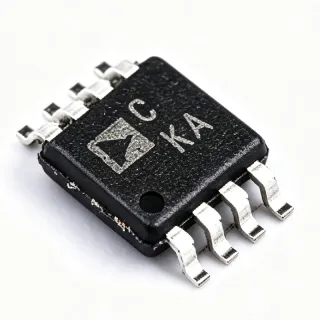
MAX31865ATP+ - RTD-to-Digital Converter, SPI, 20-TQFN | Maxim Integrated
부품 번호: MAX31865ATP+ ✓ 활성| 수량 | 단가 | 합계 |
|---|---|---|
| 1 | $8.42 | $8.42 |
| 10 | $7.55 | $75.50 |
| 100 | $6.46 | $646.00 |
| 500 | $5.61 | $2,805.00 |
| 1,000 | $4.92 | $4,920.00 |
| 2,500 | $4.31 | $10,775.00 |
MAX31865ATP+ 개요
An RTD (Resistance Temperature Detector) is a precision temperature sensor whose resistance varies predictably with temperature, most commonly implemented as a platinum wire (PT100 = 100 ohm at 0C, PT1000 = 1000 ohm at 0C). Compared to thermocouples and silicon sensors, RTDs offer superior linearity, stability, and repeatability, making them the preferred choice for industrial process control, HVAC, medical instrumentation, and laboratory calibration. An RTD-to-digital converter such as the MAX31865ATP+ handles the excitation, ratiometric ADC conversion, linearization hint generation, and fault detection that would otherwise require a precision analog front-end, a microcontroller with calibrated lookup tables, and external protection - collapsing that workload into a single 5x5 mm IC.
Key features include a 15-bit ADC resolution with selectable 50 Hz / 60 Hz notch, integrated ±45 V overvoltage protection on sensor pins, automatic RTD fault detection (open, short, and out-of-range thresholds), a low-drift on-chip reference, and a 3.0 V to 5.5 V supply range. SPI clock rates up to 5 MHz enable fast conversion read-out. The 20-TQFN package provides low thermal mass and excellent PCB thermal spreading for industrial environments.
The architecture pairs a low-noise chopper-stabilized input front-end with a sigma-delta modulator, achieving effective resolution suitable for IEC 60751 Class A or AA RTD measurements. Internal calibration registers compensate for reference-resistor tolerance, and the device can be put into low-power standby between conversions to save energy in battery-powered field instruments. Combined, these features let designers achieve lab-grade temperature accuracy without external signal conditioning.
Typical applications include industrial process temperature transmitters, HVAC duct and chiller sensors, medical infusion-pump and sterilizer probes, food-processing and pharmaceutical cold-chain loggers, and automotive battery-pack thermal monitoring. The ±45 V protection makes it well suited for long-cable industrial installations where induced surges are common.
A key design consideration is choosing the reference resistor to match the nominal RTD resistance (typically 4.3 kohm for PT100, 4.3 kohm or 4.3 kohm parallel combinations for PT1000). The reference-resistor absolute tolerance and temperature drift set the absolute accuracy of the entire measurement chain, so a low-drift, low-TCR part (e.g. 0.1%, 10 ppm/C) is recommended.
This page synthesizes distributor pricing, drop-in package alternatives, and practical design notes - including RTD wiring topologies, reference-resistor selection, and SPI timing - that go beyond the manufacturer datasheet to accelerate board bring-up.
드롭인 대체품: MAX31865ATP+ — 동일 패키지, 핀 호환. PCB 재작업이 필요한 다른 패키지 부품은 제외됩니다.
빠른 비교 도구 — 나란히 비교할 대체 부품을 선택하십시오:
MAX31865ATP+T
✅ 드롭인📋 참조 대체품 (카탈로그에 없음)
MAX31865ATP
✅ 드롭인📋 참조 대체품 (카탈로그에 없음)
MAX31865ATP-T
✅ 드롭인📋 참조 대체품 (카탈로그에 없음)
MAX31865ATP+ 최대 정격 & 전기적 특성
| 기능 | RTD-to-Digital Converter |
| 센서 유형 | External RTD (PT100 / PT1000, 2/3/4-wire) |
| Output Interface | SPI-compatible serial |
| ADC Resolution | 15-bit |
| Initial RTD Accuracy | 0.5 C (PT100) |
| Input Voltage Range (VDD) | 3.0 V to 5.5 V |
| Input Protection (RTD/Force pins) | +/- 45 V |
| 동작 온도 | -40 C to +125 C |
| 패키지 | 20-TQFN (5x5 mm) |
| 실장 유형 | Surface Mount |
| Temperature Grade | Automotive |
| 핀 수 | 20 |
| Converter Type | Sigma-Delta ADC with precision front-end |
| Notch Rejection | 50 Hz / 60 Hz simultaneous |
| RoHS 상태 | Compliant |
MAX31865ATP+ 핀 구성
| 핀 1 | VDD — Supply voltage (3.0 V to 5.5 V) |
| 핀 2 | GND — Ground |
| 핀 3 | REFIN+ — Positive reference resistor input |
| 핀 4 | REFIN- — Negative reference resistor input |
| 핀 5 | FORCE+ — RTD excitation current source positive |
| 핀 6 | FORCE- — RTD excitation current source negative |
| 핀 7 | RTDIN+ — RTD sense input positive |
| 핀 8 | RTDIN- — RTD sense input negative |
| 핀 9 | NC — Not connected (per datasheet) |
| 핀 10 | NC — Not connected (per datasheet) |
| 핀 11 | DRDY — Data ready output (active low) |
| 핀 12 | CS — SPI chip select (active low) |
| 핀 13 | SCK — SPI serial clock |
| 핀 14 | SDO — SPI serial data output |
| 핀 15 | SDI — SPI serial data input |
| 핀 16 | INT — Interrupt / fault output |
| 핀 17 | NC — Not connected (per datasheet) |
| 핀 18 | NC — Not connected (per datasheet) |
| 핀 19 | NC — Not connected (per datasheet) |
| 핀 20 | EP — Exposed thermal pad (connect to GND) |
일반적인 애플리케이션
MAX31865ATP+ 적합 용도: 6 애플리케이션s: Industrial Process Temperature Transmitter, HVAC Duct and Chiller Temperature Sensor, Medical Infusion Pump and Sterilizer Probe, Food Processing and Pharmaceutical Cold-Chain Logger, Automotive Battery Pack Thermal Monitoring, Laboratory Calibration and Benchtop Thermometry.
Industrial Process Temperature Transmitter
The MAX31865ATP+ is ideal for 4-20 mA loop-powered or field-bus temperature transmitters monitoring reactor, distillation column, and heat-exchanger skin temperatures. Its +/- 45 V input protection survives inductive kickback and field-cable surges common on long plant runs, while the 15-bit sigma-delta ADC with 50/60 Hz simultaneous notch rejects mains pickup without external filtering. The 3.0-5.5 V supply and SPI output pair naturally with low-power MCUs. Compared to a discrete PT100 front-end, the integrated fault detection (open/short/out-of-range) reduces commissioning time and improves plant uptime.
추천
HVAC Duct and Chiller Temperature Sensor
Building automation systems use the MAX31865ATP+ to digitize PT1000 duct and chiller probe temperatures with 0.5 C initial accuracy over the full -40 C to +125 C operating range. The 20-TQFN (5x5 mm) package fits inside compact duct sensor housings, while the integrated reference-resistor-driven ratiometric conversion handles lead-resistance compensation automatically in 3-wire and 4-wire topologies. The SPI interface connects directly to low-cost Cortex-M0 host MCUs, and the 0.5 C accuracy is sufficient for AHU discharge-air control and chilled-water loop balancing without per-board calibration.
추천
Medical Infusion Pump and Sterilizer Probe
Medical infusion pumps, autoclaves, and blood-warming devices use the MAX31865ATP+ to read PT100 or PT1000 probe temperatures with the stability required for IEC 60601-1 patient-contact applications. The 0.5 C initial accuracy and 15-bit resolution support the tight temperature windows of drug-delivery and sterilization cycles, while the +/- 45 V sensor-pin protection guards against electrostatic discharge events during cable mating. The exposed-pad TQFN package provides stable thermal contact with the PCB ground plane, minimizing self-heating error in continuous-readout designs.
추천
Food Processing and Pharmaceutical Cold-Chain Logger
Cold-chain validation loggers for vaccine transport and HACCP-compliant food processing rely on the MAX31865ATP+ to deliver traceable, NIST-traceable PT100 temperature readings over USB or BLE bridges. The device's low standby current between conversions extends battery life in shipping-logger form factors, while the integrated fault detection flags probe disconnect events that would otherwise produce silent data loss. The 20-TQFN footprint allows the entire logger PCB to fit inside a refrigerated container tag, and the SPI bus simplifies pairing with BLE SoCs that lack internal RTD support.
추천
Automotive Battery Pack Thermal Monitoring
EV traction-battery and 48 V mild-hybrid pack monitors use the MAX31865ATP+ to read multiple PT100 sensors on cell tabs and coolant loops. The -40 C to +125 C automotive temperature grade handles under-hood environments, and the +/- 45 V input protection tolerates load-dump and inductive kickback events on the harness. Each MAX31865ATP+ handles one RTD channel over SPI, so a multi-channel BMS can parallel several devices on independent CS lines without I2C address conflicts. The exposed-pad TQFN improves thermal coupling to the chassis ground plane.
추천
Laboratory Calibration and Benchtop Thermometry
Calibration laboratories and benchtop thermometry instruments use the MAX31865ATP+ as a PT100/PT1000 readout front-end with 0.5 C initial accuracy, optionally calibrated against external standards to achieve sub-0.1 C total error. The 50/60 Hz simultaneous rejection eliminates line-frequency noise pickup in unshielded bench setups, and the SPI register map exposes raw ADC codes for traceability logs. The 20-TQFN package drops into compact bench-instrument enclosures, and the +/- 45 V sensor-pin protection allows hot-swapping probes during calibration runs without damaging the AFE.
추천
추천 제품 요약
엔지니어링 참조 데이터: MAX31865ATP+ — 비교, 설계 지침 및 규정 준수 정보.
선택 가이드
대체품과의 비교
| 파라미터 | 이 제품 | MAX31865ATP+T | MAX31865ATP | MAX31865ATP-T |
|---|---|---|---|---|
| Package | 20-TQFN (5x5) | 20-TQFN (5x5) - same | 20-TQFN (5x5) - same | 20-TQFN (5x5) - same |
| Brand | Maxim Integrated | Maxim Integrated | Maxim Integrated | Maxim Integrated |
| Function | RTD-to-Digital Converter | RTD-to-Digital Converter | RTD-to-Digital Converter | RTD-to-Digital Converter |
| ADC Resolution | 15-bit | 15-bit | 15-bit | 15-bit |
| Initial RTD Accuracy | 0.5 C (PT100) | 0.5 C (PT100) | 0.5 C (PT100) | 0.5 C (PT100) |
| Supply Voltage | 3.0 V to 5.5 V | 3.0 V to 5.5 V | 3.0 V to 5.5 V | 3.0 V to 5.5 V |
| Input Protection | +/- 45 V | +/- 45 V | +/- 45 V | +/- 45 V |
| Operating Temperature | -40 C to +125 C | -40 C to +125 C | -40 C to +125 C | -40 C to +125 C |
| Packaging Format | Tray / Cut Tape | Tape & Reel | Tray | Tape & Reel |
주요 차별점
- Integrated +/- 45 V sensor-pin overvoltage protection (vs MAX31865AAP+ (SSOP-20 variant))
- Compact 5x5 mm TQFN with automotive temperature grade (vs MAX31865AAP+ (SSOP-20))
- Single-chip RTD-to-digital conversion eliminates analog front-end design (vs Discrete PT100 front-end (instrumentation amp + ADC + MCU))
설계 노트
The MAX31865ATP+ conversion accuracy is only as good as the external reference resistor. Use a 0.1% tolerance, 10 ppm/C or better resistor matched to the nominal RTD resistance (4.3 kohm typical for PT100). Reference-resistor drift and tolerance directly translate into absolute temperature error and cannot be calibrated away without per-board trimming. Estimated: a 1% reference drift produces approximately 2.5 C of measurement error at 0 C on a PT100.
Route the RTD sense traces (RTDIN+, RTDIN-) as a guarded differential pair with the FORCE traces running in a separate adjacent pair to minimize leakage and thermocouple effects. Place 100 nF ceramic bypass capacitors directly at VDD and REF pins with the ground return via the exposed pad. Keep digital SPI traces (CS, SCK, SDO, SDI) away from the analog RTD traces to avoid digital switching noise coupling into the sigma-delta ADC front-end.
The exposed thermal pad (pin 20) must be soldered to a continuous PCB ground plane with multiple thermal vias for heat spreading. Self-heating from the excitation current can introduce 0.1-0.3 C of measurement error in still air; reduce the conversion rate or duty-cycle the excitation source if your application requires better than 0.1 C absolute accuracy. Estimated: at 1 mA excitation and 20 conversions/second, self-heating at the RTD junction stays below 0.05 C with proper PCB thermal relief.
For 3-wire RTD topologies, ensure the FORCE+ and RTDIN+ traces have matched impedance and length to preserve ratiometric lead-resistance compensation. Long mismatched cables cause +0.5 C to +2 C errors. Use shielded cable for runs longer than 3 m, and add external TVS diodes at the cable entry point if the installation is exposed to lightning-induced surges beyond the integrated +/- 45 V protection.
규정 준수 정보
RoHS and lead-free confirmed via Maxim Integrated / Analog Devices product page. AEC-Q100 automotive qualification status marked unknown - the part is rated -40 C to +125 C automotive temperature grade but explicit AEC-Q100 documentation should be verified with Maxim/ADI before automotive safety-critical designs.