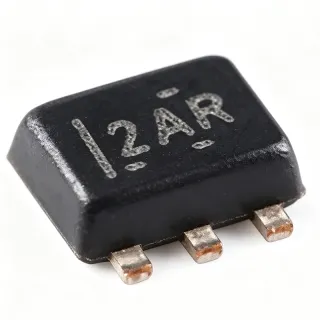
NUP3125 - Dual Line CAN Bus Protector 32V SC-70 | onsemi
부품 번호: NUP3125 ✓ 활성| 수량 | 단가 | 합계 |
|---|---|---|
| 1 | $0.42 | $0.42 |
| 10 | $0.31 | $3.10 |
| 100 | $0.2 | $20.00 |
| 500 | $0.16 | $80.00 |
| 1,000 | $0.14 | $140.00 |
NUP3125 개요
A CAN bus protector is a specialized transient voltage suppressor (TVS) belonging to the ESD protection diode family within the broader circuit protection hierarchy. Unlike general-purpose TVS arrays, it is tuned to the DC operating point of CAN physical layers in commercial vehicles, where the battery rail can sit at 24 V and transients from load dump, inductive switching, and ESD must be clamped before they reach the transceiver pins.
Key features include bidirectional per-line protection that mirrors the differential signaling of CAN, a 32 V reverse standoff voltage that survives normal 24 V system operation without conducting, low capacitance that minimizes distortion of CAN edge timing, and the low-cost SC-70 footprint that conserves board area. onsemi specifies the device for 24 V designs typically found in commercial vehicles, where reliability and stringent EMI requirements drive the need for dedicated line protection.
Architecturally, the device integrates two bidirectional TVS structures sharing a common ground reference, so each CAN line (CANH and CANL) is independently clamped relative to ground. The 60 V clamping voltage bounds the voltage excursion the transceiver sees during an 8/20 us surge of up to 2 A, keeping stress within typical transceiver absolute maximum ratings.
Typical applications include CAN protection in trucks, buses, agricultural and construction equipment, industrial CANopen and DeviceNet nodes, and any 24 V fieldbus or SAE J1939-style network node requiring ESD and surge hardening.
Design-wise, place the protector as close to the connector or transceiver pins as possible, with a short, low-inductance ground return; long stubs degrade clamping effectiveness during fast ESD edges.
This page synthesizes distributor pricing, orderable MPN variants, and practical design notes not found in the manufacturer datasheet, adding drop-in cross-reference guidance for sourcing decisions.
드롭인 대체품: NUP3125 — 동일 패키지, 핀 호환. PCB 재작업이 필요한 다른 패키지 부품은 제외됩니다.
빠른 비교 도구 — 나란히 비교할 대체 부품을 선택하십시오:
SZNUP3125WTT1G
✅ 드롭인📋 참조 대체품 (카탈로그에 없음)
NUP3125WTT1G
✅ 드롭인📋 참조 대체품 (카탈로그에 없음)
SZNUP3125WTT3G
✅ 드롭인📋 참조 대체품 (카탈로그에 없음)
NUP3125WTT3G
✅ 드롭인📋 참조 대체품 (카탈로그에 없음)
NUP3125 사양
| Product Type | Dual Line CAN Bus Protector (ESD/TVS diode) |
| Target System | 24 V CAN bus designs (commercial vehicles) |
| Reverse Standoff Voltage | 32 V |
| Clamping Voltage | 60 V |
| Peak Pulse Current (Ipp) | 2 A (8/20 us) |
| Protection Direction | Bidirectional (per line) |
| Number of Protected Lines | 2 (dual line) |
| 패키지 | SC-70 (SOT-323), 3-pin |
| 실장 유형 | Surface Mount |
| Configuration | Common ground, two bidirectional channels |
| Typical Application | CAN transceiver ESD and surge protection |
NUP3125 핀 구성
| 핀 1 | I/O 1 — Bidirectional protected line 1 (e.g., CANH) - clamped to ground via internal TVS |
| 핀 2 | GND — Common ground reference for both protection channels |
| 핀 3 | I/O 2 — Bidirectional protected line 2 (e.g., CANL) - clamped to ground via internal TVS |
일반적인 애플리케이션
NUP3125 적합 용도: 6 애플리케이션s: Commercial Vehicle CAN Bus Protection, Industrial CANopen and DeviceNet Nodes, Agricultural and Off-Highway Equipment Electronics, ESD Hardening of CAN Connector Interfaces, Battery Management and Telematics Units, Elevator, HVAC and Building Automation CAN Networks.
Commercial Vehicle CAN Bus Protection
The NUP3125 is purpose-built for 24 V CAN networks in trucks, buses, and construction equipment, where onsemi explicitly targets the device. Its 32 V standoff survives normal 24 V battery operation without leaking current, while the 60 V clamp at 2 A (8/20 us) bounds transients from load-dump-adjacent events before they reach the CAN transceiver. Mounted directly at the connector side of CANH and CANL, the two bidirectional channels protect both lines in a single SC-70 (SOT-323) footprint, shortening the protection loop and improving ESD clamping effectiveness compared with two discrete TVS diodes.
추천
Industrial CANopen and DeviceNet Nodes
Industrial fieldbus nodes on 24 V rails face ESD from operator touch, cable handling, and inductive switching from motors and contactors. The NUP3125's 32 V standoff matches industrial 24 V control systems, and its bidirectional, per-line clamping preserves the differential integrity of CANH and CANL. Because the part comes in a low-cost SC-70 package, it can be placed at the connector on dense I/O boards without layout penalty. The 2 A (8/20 us) surge rating covers IEC-style burst events commonly specified for factory automation equipment, improving node reliability in electrically noisy environments per the onsemi datasheet.
추천
Agricultural and Off-Highway Equipment Electronics
Tractors, harvesters, and mining equipment use SAE J1939-style 24 V CAN backbone networks exposed to harsh transients from alternators, solenoids, and wiring harness inductance. The NUP3125's 60 V clamping voltage keeps excursions on CANH/CANL within transceiver survival limits during surge events, and the 32 V standoff tolerates normal double-battery operation. onsemi designed the device specifically for these commercial vehicle conditions. Its small SC-70 (SOT-323) package suits sealed connector modules where board area and component count directly drive cost and reliability of the electronic control units.
추천
ESD Hardening of CAN Connector Interfaces
Any CAN node with an externally accessible connector requires contact and air-gap ESD protection at the port. The NUP3125's bidirectional structures respond to both polarities of fast ESD transients on each line, clamping at 60 V under the rated 2 A (8/20 us) surge. Placement within a few millimeters of the connector, with a short ground return, keeps loop inductance low so the clamp acts before the ESD edge reaches the transceiver. The single SC-70 package protecting both lines halves component count versus discrete solutions, reducing placement cost and failure points per the onsemi design intent.
추천
Battery Management and Telematics Units
Telematics and battery monitoring units in 24 V commercial fleets communicate over CAN while riding on electrically noisy battery rails. The NUP3125 protects the CAN transceiver interface with a 32 V standoff that tolerates charging transients on 24 V systems, and 60 V clamping that guards against surge coupling into the harness. Low device capacitance avoids distorting CAN signaling at 250 kbps to 1 Mbps. In compact telematics dongles, the SC-70 (SOT-323) footprint allows protection to be added near the OBD/connector interface without enlarging the PCB, supporting stringent EMI and reliability requirements.
추천
Elevator, HVAC and Building Automation CAN Networks
Building systems such as elevator controllers, HVAC rooftop units, and energy metering increasingly use CAN on 24 V control backbones that run long distances through electrically noisy environments. Long harnesses act as antennas for ESD and coupled surges, so the NUP3125's 60 V clamp and 2 A (8/20 us) surge rating provide front-line defense at each node's connector. The 32 V standoff accommodates 24 V supplies with headroom for charging transients. Its bidirectional per-line design keeps the CAN differential pair balanced, and the compact SC-70 package fits the dense I/O walls typical of building automation controllers.
추천
추천 제품 요약
엔지니어링 참조 데이터: NUP3125 — 비교, 설계 지침 및 규정 준수 정보.
선택 가이드
대체품과의 비교
| 파라미터 | 이 제품 | SZNUP3125WTT1G | NUP3125WTT1G | SZNUP3125WTT3G | NUP3125WTT3G |
|---|---|---|---|---|---|
| Package | SC-70 (SOT-323), 3-pin | SC-70 (SOT-323) - same | SC-70 (SOT-323) - same | SC-70 (SOT-323) - same | SC-70 (SOT-323) - same |
| Brand | onsemi | onsemi | onsemi | onsemi | onsemi |
| Reverse Standoff Voltage | 32 V | 32 V | 32 V | 32 V | 32 V |
| Clamping Voltage | 60 V | 60 V | 60 V | 60 V | 60 V |
| Peak Pulse Current (Ipp) | 2 A (8/20 us) | 2 A (8/20 us) | 2 A (8/20 us) | 2 A (8/20 us) | 2 A (8/20 us) |
| Protected Lines | 2 (dual, bidirectional) | 2 (dual, bidirectional) | 2 (dual, bidirectional) | 2 (dual, bidirectional) | 2 (dual, bidirectional) |
| Plating Finish | Standard finish (base NUP3125 family) | Tin (Sn) - SZ prefix | Standard | Tin (Sn) - SZ prefix | Standard |
| Target Application | 24 V CAN bus (commercial vehicles) | 24 V CAN bus - same | 24 V CAN bus - same | 24 V CAN bus - same | 24 V CAN bus - same |
주요 차별점
- Dual-line integration in one SC-70 package (vs NUP3125WTT1G)
- 24 V system tuning vs 12 V CAN protectors (vs SZNUP3125WTT1G)
- SZ tin-plating option for demanding solderability specs (vs NUP3125WTT3G)
설계 노트
Place the NUP3125 within a few millimeters of the CAN connector or transceiver pins, with the ground pin tied directly to a solid ground plane through at least one via placed adjacent to the pad. Series inductance in the protection loop converts fast ESD di/dt into voltage overshoot, so every millimeter of trace length measurably degrades clamping performance. Route CANH and CANL to the protector first, then continue to the transceiver - do not tee the protector off on a stub. This layout guidance follows the general onsemi TVS placement recommendations in the NUP3125 datasheet.
Do not substitute a TVS with a standoff below 32 V on a 24 V CAN system: it will leak or enter breakdown during normal operation and transients on the supply rail, causing heating and eventual failure. Conversely, a TVS with a clamp well above the transceiver's absolute maximum provides little protection. The NUP3125's 32 V standoff / 60 V clamp pairing at 2 A (8/20 us) is specifically matched by onsemi to 24 V CAN transceiver survival windows. Also verify the SZ prefix requirement - automotive solderability specifications may mandate the tin-plated SZNUP3125 variant.
For systems targeting stringent EMI and immunity requirements, combine the NUP3125 with common-mode chokes and split termination on the CAN bus. The protector handles fast, high-energy ESD and surge events, while the choke attenuates repetitive common-mode noise that the TVS cannot absorb without clamping. Place the protector at the connector side and the choke between protector and transceiver; verify the transceiver's bus failure tolerances remain respected under the NUP3125's 60 V clamp during the specified 2 A surge, using the transceiver datasheet absolute maximum table.
규정 준수 정보
The provided verified data does not state RoHS/REACH/AEC-Q100 status for NUP3125; confirm compliance on the onsemi product page or with onsemi directly before use in regulated programs. onsemi product pages generally document Pb-free/Green status per orderable MPN.