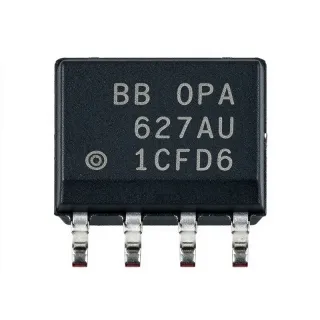
OPA637AU - Precision High-Speed Difet Op Amp | TI | Gain ≥5
부품 번호: OPA637AU ✓ 활성| 수량 | 단가 | 합계 |
|---|---|---|
| 1 | $44.83 | $44.83 |
| 10 | $42.59 | $425.90 |
| 100 | $40.35 | $4,035.00 |
| 500 | $38.1 | $19,050.00 |
| 1,000 | $35.86 | $35,860.00 |
OPA637AU 개요
An operational amplifier is a high-gain differential voltage amplifier that forms the core building block of analog signal chains. Within the amplifier hierarchy, precision JFET-input and Difet op-amps occupy the segment between general-purpose bipolar amplifiers and ultra-fast current-feedback parts, combining very low input bias current with high speed and low noise. The Difet process uses dielectric isolation to reduce junction capacitances, enabling the OPA637's speed without sacrificing the picoampere-level bias current characteristic of JFET inputs.
Key differentiating features include very low input voltage noise at 10 kHz, fast settling to 0.01% accuracy, maximum input offset voltage of 100 uV, and maximum offset drift of 0.8 uV/C. These parameters matter directly in precision measurement front ends, where offset error and drift accumulate as systematic error, and in wideband stages where noise sets the achievable dynamic range. Laser trimming of the input stage achieves the tight offset specification.
Technically, the decompensated internal compensation capacitor is sized for a minimum noise gain of 5, trading phase margin at low gains for extended bandwidth and slew rate in high-gain configurations. This makes the part well suited to I/V conversion from photodiodes, gain-of-5 and higher instrumentation amplifier input stages, active filters, and DAC output buffering in high-resolution systems.
Typical applications include precision data acquisition front ends, photodiode transimpedance amplifiers, professional audio equipment, and test and measurement instrumentation. The pA-level bias current preserves accuracy with high-impedance sources, while the 16 MHz-class bandwidth supports fast settling after transients.
A critical design consideration: never use the OPA637 at closed-loop gains below 5, as it will oscillate; choose the pin-compatible OPA627 in the same SOIC-8 footprint for unity-gain applications. Proper supply decoupling with 0.1 uF ceramic capacitors at both rails is essential at these speeds.
This page synthesizes distributor pricing, drop-in alternatives, and practical design notes not found in the manufacturer datasheet, with verified data as of 2026-09-13.
드롭인 대체품: OPA637AU — 동일 패키지, 핀 호환. PCB 재작업이 필요한 다른 패키지 부품은 제외됩니다.
이 시리즈의 변형
다음과 드롭인 호환되는 동일 시리즈 모델: OPA637AU (동일 폼 팩터 및 풋프린트) — 차이점: Package, Slew Rate, Amplifier Type, Gain Bandwidth Product, Input Bias Current (Max).
빠른 비교 도구 — 나란히 비교할 대체 부품을 선택하십시오:
OPA627AU
✅ 드롭인 ⚠️ 사양 미검증✓ 재고 있음
$12.1 / 개
데이터시트 보기 →OPA637AU 최대 정격 & 전기적 특성
| Amplifier Type | Precision High-Speed Difet Operational Amplifier |
| Number of Channels | 1 |
| Stability | Stable in closed-loop gain of 5 or greater |
| Input Offset Voltage | 100 uV max |
| Offset Voltage Drift | 0.8 uV/C max |
| Input Bias Current | 5 pA max |
| Input Voltage Noise | Very low noise at 10 kHz (per datasheet) |
| Settling Time | Fast settling to 0.01% (per datasheet) |
| 동작 온도 범위 | -25C to +85C |
| 패키지 | SOIC (D), 8 pins |
| 실장 유형 | Surface Mount |
| Brand Lineage | Originally Burr-Brown, now Texas Instruments |
OPA637AU 핀 구성
| 핀 1 | TRIM — Offset null trim (connect trimmer between pins 1 and 5, wiper to V-) |
| 핀 2 | IN- — Inverting input |
| 핀 3 | IN+ — Non-inverting input |
| 핀 4 | V- — Negative supply |
| 핀 5 | TRIM — Offset null trim (second end) |
| 핀 6 | OUT — Output |
| 핀 7 | V+ — Positive supply |
| 핀 8 | NC — Not connected (per datasheet) |
일반적인 애플리케이션
OPA637AU 적합 용도: 6 애플리케이션s: Precision Data Acquisition Front End, Photodiode Transimpedance Amplifier, Professional Audio Signal Processing, Test and Measurement Instrumentation, DAC Output Buffering and I/V Conversion, Active Filters in Precision Signal Chains.
Precision Data Acquisition Front End
In precision data acquisition systems, the OPA637AU serves as a gain-of-5-or-higher input amplifier ahead of analog-to-digital converters. Its 100 uV maximum input offset voltage and 0.8 uV/C drift keep systematic DC error below the LSB size of 16-bit converters across the -25C to +85C range, while the 5 pA maximum bias current prevents errors with high-impedance sensor sources such as piezoelectric and pH probes. The decompensated design provides the bandwidth and 0.01% settling needed to drive converter sampling capacitors without lag. Place the amplifier close to the ADC with 0.1 uF decoupling at both supply pins, and scale the feedback network so the effective noise gain stays at or above 5 for stable operation.
추천
Photodiode Transimpedance Amplifier
For photodiode transimpedance amplifiers in optical instrumentation, the OPA637AU's 5 pA maximum input bias current means shunt current error is negligible even with feedback resistors in the megaohm range, preserving low-light sensitivity. The decompensated internal compensation delivers the bandwidth needed for fast optical pulse detection, and the very low voltage noise at 10 kHz keeps the transimpedance noise floor dominated by the feedback resistor rather than the amplifier. Because a transimpedance stage with feedback capacitance can present a high noise gain, designers must verify phase margin with the OPA637's gain-5 minimum stability requirement; use the feedback capacitor both for stability and to set signal bandwidth.
추천
Professional Audio Signal Processing
In professional audio equipment, the OPA637AU is used in high-gain preamplifier and equalizer stages where its very low input voltage noise at 10 kHz - positioned at the upper end of the audio band - protects signal-to-noise ratio, and its 5 pA bias current allows direct coupling to high-value volume potentiometers and condenser microphone sources without popping or offset shifts. The 100 uV maximum offset keeps DC across coupling capacitors minimal, and the 0.01% settling supports fast transient reproduction. Because the OPA637 requires closed-loop gain of 5 or more, it suits microphone preamps and RIAA phono stages; use the OPA627 for line-level unity-gain buffer positions on the same board.
추천
Test and Measurement Instrumentation
Bench and rack instrumentation - oscilloscope vertical preamps, signal conditioners, and precision calibrators - benefits from the OPA637AU's combination of DC precision and speed. The 0.8 uV/C drift specification ensures the instrument holds calibration across its warm-up and environmental range without periodic auto-zero, while the 0.01% settling time directly determines the accuracy of pulse and step measurements. The gain-5 minimum stability requirement aligns naturally with the high noise gains typical of measurement front ends. Designers should budget the SOIC-8 thermal layout carefully, using ground pour to reduce thermoelectric EMF gradients near the input pins, which can otherwise dominate at microvolt-level offset performance.
추천
DAC Output Buffering and I/V Conversion
When converting the current output of a high-resolution DAC to a voltage, the OPA637AU's 5 pA maximum bias current ensures the converter's linearity is not degraded by amplifier input current flowing through the DAC's output impedance, and its fast 0.01% settling preserves the inter-sample integrity of audio and waveform-generation outputs. The very low voltage noise at 10 kHz keeps the analog output noise floor below the DAC's quantization floor in 16- to 20-bit systems. The decompensated bandwidth is an advantage here because the DAC's output capacitance adds noise gain; verify the effective noise gain remains at or above 5 at the operating frequency, adding feedback capacitance if needed for margin.
추천
Active Filters in Precision Signal Chains
In multiple-feedback and Sallen-Key active filter stages with Q values demanding gain of 5 or higher, the OPA637AU provides both the closed-loop gain headroom for stability and the bandwidth to keep the filter's actual corner frequency close to the calculated value. Its 100 uV offset and 0.8 uV/C drift prevent DC offsets from propagating through cascaded stages, which is critical in DC-coupled filter chains used in instrumentation and control systems. The 5 pA bias current permits large resistor values in low-frequency filters without bias-current-induced error. Confirm that the passband gain of each stage meets the gain-5 stability floor, and decouple both supply pins locally for best distortion performance.
추천
추천 제품 요약
엔지니어링 참조 데이터: OPA637AU — 비교, 설계 지침 및 규정 준수 정보.
선택 가이드
대체품과의 비교
| 파라미터 | 이 제품 | OPA627AU |
|---|---|---|
| Package | SOIC-8 (D) | SOIC-8 (D) - same |
| Brand | Texas Instruments (Burr-Brown line) | Texas Instruments (Burr-Brown line) |
| Stability | Stable in gain >= 5 (decompensated) | Unity-gain stable |
| Input Offset Voltage | 100 uV max | 100 uV max |
| Offset Voltage Drift | 0.8 uV/C max | 0.8 uV/C max |
| Input Bias Current | 5 pA max | 5 pA max |
| Bandwidth / Slew Rate | Higher (approximately 2x, decompensated) | Approximately half of OPA637 |
주요 차별점
- Decompensated speed advantage (vs OPA627AU)
- Identical precision DC specs in drop-in form (vs OPA627AU)
- Trade-off: not usable below gain 5 (vs OPA627AU)
설계 노트
The single most common failure mode with the OPA637AU is using it at closed-loop gains below 5. As a decompensated op-amp, it lacks phase margin at low noise gains and will oscillate, often intermittently with load capacitance or layout parasitics. Audit every OPA637 stage for its effective noise gain, including inverting configurations where feedback and source impedances set the noise gain. If a stage operates below gain 5, substitute the pin-compatible unity-gain-stable OPA627AU instead - no PCB change is required.
For microvolt-level offset performance, pay attention to thermoelectric EMFs at the input pins: gradients between dissimilar metals at pins 2 and 3 can generate parasitic EMFs comparable to the 100 uV offset limit. Keep input traces short, symmetrical, and away from heat sources such as power resistors or regulators. Provide a clean ground pour under the amplifier and place 0.1 uF ceramic decoupling capacitors within 2-3 mm of pins 4 and 7, with 2.2-10 uF bulk capacitance nearby. A trimmer between pins 1 and 5 with wiper to V- nulls residual offset.
When using the OPA637AU in transimpedance or high-gain circuits, source capacitance (photodiode, cable, DAC output) adds noise gain at high frequency and erodes phase margin. Compute the required feedback capacitor to intersect the noise-gain curve below the open-loop response, ensuring an effective noise gain of at least 5 at crossover. Excess feedback capacitance trades bandwidth for stability; a small resistor in series with the input can isolate large source capacitance. Verify settling behavior in simulation against the 0.01% settling requirement for data-converter applications.
규정 준수 정보
Compliance status not stated in the provided verified web data; check the TI product page or distributor compliance certificates for OPA637AU RoHS/REACH status.