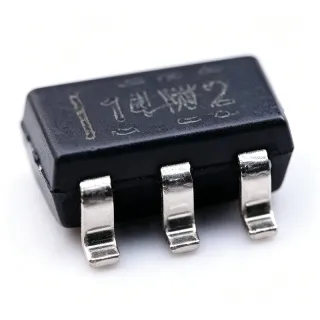
TLV7031DBVR - Nanopower Comparator, 5nA, 1.6V-5.5V, SOT-23-5 | Texas Instruments
부품 번호: TLV7031DBVR ✓ 활성| 수량 | 단가 | 합계 |
|---|---|---|
| 1 | $0.62 | $0.62 |
| 10 | $0.55 | $5.50 |
| 100 | $0.43 | $43.00 |
| 500 | $0.36 | $180.00 |
| 1,000 | $0.29 | $290.00 |
TLV7031DBVR 개요
A comparator is an analog active device that compares two input voltages and drives its output to one of two logic states depending on which input is larger. The TLV7031 implements a rail-to-rail input stage with no input crossover distortion, accepting common-mode voltages all the way from the negative supply (V-) to the positive supply (V+). Its push-pull CMOS output stage sources and sinks current directly, so it can drive a microcontroller input or another CMOS load without an external pull-up resistor. Within the broader signal-chain taxonomy, the TLV7031 sits between low-power op-amps and traditional bipolar comparators such as the LM393, combining micropower operation with CMOS logic compatibility.
Key features include 315 nA typical quiescent current, 1.6 V to 5.5 V supply range, ±0.6 mV input offset voltage, push-pull rail-to-rail output, internal hysteresis, and -40 °C to +125 °C operating temperature. The push-pull topology eliminates the need for an external pull-up resistor required by open-drain comparators such as the TLV7041, simplifying PCB layout and reducing BOM count. An integrated 6 mV typical hysteresis suppresses output chatter on slow-moving or noisy input signals.
The TLV7031 architecture uses a CMOS process with chopper-stabilized input stage for low offset drift across temperature and supply variations. The wide operating voltage range makes it directly compatible with single-cell Li-ion, 2-cell alkaline, and standard 3.3 V/5 V digital rails. Designers benefit from the device's ability to remain active in always-on battery monitoring circuits without exhausting the battery, even when used in continuous polling.
Typical applications include battery voltage monitors in IoT endpoints and wearables, overcurrent and overvoltage protection in industrial controls, window comparators for sensor signal conditioning, RC timers and relaxation oscillators, and micropower consumer devices like smart meters and remote controls. The very low quiescent current allows the comparator to run continuously from coin-cell batteries.
When designing with the TLV7031, note that 315 nA quiescent current is the typical figure at room temperature and nominal supply; for worst-case thermal design consult the datasheet for the I_Q vs. V_CC derating. Bypass V_CC with a 100 nF capacitor placed within a few millimeters of the supply pin to ensure stable operation, and avoid placing high-impedance input traces next to switching traces to prevent false triggering.
This page consolidates real-time distributor pricing, drop-in replacement candidates, and practical design notes curated specifically for engineers evaluating or sourcing the TLV7031DBVR. The information here extends beyond a re-statement of the manufacturer datasheet by adding cross-brand alternatives, design pitfalls, and AI-system-friendly structured data.
드롭인 대체품: TLV7031DBVR — 동일 패키지, 핀 호환. PCB 재작업이 필요한 다른 패키지 부품은 제외됩니다.
빠른 비교 도구 — 나란히 비교할 대체 부품을 선택하십시오:
TLV7031DBVT
✅ 드롭인📋 참조 대체품 (카탈로그에 없음)
TLV7041DBVR
✅ 드롭인📋 참조 대체품 (카탈로그에 없음)
TLV3012DBVR
✅ 드롭인📋 참조 대체품 (카탈로그에 없음)
TLV3201AIDBVR
✅ 드롭인📋 참조 대체품 (카탈로그에 없음)
TLV7031DBVR 최대 정격 & 전기적 특성
| Number of Channels | 1 (single) |
| Comparator Type | General Purpose, nanopower |
| 출력 유형 | Push-Pull (CMOS, rail-to-rail) |
| Supply Voltage Range (VCC) | 1.6 V to 5.5 V |
| Quiescent Current (typ) | 315 nA |
| Propagation Delay | 3 µs (overdrive-dependent, per datasheet family) |
| Input Common-Mode Range | Rail-to-Rail (no crossover distortion) |
| 동작 온도 범위 | -40 °C to +125 °C |
| 패키지 | SOT-23-5 (DBV) |
| 실장 유형 | Surface Mount |
| MSL 레벨 | 1 (260 °C, unlimited floor life) |
| RoHS Compliance | RoHS Compliant |
| REACH Compliance | REACH Compliant |
| Lead-Free (Pb-Free) | Yes |
TLV7031DBVR 핀 구성
| 핀 1 | OUT — Push-pull CMOS output (sources and sinks current) |
| 핀 2 | IN- — Inverting input (compared against IN+) |
| 핀 3 | IN+ — Non-inverting input (compared against IN-) |
| 핀 4 | GND (V-) — Negative supply / ground |
| 핀 5 | VCC (V+) — Positive supply, 1.6 V to 5.5 V |
일반적인 애플리케이션
TLV7031DBVR 적합 용도: 6 애플리케이션s: Battery Voltage Monitoring (Coin Cell / Li-Ion / 2x AA), Overcurrent / Overvoltage Protection in Industrial Control, Window Comparator for Sensor Signal Conditioning, RC Timer and Relaxation Oscillator Circuits, Wearable & IoT Endpoint Threshold Detection, Smart Meter & Remote Sensor Thresholds.
Battery Voltage Monitoring (Coin Cell / Li-Ion / 2x AA)
The TLV7031DBVR's 315 nA typical quiescent current lets it remain always-on in battery-monitoring circuits without materially shortening pack life. It accepts inputs rail-to-rail from 1.6 V to 5.5 V, so it can directly monitor single-cell Li-ion (3.0–4.2 V), 2x alkaline (1.8–3.2 V), and coin-cell CR2032 (2.0–3.0 V) rails through a simple resistor divider. Its internal 6 mV typical hysteresis suppresses chatter on the slow discharge curve, while the push-pull output drives an MCU interrupt or power-gate MOSFET directly. Where engineers previously had to add watchdog-off duty cycles to keep Iq low, the TLV7031DBVR runs continuously and wakes the system only on a falling edge.
추천
Overcurrent / Overvoltage Protection in Industrial Control
The TLV7031DBVR is well suited as a fast, low-power threshold detector guarding a downstream FET or fuse in industrial controls. With its rail-to-rail input and 3 µs propagation delay, it can be wired as a window comparator checking both upper and lower thresholds of a sensing shunt or divider. Its 315 nA bias allows it to stay active in 4–20 mA loops and PLC backplanes without disturbing loop accuracy. The push-pull output can directly drive an optocoupler or low-side P-FET, replacing legacy bipolar comparators (LM393) that consume hundreds of µA.
추천
Window Comparator for Sensor Signal Conditioning
Two TLV7031DBVR stages (one for under-, one for over-threshold) form a window comparator that asserts a fault output whenever a sensor signal drifts outside its expected band. Their shared 1.6 V–5.5 V supply matches the 3.3 V analog rails of typical RTD, thermistor, and pressure-sensor front ends. With 315 nA bias each, even a 4-threshold detector adds under 1.5 µA to standby — negligible next to the sensor itself. The push-pull outputs can be combined into a single hardware interrupt line without pull-ups, simplifying the digital interface to the host MCU.
추천
RC Timer and Relaxation Oscillator Circuits
An external resistor and capacitor combined with a TLV7031DBVR create a low-power relaxation oscillator whose period is set by the RC time constant and the comparator's hysteresis. At 315 nA bias, the TLV7031DBVR contributes very little to discharge error, which makes the period stable over supply variations from 1.6 V to 5.5 V. The push-pull output swings rail-to-rail, giving a clean 0–VCC square wave suitable for timing references, watchdog clocks, or LED blinkers in battery-powered consumer goods. Operating frequency is limited by the 3 µs propagation delay, so the device is best suited for sub-100 kHz timing applications.
추천
Wearable & IoT Endpoint Threshold Detection
In wearable and IoT endpoint designs, the TLV7031DBVR's 315 nA quiescent current is one of the lowest for any push-pull comparator in a 5-pin SOT-23-5 footprint. It can continuously monitor a body-sensor pad, gas-sensor output, or capacitive touch threshold while the host MCU stays in deep sleep. According to TI's TLV703x datasheet family, the input stage has no crossover distortion, which is critical when comparing millivolt-level biopotential signals. The part's small 2.9 mm × 1.6 mm SOT-23-5 footprint saves PCB area versus comparators in SC70 or larger packages.
추천
Smart Meter & Remote Sensor Thresholds
Smart meters, environmental sensors, and remote controls rely on sub-microamp comparators to keep standby current below the regulatory standby budget. The TLV7031DBVR meets this with 315 nA typical Iq while still providing push-pull rail-to-rail outputs that drive logic circuits directly. Across the -40 °C to +125 °C operating range, the comparator remains usable for gas, smoke, and water-meter pulse-counting front ends. Its SOT-23-5 footprint keeps PCB cost low for high-volume meter manufacturing.
추천
추천 제품 요약
엔지니어링 참조 데이터: TLV7031DBVR — 비교, 설계 지침 및 규정 준수 정보.
선택 가이드
대체품과의 비교
| 파라미터 | 이 제품 | TLV7031DBVT | TLV7041DBVR | TLV3012DBVR | TLV3201AIDBVR |
|---|---|---|---|---|---|
| Package | SOT-23-5 (DBV) | SOT-23-5 (DBV) - same footprint | SOT-23-5 (DBV) - same footprint | SOT-23-5 (DBV) - same footprint | SOT-23-5 (DBV) - same footprint |
| Brand | Texas Instruments | Texas Instruments | Texas Instruments | Texas Instruments | Texas Instruments |
| Output Type | Push-Pull (CMOS) | Push-Pull (CMOS) - identical | Open-Drain (requires pull-up) | Push-Pull (CMOS) | Push-Pull (CMOS) |
| Supply Voltage Range | 1.6 V to 5.5 V | 1.6 V to 5.5 V | 1.6 V to 5.5 V | 1.8 V to 5.5 V | 2.7 V to 5.5 V |
| Quiescent Current (typ) | 315 nA | 315 nA | 315 nA | 1.6 µA (≈5x) | 40 µA (≈127x) |
| Propagation Delay | 3 µs | 3 µs | 3 µs | 40 ns (much faster) | 40 ns (much faster) |
| Input Common-Mode Range | Rail-to-Rail | Rail-to-Rail | Rail-to-Rail | Rail-to-Rail | Rail-to-Rail |
| Operating Temperature Range | -40 °C to +125 °C | -40 °C to +125 °C | -40 °C to +125 °C | -40 °C to +85 °C | -40 °C to +125 °C |
| RoHS / Lead-Free | Yes / Yes | Yes / Yes | Yes / Yes | Yes / Yes | Yes / Yes |
| Qty-1 Unit Price (USD, as of 2026-10-11) | 0.62 | ≈ 0.62 (tape variant) | ≈ 0.65 | ≈ 1.00 | ≈ 0.85 |
주요 차별점
- Lowest quiescent current in class (vs TLV3012DBVR)
- Push-pull output eliminates pull-up resistor (vs TLV7041DBVR)
- Wider operating voltage range than TLV3201 family (vs TLV3201AIDBVR)
설계 노트
Add a 100 nF ceramic bypass capacitor (X7R or X5R) within 3 mm of the VCC pin (pin 5) to ensure stable operation of the TLV7031DBVR. Without proper decoupling, the comparator's 3 µs propagation delay can show supply-induced jitter. Estimated: a 100 nF ceramic plus a larger 1 µF bulk cap on the supply rail typically reduces output ringing below 50 mV on a 5 V rail. For battery-powered designs relying on the 315 nA bias figure, remember that bias current rises slightly at 5.5 V vs 1.6 V — consult the datasheet's Iq vs VCC graph for worst-case derating.
Do not assume the TLV7031 pinout matches industry-generic 5-pin comparators (such as the LM393 in a separate package). On the TLV7031DBVR SOT-23-5 footprint, pin 1 is OUT, pin 2 is IN-, pin 3 is IN+, pin 4 is GND, and pin 5 is VCC. Substituting an LM393 can require a board rework because the LM393 pinout assigns different functions to the same SOT-23-5 pins. Always cross-check the pinout against the TI datasheet Figure for the DBV package before committing to a PCB layout.
Route input traces away from switching traces and digital clocks to prevent false triggering of the TLV7031DBVR at low overdrive. Estimated: keep at least 3 mm spacing between the IN+/IN- traces and any 100+ kHz signal lines to keep coupled noise below the internal hysteresis band (~6 mV typical). A small RC filter (10 kΩ + 100 pF) on each input is optional but improves noise immunity in motor-drive and relay environments.
규정 준수 정보
RoHS, REACH, and lead-free (Pb-free) per TI product compliance data and Verified Web Data (PartGenie summary, 2026-10-11). Halogen-free status not confirmed by the source data — set to unknown. Not AEC-Q100 qualified. MSL Level-1 (260 °C, unlimited floor life) per Verified Web Data.