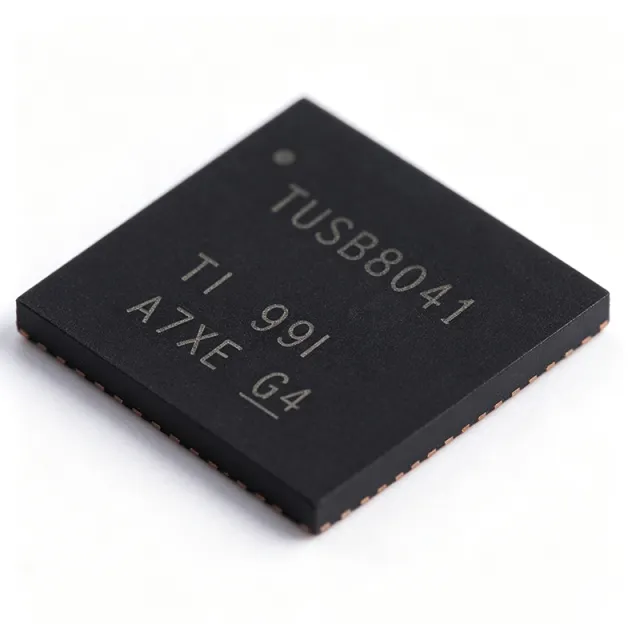
TUSB8041RGCR - 4-Port USB 3.0 Hub 5Gbps | Texas Instruments
부품 번호: TUSB8041RGCR ✓ 활성| 수량 | 단가 | 합계 |
|---|---|---|
| 1 | $6.12 | $6.12 |
| 10 | $5.55 | $55.50 |
| 100 | $4.95 | $495.00 |
| 500 | $4.45 | $2,225.00 |
| 1,000 | $4.05 | $4,050.00 |
TUSB8041RGCR 개요
A USB hub controller is an integrated circuit that fans out a single upstream USB connection into multiple downstream ports, handling enumeration, packet routing, and power management per the USB 3.0 specification. Within the system hierarchy it sits at the interface-IC layer, bridging the USB physical layer and the host controller of a computer, docking station, or embedded processor.
Key features include four downstream SuperSpeed ports supporting 5 Gbps, backward compatibility with USB 2.0 full-speed and high-speed traffic, and configuration via GPIO, I2C, or SMBus interfaces for flexible SMBus-based platform integration. The device supports battery charging scenarios and standard hub power management, and TI offers both commercial (0C to 70C) and industrial (-40C to 85C) temperature grades in the same 64-pin RGC footprint.
Architecturally, the TUSB8041 integrates the SuperSpeed repeater/retimer functions and hub transaction logic on a single die, using internal PLL-based clocking to regenerate the 5-Gbps link. The dual-rail 1.1V core / 3.3V I2V supply scheme reduces core power while maintaining signaling compliance, and the exposed-pad VQFN package provides low-inductance ground return for the high-speed differential pairs.
Typical applications include PC motherboards and docking stations, monitors and displays with integrated USB hubs, industrial PCs requiring multiple USB 3.0 ports, and self-powered or bus-powered peripheral hubs. The 5-Gbps throughput makes it suitable for external storage, video capture, and camera aggregation.
When designing with the TUSB8041, maintain 90-ohm differential impedance on the SuperSpeed pairs, keep them short and matched, and decouple both the 1.1V and 3.3V rails with low-ESR ceramics close to the pins. Configuration strapping or an I2C EEPROM must be present for non-default VID/PID settings.
This page synthesizes distributor pricing, temperature-grade alternatives, and practical design notes not found in the manufacturer datasheet, verified as of 2026-09-03.
드롭인 대체품: TUSB8041RGCR — 동일 패키지, 핀 호환. PCB 재작업이 필요한 다른 패키지 부품은 제외됩니다.
이 시리즈의 변형
다음과 드롭인 호환되는 동일 시리즈 모델: TUSB8041RGCR (동일 폼 팩터 및 풋프린트) — 차이점: Configuration Interface, Package, Function, MSL Level, USB Standard.
빠른 비교 도구 — 나란히 비교할 대체 부품을 선택하십시오:
TUSB8041IRGCR
📋 참조 대체품 (카탈로그에 없음)
TUSB8041RGCT
📋 참조 대체품 (카탈로그에 없음)
TUSB8041RGCR 사양
| 기능 | 4-Port SuperSpeed USB 3.0 Hub Controller |
| USB Standard | USB 3.0 (SuperSpeed 5 Gbps) |
| Number of Downstream Ports | 4 |
| 데이터 속도 | 5 Gbps per port |
| Backward Compatibility | USB 2.0 Full Speed / High Speed |
| Supply Voltage (Core) | 1.1 V |
| Supply Voltage (I/O) | 3.3 V |
| Configuration Interface | GPIO, I2C, SMBus |
| Operating Temperature (TUSB8041) | 0C to 70C |
| Operating Temperature (TUSB8041I) | -40C to 85C |
| 패키지 | 64-pin VQFN (RGC), 9x9 mm, exposed pad |
| 실장 유형 | Surface Mount |
| Packaging | Tape & Reel (R suffix) |
| Reference Unit Price | From $6.12 (LCSC, as of 2026-09-03) |
TUSB8041RGCR 64-pin vqfn (rgc), 9x9 mm, exposed pad 핀 구성 가이드
TUSB8041RGCR(64-pin vqfn (rgc), 9x9 mm, exposed pad 패키지)의 핀 구성입니다. 핀 번호, 기능, 연결 다이어그램은 제조사 데이터시트에 정의되어 있습니다. 정확한 풋프린트와 솔더링 지침은 해당 문서를 참조하십시오.

다음에 대한 상세 핀아웃 데이터 없음: TUSB8041RGCR.
다음을 참조하십시오: 데이터시트 전체 핀 구성은 다음을 참조하십시오.
일반적인 애플리케이션
TUSB8041RGCR 적합 용도: 6 애플리케이션s: PC Motherboards and Docking Stations, Monitors and Displays with Integrated USB Hub, Industrial PCs and Embedded Controllers, External Storage and Multi-Drive Enclosures, Self-Powered and Bus-Powered Peripheral Hubs, Machine Vision and Camera Aggregation.
PC Motherboards and Docking Stations
The TUSB8041RGCR is widely used to expand a single USB 3.0 host port into four 5-Gbps downstream ports on motherboards and Thunderbolt/USB-C docking stations. Its 4-port integration with GPIO/I2C/SMBus configuration lets the platform BIOS set custom VID/PID and port mapping, while the 64-pin VQFN (RGC) 9x9 mm exposed-pad package keeps the high-speed differential routing compact near the connector field. Placed directly behind the host controller with short matched 90-ohm SuperSpeed pairs, the hub regenerates the 5-Gbps link so cable and connector losses do not accumulate. The SMBus interface allows the embedded controller to manage power states and port enable/disable during system sleep, improving platform-level power compliance without additional glue logic.
추천
Monitors and Displays with Integrated USB Hub
Monitors with built-in USB ports commonly use the TUSB8041RGCR to route USB 3.0 traffic received over the display's upstream cable to peripheral connectors on the monitor bezel. The hub's support of GPIO strapping simplifies firmware-free designs in cost-sensitive display products, while the I2C option allows the scaler MCU to reconfigure ports dynamically. Its 5-Gbps per-port SuperSpeed repeater maintains signal integrity across the additional PCB length inside the display chassis. Because the commercial grade covers 0C to 70C, it matches the internal thermal environment of consumer displays, and the same-footprint industrial TUSB8041IRGCR can be substituted without layout change for commercial-grade display variants intended for semi-industrial signage installations.
추천
Industrial PCs and Embedded Controllers
For industrial computers and embedded controllers needing multiple high-speed USB ports for cameras, storage, and commissioning tools, the industrial-grade TUSB8041IRGCR in the same 64-pin VQFN (RGC) footprint covers -40C to 85C. The hub's 5-Gbps SuperSpeed ports support machine-vision cameras and high-speed data loggers, while backward compatibility lets legacy USB 2.0 service tools share the same connectors. The SMBus configuration path integrates with the platform management bus, enabling port power control and fault reporting. Designers should place the hub close to the connector field with solid ground return through the exposed pad, and use per-port power switches to enforce the current budgets demanded by industrial USB subsystems.
추천
External Storage and Multi-Drive Enclosures
Multi-bay external SSD/HDD enclosures leverage the TUSB8041RGCR to expose four 5-Gbps ports behind a single upstream USB 3.0 connection. Although the upstream link aggregates traffic, the hub's transaction logic balances throughput across drives, and each port still sustains SuperSpeed bursts needed forJBOD-style access. The dual 1.1V/3.3V supply architecture reduces core power, helping passively cooled enclosure designs stay within thermal limits. The hub supports U1/U2 link power states, minimizing idle consumption in always-connected desktop storage. Enclosure designers typically pair the hub with USB attached SCSI (UAS) capable bridges per drive, using the hub's clean 5-Gbps retiming to avoid packet retries that would otherwise degrade sustained transfer rates in multi-drive concurrent workloads.
추천
Self-Powered and Bus-Powered Peripheral Hubs
Standalone USB hubs - desktop hubs, rack hubs, and KVM USB sections - are a primary application for the TUSB8041RGCR. For bus-powered designs, the hub enforces the USB 3.0 900 mA upstream budget, disabling or limiting downstream ports as required by the specification, while self-powered designs use an external adapter with per-port power switching for full 500-900 mA delivery per port. GPIO configuration supports firmware-free economy hubs, whereas I2C EEPROM configurations enable branded hubs with custom descriptors and LED behavior. The 64-pin VQFN (RGC) package integrates all four port transceivers, reducing BOM count versus discrete repeater approaches, and the commercial 0C to 70C grade suits typical indoor consumer operating environments with margin.
추천
Machine Vision and Camera Aggregation
Machine-vision systems frequently aggregate several USB3 Vision cameras into a single host interface, and the TUSB8041RGCR provides the four 5-Gbps SuperSpeed ports needed at the capture node. The hub's retimed 5-Gbps links preserve eye margin after the additional PCB and cabling of a camera breakout board, reducing CRC errors and frame drops that plague passive repeater designs. Industrial installations should use the pin-identical TUSB8041IRGCR for -40C to 85C coverage near motors and actuators. Designers must maintain strict differential-pair length matching and use the exposed-pad ground connection for low-inductance return paths; per TI datasheet guidance, keeping SuperSpeed stubs shorter than a few millimeters prevents reflections at these multi-gigabit edge rates.
추천
추천 제품 요약
엔지니어링 참조 데이터: TUSB8041RGCR — 비교, 설계 지침 및 규정 준수 정보.
선택 가이드
대체품과의 비교
| 파라미터 | 이 제품 | TUSB8041IRGCR | TUSB8041RGCT |
|---|---|---|---|
| Package | VQFN-64 (RGC) 9x9 mm | VQFN-64 (RGC) 9x9 mm - same | VQFN-64 (RGC) 9x9 mm - same |
| Brand | Texas Instruments | Texas Instruments | Texas Instruments |
| USB Ports | 4 downstream, USB 3.0 | 4 downstream, USB 3.0 | 4 downstream, USB 3.0 |
| Data Rate | 5 Gbps per port | 5 Gbps per port | 5 Gbps per port |
| Supply Voltage | 1.1 V / 3.3 V | 1.1 V / 3.3 V | 1.1 V / 3.3 V |
| Operating Temperature | 0C to 70C | -40C to 85C | 0C to 70C |
| Configuration Interface | GPIO / I2C / SMBus | GPIO / I2C / SMBus | GPIO / I2C / SMBus |
| Packaging Variant | Tape & Reel (R) | Tape & Reel (R) | Small Tape & Reel (T) |
주요 차별점
- Single-chip 4-port integration (vs Discrete SuperSpeed repeater designs)
- Pin-identical industrial temperature option (vs TUSB8041IRGCR)
- Flexible configuration paths (vs GPIO-only hub controllers)
설계 노트
Route the SuperSpeed (SSTX/SSRX) differential pairs with 90-ohm differential impedance, length-matched within a few mils, and keep them as short as possible between the TUSB8041 and the connectors. Avoid stubs and layer transitions; when a transition is unavoidable, place a ground via adjacent to each signal via. The 5-Gbps edge rates make any unterminated stub longer than a few millimeters a reflection source that degrades eye margin and increases packet retries.
The TUSB8041 requires both 1.1V core and 3.3V I/O rails. Decouple each rail with a combination of bulk capacitance and 0.1 uF ceramics placed within 2 mm of the respective supply pins. Follow the datasheet power-sequencing guidance so the 1.1V rail reaches regulation before or with the 3.3V rail to keep the internal PLL and logic in a defined state at power-up. Filter the 1.1V rail from any upstream switching converter to avoid conducted noise coupling into the SuperSpeed transmitter.
Solder the exposed pad of the 64-pin VQFN (RGC) package to a solid ground plane using a pattern of vias under the pad - it is the primary ground return for all four SuperSpeed transceivers and must not be left floating. Divide the pad aperture into ~1 mm squares with 4-6 connecting vias to prevent solder wicking voids during reflow. Reference all high-speed pairs to an unbroken ground layer with no splits beneath the routing channel.
Configuration strapping is required: designs relying on default VID/PID can use GPIO straps, but any custom descriptor set needs an I2C EEPROM or an SMBus host loaded at power-up - a frequently missed item causing enumeration failures. Also verify the correct temperature grade ordering code: TUSB8041RGCR is 0C to 70C only; for enclosures that can exceed 70C near the hub, order the pin-identical TUSB8041IRGCR instead.
규정 준수 정보
Compliance status not stated in the provided verified web data; confirm on the TI.com product quality page. No automotive-qualified TUSB8041 variant is documented in the provided data.







