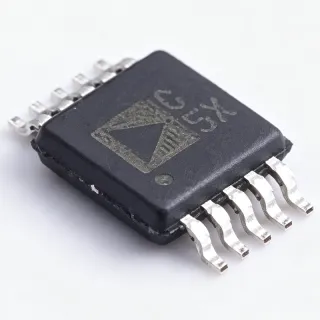
AD977AANZ - 16-Bit 200 kSPS SAR ADC | Analog Devices
MPN: AD977AANZ ✗ Akhir HayatAD977AANZ Ringkasan
A successive-approximation register, or SAR, ADC is a type of analog-to-digital converter that compares the sampled input voltage against a series of internal trial voltages. The SAR architecture combines moderate conversion speed with relatively low power, making it appropriate for precision industrial measurement, control, instrumentation, and signal-acquisition systems where a 200 kSPS sampling rate is sufficient.
The AD977AANZ provides 16-bit nominal resolution, one analog input, and a 200 kSPS throughput rate. Its single 5 V supply simplifies system power design, while the internal 2.5 V reference supports standalone operation when an external precision reference is not required. The serial interface reduces the number of package pins needed for data transfer and is suitable for connecting the converter to a microcontroller, DSP, FPGA, or other digital acquisition controller.
Factory calibration is an important technical feature because it reduces the need for board-level offset and gain correction. The converter remains a sampled-data system, so front-end settling time, source impedance, input filtering, reference stability, and digital clock quality influence the usable accuracy. Designers should therefore treat the analog input and reference paths as precision signal paths rather than ordinary utility connections.
Typical uses include industrial process-control loops, multichannel measurement systems when several AD977AANZ devices are combined, factory automation equipment, laboratory instrumentation, data acquisition, and embedded control products. The 200 kSPS rate supports rapidly changing process variables while keeping power and implementation complexity below high-speed flash-converter designs.
The primary design tradeoff is conversion throughput versus resolution and implementation complexity. AD977AANZ provides more usable resolution and simpler integration than many lower-rate converters, but it cannot match the multi-megahertz sampling rates of modern flash ADCs. Validate the source impedance, acquisition time, reference arrangement, digital interface timing, and thermal conditions before fixing the production design.
This page combines the manufacturer specifications, package and interface details, verified drop-in options, and practical implementation guidance needed to evaluate the AD977AANZ for precision data-acquisition and industrial-control designs.
Pilihan pengganti yang segera untuk AD977AANZ — sama paket, pin-pin kompatibel. Bahagian paket yang berbeza memerlukan kerja ulang PCB diasingkan.
Varietas dalam siri ini
Model serupa yang kompatibel dengan pengganti yang segera AD977AANZ (sama faktor bentuk dan kaki) — berbeza dalam Package, Supply Voltage, Throughput Rate, Internal Reference, Power-Down Mode.
AD977ABNZ
✅ Masuk Drop-InHubungi untuk harga
Lihat Datasheet →AD977ABN
✅ Masuk Drop-InHubungi untuk harga
Lihat Datasheet →AD977AANZ Penilaian maksimum & Ciri-ciri Elektrik
| Converter Type | Successive-approximation ADC |
| Pemecahkatan | 16 bit |
| Number of Input Channels | 1 channel |
| Throughput Rate | 200 kSPS |
| Tegangan Pemberi Arus | 5 V |
| Internal Reference | 2.5 V |
| External Reference Support | Supported |
| Sampling Architecture | Switched-capacitor SAR |
| Data Interface | Serial, SPI-compatible |
| Kemasan | 20-pin PDIP, 0.300 in (7.62 mm) pitch |
| Packaging | Tube |
| Suhu Operasi | -40°C to +85°C |
| Factory Calibration | Yes |
| Power-Down Mode | Supported |
Panduan Konfigurasi Pin AD977AANZ 20-pin pdip, 0.300 in (7.62 mm) pitch
Konfigurasi pin untuk AD977AANZ (20-pin pdip, 0.300 in (7.62 mm) pitch pakai). Komponen analog ini mempunyai pin masukan, keluaran, dan kuasa. Rujuk dokumen pengeluar untuk konfigurasi pengecualian, pemulihan, dan pin aktifkan. Ideal untuk pengawasan isyarat dan litar pengukur.

Tiada data garisan pin yang diperoleh untuk AD977AANZ.
Rujuk kepada lembaran data untuk konfigurasi pin penuh.
Aplikasi Biasa
AD977AANZ patut untuk 6 aplikasis: Industrial Process Measurement, Factory Automation Control, Laboratory Data Acquisition, Embedded Sensor Interface, Power and Energy Monitoring, Precision Control and Monitoring.
Industrial Process Measurement
The AD977AANZ fits process-control designs that require 16-bit nominal resolution and a 200 kSPS sampling rate from a single 5 V supply. It can acquire a conditioned sensor signal while the switched-capacitor SAR architecture limits power relative to many high-speed flash converters. Its factory calibration reduces the need for board-level offset and gain correction. The practical design limit is the converter’s acquisition behavior: source impedance, input RC filtering, settling time, and reference noise must be characterized so that the complete signal chain preserves the intended measurement accuracy.
Disebarkan
Factory Automation Control
AD977AANZ is suitable for factory automation modules that inspect position, pressure, level, or other slowly changing analog quantities while maintaining a compact acquisition channel. The 200 kSPS rate provides more temporal headroom than the 100 kSPS AD977ANZ, while single 5 V operation simplifies embedded controller power planning. Place input filtering close to the converter, maintain a low-impedance drive path, and account for relay or sensor excitation transients before sampling. The serial interface also reduces the number of traces required between the analog front end and a microcontroller or FPGA.
Disebarkan
Laboratory Data Acquisition
The AD977AANZ can form the analog input stage of a laboratory data-acquisition instrument requiring 16-bit nominal resolution and 200 kSPS acquisition. A serial controller can request conversions and transfer results through the compact interface, leaving more board area for input conditioning and isolation. Because this is a switched-capacitor SAR ADC, the source must settle before each conversion. Use a properly designed reference network, shielded analog routing, and calibrated excitation to prevent the instrument’s accuracy from being limited by the sensor interface rather than the converter.
Disebarkan
Embedded Sensor Interface
AD977AANZ is appropriate for embedded sensing systems that digitize a conditioned analog sensor output at up to 200 kSPS. The single 5 V supply can align with many digital control systems, and the internal 2.5 V reference reduces the component count when reference accuracy is adequate. A microcontroller or FPGA can handle serial conversion control and data transfer. Designers should evaluate whether the sensor output can drive the sampling network without excessive settling errors, and should place the analog input path away from switching nodes and high-current return paths to preserve measurement repeatability.
Disebarkan
Power and Energy Monitoring
The AD977AANZ can digitize conditioned voltage or current signals in power-monitoring equipment when 200 kSPS is sufficient for the measured bandwidth. Its 16-bit nominal resolution is useful for representing small changes around a full-scale value, and the low-power SAR architecture supports multi-channel monitoring boards. Each channel still requires isolated or appropriately scaled front-end circuitry. The internal reference simplifies basic designs, while external-reference operation should be considered when calibration drift, common-mode behavior, or sharing a precision reference across several converters is important.
Disebarkan
Precision Control and Monitoring
AD977AANZ is suitable for precision feedback and supervisory monitoring circuits that require deterministic sampling without the complexity of a high-speed flash converter. A 200 kSPS conversion rate can capture dynamic events while single 5 V operation and factory calibration simplify system integration. For closed-loop control, verify acquisition time and control-loop latency rather than using throughput as the complete timing budget. The serial interface timing, reference settling, and external conditioning delays determine the usable update rate, so those paths should be validated together in the final controller board.
Disebarkan
Ringkasan Produk Disebarkan
Data referensi kejuruteraan untuk AD977AANZ — perbandingan, panduan rancangan, dan maklumat kesediaan
Panduan Pilihan
Perbandingan dengan Gantian
| Parametr | Produk Ini | AD977ABNZ | AD977ABN |
|---|---|---|---|
| Package | 20-pin PDIP | 20-pin PDIP | 20-pin PDIP |
| Brand | Analog Devices | Analog Devices | Analog Devices |
| Resolution | 16 bit | 16 bit | 16 bit |
| Throughput Rate | 200 kSPS | 200 kSPS | 200 kSPS |
| Supply Voltage | 5 V | 5 V | 5 V |
| Converter Architecture | Successive-approximation ADC | Successive-approximation ADC | Successive-approximation ADC |
| Internal Reference | 2.5 V | 2.5 V | 2.5 V |
| Data Interface | Serial, SPI-compatible | Serial | Serial |
| Input Channels | 1 channel | 1 channel | 1 channel |
Penyeberangsung Jelas
- Matches the verified 200 kSPS conversion rate (vsAD977ABNZ)
- Retains the same single 5 V supply arrangement (vsAD977ABN)
- Preserves the same 20-pin PDIP footprint (vsAD977ABNZ)
Catatan Desain
Route the analog input and reference connections away from digital clock traces, switching-node copper, and high-current return paths. Place the input filtering network close to the ADC input so that settling occurs before the sampled window. For a 20-pin through-hole layout, preserve the 0.300 in (7.62 mm) pitch and verify every net against the numbered pin-description table in the manufacturer datasheet.
Decouple the 5 V supply close to the analog power pins and keep return-current paths short. The analog input source impedance and external filter capacitors must permit the sampling network to settle during the acquisition interval. If an external reference replaces the internal 2.5 V source, verify its noise, stability, startup behavior, and allowable input range against the AD977/AD977A electrical characteristics.
Do not assume that a converter with the same 16-bit resolution is interchangeable because interface timing, acquisition behavior, reference polarity, and pin assignment may differ. Confirm the complete numbered 20-pin mapping, digital mode, conversion timing, and operating-temperature grade before substituting AD977ABNZ or AD977ABN. Also avoid driving the analog input beyond the selected reference range.
Use a low-noise, stable reference and place reference-decoupling components close to the associated converter pins. Check that digital activity on the serial interface does not couple into the analog input through board capacitance or shared return paths. A controlled analog ground region and short, continuous ground connections are preferable to a split-ground arrangement that creates unpredictable return currents.
Maklumat Kesediaan
No explicit RoHS, REACH, halogen-free, lead-free, or conflict-minerals statement was identified for this exact ordering code. AEC-Q100 qualification is not applicable to the identified industrial and legacy converter application.