2SK170-GR - N-Channel JFET Low Noise Audio | Toshiba
MPN: 2SK170-GR ✗ End of Life2SK170-GR Overview
A JFET (junction field-effect transistor) is a voltage-controlled semiconductor in which a reverse-biased gate junction controls conduction between source and drain. Unlike MOSFETs, JFETs have no insulating gate oxide, giving them very low 1/f noise and high input impedance - properties that place them at the input stage of the amplifier-device hierarchy, ahead of bipolar transistors for high-impedance, low-noise signal acquisition.
The defining feature of the 2SK170-GR is its exceptionally low input-referred noise, which made it a legendary input device for audio preamplifiers, moving-magnet and moving-coil phono stages, and microphone preamps. Its high gate input impedance (in the gigaohm range typical for JFETs) allows direct connection to high-impedance sources, and its low input capacitance preserves high-frequency response in MM cartridge inputs.
The GR grade is specifically chosen when the design bias point targets the 2.6-6.5 mA Idss range; designers typically select and match devices within a grade to minimize offset and distortion in differential input pairs. Because it is depletion-mode, the device conducts at Vgs = 0 and is biased with a negative gate-source voltage, simplifying self-bias circuits with a source resistor.
Typical applications include discrete audio preamplifier input stages, phono equalizer front ends, condenser microphone buffers, and low-noise measurement front ends. Toshiba has discontinued the 2SK170 family, so the part is commonly sourced as leftover stock or replaced by the Linear Systems LSK170 series.
Design tip: because Idss varies widely unit-to-unit, always measure and match Idss across input pairs and set bias at roughly half of Idss for best linearity and noise trade-off.
This page synthesizes distributor pricing, verified drop-in alternatives, and practical matching guidance not found in the manufacturer datasheet.
Drop-in alternatives for 2SK170-GR — same package, pin-to-pin compatible. Different-package parts requiring PCB rework are excluded.
Variants in this series
Same-series models that are drop-in compatible with 2SK170-GR (same form factor and footprint) — differing in Mounting Type, Package, Transistor Type, Configuration.
2SK170-BL
Contact for price
View Datasheet →LSK170A
Contact for price
View Datasheet →2SK117-GR
📋 Reference alternative (not in catalog)
LSK170B
📋 Reference alternative (not in catalog)
LSK170C
📋 Reference alternative (not in catalog)
2SK170-GR Maximum Ratings & Electrical Characteristics
| Transistor Type | N-Channel JFET (depletion mode) |
| Grade | GR (Idss 2.6 mA to 6.5 mA) |
| Idss (Zero-Gate Drain Current) | 2.6 mA to 6.5 mA |
| Application | Low noise audio amplifier |
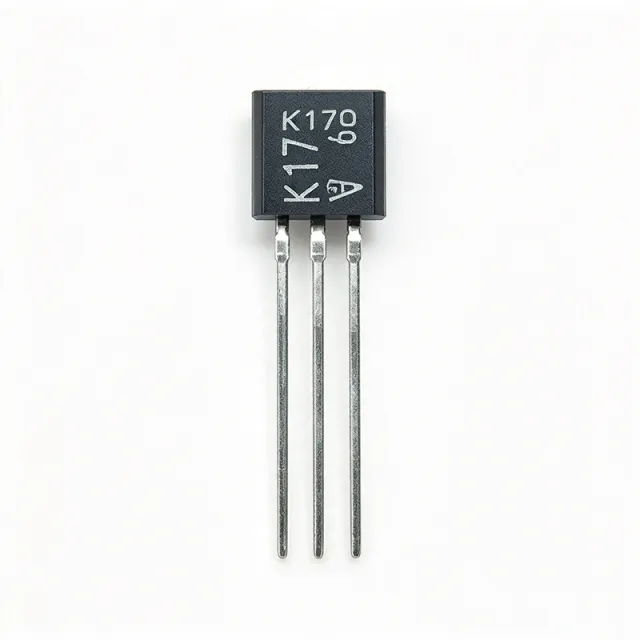
| Package | TO-92 (3-pin) |
| Mounting Type | Through Hole |
| Technology | Silicon N-Channel Junction Type |
| Pin Count | 3 |
| Replacement Series | LSK170 (Linear Systems) |
2SK170-GR Pin Configuration
| Pin 1 | G (Gate) — Gate - high-impedance control terminal |
| Pin 2 | D (Drain) — Drain - connects to positive supply side |
| Pin 3 | S (Source) — Source - connects to ground or bias resistor |
Typical Applications
2SK170-GR is suitable for 6 applications: Phono Preamplifier Input Stage, Discrete Audio Preamplifier, Condenser Microphone Buffer, Low-Noise Measurement Front Ends, Guitar Effects and Instrument Inputs, RF and Oscillator Gain Blocks (LF).
Phono Preamplifier Input Stage
The 2SK170-GR is a classic input device for moving-magnet and moving-coil phono stages, where cartridge signal levels are in the millivolt range and any input noise is amplified by the RIAA EQ network. Its N-channel JFET gate presents gigaohm-level input impedance, preventing cartridge loading and preserving high-frequency response, while the GR grade's 2.6-6.5 mA Idss allows a bias point that minimizes input-referred voltage noise without excess dissipation. Designers run the device at roughly half Idss via a self-bias source resistor and parallel multiple matched units to reduce noise by the square root of the device count. Because Toshiba discontinued the part, matched GR stock or Linear Systems LSK170A replacements are typically specified today.
Recommended
Discrete Audio Preamplifier
In discrete hi-fi and instrument preamplifiers, the 2SK170-GR serves as the first amplifying device after the volume control or input selector. The JFET's extremely low 1/f corner noise keeps the noise floor below the thermal noise of the source impedance, while its depletion-mode operation permits simple one-resistor self-bias with no gate supply. The GR grade Idss (2.6-6.5 mA) suits battery-powered preamps where standing current is limited. In differential or cascode front ends, matching Idss across the pair is essential - designers measure and bin devices to within a few percent to cancel offset and even-order distortion. The TO-92 through-hole package also makes it easy to hand-match and solder in point-to-point audio builds.
Recommended
Condenser Microphone Buffer
Electret and externally polarized condenser capsules need a follower with near-infinite gate impedance to sense the capsule charge without discharging it, and the 2SK170-GR is a canonical choice. Configured as a source follower, the GR-grade device draws only a few milliamps, important in 48 V phantom or battery-powered microphones, while its low input capacitance minimizes capsule loading and high-frequency loss. The gate leak resistor (typically 1 gigaohm) biases the gate at DC, and a source resistor or current source sets the follower current near half of Idss. Matching is less critical than in differential stages, but Idss measurement is still recommended to set the bias point correctly per unit.
Recommended
Low-Noise Measurement Front Ends
Laboratory and industrial instrumentation that measures signals from high-impedance sources - pH probes, photodiodes, piezoelectric sensors - benefits from the 2SK170-GR as a source-follower or common-source buffer. The JFET's gate leakage is in the picoampere region, so it does not discharge high-impedance sensors, and its low voltage noise keeps small signals resolvable above the floor. The GR grade's modest 2.6-6.5 mA Idss suits low-power portable instruments. For precision work, bias the device in a cascode to stabilize drain voltage and reduce Miller capacitance, and shield or guard the gate node to prevent leakage paths across the PCB surface.
Recommended
Guitar Effects and Instrument Inputs
High-impedance instrument inputs - guitars, piezo pickups, ribbon microphones - use JFET buffers to avoid loading the source and dulling the tone. The 2SK170-GR's gigaohm gate impedance preserves the pickup's natural resonance, and the GR grade bias current keeps battery-powered stompbox circuits economical. A simple source follower with a 1-10 megaohm gate bias resistor is the standard topology; the device's low noise ensures hiss stays below audibility at typical gain settings. The DIY audio community actively recommends 2SK117-GR as a direct replacement with the same parameters and pinout, since original 2SK170 stock is exhausted and re-marked counterfeits circulate in the surplus channel.
Recommended
RF and Oscillator Gain Blocks (LF)
Below the VHF range, the 2SK170-GR also performs well as a low-noise gain device in local oscillator buffers, crystal oscillators, and IF front ends where a bipolar transistor's base current noise would be excessive. Its high transconductance for a small-signal JFET and low feedback capacitance support stable Colpitts and Pierce oscillator operation, and the GR grade current keeps crystal drive within safe limits. In receiver front ends for LF/HF bands, a cascode connection with the 2SK170-GR as the lower device minimizes Miller effect and improves reverse isolation. Designers verify the drain-source and gate voltage ratings against the Toshiba datasheet before applying supply voltages.
Recommended
Recommended Products Summary
Engineering reference data for 2SK170-GR — comparison, design guidance, and compliance information.
Selection Guide
Comparison with Alternatives
| Parameter | This Product | 2SK170-BL | 2SK117-GR | LSK170A | LSK170B |
|---|---|---|---|---|---|
| Package | TO-92 (3-pin) | TO-92 - same | TO-92 - same | TO-92 - same | TO-92 - same |
| Brand | Toshiba | Toshiba | Toshiba | Linear Systems | Linear Systems |
| Idss Grade | GR (2.6-6.5 mA) | BL (6-12 mA) | GR (2.6-6.5 mA) | Grade A (closest to GR range) | Grade B (6-12 mA) |
| Transistor Type | N-Channel JFET | N-Channel JFET | N-Channel JFET | N-Channel JFET | N-Channel JFET |
| Pinout | 1=G, 2=D, 3=S (TO-92) | Identical | Identical | Pin-for-pin replacement (documented) | Pin-for-pin replacement (documented) |
| Lifecycle Status | EOL (discontinued by Toshiba) | EOL | EOL | Active production | Active production |
| Primary Application | Low noise audio amplifier | Low noise audio amplifier | Low noise audio amplifier | Ultra low noise audio/acoustic | Ultra low noise audio/acoustic |
Key Differentiators
- Lowest-current grade in the 2SK170 family (vs 2SK170-BL)
- Active-production equivalent available (vs 2SK117-GR)
- Honest trade-off: higher-current grades give more transconductance (vs LSK170B)
Design Notes
The GR grade spans 2.6 mA to 6.5 mA of Idss - a 2.5:1 spread. Never assume a nominal value: measure Idss of each unit at Vds = 10 V, Vgs = 0 before biasing. In differential input pairs, match devices within about 5% of Idss to cancel offset and even-order distortion. Counterfeit and re-marked 2SK170 parts circulate widely since discontinuation; buying from reputable distributors and verifying Idss on receipt is essential.
Estimated: bias the GR-grade device at roughly half its measured Idss (about 1.3-3.3 mA). With a 15 V supply and a drain load of, say, 4.7 kilohm, dissipation is a few tens of milliwatts - far below any thermal concern in TO-92. The real constraint is the drain-gate voltage rating: consult the Toshiba datasheet for maximum ratings and keep the drain-gate bias well inside the limit, especially in cascode or oscillator circuits where swings exceed the quiescent point.
For through-hole TO-92 audio circuits, keep the gate trace short and guarded: a high-value (1-100 megaohm) gate leak resistor plus PCB surface leakage can dominate noise and offset. Ring the gate node with a guard ring driven at source potential, clean flux thoroughly, and use glass-epoxy PCBs. In follower configurations, place the source resistor close to pin 3 to minimize loop area. This mirrors the layout practice shown in Toshiba application examples for the 2SK170.
Compliance Information
Original 2SK170 production predates uniform RoHS labeling; verify certificate of conformity with the specific seller. The LSK170 replacement series is documented as available in RoHS-compliant packaging.