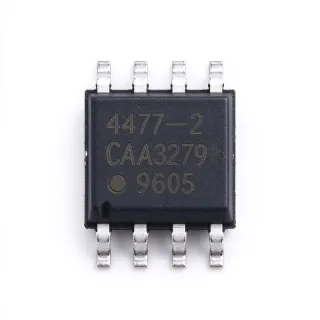
AD548KR - Low-Power Precision BiFET Op Amp | Analog Devices
MPN: AD548KR ✗ End of LifeAD548KR Overview
A BiFET operational amplifier is an input stage that uses field-effect transistors to achieve very high input impedance and low input bias current. Within the amplifier hierarchy, the AD548KR is a voltage-feedback operational amplifier, also classified as a precision low-noise amplifier and a low-power analog signal-conditioning IC. Its combination of low supply current and precision DC performance supports battery-powered instruments, industrial measurement systems, and low-level sensor interfaces.
The AD548 family is specified for low quiescent current of 170 uA typical and 200 uA maximum. Its warmed input bias current reaches 10 pA maximum, while offset voltage is limited to 250 uV maximum and offset drift to 2 uV/°C maximum. These characteristics make the amplifier suitable for high-impedance transducers, current measurements, and precision feedback networks where bias current and thermal drift can materially affect accuracy.
AC performance includes a 1 MHz unity-gain bandwidth and a 1 V/us slew rate. The Analog Devices AD548 data sheet identifies the AD548 as pin compatible with the LF441, TL061, and AD542, allowing designers to improve performance while reducing power dissipation by as much as 85%. A single-amplifier, single-supply-compatible topology provides flexibility for battery-operated and dual-supply analog systems.
Typical uses include low-level sensor amplification, biomedical instrumentation, industrial process measurement, photodiode signal chains, precision current sensing, and portable data-acquisition equipment. The low bias current benefits high-source-impedance sensors, while the low quiescent current limits supply consumption in battery-powered systems.
The primary PCB-design consideration is input bias-current management. Keep sensitive input traces short, use guarded or low-leakage construction where appropriate, and place the amplifier input network close to the device. Confirm the SOIC-8 footprint, supply decoupling, output-load limits, and stability requirements against the manufacturer data sheet before production release.
This page combines manufacturer specifications, lifecycle information, pin-compatible comparison data, application guidance, and design-focused selection criteria to support faster engineering evaluation. It also identifies where replacement decisions require checking exact grade, package, supply range, and electrical limits.
Drop-in alternatives for AD548KR — same package, pin-to-pin compatible. Different-package parts requiring PCB rework are excluded.
AD548JRZ
✅ Drop-In📋 Reference alternative (not in catalog)
AD548JRZ-REEL
✅ Drop-In📋 Reference alternative (not in catalog)
AD548JR
✅ Drop-In ⚠️ Specs Unverified📋 Reference alternative (not in catalog)
AD548JZ
✅ Drop-In ⚠️ Specs Unverified📋 Reference alternative (not in catalog)
AD548KR
✅ Drop-In ⚠️ Specs UnverifiedContact for price
View Datasheet →AD548KR Maximum Ratings & Electrical Characteristics
| Amplifier Type | Precision, low-power BiFET operational amplifier |
| Number of Amplifiers | 1 amplifier |
| Maximum Supply Voltage | 18 V |
| Operating Supply Range | ±4.5 V to ±18 V |
| Quiescent Current | 170 uA typical, 200 uA maximum |
| Input Bias Current | 10 pA maximum, warmed |
| Offset Voltage | 250 uV maximum |
| Offset Voltage Drift | 2 uV/°C maximum |
| Unity-Gain Bandwidth | 1 MHz |
| Slew Rate | 1 V/us |
| Input Noise Voltage | 2 V p-p |
| Package | 8-lead SOIC |
| Mounting Type | Surface mount |
| Maximum Power Dissipation | 500 mW |
| AD548B Temperature Range | -40°C to +85°C |
| Pin Compatibility | Compatible with LF441, TL061, and AD542 |
| Lifecycle Recommendation | Not recommended for new designs |
AD548KR 8-lead soic Pin Configuration Guide
Pin configuration for AD548KR (8-lead soic package). This analog component features input, output, and power supply pins. Refer to the manufacturer datasheet for offset null, compensation, and enable pin configurations. Ideal for signal conditioning and amplifier circuits.

No detailed pinout data available for AD548KR.
Refer to the datasheet for full pin configuration.
Typical Applications
AD548KR is suitable for 6 applications: Precision Current Sensing, Battery-Powered Sensor Interface, Biomedical Signal Conditioning, Industrial Process Measurement, Photodiode Amplification, Portable Data Acquisition.
Precision Current Sensing
The AD548KR is well suited to precision current sensing because its BiFET input stage limits warmed input bias current to 10 pA maximum, helping reduce measurement error when connected to a high-impedance shunt or transimpedance network. Its 250 uV maximum offset voltage and 2 uV/°C maximum drift also support accurate low-level signal amplification. Place the device close to the sense element, use low-leakage PCB construction, and verify that the selected gain remains stable with the intended load and output capacitance.
Recommended
Battery-Powered Sensor Interface
The AD548KR fits battery-powered sensor interfaces that require more precision than a general-purpose amplifier but cannot tolerate excessive supply consumption. Its quiescent current is 170 uA typical and 200 uA maximum, while the 1 MHz unity-gain bandwidth supports signals extending beyond a simple DC bridge. Use low-leakage input routing and controlled reference circuitry to preserve accuracy. Supply operating headroom and output swing must remain within the ±4.5 V to ±18 V operating range.
Recommended
Biomedical Signal Conditioning
The AD548KR can serve as a low-level signal conditioner in biomedical instrumentation because its 10 pA maximum warmed input bias current reduces loading on high-source-impedance sensors. The 250 uV maximum offset voltage and 2 uV/°C maximum drift help maintain measurement stability, while the low 170 uA typical quiescent current supports portable equipment. Confirm medical-system requirements, isolation strategy, input protection, and applicable regulatory validation separately; amplifier qualification alone does not establish system compliance.
Recommended
Industrial Process Measurement
The AD548KR is appropriate for industrial process-measurement front ends that combine slow sensor signals with modest bandwidth requirements. Its precision offset and drift characteristics support stable amplification, and its 1 MHz unity-gain bandwidth is sufficient for many pressure, temperature, and slow process-control signals. The 1 V/us slew rate supports larger output transitions without requiring a wide-band amplifier. Protect industrial inputs from transients, maintain clean grounding, and account for the -40°C to +85°C AD548B industrial-temperature family range when applicable.
Recommended
Photodiode Amplification
The AD548KR is suitable for low-level photodiode and optical-sensor amplification because its very low warmed input bias current limits disturbance of high-impedance sources. The 1 MHz unity-gain bandwidth permits useful signal bandwidth without moving to a much higher-power amplifier, while low quiescent current benefits portable optical instruments. Use guarded input traces, keep the photodiode junction area and PCB surface clean, and choose feedback capacitance that preserves the required signal bandwidth and phase margin.
Recommended
Portable Data Acquisition
The AD548KR supports portable data-acquisition channels that must combine low power with accurate DC measurement. Its maximum quiescent current of 200 uA reduces continuous battery drain, while the 250 uV maximum offset and 2 uV/°C maximum drift improve channel stability. The 1 MHz unity-gain bandwidth is appropriate for many sensor, thermocouple, and low-frequency acquisition stages. Validate input filtering, common-mode range, gain accuracy, and settling time across the complete measurement bandwidth.
Recommended
Recommended Products Summary
Engineering reference data for AD548KR — comparison, design guidance, and compliance information.
Selection Guide
Comparison with Alternatives
| Parameter | This Product | AD548JRZ | AD548JRZ-REEL | AD548JR | AD548JZ | AD548KR |
|---|---|---|---|---|---|---|
| Package | SOIC-8 | SOIC-8 | SOIC-8 | SOIC-8 | SOIC-8 | SOIC-8 |
| Brand | Analog Devices | Analog Devices | Analog Devices | Analog Devices | Analog Devices | Analog Devices |
Key Differentiators
- Low-power precision operation (vs AD548JRZ)
- Very low warmed input bias current (vs AD548JRZ)
- Precision DC characteristics (vs AD548JRZ)
- Legacy footprint upgrade path (vs AD548JRZ-REEL)
Design Notes
For high-impedance sensor inputs, keep the AD548KR input node physically short and isolate it from residual flux, moisture, and conductive contamination. The device's warmed input bias current can reach 10 pA maximum, so board leakage that appears in parallel with the source may dominate the total error. Use a guarded input layout where practical, avoid copper underneath the sensitive node, and clean the assembled PCB before high-impedance calibration.
Place supply bypass capacitors close to the power and ground pins and use a compact, low-loop-area return path. The 8-lead SOIC footprint is pin-compatible with several legacy amplifiers, but footprint compatibility does not guarantee identical stability behavior. Recheck the feedback network, output loading, input capacitance, and gain-bandwidth interaction whenever AD548KR replaces an LF441, TL061, or AD542 implementation.
Do not interpret the ±4.5 V to ±18 V operating range as permission to apply 18 V to a single rail. Check the common-mode input range, output swing, and maximum total supply voltage at the highest temperature and worst-case load. Also verify the exact AD548 grade and suffix before substitution because ordering options can differ in temperature grade or production-delivery format even when they use the same SOIC-8 footprint.
Estimated: at a 15 V total supply, 12 V output, and 1 mA load, the amplifier's approximate signal-path dissipation is 3 mW, calculated as (15 V - 12 V) × 1 mA. This estimate excludes quiescent power and does not represent a manufacturer thermal rating. Actual PCB heating depends on total supply voltage, load current, copper area, ambient temperature, and neighboring heat sources.
Compliance Information
The cited AD548 product information does not provide explicit customer-facing RoHS, REACH, lead-free, halogen-free, or conflict-minerals declarations. Request current compliance documentation for the exact AD548KR ordering code before production release.