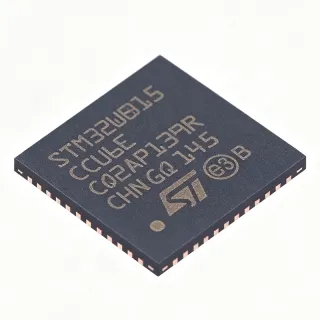
ADMV4821C - 24-29.5GHz Dual-Pol Beamformer | Analog Devices
MPN: ADMV4821C ✓ Active| Qty | Unit Price | Extended |
|---|---|---|
| 1 | $0 | $0.00 |
| 10 | $0 | $0.00 |
| 100 | $0 | $0.00 |
| 500 | $0 | $0.00 |
| 1,000 | $0 | $0.00 |
ADMV4821C Overview
A beamformer is a key component in phased-array antenna systems, responsible for controlling the phase and amplitude of signals to steer the antenna beam electronically. It is part of the RF front-end chain, which includes antennas, transceivers, and beamformers. The ADMV4821C is a dual-polarization beamformer, meaning it can handle both horizontal and vertical polarizations simultaneously, effectively doubling the data throughput in MIMO systems. This makes it ideal for 5G base stations and satellite communications.
Key features include a wide RF frequency range of 24 GHz to 29.5 GHz, 16 TX and 16 RX channels, dual-polarization support, and matched 50-ohm single-ended interfaces. The device is designed for high linearity and low noise figure, ensuring excellent signal quality. It also offers flexible control interfaces for beam steering, making it suitable for advanced antenna arrays.
Technically, the ADMV4821C integrates multiple RF chains with phase shifters and gain amplifiers, all controlled via a serial interface. The dual-polarization architecture allows for 2x2 MIMO operation, enhancing spectral efficiency. The device operates from a single supply voltage and includes on-chip temperature compensation for stable performance across temperature.
Typical applications include 5G NR base stations, satellite ground terminals, radar systems, and point-to-point communication links. The wide frequency coverage and dual-polarization capability make it a versatile solution for emerging mmWave applications.
When designing with the ADMV4821C, careful attention must be paid to thermal management and RF layout. The device dissipates significant power, and proper heat sinking is essential. Additionally, the RF traces should be impedance-matched to 50 ohms to minimize reflections.
Drop-in alternatives for ADMV4821C — same package, pin-to-pin compatible. Different-package parts requiring PCB rework are excluded.
Quick Comparison Tool — Select alternative parts for side-by-side comparison:
ADMV4821BCCZ
✅ Drop-In📋 Reference alternative (not in catalog)
ADMV4820
✅ Drop-In ⚠️ Specs Unverified📋 Reference alternative (not in catalog)
ADMV4822
✅ Drop-In ⚠️ Specs Unverified📋 Reference alternative (not in catalog)
ADMV4821C Specifications
| RF Frequency Range | 24 GHz to 29.5 GHz |
| Number of TX Channels | 16 |
| Number of RX Channels | 16 |
| Polarization | Horizontal and Vertical |
| RF Interface | Matched 50-ohm single-ended |
| Supported 5G NR Bands | n257, n258, n261 |
| Package | BCCZ |
| RoHS Status | Compliant |
ADMV4821C bccz Pin Configuration Guide
Pin configuration for ADMV4821C (bccz package). Pin numbering, functions, and connection diagrams are defined in the manufacturer datasheet. Refer to it for the exact footprint and soldering guidelines.

No detailed pinout data available for ADMV4821C.
Refer to the datasheet for full pin configuration.
Typical Applications
ADMV4821C is suitable for 6 applications: 5G NR Base Stations, Satellite Ground Terminals, Radar Systems, Point-to-Point Communication Links, Test and Measurement Equipment, Phased Array Antenna Systems.
5G NR Base Stations
The ADMV4821C is ideal for 5G NR base stations operating in the n257, n258, and n261 bands. Its 16 TX and 16 RX channels with dual polarization enable high-capacity MIMO systems, supporting beamforming and beam steering for enhanced spectral efficiency. The wide frequency range covers multiple 5G bands in one design, reducing BOM complexity. The matched 50-ohm interfaces simplify antenna array integration, and the compact BCCZ package allows dense array layouts.
Recommended
Satellite Ground Terminals
The ADMV4821C is suitable for satellite ground terminals requiring phased-array antennas. Its dual-polarization capability supports both horizontal and vertical polarization, enabling frequency reuse and increased throughput. The 24-29.5 GHz frequency range aligns with Ka-band satellite communications. The 16-channel architecture provides the flexibility needed for beam steering and tracking. The device's high linearity ensures reliable signal reception and transmission in demanding satellite links.
Recommended
Radar Systems
The ADMV4821C can be used in radar systems operating in the 24-29.5 GHz band, such as automotive radar and surveillance radar. Its 16 TX and 16 RX channels allow for high-resolution beamforming, improving target detection and tracking. The dual-polarization feature enhances radar performance by providing additional information about target shape and material. The matched 50-ohm interfaces simplify integration with radar front-end components. The device's wide operating frequency range supports multiple radar applications.
Recommended
Point-to-Point Communication Links
The ADMV4821C is well-suited for point-to-point communication links in the 24-29.5 GHz band, commonly used for backhaul and fixed wireless access. Its dual-polarization capability doubles the data rate by transmitting two independent data streams. The 16-channel beamforming enables high-gain directional links, extending range and improving link reliability. The compact package and matched 50-ohm interfaces make it easy to integrate into small form-factor radios. The device's low noise figure ensures high sensitivity for long-distance links.
Recommended
Test and Measurement Equipment
The ADMV4821C is used in test and measurement equipment for characterizing 5G and radar components. Its 16 TX and 16 RX channels allow for parallel testing of multiple devices, increasing throughput. The dual-polarization support enables testing of polarization-sensitive components. The wide frequency range covers multiple bands, making it a versatile tool for R&D labs. The device's high linearity ensures accurate measurements of DUT performance.
Recommended
Phased Array Antenna Systems
The ADMV4821C is a core component in phased array antenna systems, providing beamforming and beam steering capabilities. Its 16 channels per polarization allow for precise control of the antenna pattern. The dual-polarization architecture supports 2x2 MIMO, enhancing system capacity. The device's wide frequency range makes it adaptable to various applications, from 5G to satellite communications. The matched 50-ohm interfaces simplify the connection to antenna elements.
Recommended
Recommended Products Summary
Engineering reference data for ADMV4821C — comparison, design guidance, and compliance information.
Selection Guide
Comparison with Alternatives
| Parameter | This Product | ADMV4821BCCZ | ADMV4820 | ADMV4822 |
|---|---|---|---|---|
| Package | BCCZ | BCCZ | BCCZ | BCCZ |
| Brand | Analog Devices | Analog Devices | Analog Devices | Analog Devices |
Key Differentiators
- Dual-polarization support (vs ADMV4820)
- 16 TX and 16 RX channels (vs ADMV4822)
- Wide frequency coverage (vs ADMV4820)
Design Notes
The ADMV4821C dissipates significant power due to its 32 RF channels. Ensure adequate heat sinking and thermal vias in the PCB layout. Refer to the thermal resistance values in the datasheet, which are simulated based on JEDEC specifications (JESD51-12).
For optimal RF performance, use a high-frequency laminate with controlled impedance. Keep RF traces as short as possible and match them to 50 ohms. Place decoupling capacitors close to the power pins to minimize noise.
Ensure the control interface is properly configured for beam steering. Incorrect register settings can lead to phase errors. Also, verify the power supply sequencing to avoid latch-up.
Compliance Information
RoHS compliance is assumed based on Analog Devices standard practice, but not explicitly stated in the provided data.