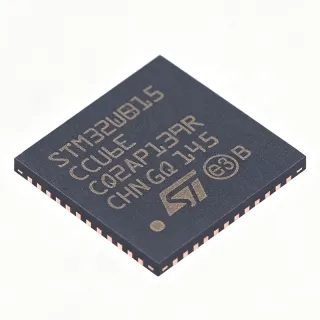
STM32WBA52CEU6 - Arm Cortex-M33 BLE 5.4 MCU | STMicroelectronics
MPN: STM32WBA52CEU6 ✓ Active| Qty | Unit Price | Extended |
|---|---|---|
| 1 | $6.5 | $6.50 |
| 10 | $5.85 | $58.50 |
| 100 | $5.2 | $520.00 |
| 500 | $4.68 | $2,340.00 |
| 1,000 | $4.16 | $4,160.00 |
STM32WBA52CEU6 Overview
A microcontroller (MCU) is a compact integrated circuit designed to govern a specific operation in an embedded system. It contains a processor core, memory, and programmable input/output peripherals. The STM32WBA52CEU6 belongs to the STM32WBA series, which is part of the broader STM32 family of 32-bit microcontrollers. This series is optimized for wireless connectivity, combining the Arm Cortex-M33 core with a radio transceiver, enabling secure and low-power communication in IoT devices.
Key features include 512 KB of flash memory and 128 KB of SRAM, a rich set of analog and digital peripherals, and advanced security features such as TrustZone, secure boot, and hardware cryptographic accelerators. The BLE 5.4 radio supports long-range, high-throughput, and advertising extensions, with a link budget of up to 105 dB. The device also includes a 12-bit ADC, multiple timers, and communication interfaces like SPI, I2C, USART, and USB.
The STM32WBA52CEU6 is built on a low-power process technology, offering multiple low-power modes including Sleep, Stop, and Standby, with typical current consumption as low as 2.2 uA in Standby mode with RTC. The TrustZone technology provides hardware-enforced isolation for secure code execution, making it suitable for applications requiring robust security, such as secure payment, authentication, and firmware protection.
Typical applications include smart home devices, industrial sensors, medical wearables, and asset tracking. The integrated BLE radio and security features make it a strong choice for IoT edge nodes that need secure wireless communication. The device supports over-the-air (OTA) firmware updates, enabling remote maintenance and feature updates.
When designing with this MCU, ensure proper antenna matching for the BLE radio and follow the layout guidelines in the datasheet to minimize RF interference. The supply voltage should be decoupled with a 100 nF capacitor close to each VDD pin, and the VDDA pin should have a dedicated 1 uF capacitor for analog performance.
Drop-in alternatives for STM32WBA52CEU6 — same package, pin-to-pin compatible. Different-package parts requiring PCB rework are excluded.
Quick Comparison Tool — Select alternative parts for side-by-side comparison:
STM32WBA55CEU6
✅ Drop-In ⚠️ Specs Unverified📋 Reference alternative (not in catalog)
STM32WBA50CEU6
✅ Drop-In ⚠️ Specs Unverified📋 Reference alternative (not in catalog)
STM32WBA54CEU6
✅ Drop-In ⚠️ Specs Unverified📋 Reference alternative (not in catalog)
STM32WBA52CEU6 Maximum Ratings & Electrical Characteristics
| Core | Arm Cortex-M33 with FPU and TrustZone |
| Maximum Clock Frequency | 100 MHz |
| Flash Memory | 512 KB |
| SRAM | 128 KB |
| Supply Voltage Range | 1.71 V to 3.6 V |
| Bluetooth Version | BLE 5.4 |
| Radio Frequency | 2.4 GHz |
| Maximum Output Power | +10 dBm |
| Link Budget | 105 dB |
| Package | UFQFPN-48 (7x7 mm) |
| Operating Temperature Range | -40C to +85C |
| Standby Current (with RTC) | 2.2 uA |
| ADC Resolution | 12-bit |
| Communication Interfaces | SPI, I2C, USART, USB |
| Security Features | TrustZone, secure boot, hardware crypto accelerators |
| RoHS Status | Compliant |
STM32WBA52CEU6 Pin Configuration
| Pin 1 | VDD — Power supply |
| Pin 2 | PA0 — GPIO / ADC input |
| Pin 3 | PA1 — GPIO / ADC input |
| Pin 4 | PA2 — GPIO / USART2_TX |
| Pin 5 | PA3 — GPIO / USART2_RX |
| Pin 6 | PA4 — GPIO / SPI1_NSS |
| Pin 7 | PA5 — GPIO / SPI1_SCK |
| Pin 8 | PA6 — GPIO / SPI1_MISO |
| Pin 9 | PA7 — GPIO / SPI1_MOSI |
| Pin 10 | VSS — Ground |
| Pin 11 | PB0 — GPIO / ADC input |
| Pin 12 | PB1 — GPIO / ADC input |
| Pin 13 | PB2 — GPIO / BOOT1 |
| Pin 14 | PB3 — GPIO / SWO |
| Pin 15 | PB4 — GPIO / NJTRST |
| Pin 16 | PB5 — GPIO / I2C1_SMBA |
| Pin 17 | PB6 — GPIO / I2C1_SCL |
| Pin 18 | PB7 — GPIO / I2C1_SDA |
| Pin 19 | PB8 — GPIO / I2C1_SCL |
| Pin 20 | PB9 — GPIO / I2C1_SDA |
| Pin 21 | VDD — Power supply |
| Pin 22 | PA8 — GPIO / MCO |
| Pin 23 | PA9 — GPIO / USART1_TX |
| Pin 24 | PA10 — GPIO / USART1_RX |
| Pin 25 | PA11 — GPIO / USB_DM |
| Pin 26 | PA12 — GPIO / USB_DP |
| Pin 27 | PA13 — GPIO / SWDIO |
| Pin 28 | PA14 — GPIO / SWCLK |
| Pin 29 | PA15 — GPIO / JTDI |
| Pin 30 | VSS — Ground |
| Pin 31 | PB10 — GPIO / I2C2_SCL |
| Pin 32 | PB11 — GPIO / I2C2_SDA |
| Pin 33 | PB12 — GPIO / SPI2_NSS |
| Pin 34 | PB13 — GPIO / SPI2_SCK |
| Pin 35 | PB14 — GPIO / SPI2_MISO |
| Pin 36 | PB15 — GPIO / SPI2_MOSI |
| Pin 37 | PC14 — GPIO / OSC32_IN |
| Pin 38 | PC15 — GPIO / OSC32_OUT |
| Pin 39 | VDD — Power supply |
| Pin 40 | PH0 — GPIO / OSC_IN |
| Pin 41 | PH1 — GPIO / OSC_OUT |
| Pin 42 | NRST — Reset |
| Pin 43 | PC0 — GPIO / ADC input |
| Pin 44 | PC1 — GPIO / ADC input |
| Pin 45 | PC2 — GPIO / ADC input |
| Pin 46 | PC3 — GPIO / ADC input |
| Pin 47 | VSS — Ground |
| Pin 48 | VDDA — Analog power supply |
Typical Applications
STM32WBA52CEU6 is suitable for 6 applications: Smart Home Devices, Industrial Sensors, Medical Wearables, Asset Tracking, Secure IoT Edge Nodes, Beacons and Proximity Marketing.
Smart Home Devices
The STM32WBA52CEU6 is ideal for smart home devices such as smart locks, lighting controls, and environmental sensors. Its BLE 5.4 radio provides reliable wireless connectivity with a link budget of 105 dB, ensuring robust communication even in challenging indoor environments. The Arm Cortex-M33 core with TrustZone enables secure firmware updates and protects against unauthorized access. The low-power modes, including a standby current of 2.2 uA, allow battery-powered devices to operate for years. The integrated 12-bit ADC and multiple timers support sensor interfacing and precise control. The UFQFPN-48 package is compact enough for space-constrained designs. For a smart lock, the MCU can manage the motor driver, read the keypad, and handle BLE communication with a smartphone app. The security features ensure that the lock's firmware cannot be tampered with, and OTA updates can be delivered securely. The device's 512 KB flash provides ample space for application code and secure storage. The BLE radio's +10 dBm output power ensures a strong signal for reliable communication with a hub or smartphone. Overall, the STM32WBA52CEU6 offers a balanced combination of performance, security, and low power, making it a top choice for smart home applications.
Recommended
Industrial Sensors
In industrial settings, the STM32WBA52CEU6 excels in wireless sensor nodes for condition monitoring, predictive maintenance, and process control. Its BLE 5.4 radio supports long-range and high-throughput modes, enabling reliable data transmission over distances up to 105 dB link budget. The MCU's 100 MHz Cortex-M33 core with DSP instructions handles complex signal processing algorithms, such as vibration analysis and temperature compensation. The 12-bit ADC and multiple timers allow precise sensor sampling and timing. The device's wide supply voltage range (1.71V to 3.6V) accommodates various power sources, including battery and energy harvesting. The security features, including TrustZone and secure boot, protect against cyber threats in critical infrastructure. The industrial temperature range (-40C to +85C) ensures reliable operation in harsh environments. For a vibration sensor, the MCU can sample accelerometer data at high rates, perform FFT analysis, and transmit alerts via BLE. The low-power modes enable battery-powered operation for extended periods. The UFQFPN-48 package is suitable for compact sensor modules. The STM32WBA52CEU6 provides the performance and reliability needed for demanding industrial applications.
Recommended
Medical Wearables
The STM32WBA52CEU6 is well-suited for medical wearables such as health monitors, fitness trackers, and continuous glucose monitors. Its ultra-low-power design, with standby current as low as 2.2 uA, extends battery life, which is critical for wearable devices. The BLE 5.4 radio provides efficient wireless communication with smartphones and medical hubs, supporting data transfer with minimal power consumption. The Arm Cortex-M33 core with TrustZone ensures the security and privacy of sensitive health data, complying with regulations like HIPAA. The integrated 12-bit ADC and analog peripherals enable accurate biosignal acquisition, such as ECG and heart rate monitoring. The 512 KB flash and 128 KB SRAM provide ample storage for firmware and data logging. The compact UFQFPN-48 package fits into small wearable form factors. For a fitness tracker, the MCU can process sensor data from an optical heart rate sensor and an accelerometer, calculate activity metrics, and transmit results to a smartphone app. The low-power modes allow the device to run for weeks on a small battery. The security features protect user data during transmission and storage. The STM32WBA52CEU6 offers the perfect balance of performance, power efficiency, and security for medical wearables.
Recommended
Asset Tracking
The STM32WBA52CEU6 is an excellent choice for asset tracking devices that require long battery life and reliable wireless connectivity. Its BLE 5.4 radio supports advertising extensions and long-range modes, enabling efficient communication with tracking infrastructure. The low-power modes, including a standby current of 2.2 uA, allow the device to operate for years on a coin cell battery. The Arm Cortex-M33 core with TrustZone provides secure communication and protects against unauthorized tracking or tampering. The integrated 12-bit ADC and multiple timers support sensor interfacing for environmental monitoring, such as temperature and humidity. The 512 KB flash provides ample storage for firmware and data logging. The compact UFQFPN-48 package is ideal for small tracking tags. For a logistics tracker, the MCU can periodically wake up, read GPS or BLE beacon data, and transmit location updates. The security features ensure that the tracking data is encrypted and authenticated. The device's wide supply voltage range (1.71V to 3.6V) accommodates various battery types. The STM32WBA52CEU6 provides the performance, security, and power efficiency needed for reliable asset tracking.
Recommended
Secure IoT Edge Nodes
The STM32WBA52CEU6 is designed for secure IoT edge nodes that require robust security and wireless connectivity. Its Arm TrustZone technology provides hardware-enforced isolation between secure and non-secure code, protecting sensitive data and firmware. The BLE 5.4 radio enables secure communication with gateways and cloud services. The 100 MHz Cortex-M33 core with DSP instructions handles complex edge computing tasks, such as data preprocessing and anomaly detection. The 512 KB flash and 128 KB SRAM provide ample resources for application code and data buffering. The device's low-power modes, including a standby current of 2.2 uA, enable battery-powered operation. The integrated cryptographic accelerators support AES, RSA, and ECC, ensuring secure data encryption and authentication. The UFQFPN-48 package is suitable for compact edge devices. For a smart meter, the MCU can securely collect consumption data, encrypt it, and transmit it via BLE to a gateway. The security features protect against tampering and cyber attacks. The device's wide supply voltage range and industrial temperature range make it suitable for various deployment environments. The STM32WBA52CEU6 is a reliable choice for secure IoT edge nodes.
Recommended
Beacons and Proximity Marketing
The STM32WBA52CEU6 is well-suited for BLE beacons used in proximity marketing, indoor navigation, and location-based services. Its BLE 5.4 radio supports advertising extensions, enabling the transmission of rich data packets. The low-power modes, with a standby current of 2.2 uA, allow beacons to operate for years on a coin cell battery. The Arm Cortex-M33 core with TrustZone provides secure communication and protects against spoofing. The 512 KB flash provides ample storage for beacon configuration and firmware updates. The compact UFQFPN-48 package is ideal for small beacon devices. For a retail beacon, the MCU can broadcast advertising packets with store information, promotions, and navigation data. The security features ensure that the beacon cannot be hijacked or tampered with. The device's wide supply voltage range accommodates various battery types. The BLE radio's +10 dBm output power ensures a strong signal for reliable detection by smartphones. The STM32WBA52CEU6 offers the performance, security, and power efficiency needed for effective beacon applications.
Recommended
Recommended Products Summary
Engineering reference data for STM32WBA52CEU6 — comparison, design guidance, and compliance information.
Selection Guide
Comparison with Alternatives
| Parameter | This Product | STM32WBA55CEU6 | STM32WBA50CEU6 | STM32WBA54CEU6 | nRF52840 | EFR32MG21 |
|---|---|---|---|---|---|---|
| Package | UFQFPN-48 (7x7 mm) | UFQFPN-48 (7x7 mm) - same | UFQFPN-48 (7x7 mm) - same | UFQFPN-48 (7x7 mm) - same | QFN-48 (6x6 mm) - different | QFN-32 (5x5 mm) - different |
| Brand | STMicroelectronics | STMicroelectronics | STMicroelectronics | STMicroelectronics | Nordic Semiconductor | Silicon Labs |
| Core | Arm Cortex-M33 @ 100 MHz | Arm Cortex-M33 @ 100 MHz | Arm Cortex-M33 @ 100 MHz | Arm Cortex-M33 @ 100 MHz | Arm Cortex-M4F @ 64 MHz | Arm Cortex-M33 @ 80 MHz |
| Flash Memory | 512 KB | 1 MB | 256 KB | 512 KB | 1 MB | 512 KB |
| SRAM | 128 KB | 256 KB | 64 KB | 128 KB | 256 KB | 64 KB |
| Bluetooth Version | BLE 5.4 | BLE 5.4 | BLE 5.4 | BLE 5.4 | BLE 5.0 | BLE 5.1 |
| Maximum Output Power | +10 dBm | +10 dBm | +10 dBm | +10 dBm | +8 dBm | +10 dBm |
| Security Features | TrustZone, secure boot, crypto accelerators | TrustZone, secure boot, enhanced crypto | TrustZone, secure boot | TrustZone, secure boot, crypto accelerators | ARM TrustZone, CryptoCell | Secure Vault, TrustZone |
Key Differentiators
- Higher memory and security features (vs STM32WBA50CEU6)
- Cost-effective with balanced features (vs STM32WBA55CEU6)
- Pin-compatible with higher-memory variant (vs STM32WBA55CEU6)
Design Notes
For the BLE radio, ensure proper antenna matching and follow the layout guidelines in the STM32WBA52CEU6 datasheet. Place the antenna on the edge of the PCB with a clear ground plane underneath. Use a 50-ohm impedance-controlled trace for the RF path. Add a matching network as recommended in the application note AN5129. Keep the RF section isolated from digital noise by using ground vias and shielding if necessary.
Decouple the supply voltage with a 100 nF capacitor close to each VDD pin and a 1 uF capacitor on the VDDA pin for analog performance. Use a low-ESR ceramic capacitor for the VDDA pin. For battery-powered applications, consider using a low-dropout regulator (LDO) to provide a stable supply voltage. The STM32WBA52CEU6 operates from 1.71V to 3.6V, so ensure the supply stays within this range during all operating conditions.
The STM32WBA52CEU6 in the UFQFPN-48 package has a thermal resistance of approximately 40 C/W (theta_JA). For typical BLE applications with low duty cycles, power dissipation is minimal. However, if the device is used in high-temperature environments or with continuous radio transmission, ensure adequate heat dissipation by providing a thermal pad connection to a ground plane. The exposed pad on the bottom of the package should be soldered to the PCB for optimal thermal performance.
Compliance Information
RoHS compliant per ST product page. Not AEC-Q100 qualified - this is a general-purpose MCU, not automotive grade.