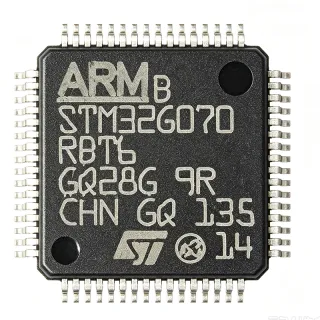
ATMEGA1609-AFR - 8-bit AVR MCU 20MHz 16KB Flash TQFP-48 | Microchip
MPN: ATMEGA1609-AFR ✓ Active| Qty | Unit Price | Extended |
|---|---|---|
| 1 | $2.9 | $2.90 |
| 10 | $2.61 | $26.10 |
| 100 | $2.32 | $232.00 |
| 500 | $2.08 | $1,040.00 |
| 1,000 | $1.87 | $1,870.00 |
ATMEGA1609-AFR Overview
An 8-bit microcontroller (MCU) is a single integrated circuit that contains a processor core, program memory, data memory, and peripherals such as timers, UARTs, and ADCs. Within the power-management-and-embedded hierarchy, an MCU sits above discrete logic and below application processors, executing real-time control tasks in embedded systems. The megaAVR 0-series belongs to the AVR RISC family, which executes most instructions in a single clock cycle.
Key features include a 20 MHz maximum clock frequency, 41 programmable I/O lines, and Core Independent Peripherals (CIPs) that offload tasks from the CPU. The wide 1.8V to 5.5V supply voltage range allows direct operation from lithium cells, 3.3V rails, or 5V industrial supplies, with a maximum active supply current of about 8.5 mA. Integrated 10-bit ADC functionality supports direct analog sensor interfacing.
Technically, the AVR core pairs an 8-bit RISC pipeline with a hardware multiplier, achieving efficient DSP-style math on an 8-bit platform. Flash program memory is organized as 8192 words, and the Harvard architecture separates instruction and data buses for deterministic execution. The megaAVR 0-series also integrates event routing and configurable custom logic peripherals, reducing external component count and interrupt latency.
Typical applications include industrial automation and motor control nodes, automotive body and comfort modules (the AFR suffix denotes the automotive temperature grade), and consumer appliances requiring robust 5V operation with rich I/O. The Functional Safety (FuSa) designation supports safety-oriented designs.
Design consideration: validate the full 1.8V-to-5.5V operating envelope against your crystal or oscillator configuration, since maximum safe clock frequency depends on VDD; use internal oscillators with factory calibration for cost-sensitive designs.
This page synthesizes distributor pricing, drop-in family alternatives, pinout guidance, and practical design notes not consolidated in the manufacturer datasheet.
Drop-in alternatives for ATMEGA1609-AFR — same package, pin-to-pin compatible. Different-package parts requiring PCB rework are excluded.
Variants in this series
Same-series models that are drop-in compatible with ATMEGA1609-AFR (same form factor and footprint) — differing in Core Processor, Package, Series, Connectivity, Number of I/O.
Quick Comparison Tool — Select alternative parts for side-by-side comparison:
ATMEGA3209-AFR
✅ Drop-In ⚠️ 参数待验证📋 Reference alternative (not in catalog)
ATMEGA4809-AFR
✅ Drop-In ⚠️ 参数待验证📋 Reference alternative (not in catalog)
ATMEGA809-AFR
✅ Drop-In ⚠️ 参数待验证📋 Reference alternative (not in catalog)
ATMEGA4809-AUR
✅ Drop-In ⚠️ 参数待验证📋 Reference alternative (not in catalog)
ATMEGA3209-AUR
✅ Drop-In ⚠️ 参数待验证📋 Reference alternative (not in catalog)
ATMEGA1609-AFR Maximum Ratings & Electrical Characteristics
| Core Processor | AVR (8-bit RISC with hardware multiplier) |
| Core Size | 8-bit |
| Maximum Clock Frequency | 20 MHz |
| Flash Program Memory | 16 KB (16K x 8 / 8192 words) |
| SRAM | 2 KB |
| EEPROM | 256 bytes |
| Supply Voltage Range | 1.8 V to 5.5 V (nominal 3 V) |
| Maximum Supply Current | 8.5 mA |
| Number of I/O | 41 |
| Peripherals | ADC, Core Independent Peripherals (CIPs) |
| Operating Temperature | -40C to +125C (automotive grade) |
| Package | 48-TQFP (7x7 mm) |
| Mounting Type | Surface Mount |
| Packaging | Tape & Reel (TR) |
| Product Status | Active |
| Series | megaAVR 0, Functional Safety (FuSa) |
| Connectivity | I2C, SPI, UART/USART (megaAVR 0-series standard set) |
ATMEGA1609-AFR 48-tqfp (7x7 mm) Pin Configuration Guide
Pin configuration for ATMEGA1609-AFR (48-tqfp (7x7 mm) package). This digital IC includes GPIO, communication interfaces (UART, SPI, I2C), and power pins. Refer to the manufacturer datasheet for alternate pin functions and configuration options. Essential for embedded system design and PCB layout.

No detailed pinout data available for ATMEGA1609-AFR.
Refer to the datasheet for full pin configuration.
Typical Applications
ATMEGA1609-AFR is suitable for 6 applications: Industrial Automation and Control Nodes, Automotive Body and Comfort Electronics, Motor Control and Small Actuation, Home Appliances and White Goods, IoT Sensor Nodes and Wired Gateways, Test, Measurement, and Diagnostic Equipment.
Industrial Automation and Control Nodes
Factory automation nodes such as sensor aggregators, relay controllers, and small PLC I/O modules benefit from the ATMEGA1609-AFR's 41 I/O lines and 20 MHz AVR core with hardware multiplier. The wide 1.8V to 5.5V supply range allows direct connection to 5V industrial logic, and the 10-bit ADC reads analog transducers without an external converter. Core Independent Peripherals route timer and comparator events without CPU intervention, giving deterministic response in cyclic control loops. With 16 KB Flash and 2 KB SRAM, Modbus RTU slaves or IO-Link-style polling firmware fit comfortably. The -40C to +125C rating survives control-cabinet heat near power electronics, and a maximum 8.5 mA supply current simplifies budgeting for passively cooled modules.
Recommended
Automotive Body and Comfort Electronics
The AFR automotive temperature grade (-40C to +125C) and Functional Safety (FuSa) designation make the ATMEGA1609-AFR appropriate for non-safety-critical body electronics: window lift helpers, mirror controllers, seat memory modules, and lighting sequencers. The 41 GPIOs drive lamps, relays, and LIN-style UART links directly, while the ADC monitors battery voltage and load currents through shunt sensing. Operation from the automotive 12V rail requires only a simple pre-regulator to the MCU's 5V input. Core Independent Peripherals offload PWM generation and input capture from the CPU, ensuring consistent timing during bus traffic. Designers should validate load-dump transient protection externally and confirm the required functional-safety documentation package with Microchip for the target ASIL assessment.
Recommended
Motor Control and Small Actuation
The ATMEGA1609-AFR suits small brushed-DC and stepper motor controllers using its hardware multiplier for PI-loop arithmetic and its timers for complementary PWM generation. The 20 MHz single-cycle RISC core executes control loops at multiple-kHz rates, while Core Independent Peripherals keep PWM outputs alive even during long interrupt service in the communication stack. The 10-bit ADC samples back-EMF or shunt current for speed feedback; at 5V the full-scale range directly matches typical low-side current-sense amplifier outputs. With 16 KB Flash, field-oriented-control-style fixed-point code for a single motor plus UART diagnostics fits within budget. For three-phase BLDC drives, the 4809's larger Flash in the identical footprint provides code headroom without PCB changes.
Recommended
Home Appliances and White Goods
Appliance control boards - fan sequencers, dispenser controls, induction-cooker user interfaces - exploit the ATMEGA1609-AFR's robust 5V operation, 41 I/O for button matrices and LED multiplexing, and wide -40C to +125C ambient tolerance near heat sources. The 256-byte EEPROM retains user settings and cycle counters through power loss without external nonvolatile memory. The hardware multiplier accelerates the scaling math used in temperature-curve compensation, and Core Independent Peripherals implement zero-cross detection with capture timers for AC-load phase control. The 8.5 mA maximum active current keeps standby budgets achievable with periodic sleep; the AVR idle and power-down modes reduce consumption further. FuSa designation supports documentation demands of major appliance QA programs.
Recommended
IoT Sensor Nodes and Wired Gateways
For sensor endpoints reporting over RS-485, UART, or I2C backhaul, the ATMEGA1609-AFR combines a 20 MHz AVR core with 16 KB Flash for protocol stacks and 2 KB SRAM for buffering. The internal oscillator option eliminates the crystal BOM line for baud-rate-tolerant links, while the 10-bit ADC digitizes local analog channels. Supply operation from 1.8V to 5.5V lets the MCU share a rail with 3.3V radio modules or run from primary cells; at sleep currents in the microamp class, battery-powered nodes reach multi-year lifetimes when the CPU idles between samples. Core Independent Peripherals can timestamp sensor events autonomously, waking the core only for transmission. The -40C to +125C grade covers unheated outdoor enclosures.
Recommended
Test, Measurement, and Diagnostic Equipment
Bench accessories - continuity meters, threshold monitors, calibrator front ends - benefit from the ATMEGA1609-AFR's deterministic AVR execution and 10-bit ADC for measurement front ends. The 20 MHz core with single-cycle multiply computes RMS and filtering in fixed point, while 16 KB Flash hosts a full command interpreter over UART for PC-hosted test scripts. Core Independent Peripherals generate precision gate windows and frequency counters via capture without CPU jitter, improving repeatability between identical units. The 41 I/O lines drive relay multiplexers, range-select dividers, and indicator arrays directly from a single chip. The -40C to +125C operating range permits use inside heated instruments and handheld automotive diagnostic tools operating on warm dashboards.
Recommended
Recommended Products Summary
Engineering reference data for ATMEGA1609-AFR — comparison, design guidance, and compliance information.
Selection Guide
Comparison with Alternatives
| Parameter | This Product | ATMEGA3209-AFR | ATMEGA4809-AFR | ATMEGA809-AFR | ATMEGA4809-AUR | ATMEGA3209-AUR |
|---|---|---|---|---|---|---|
| Package | 48-TQFP (7x7 mm) | 48-TQFP (7x7 mm) - same | 48-TQFP (7x7 mm) - same | 48-TQFP (7x7 mm) - same | 48-TQFP (7x7 mm) - same | 48-TQFP (7x7 mm) - same |
| Brand | Microchip Technology | Microchip Technology | Microchip Technology | Microchip Technology | Microchip Technology | Microchip Technology |
| Flash Memory | 16 KB | 32 KB | 48 KB | 8 KB | 48 KB | 32 KB |
| SRAM | 2 KB | 4 KB | 6 KB | 1 KB | 6 KB | 4 KB |
| Max Clock Frequency | 20 MHz | 20 MHz | 20 MHz | 20 MHz | 20 MHz | 20 MHz |
| Supply Voltage Range | 1.8 V to 5.5 V | 1.8 V to 5.5 V | 1.8 V to 5.5 V | 1.8 V to 5.5 V | 1.8 V to 5.5 V | 1.8 V to 5.5 V |
| Operating Temperature | -40C to +125C (automotive) | -40C to +125C | -40C to +125C | -40C to +125C | -40C to +105C (industrial) | -40C to +105C (industrial) |
| Core / Peripherals | AVR 8-bit, 20 MHz, CIPs, ADC | Identical megaAVR 0-series | Identical megaAVR 0-series | Identical megaAVR 0-series | Identical megaAVR 0-series | Identical megaAVR 0-series |
Key Differentiators
- Automotive temperature grade to +125C with FuSa designation (vs ATMEGA4809-AUR)
- Cost-optimized entry point in the 48-pin footprint (vs ATMEGA4809-AFR)
- More program memory than the 8 KB sibling (vs ATMEGA809-AFR)
- Honest trade-off: SRAM is modest at 2 KB (vs ATMEGA3209-AFR)
Design Notes
Budget the supply from the 8.5 mA maximum active current cited in distributor data plus I/O and peripheral loading; the wide 1.8V to 5.5V range means a single 5V LDO can feed the MCU and 5V peripherals together, but verify the LDO's dropout at worst-case load. Decouple each VDD pin of the TQFP-48 with 100 nF ceramics placed within a few millimeters, plus one bulk capacitor per board. Estimated: a 5V rail at 15 mA total with a 300 mV-dropout LDO tolerates input down to about 5.3 V with margin.
Legacy ATmega (328P/2560) designers must not assume pinout or register compatibility: the megaAVR 0-series renames ports, moves peripherals, and changes fuses to fusebytes configured in code. Migrating firmware requires the AVR 0-series register map and updated startup code; toolchain support exists in MegaCoreX and MPLAB X. Also note the AFR temperature grade extends to +125C, but confirm clock derating versus VDD for the full envelope before qualifying production code.
The 48-TQFP 0.5 mm pitch footprint needs standard surface-mount assembly; use a solder-mask-defined land pattern per the Microchip package drawing in the megaAVR 0-series datasheet. Place the RESET pull-up (10 kOhm) and programming header (UPDI single-wire) early in layout - the UPDI pin doubles as GPIO in some configurations, so design the jumper accordingly. Keep crystal traces (if used) short and guard them with ground pour for EMI robustness in motor-control environments.
Estimated: at 5V and 8.5 mA the core dissipates roughly 43 mW, negligible for the 7x7 mm TQFP even at +125C ambient given typical junction-to-ambient resistance near 50-70 C/W for this package class - but verify the exact theta-JA in the datasheet package section. Thermal concerns arise only from heavy simultaneous GPIO sourcing; compute total P = VDD x I_total and keep junction estimates below the absolute maximum rating with at least 15C margin for automotive cabinets.
Compliance Information
FindIC listing describes ATMEGA1609-AFR as Green, Tape & Reel, Ind 125C. Full REACH SVHC, halogen-free, and conflict-minerals declarations should be pulled from Microchip's material declaration database; not found in the retrieved web data.