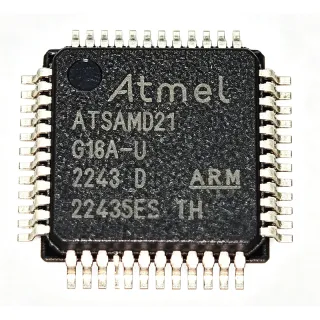
ATMEGA809-AF - 8-bit AVR MCU 20MHz 8KB Flash 48-TQFP | Microchip
MPN: ATMEGA809-AF ✓ Active| Qty | Unit Price | Extended |
|---|---|---|
| 1 | $0 | $0.00 |
| 10 | $0 | $0.00 |
| 100 | $0 | $0.00 |
| 500 | $0 | $0.00 |
| 1,000 | $0 | $0.00 |
ATMEGA809-AF Overview
An 8-bit microcontroller (MCU) integrates a processor core, memory, and peripherals on a single chip, forming the lowest tier of the embedded controller hierarchy: MCU -> embedded processor -> system-on-chip. The megaAVR 0 series is Microchip's latest generation of AVR devices, replacing the classic megaAVR line with Core Independent Peripherals (CIPs), an Event System, and intelligent analog. Because peripherals operate without CPU intervention, real-time tasks continue even while the core sleeps, which reduces power consumption and firmware complexity.
Key features of the ATMEGA809-AF include the 20 MHz AVR core with a hardware multiplier for efficient integer math, 8 KB of self-programmable Flash memory, 1 KB SRAM, and 256 bytes of separate EEPROM for data retention across power cycles. The device operates from a single supply in the 1.8 V to 5.5 V range, giving wide design headroom for battery and industrial 5 V systems. The Peripheral Touch Controller (PTC) supports capacitive touch buttons and sliders without external components, and the 10-bit ADC plus analog comparators cover most sensing needs.
Architecturally, the Event System routes peripheral signals to other peripherals without CPU loading, enabling deterministic low-latency control. The device integrates USART, SPI, and TWI (I2C) serial interfaces, multiple 16-bit timers with PWM outputs, a watchdog timer, and CRC-SCAN hardware. Functional Safety (FuSa) documentation support makes it suitable for safety-oriented industrial designs.
Typical applications include industrial automation and control panels, home appliances and HVAC control boards, capacitive-touch user interfaces, and low-power battery-operated sensor nodes. The 48-pin TQFP offers generous GPIO count for keypads, LEDs, and displays.
When designing with this part, remember that the UPDI (Unified Program and Debug Interface) uses one pin for programming, freeing board space compared with legacy ISP headers; flash writes are self-programmable for field updates.
This page synthesizes distributor pricing, drop-in same-family alternatives, design notes, and AEO-optimized FAQs not consolidated in the manufacturer datasheet.
Drop-in alternatives for ATMEGA809-AF — same package, pin-to-pin compatible. Different-package parts requiring PCB rework are excluded.
Variants in this series
Same-series models that are drop-in compatible with ATMEGA809-AF (same form factor and footprint) — differing in Core Processor, Peripherals, SRAM, Series, Package.
Quick Comparison Tool — Select alternative parts for side-by-side comparison:
ATMEGA1609-AFR
✅ Drop-In ⚠️ 参数待验证✓ In Stock
$1.87 / Unit
View Datasheet →ATMEGA3209-AF
✅ Drop-In ⚠️ 参数待验证✓ In Stock
$1.72 / Unit
View Datasheet →ATMEGA4809-AF
✅ Drop-In ⚠️ 参数待验证✓ In Stock
$1.92 / Unit
View Datasheet →ATMEGA4809-AU
✅ Drop-In ⚠️ 参数待验证📋 Reference alternative (not in catalog)
ATMEGA809-AF Maximum Ratings & Electrical Characteristics
| Core Processor | AVR (8-bit, hardware multiplier) |
| Core Size | 8-bit |
| Maximum Clock Frequency | 20 MHz |
| Flash Memory | 8 KB (8K x 8) |
| SRAM | 1 KB |
| EEPROM | 256 bytes |
| Supply Voltage Range | 1.8 V to 5.5 V |
| Package | 48-TQFP (7x7 mm) |
| Mounting Type | Surface Mount |
| Series | megaAVR 0 (Functional Safety / FuSa supported) |
| Programming Interface | UPDI |
| Peripherals | Event System, PTC (capacitive touch), CRC-SCAN, WDT |
| Communication Interfaces | USART, SPI, TWI (I2C) |
| ADC Resolution | 10-bit |
| RoHS Status | Compliant |
ATMEGA809-AF 48-tqfp (7x7 mm) Pin Configuration Guide
Pin configuration for ATMEGA809-AF (48-tqfp (7x7 mm) package). This digital IC includes GPIO, communication interfaces (UART, SPI, I2C), and power pins. Refer to the manufacturer datasheet for alternate pin functions and configuration options. Essential for embedded system design and PCB layout.

No detailed pinout data available for ATMEGA809-AF.
Refer to the datasheet for full pin configuration.
Typical Applications
ATMEGA809-AF is suitable for 6 applications: Industrial Automation and Control, Capacitive Touch User Interfaces, Home Appliances and HVAC Control, Battery-Powered Sensor Nodes, Arduino-Compatible Prototyping, Motor Control and Fan Drivers.
Industrial Automation and Control
The ATMEGA809-AF fits industrial control boards that need deterministic real-time behavior at low cost. Its 20 MHz AVR core with hardware multiplier executes PID and modulation math efficiently, while Core Independent Peripherals - timers with PWM outputs, analog comparators, and the Event System - drive actuators and sample sensors without CPU intervention, keeping loop latency predictable. The Functional Safety (FuSa) documentation support simplifies safety assessments for machinery sub-assemblies. In a typical design, the MCU sits between field sensors and relays or motor drivers, communicating over TWI or USART to a higher-level PLC or gateway; the 1.8 V to 5.5 V supply range lets it run directly from a 5 V industrial rail. The wide operating envelope and long product lifecycle typical of Microchip MCUs reduce requalification risk in multi-year production programs.
Recommended
Capacitive Touch User Interfaces
The Peripheral Touch Controller (PTC) is the headline fit for touch HMI designs: it autonomously scans self- or mutual-capacitance electrodes, leaving the 20 MHz AVR core free for application logic and communications. With Microchip's QTouch Library, developers implement buttons, sliders, and wheels with water-tolerance and noise-immunity algorithms at no license cost. The 48-pin TQFP package supplies enough GPIO for touch electrodes alongside LEDs, buzzers, and a USART link to a main controller. Because the PTC acquisition runs through the Event System, touch sensing continues during CPU sleep, cutting average power in battery-powered panels. Typical products include appliance front panels, thermostat keypads, and industrial push-button replacements where mechanical switches would collect dirt or wear out.
Recommended
Home Appliances and HVAC Control
Appliance and HVAC boards benefit from the ATMEGA809-AF's combination of EEPROM, robust GPIO count, and analog integration. The 256-byte EEPROM stores calibration constants and user settings that survive power cycles, the 10-bit ADC reads thermistors and potentiometers, and hardware PWM controls fan speeds or heater duty cycles without software jitter. The Event System ties comparator outputs directly to timer actions, enabling protection cutoffs - such as over-temperature shutdown - with hardware-only latency. Operating from 1.8 V to 5.5 V, the part tolerates noisy 5 V rails in motor-heavy environments, and the watchdog timer plus CRC-SCAN support fail-safe firmware behavior demanded by appliance manufacturers. The 8 KB Flash is generally sufficient for fan-coil, dishwasher, and compressor-start control logic.
Recommended
Battery-Powered Sensor Nodes
For battery-operated sensing, the ATMEGA809-AF offers sleep-mode operation with Core Independent Peripherals that collect data while the core sleeps. The Event System can chain a timer overflow to an ADC sample and comparator threshold to a wake event entirely in hardware, so the CPU wakes only when a reading is meaningful. At the 1.8 V supply end, the device runs from two alkaline cells or a single Li-SOCl2 cell with a small regulator. The 48-pin TQFP provides spare GPIO for RF module links (USART or SPI), status LEDs, and calibration connectors. Typical end products include wireless door sensors, metering transmitters, and environmental monitors where multi-year battery life and sub-dollar MCU cost are both mandatory design constraints.
Recommended
Arduino-Compatible Prototyping
Community support makes the ATMEGA809-AF attractive for rapid prototyping: the open-source MegaCoreX Arduino core provides full support for ATmega809 alongside ATmega4809/3209/1609, exposing standard Arduino APIs on the megaAVR 0 peripherals. Engineers can prototype logic on a low-cost ATmega4809-based board (such as the ATmega4809 Xplained Pro) and migrate to the ATMEGA809-AF in the production BOM when the smaller 8 KB Flash suffices, cutting unit cost. UPDI programming via Microchip SNAP or PICkit 4 requires only a single-pin header, simplifying test fixtures. The hardware multiplier, 20 MHz clock, and rich timer set outperform classic ATmega328P-class parts, making this path ideal for hobby products, student projects, and pre-production industrial prototypes alike.
Recommended
Motor Control and Fan Drivers
The ATMEGA809-AF handles small motor and fan control tasks using its hardware PWM timers and analog comparators. Timer PWM outputs drive MOSFET half-bridges or low-side switches for brushed-DC, BLDC, or fan motors; comparator-based zero-cross or over-current detection routes straight to timer actions through the Event System, achieving fault response without firmware latency. The 20 MHz core with hardware multiplier executes commutation and speed-loop math, while the 10-bit ADC samples back-EMF or current-shunt signals. With 48 pins, one MCU can supervise multiple fans plus a UART link to a host controller. Typical implementations include server-fan hubs, ventilation controllers, and small pump drivers where a 32-bit MCU would be over-spec and over-budget.
Recommended
Recommended Products Summary
Engineering reference data for ATMEGA809-AF — comparison, design guidance, and compliance information.
Selection Guide
Comparison with Alternatives
| Parameter | This Product | ATMEGA1609-AF | ATMEGA3209-AF | ATMEGA4809-AF |
|---|---|---|---|---|
| Brand | Microchip Technology | Microchip Technology | Microchip Technology | Microchip Technology |
| Package | 48-TQFP (7x7 mm) | 48-TQFP (7x7 mm) - same | 48-TQFP (7x7 mm) - same | 48-TQFP (7x7 mm) - same |
| Flash Memory | 8 KB | 16 KB | 32 KB | 48 KB |
| SRAM | 1 KB | 2 KB | 4 KB | 6 KB |
| EEPROM | 256 bytes | 256 bytes | 256 bytes | 256 bytes |
| Max Clock Frequency | 20 MHz | 20 MHz | 20 MHz | 20 MHz |
| Core | 8-bit AVR (hardware multiplier) | 8-bit AVR (hardware multiplier) | 8-bit AVR (hardware multiplier) | 8-bit AVR (hardware multiplier) |
| Supply Voltage | 1.8 V to 5.5 V | 1.8 V to 5.5 V | 1.8 V to 5.5 V | 1.8 V to 5.5 V |
| Pin Count / GPIO | 48-pin TQFP | 48-pin TQFP - same | 48-pin TQFP - same | 48-pin TQFP - same |
| Cost Position | Lowest in 48-pin family | Higher than ATMEGA809 | Higher than ATMEGA1609 | Highest in family |
Key Differentiators
- Lowest-cost entry to the 48-pin megaAVR 0 family (vs ATMEGA4809-AF)
- Functional Safety (FuSa) documentation support (vs ATMEGA1609-AF)
- Core Independent Peripherals and Event System (vs Classic AVR parts such as ATMEGA48PA (different family))
Design Notes
Design the supply for the 1.8 V to 5.5 V range with a decoupling network of at least 100 nF ceramic close to each VDD/GND pair of the 48-TQFP, plus bulk capacitance near the regulator. The megaAVR 0 series tolerates noisy 5 V rails, but brown-out detection (BOD) should be enabled in configuration fuses so EEPROM and Flash writes never occur below the safe voltage - a corrupted EEPROM sector is the most common field failure in appliance designs. Estimated: a typical application draws only tens of mA active, so regulator sizing is rarely thermal-limited.
The 48-TQFP (7x7 mm) has 0.5 mm pitch; use 5-6 mil trace/space routing under the package with a solid ground plane on layer 2. Escape fan-out standard practice: route diagonal traces from inner rows. Keep the UPDI pin routed to a 3-pad programming header (UPDI, VDD, GND) at the board edge - this one-pin interface replaces legacy 6-pin ISP headers and saves board area. Provide test points on TWI/SPI and reset-adjacent nets for production debugging with SNAP or PICkit 4.
Do not confuse family pinouts: ATMEGA808/1608/3208/4808 variants use different pin counts and are NOT drop-in with the ATMEGA809's 48-TQFP footprint - verify the full MPN suffix (-AF denotes 48-TQFP) when ordering. Also remember the megaAVR 0 register map differs from classic megaAVR (ATmega328P) parts, so legacy AVR code needs porting; MegaCoreX/Arduino cores abstract much of this. Finally, confirm analog reference configuration before using the 10-bit ADC - default reference selection differs from classic AVRs.
Compliance Information
RoHS/lead-free status inferred from Microchip's current standard production offering; formal certificates should be pulled from the Microchip product page. REACH, halogen-free, and conflict-minerals status not stated in the retrieved web data.