Microchip Technology

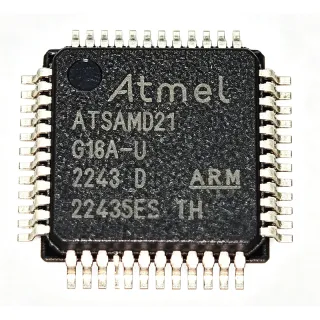
ATMEGA1609-AU - 8-bit AVR MCU, 20MHz, 16KB Flash | Microchip

MPN: ATMEGA1609-AU βœ“ Active
In Stock Ships in 1-3 business days
1.8 V to 5.5 V Vdss 48-TQFP (7x7 mm) Package 20 MHz Speed 16 KB (16K x 8) Memory
From $1.15 USD / Unit
MOQ: 1 |
Price updated: 2026-09-15
Volume Pricing
Qty Unit Price Extended
1 $1.95 $1.95
10 $1.76 $17.60
100 $1.52 $152.00
500 $1.32 $660.00
1,000 $1.15 $1,150.00
ℹ️ All prices are in USD

ATMEGA1609-AU Overview

The Microchip Technology ATMEGA1609-AU is an 8-bit AVR megaAVR 0-series microcontroller running at up to 20 MHz with 16 KB Flash, 2 KB SRAM, and 256 bytes of EEPROM, housed in a 48-pin TQFP (7x7 mm) surface-mount package. It operates from 1.8V to 5.5V and integrates I2C, SPI, and UART/USART connectivity.

An 8-bit AVR microcontroller is a Harvard-architecture RISC processor that executes most instructions in a single clock cycle, placing it in the broader hierarchy of microcontrollers (MCU) under embedded processors and system-on-chip devices. The megaAVR 0-series is Microchip's general-purpose AVR family, combining a hardware multiplier, Core Independent Peripherals (CIPs), and event system for deterministic, interrupt-free operation.

Key features include the 20 MHz AVR CPU with hardware multiplier, Core Independent Peripherals such as configurable custom logic (CCL), a 12-bit ADC, comparators, and timer/counter types A and B. The event system routes peripheral signals without CPU intervention, cutting latency and code size. Multi-voltage operation from 1.8V to 5.5V allows use in both battery-powered and 5V industrial designs.

The ATmega1609 architecture is based on the AVR RISC core with a two-stage pipeline, executing an average of one instruction per cycle. Program Flash is self-programmable for bootloaders, and the 256-byte EEPROM retains calibration data through power cycles. Peripheral features such as the 16-bit Type A PWM timers and the CCL logic blocks offload real-time tasks from software.

Typical applications include industrial control and automation nodes, consumer appliances, and IoT sensor endpoints where 16 KB Flash and rich analog peripherals are sufficient. The Functional Safety (FuSa) documented variant family also suits safety-related designs.

Design consideration: at 5V the device tolerates the full 20 MHz clock, while at the 1.8V minimum supply the maximum frequency is derated per the datasheet frequency-versus-voltage curve; plan clock scaling with supply rails.

This page synthesizes verified distributor data, same-family drop-in alternatives, and design notes not found in the manufacturer datasheet, with pricing as of 2026-09-16.

Drop-in alternatives for ATMEGA1609-AU β€” same package, pin-to-pin compatible. Different-package parts requiring PCB rework are excluded.

Variants in this series

Same-series models that are drop-in compatible with ATMEGA1609-AU (same form factor and footprint) β€” differing in Connectivity, Core Processor, Peripherals, Series.

Microchip Technology
Connectivity: I2C, SPI, UART/USART (megaAVR 0-series standard set)
Core Processor: AVR (8-bit RISC with hardware multiplier)
Peripherals: ADC, Core Independent Peripherals (CIPs)
Compare with ATMEGA1609-AU β†’

Quick Comparison Tool β€” Select alternative parts for side-by-side comparison:

ATMEGA1609-AFR

βœ… Drop-In
Microchip Technology
πŸ“¦ 48-TQFP (7x7 mm)
AVR (8-bit RISC with hardware multiplier) Β· 8-bit Β· 20 MHz Β· 16 KB (16K x 8 / 8192 words) Β· 2 KB Β· 256 bytes Β· 1.8 V to 5.5 V (nominal 3 V) Β· 8.5 mA

βœ“ In Stock

$1.87 / Unit

View Datasheet β†’

ATMEGA1608-AU

βœ… Drop-In ⚠️ 参数待ιͺŒθ―
Microchip Technology
πŸ“¦ 48-TQFP (7x7 mm)
AVR (8-bit, hardware multiplier) Β· 8-bit Β· 20 MHz Β· 16 KB (16K x 8) Β· 2 KB Β· 256 bytes Β· 1.8 V to 5.5 V Β· -40C to +85C

βœ“ In Stock

$0.86 / Unit

View Datasheet β†’

ATMEGA3209-AU

βœ… Drop-In ⚠️ 参数待ιͺŒθ―
πŸ“¦ 48-TQFP (7x7 mm)
32 KB Flash (2x) and 4 KB SRAM (2x) vs 16 KB/2 KB; same core, same footprint

πŸ“‹ Reference alternative (not in catalog)

ATMEGA4809-AU

βœ… Drop-In ⚠️ 参数待ιͺŒθ―
πŸ“¦ 48-TQFP (7x7 mm)
48 KB Flash (3x) and 6 KB SRAM (3x) vs 16 KB/2 KB; same core, same footprint

πŸ“‹ Reference alternative (not in catalog)

ATMEGA809-AU

βœ… Drop-In ⚠️ 参数待ιͺŒθ―
πŸ“¦ 48-TQFP (7x7 mm)
8 KB Flash (-50%) and 1 KB SRAM (-50%) vs 16 KB/2 KB; cost-down option in same footprint

πŸ“‹ Reference alternative (not in catalog)

ATMEGA1609-AU Maximum Ratings & Electrical Characteristics

Core Processor AVR 8-bit RISC
Core Size 8-bit
Maximum Clock Frequency 20 MHz
Flash Memory 16 KB (16K x 8)
SRAM 2 KB
EEPROM 256 bytes
Operating Voltage Range 1.8 V to 5.5 V
Connectivity I2C, SPI, UART/USART
Series megaAVR 0-series (ATmega808/809/1608/1609)
Package 48-TQFP (7x7 mm)
Mounting Type Surface Mount
Number of Pins 48
Hardware Multiplier Yes
Peripherals Brown-out Detect/Reset, POR, PWM, WDT, Core Independent Peripherals
Safety Qualification Functional Safety (FuSa) supported family
Product Status Active

ATMEGA1609-AU 48-tqfp (7x7 mm) Pin Configuration Guide

Pin configuration for ATMEGA1609-AU (48-tqfp (7x7 mm) package). This digital IC includes GPIO, communication interfaces (UART, SPI, I2C), and power pins. Refer to the manufacturer datasheet for alternate pin functions and configuration options. Essential for embedded system design and PCB layout.

48-tqfp (7x7 mm) package pinout diagram for ATMEGA1609-AU

No detailed pinout data available for ATMEGA1609-AU.

Refer to the datasheet for full pin configuration.

Typical Applications

ATMEGA1609-AU is suitable for 6 applications: Industrial Control and Automation, IoT Sensor Endpoints, Consumer Appliances, Motor Control and Fan Drivers, Human Interface Devices and Lighting Control, Education, Prototyping and Hobby Electronics.

🏭

Industrial Control and Automation

The ATMEGA1609-AU fits industrial control nodes because it runs from a 5V rail with a full 20 MHz clock, integrates brown-out detection, power-on reset, and a watchdog timer, and exposes multiple UART/SPI/I2C interfaces for PLC I/O, motor control front-ends, and sensor hubs. Its Core Independent Peripherals and event system service time-critical tasks - PWM generation, quadrature decoding, and comparator tripping - without CPU intervention, improving determinism in polling-heavy designs. With 16 KB Flash and 2 KB SRAM, compact Modbus or CAN-adjacent slaves fit without external memory. The 48-pin TQFP provides up to 42 GPIO for relay driving, keypad scanning, and status LEDs, while the 1.8V to 5.5V range supports both legacy 5V panels and newer 3.3V subsystems on one board revision.

🧩

IoT Sensor Endpoints

Battery- and line-powered IoT sensor nodes benefit from the ATMEGA1609-AU's combination of a 12-bit ADC, analog comparators, and low-power sleep modes across a 1.8V to 5.5V supply, letting one MCU span both primary-cell and regulated-supply designs. The event system routes ADC-ready and comparator outputs to timers without waking the CPU, dramatically reducing active time in duty-cycled sensing. I2C and SPI interfaces connect digital sensors (humidity, pressure, accelerometers), while a UART links to a radio module or RS-485 transceiver. The 256-byte EEPROM stores calibration coefficients and node addressing through power cycles. MegaCoreX Arduino support shortens prototyping, and the 16 KB/2 KB memory budget comfortably hosts a sensor stack with a lightweight protocol layer.

πŸ”§

Consumer Appliances

White goods, small kitchen appliances, and HVAC controllers use the ATMEGA1609-AU for its 5V noise immunity, integrated PWM Type A timers for heater and fan control, and brown-out protection that prevents EEPROM corruption during mains sags. The 42 available GPIO drive seven-segment displays, relays, and touch or mechanical button arrays, while the CCL configurable logic implements safety interlocks in hardware - for example, gating a heater PWM only when a door-switch comparator indicates closure. The 16 KB Flash accommodates state machines and display drivers, and the hardware multiplier accelerates PID loops for temperature regulation. Wide-voltage operation tolerates unregulated transformer-rectifier supplies common in appliance architectures, and the 48-pin TQFP simplifies assembly on two-layer boards.

βš™οΈ

Motor Control and Fan Drivers

The ATMEGA1609-AU suits small BLDC and brushed-DC motor control through its Type A 16-bit PWM timers with complementary waveform outputs and dead-time insertion, plus analog comparators usable for over-current trip in hardware. The event system connects comparator outputs to timer fault inputs without software latency, protecting power stages during stalls. At 20 MHz with a hardware multiplier, field-oriented-control-adjacent scalar algorithms and commutation tables run with headroom in 16 KB Flash. I2C connects digital current sensors while a UART reports telemetry to a host controller. The 5V GPIO directly interfaces gate drivers and MOSFET pre-drivers, and the 1.8V to 5.5V range allows battery-powered tool designs to share firmware across cell-count variants.

πŸ’‘

Human Interface Devices and Lighting Control

Keypanels, remote controls, and DMX or DALI-adjacent lighting controllers leverage the ATMEGA1609-AU's GPIO density, wake-on-pin-change sleep, and hardware PWM channels. The 48-pin TQFP exposes up to 42 I/O, enough for a 4x8 key matrix plus LED column drivers without external port expanders. Type B timers generate precise dimming waveforms while the ADC reads potentiometer or ambient-light inputs for adaptive brightness. The event system chains pin-change events to timers so button wake-up and debounce run with minimal firmware. At deep sleep currents typical of the megaAVR 0-series, battery-powered remotes achieve multi-year life; the 16 KB Flash holds lookup tables for color mixing and per-unit calibration stored in the 256-byte EEPROM during production.

πŸ”§

Education, Prototyping and Hobby Electronics

The ATMEGA1609-AU is an excellent teaching and prototyping MCU because MegaCoreX provides full Arduino IDE support for the megaAVR 0-series, and the same architecture powers the Arduino Uno WiFi Rev2 - so skills transfer directly. UPDI programming needs only a single pin plus ground, and a 1 kOhm resistor plus USB-UART adapter is sufficient with pyupdi, removing programmer cost barriers in classrooms. The Core Independent Peripherals (CCL, event system) offer hands-on learning of hardware-level design beyond software loops. DIP-adapter-friendly 7x7 mm TQFP and wide 1.8V to 5.5V operation make breadboard experiments forgiving. According to the MegaCoreX GitHub repository, all eight family members share tooling, so students can migrate from 8 KB to 48 KB devices seamlessly.

Recommended Products Summary

ATMEGA1609-AFR Microchip Technology Used in: Industrial Control and Automation ATMEGA3209-AU Same-footprint upgrade with 32 KB Flash for larger firmware Used in: Industrial Control and Automation, Consumer Appliances ATMEGA1608-AU Microchip Technology Used in: IoT Sensor Endpoints, Human Interface Devices and Lighting Control ATMEGA4809-AU Same-footprint 48 KB Flash upgrade for protocol-heavy firmware Used in: IoT Sensor Endpoints, Motor Control and Fan Drivers, Education, Prototyping and Hobby Electronics ATMEGA809-AU 8 KB Flash cost-down variant for simpler appliance firmware Used in: Consumer Appliances, Education, Prototyping and Hobby Electronics
What is the ATMEGA1609-AU?
The ATMEGA1609-AU is an 8-bit AVR microcontroller from Microchip Technology's megaAVR 0-series, running at up to 20 MHz with a hardware multiplier. It provides 16 KB Flash, 2 KB SRAM, and 256 bytes of EEPROM in a 48-pin TQFP (7x7 mm) package. According to the Microchip ATmega808/809/1608/1609 datasheet (DS40002172), the family also includes Core Independent Peripherals and an event system, with I2C, SPI, and UART/USART connectivity and a 1.8V to 5.5V supply range.
What are the key specifications of ATMEGA1609-AU that engineers should know?
Key specifications: AVR 8-bit RISC core at up to 20 MHz, 16 KB self-programmable Flash, 2 KB SRAM, 256 bytes EEPROM, 1.8V to 5.5V operation, I2C/SPI/UART connectivity, and a 48-pin TQFP 7x7 mm package. The megaAVR 0-series adds Core Independent Peripherals (CCL, event system, Type A/B timers) and functional-safety documentation. According to the Microchip product page and datasheet DS40002172, the part status is Active and it is surface-mount with brown-out detection, POR, PWM, and watchdog timer built in.
What is the difference between ATMEGA1609-AU and ATMEGA1608-AU?
The ATMEGA1609 and ATMEGA1608 share the same AVR core, 20 MHz speed, 16 KB Flash, 2 KB SRAM, and 256 bytes EEPROM; the primary difference is the pin-count and peripheral-instance availability in each package option. In the 48-pin TQFP, the ATMEGA1609 exposes the full port set of the 16 KB family members. According to Microchip's product pages, both belong to the ATmega808/809/1608/1609 family documented in DS40002172, so firmware written for one 16 KB device typically ports with only pin mapping changes.
What is the difference between ATMEGA1609-AU and ATMEGA4809-AU?
The main difference is program memory: the ATMEGA1609-AU has 16 KB Flash and 2 KB SRAM, while the ATMEGA4809-AU has 48 KB Flash and 6 KB SRAM. Both are megaAVR 0-series parts running at up to 20 MHz, sharing the same core, peripherals, and the same 48-pin TQFP footprint, making the ATMEGA4809-AU a same-footprint upgrade when code outgrows 16 KB. According to Microchip datasheet DS40002172, the ATmega808/809/1608/1609/4809 family shares a common peripheral set, so migration requires only a recompile.
Is ATMEGA1609-AU suitable for 5V industrial applications?
Yes, the ATMEGA1609-AU operates from 1.8V to 5.5V, so it runs directly from a 5V industrial supply with a full 20 MHz clock and 5V-tolerant GPIO noise margins. According to the Microchip product data, the device integrates brown-out detection, power-on reset, and a watchdog timer, which are valued in industrial environments. The 48-pin TQFP package provides up to 42 GPIO plus multiple communication interfaces, allowing direct interfacing with 5V sensors, relays, and RS-485 transceivers without level shifting.
What is the best drop-in replacement for ATMEGA1609-AU?
The best drop-in replacement is ATMEGA1609-AFR, the same die in the same 48-pin TQFP package with a different temperature/packaging suffix, available on XAIPART. For same-footprint family migrations, ATMEGA1608-AU (identical 16 KB/2 KB memory in 48-pin TQFP) and ATMEGA3209-AU or ATMEGA4809-AU (32/48 KB Flash upgrades in the identical footprint) are pin-to-pin compatible. According to Microchip datasheet DS40002172, all family members share the same peripheral architecture, so code porting is minimal.
Where can I buy ATMEGA1609-AU online?
The ATMEGA1609-AU is available from authorized distributors including DigiKey, Mouser, and Octopart-listed channels, as well as MicrochipDirect, and on XAIPART with quantity pricing. According to DigiKey's product listing, the part is in stock with same-day shipping options (ships today as of 2026-09-16). Octopart aggregates pricing from 10 distributors, and Mouser lists inventory and pricing for the 48-pin TQFP package. Always verify stock and lead time at order placement, as MCU availability fluctuates.
What is the price of ATMEGA1609-AU?
As of 2026-09-16, the ATMEGA1609-AU is priced at approximately $1.95 at quantity 1, decreasing to roughly $1.15 at 1,000 units, based on aggregated distributor data. Octopart reports pricing from 10 distributors for this part. Final pricing depends on distributor, packaging (tray versus tape and reel), and currency. For volume quotes above 1,000 units, contact XAIPART or MicrochipDirect for project pricing, since megaAVR 0-series parts often carry competitive tiered discounts.
Is ATMEGA1609-AU in stock and what is its lead time?
As of 2026-09-16, DigiKey lists the ATMEGA1609-AU with same-day shipping (ships today) and Mouser lists inventory, indicating stock at major authorized distributors. Lead times for megaAVR 0-series parts have generally normalized to short standard intervals at franchised distributors, though exact stock and lead time vary daily. Check the live inventory on DigiKey, Mouser, or XAIPART before ordering, and consider the ATMEGA1609-AFR or tape-and-reel variants if the tray-packaged AU suffix is constrained.
ATMEGA1609-AU vs ATMEGA3209-AU - which is better for a new design?
For headroom, the ATMEGA3209-AU is better: it doubles Flash to 32 KB and increases SRAM to 4 KB in the identical 48-pin TQFP footprint, eliminating redesign if firmware grows. Choose the ATMEGA1609-AU when the 16 KB/2 KB budget is confirmed and unit cost matters, since lower-memory variants are typically cheaper. According to Microchip datasheet DS40002172, both share the same core, peripherals, and package, so a late migration between them requires only recompilation and BOM change, not PCB rework.
What is the best Microchip equivalent for ATMEGA1609-AU within the same family?
Within Microchip, the closest equivalents are the megaAVR 0-series siblings: ATMEGA1608-AU (same 16 KB memory, same 48-pin TQFP), ATMEGA3209-AU and ATMEGA4809-AU (memory upgrades in the same footprint), and ATMEGA809-AU (8 KB Flash cost-down). All run the same AVR core at up to 20 MHz with identical peripherals. According to Microchip's family documentation, they are software-compatible within the family, and the shared footprint makes them pin-to-pin drop-in options on the same PCB.
Where can I download the ATMEGA1609 datasheet PDF?
The official datasheet PDF is the ATmega808/809/1608/1609 Data Sheet, document DS40002172 (revision C), downloadable from Microchip's website at ww1.microchip.com. The direct link is available on the Microchip ATMEGA1609 product page under Documentation. Avoid third-party mirror sites such as alldatasheet or datasheet4u when possible, as they may host outdated revisions. The same document covers the entire ATmega808/809/1608/1609 family, including electrical characteristics, pinout diagrams, and register descriptions for the 48-pin TQFP package.
Where can I find the ATMEGA1609-AU pinout for the 48-pin TQFP?
The complete 48-pin TQFP (7x7 mm) pinout diagram for the ATMEGA1609-AU is in the Pinout Diagrams section of Microchip datasheet DS40002172, covering all four family members. The diagram maps the VDD/GND pins, the GPIO ports (PA through PF), UPDI programming pin, and communication peripherals (I2C, SPI, UART/USART muxing). For quick reference, tools such as Microchip's MPLAB X I/O viewer and community resources like MegaCoreX document pin assignments for Arduino-style development on this family.
Hey Google, what can replace ATMEGA1609-AU?
The closest drop-in replacements for the ATMEGA1609-AU are ATMEGA1609-AFR (same die, same 48-pin TQFP footprint, different suffix) and ATMEGA1608-AU (identical 16 KB Flash and 2 KB SRAM in the same package). For more headroom, ATMEGA3209-AU and ATMEGA4809-AU fit the same PCB footprint with 32 KB and 48 KB Flash. For cost reduction, ATMEGA809-AU (8 KB Flash) is pin-compatible when code fits. Per Microchip datasheet DS40002172, all are pin-to-pin compatible within the 48-pin megaAVR 0-series.
Does the ATMEGA1609-AU support Arduino development?
Yes, the ATMEGA1609-AU is supported by the MegaCoreX open-source Arduino hardware package, which covers ATmega4809, 4808, 3209, 3208, 1609, 1608, 809, and 808. The official Arduino Uno WiFi Rev2 uses the same megaAVR 0-series architecture, so peripherals such as the event system and CCL are exposed through Arduino APIs. According to the MegaCoreX GitHub repository, the package provides core libraries, bootloader (optiboot), and UPDI programming support, making the 48-pin TQFP part usable with standard Arduino IDE tooling.
Is ATMEGA1609-AU RoHS compliant and lead-free?
The ATMEGA1609-AU in the TQFP package is supplied as a standard commercial-grade Microchip part that is RoHS-compliant and lead-free; the AU suffix denotes a matte-tin lead finish suitable for lead-free reflow soldering profiles. Exact REACH, halogen-free, and conflict-minerals statements should be confirmed on the official Microchip product page or its Product Change Notifications, since compliance declarations are maintained per package and suffix. Microchip's compliance documentation for TQFP packages typically covers RoHS, REACH SVHC, and halogen content.
How do I program the ATMEGA1609-AU?
The ATMEGA1609-AU is programmed via the single-wire UPDI (Unified Program and Debug Interface) pin, requiring only one GPIO and ground - unlike classic AVR ISP. Tools include the Microchip PICkit 4, SNAP, Atmel-ICE, and third-party UPDI programmers, driven by MPLAB X or Atmel Studio 7; pyupdi offers a low-cost resistor-based option from any USB-UART adapter. According to Microchip datasheet DS40002172, UPDI supports flash programming, EEPROM writes, and on-chip debugging including breakpoints and variable watch.

Engineering reference data for ATMEGA1609-AU β€” comparison, design guidance, and compliance information.

Selection Guide

Choose the ATMEGA1609-AU when your firmware fits 16 KB Flash and 2 KB SRAM and you want the lowest-cost 48-pin megaAVR 0-series device at that memory point - typical for industrial I/O nodes, appliance controllers, and sensor endpoints. Select ATMEGA1608-AU if pin-muxing requirements are lighter and availability favors it; both share the 48-pin TQFP footprint. Upgrade to ATMEGA3209-AU or ATMEGA4809-AU when protocol stacks, graphics, or FFT workloads need 32-48 KB Flash and 4-6 KB SRAM - the identical package means zero PCB rework. Downgrade to ATMEGA809-AU only for simple, ROM-tight applications. For sourcing resilience, the ATMEGA1609-AFR offers the same die with alternate packaging. All options share the 20 MHz AVR core, 1.8V-5.5V operation, and UPDI programming.

Comparison with Alternatives

Parameter This Product ATMEGA1609-AFR ATMEGA1608-AU ATMEGA3209-AU ATMEGA4809-AU ATMEGA809-AU
Package 48-TQFP (7x7 mm) 48-TQFP (7x7 mm) - same 48-TQFP (7x7 mm) - same 48-TQFP (7x7 mm) - same 48-TQFP (7x7 mm) - same 48-TQFP (7x7 mm) - same
Brand Microchip Technology Microchip Technology Microchip Technology Microchip Technology Microchip Technology Microchip Technology
Flash Memory 16 KB 16 KB 16 KB 32 KB 48 KB 8 KB
SRAM 2 KB 2 KB 2 KB 4 KB 6 KB 1 KB
Max Clock Frequency 20 MHz 20 MHz 20 MHz 20 MHz 20 MHz 20 MHz
Supply Voltage 1.8 V to 5.5 V 1.8 V to 5.5 V 1.8 V to 5.5 V 1.8 V to 5.5 V 1.8 V to 5.5 V 1.8 V to 5.5 V
Connectivity I2C, SPI, UART/USART I2C, SPI, UART/USART I2C, SPI, UART/USART I2C, SPI, UART/USART I2C, SPI, UART/USART I2C, SPI, UART/USART
EEPROM 256 bytes 256 bytes 256 bytes 256 bytes 256 bytes 256 bytes

Key Differentiators

  • 16 KB Flash balance point of the megaAVR 0-series (vs ATMEGA809-AU)
  • Cost-efficient versus 32/48 KB siblings (vs ATMEGA3209-AU)
  • Same footprint packaging flexibility (vs ATMEGA1609-AFR)

Design Notes

The ATMEGA1609-AU accepts 1.8V to 5.5V, but maximum CPU frequency scales with supply: the full 20 MHz rating applies near the high end of the voltage range while low-voltage operation requires frequency derating per the frequency-versus-voltage curve in datasheet DS40002172. If your board runs from an LDO at 3.3V, verify the permitted clock before selecting a 20 MHz crystal or internal oscillator setting. Add 100 nF decoupling on each VDD pin pair and a 10 uF bulk capacitor; the two VDD pins (distributed around the 48-pin TQFP) must both be connected.

For the UPDI programming interface, reserve a 3-pin header (UPDI, GND, and optionally VDD) during PCB layout - retrofitting access to the single-wire UPDI pin after layout is the most common rework request for megaAVR 0-series boards. Keep the UPDI trace short and away from high-dV/dt nets such as relay or MOSFET gate drives, since UPDI is active from power-up. If in-field programming is planned, a series 1 kOhm resistor on UPDI allows the pin to double as a GPIO input in application mode.

Unlike classic AVRs, megaAVR 0-series parts have no dedicated RESET pin by default - reset is via the UPDI pin or brown-out, so legacy external-RC reset circuits are unnecessary and the pin saved can be used as GPIO. Also note that write access to configuration peripherals requires protected I/O sequences; direct register writes from application code to clock or reset controller registers will fault unless the CPU write-protection sequence is followed. Port EEPROM writes with interrupts disabled or use the built-in EEWRDY interrupt to avoid corruption during power loss.

Compliance Information

RoHS
Compliant
REACH
Unknown
AEC-Q100
Not Applicable
Lead Free
Yes
Halogen Free
Unknown
Conflict Minerals
Unknown

Standard commercial-grade Microchip MCU in TQFP with lead-free matte-tin finish (AU suffix). Verify REACH, halogen-free, and conflict-minerals declarations on the official Microchip product page compliance documents.
Data verified on: 2026-09-16 β€” data verified and curated by XAIPART's component engineering team

Related Searches

ATMEGA1609-AU datasheet ATMEGA1609-AU price Microchip ATMEGA1609-AU 48-pin TQFP microcontroller ATMEGA1609-AU pinout 48-TQFP ATMEGA1609 vs ATMEGA3209 difference ATMEGA1609-AU drop-in replacement equivalent megaAVR 0-series 16KB flash microcontroller 20MHz ATMEGA1609-AU buy in stock distributor ATMEGA1609 Arduino MegaCoreX support 8-bit AVR microcontroller industrial 5V 20MHz what can replace ATMEGA1609-AU ATMEGA1609 UPDI programming

Related Components & Terms

Microchip Technology ATMEGA1609-AU ATMEGA1609 ATMEGA1608 ATMEGA3209 ATMEGA4809 ATMEGA809 AVR megaAVR 0-series 8-bit RISC microcontroller MCU UPDI Core Independent Peripherals TQFP-48 QFP package family surface mount RoHS I2C SPI UART/USART Flash memory EEPROM SRAM MegaCoreX Arduino Uno WiFi Rev2 industrial control IoT sensor node
Quick Quote RFQ
Fill in complete details β€” our sales team will respond within 24 hours
Part Number Manufacturer Package QTY Target Price Extended
Total: $0.00 USD
βœ“
Quote submitted!

We will respond to your email within 24 hours

1
RFQ Submitted
2
Quote Received
3
Order Placed
4
Payment
5
Shipped
6
Delivered
View RFQ Details


