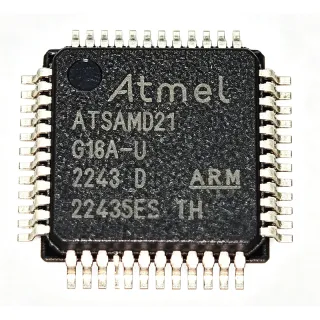
ATMXT112S-MA5U - 112-Ch maXTouch Touchscreen IC | Microchip
MPN: ATMXT112S-MA5U ✓ Active| Qty | Unit Price | Extended |
|---|---|---|
| 1 | $0 | $0.00 |
| 10 | $0 | $0.00 |
| 100 | $0 | $0.00 |
| 500 | $0 | $0.00 |
| 1,000 | $0 | $0.00 |
ATMXT112S-MA5U Overview
A capacitive touchscreen controller is a specialized interface-sensor IC that measures tiny capacitance changes on a projected-capacitive (PCAP) sensor panel and converts finger and stylus positions into digital coordinates for a host processor. Within the system hierarchy, it sits between the physical touch sensor (ITO patterned glass or film) and the host MCU or application processor, making it a key element of human-machine interface (HMI) and interface IC subsystems in embedded products.
Key features of the ATMXT112S-MA5U include the maXTouch S Series architecture delivering smartphone-like touch performance, 112 nodes supporting sensor panels up to 3.5 inches, and an on-chip noise mitigation engine that rejects charger and display noise without external filtering components. It communicates with the host over a standard I2C-style serial interface and supports self- and mutual-capacitance scanning for gloved-hand and proximity detection behavior typical of the maXTouch family.
Technically, the S Series generation integrates the acquisition engine, touch-processing firmware, and noise rejection in a single chip, offloading touch decoding entirely from the host CPU. This allows designers to add a responsive multi-touch interface to cost-sensitive devices while retaining a minimal bill of materials - typically the controller, the sensor panel, and a small number of passive support components.
Typical applications include smart watches and small wearables, portable medical and industrial handheld instruments, IoT device control panels, and compact appliance or automotive-adjacent HMI panels where screen sizes of 3.5 inches or below are used.
A key design consideration is matching the controller's 112-node budget to the sensor electrode count; over-counting nodes forces reduced scan rates, while under-utilization wastes cost. Firmware configuration files supplied by Microchip tuning tools should be validated on the actual sensor stack.
This page synthesizes verified distributor stock data, manufacturer cross-references, drop-in alternative analysis, and practical design guidance not found together in the standard datasheet.
Drop-in alternatives for ATMXT112S-MA5U — same package, pin-to-pin compatible. Different-package parts requiring PCB rework are excluded.
Variants in this series
Same-series models that are drop-in compatible with ATMXT112S-MA5U (same form factor and footprint) — differing in Max Screen Size, Sensing Technology, Family, Manufacturer, Noise Mitigation.
Quick Comparison Tool — Select alternative parts for side-by-side comparison:
ATMXT112S-MAU
✅ Drop-In✓ In Stock
Contact for price
View Datasheet →ATMXT112S-MAUR
✅ Drop-In✓ In Stock
$1.06 / Unit
View Datasheet →ATMXT112S-MA5UR
✅ Drop-In✓ In Stock
$2.35 / Unit
View Datasheet →ATMXT144U
✅ Drop-In📋 Reference alternative (not in catalog)
ATMXT112S-MA5U Specifications
| Manufacturer | Microchip Technology |
| Product Family | maXTouch S Series (mXT112S) |
| Function | Capacitive touchscreen controller |
| Touch Sensing Nodes | 112 |
| Screen Size Support | Up to 3.5 inches |
| Sensing Technology | Projected capacitive (mutual capacitance) |
| Noise Mitigation | On-chip noise mitigation system |
| Interface Type | Serial (I2C-style) to host |
| Category | Interface, Touch Screen Controllers / Capacitive Touch Sensors |
| ECCN | EAR99 |
| Mounting Type | Surface Mount |
| Parametric Data Last Updated | 2024-03-06 |
ATMXT112S-MA5U standard Pin Configuration Guide
Pin configuration for ATMXT112S-MA5U (standard package). Pin numbering, functions, and connection diagrams are defined in the manufacturer datasheet. Refer to it for the exact footprint and soldering guidelines.

No detailed pinout data available for ATMXT112S-MA5U.
Refer to the datasheet for full pin configuration.
Typical Applications
ATMXT112S-MA5U is suitable for 6 applications: Smart Watches and Wearables, Industrial Handheld Instruments, Medical Monitoring Devices, IoT Smart Home Control Panels, Appliance and Consumer HMI Panels, Automotive-Adjacent and Cabin HMI (Non-Safety).
Smart Watches and Wearables
The ATMXT112S-MA5U fits wearable HMI designs because its 112-node budget matches the electrode counts typical of round or rectangular 1.2-3.5 inch smart watch panels. The on-chip noise mitigation system is essential here: wearable devices frequently charge over USB or wireless coils while the display remains active, and the mXT112S rejects charger and battery-management noise digitally without external filter components, preserving touch accuracy during charging. Its S Series architecture scans mutual capacitance with firmware-based processing, delivering smartphone-grade responsiveness while offloading all touch decoding from the constrained wearable MCU. Placed between the ITO sensor on the cover glass and the host SoC over a serial interface, it needs only a small passive support network, keeping the wearable BOM and PCB area minimal. Verify gloved-hand and wet-finger behavior during design-in, as small panels concentrate electrode coupling.
Recommended
Industrial Handheld Instruments
Portable industrial instruments - data loggers, field testers, handheld meters - benefit from the ATMXT112S-MA5U's combination of 112 sensing nodes and robust on-chip noise mitigation. Industrial environments expose the touchscreen to switching power supplies, motor drives, and RF equipment; the mXT112S S Series rejects this interference on-chip, maintaining reliable touch detection where first-generation controllers would report false touches. The controller's serial interface connects cleanly to industrial MCUs, and the surface-mount QFN package withstands vibration typical of field instruments. Because the entire touch-processing stack runs on-chip, the host processor retains full bandwidth for measurement tasks. Designers should pair the controller with a properly bonded sensor stack and validate performance across the operating temperature range on the actual instrument enclosure, since panel stacking and grounding strongly influence noise immunity in metal-cased instruments.
Recommended
Medical Monitoring Devices
Compact medical monitors and diagnostic handhelds use the ATMXT112S-MA5U to provide intuitive touch interaction on screens up to 3.5 inches. Medical environments impose strict interference requirements - the controller's on-chip noise mitigation rejects noise from adjacent pumps, defibrillation events' residual interference, and hospital-grade switching supplies without external shielding. The 112-node architecture supports the moderate electrode counts of small medical panels, and the S Series firmware delivers the responsive, smartphone-like interface clinicians expect from consumer devices, reducing training burden. Its QFN surface-mount package suits the dense, sterilizable enclosures of portable medical hardware. During design-in, validate touch performance with the device connected to hospital-grade isolation circuits and confirm that the touch sensing does not interfere with, nor is affected by, the medical signal chain's analog front end.
Recommended
IoT Smart Home Control Panels
Smart home thermostats, door locks, and wall controllers increasingly replace mechanical buttons with capacitive touch panels, and the ATMXT112S-MA5U serves this segment directly: its 112 nodes cover the small 2-3.5 inch panels typical of these products, while the integrated noise mitigation handles the noisy 50/60 Hz mains environment and Wi-Fi module interference common inside IoT enclosures. The controller's on-chip processing means even a modest IoT MCU can drive a polished touch interface, and the serial interface integrates simply with existing home-automation MCUs. Proximity-aware maXTouch sensing allows wake-on-approach behavior that saves display power in battery-backed panels. Designers should budget scan rate carefully - on small panels, the 112-node ceiling is rarely a constraint, allowing higher report rates for fluid UI animations on wall-mounted devices.
Recommended
Appliance and Consumer HMI Panels
Coffee machines, cooktops, and white-goods control panels use projected-capacitive touch for premium user experiences, and the ATMXT112S-MA5U delivers the required robustness: the on-chip noise mitigation system rejects interference from inverter-driven motors, induction heating, and switching power supplies that share the appliance's board - historically the biggest failure mode for capacitive touch in appliances. Its 112-node budget suits the small-to-medium 3.5 inch and below panels used on compact appliances, while wet-finger tolerance from the S Series sensing architecture handles kitchen moisture conditions. The QFN surface-mount package mounts reliably through reflow on appliance control boards. Validate performance with the appliance running its full power profile, since induction loads can couple significant common-mode noise into the sensor stack, and adjust the Microchip-supplied configuration file accordingly.
Recommended
Automotive-Adjacent and Cabin HMI (Non-Safety)
Non-safety-critical cabin interfaces - climate sub-panels, seat configuration touch strips, and accessory HMIs - can use the ATMXT112S-MA5U where its 112 nodes and compact 3.5-inch optimization fit the panel design. The on-chip noise mitigation addresses the automotive electrical environment's charger and transient noise, though designers must confirm the specific ordering suffix's temperature grade and qualification level against the datasheet before automotive deployment, as standard parts may not be AEC-Q100 qualified. The S Series architecture provides the smooth multi-touch response expected in modern vehicle interiors, and its host-offload design frees the body controller from touch-processing tasks. For screens beyond 3.5 inches or higher node counts, migrate to the ATMXT144U, which Microchip lists as the recommended alternative within the same maXTouch ecosystem and toolchain.
Recommended
Recommended Products Summary
Engineering reference data for ATMXT112S-MA5U — comparison, design guidance, and compliance information.
Selection Guide
Comparison with Alternatives
| Parameter | This Product | ATMXT112S-MAU | ATMXT112S-MAUR | ATMXT112S-MA5UR | ATMXT144U |
|---|---|---|---|---|---|
| Brand | Microchip Technology | Microchip Technology (Atmel legacy) | Microchip Technology (Atmel legacy) | Microchip Technology | Microchip Technology |
| Sensing Nodes | 112 | 112 | 112 | 112 | 144 |
| Screen Size Support | Up to 3.5 inches | Up to 3.5 inches | Up to 3.5 inches | Up to 3.5 inches | Larger panels (higher node budget) |
| Architecture | maXTouch S Series | maXTouch S Series | maXTouch S Series | maXTouch S Series | maXTouch family |
| Noise Mitigation | On-chip noise mitigation system | On-chip noise mitigation system | On-chip noise mitigation system | On-chip noise mitigation system | On-chip noise mitigation system |
| Firmware Reconfiguration Needed | - | No (same die) | No (same die) | No (same die) | Yes (different node count) |
Key Differentiators
- 112-node budget optimized for 3.5-inch panels (vs ATMXT144U)
- Advanced on-chip noise mitigation (vs Generic capacitive touch controllers)
- Identical-die sourcing variants for supply resilience (vs ATMXT112S-MAU / ATMXT112S-MAUR)
Design Notes
Place the ATMXT112S-MA5U as close to the sensor panel connector as practical, keeping the sensitive sense (Y) lines short and routed away from switching regulators and display backlight drivers. Follow the reference layout in the Microchip mXT112S design collateral: solid ground plane under the controller, guard the sense traces with ground, and use the recommended bypass capacitor network directly at the supply pins. Since the exact MA5U package dimensions should be confirmed on the datasheet package drawing, generate the PCB footprint from the official drawing rather than third-party footprints.
Node budget mismatch is the most common maXTouch design error: count the actual sensor electrode intersections (X electrodes times Y electrodes) and confirm it does not exceed 112. Exceeding the node count forces the firmware to drop nodes or reduce scan rates, degrading report rate and wet-finger performance. Also, the sensor stack (cover glass thickness, adhesive, ITO pattern) must match the assumptions in the Microchip-supplied configuration file; retune with Microchip's tuning tools on the final mechanical assembly, not on a bare sensor.
Although the mXT112S integrates an on-chip noise mitigation system, layout still matters: route the charger, battery, and RF antenna lines away from the sensor flex and controller. When the device charges while touch is active, enable the noise mitigation configuration profiles in firmware and validate touch accuracy across all charger types in your market. Adding a single chassis-grounded shield layer in the sensor stack further improves immunity in noisy appliance and industrial enclosures.
Compliance Information
ECCN EAR99 per distributor data. RoHS/REACH/lead-free status not present in verified data - confirm on Microchip product page compliance documents.