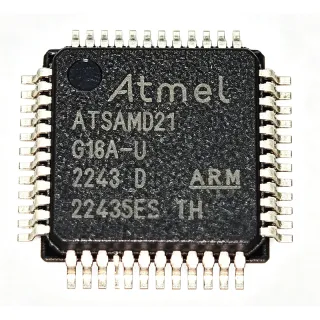
ATMXT112S-MA5UR - 112-Node maXTouch Touchscreen IC | Microchip
MPN: ATMXT112S-MA5UR ✓ Active| Qty | Unit Price | Extended |
|---|---|---|
| 1 | $3.62 | $3.62 |
| 10 | $3.26 | $32.60 |
| 100 | $2.9 | $290.00 |
| 500 | $2.61 | $1,305.00 |
| 1,000 | $2.35 | $2,350.00 |
ATMXT112S-MA5UR Overview
A capacitive touchscreen controller IC measures mutual-capacitance changes across a grid of sense nodes embedded in the touch panel overlay. It sits within the broader hierarchy of sensor ICs: touch sensor -> capacitive touch sensor -> touchscreen controller -> human-machine interface (HMI) semiconductor. The controller scans the node matrix, applies noise-filtering and water-rejection algorithms, and reports touch coordinates to a host processor, typically over an I2C or SPI interface.
Key features of the ATMXT112S-MA5UR include 112 mutual-capacitance sensing nodes, S Series maXTouch signal processing that supports gloved-touch and stylus operation, and support for touchscreen panels up to 3.5 inches diagonal. The S Series brings the same core acquisition engine as larger maXTouch devices to compact HMI panels, portable instruments, and small industrial displays.
The mXT112S is manufactured by Atmel, now Microchip Technology, and continues the maXTouch product line with automotive-proven algorithms adapted for consumer and industrial touch panels. The 112-node budget allows a practical trade-off between X-Y electrode count and line widths on small panels, keeping sensor patterning cost low while retaining accurate multi-touch reporting.
Typical applications include smartwatch and wearable HMIs, small handheld instrument displays, compact industrial control panels, and battery-powered devices with 2.4-inch to 3.5-inch touchscreens. Its low-node-count architecture suits cost-sensitive designs that do not require the 200+ node capacity of mXT1664S-class devices.
Design consideration: firmware configuration (node mapping, acquisition settings, self-calibration thresholds) is written to the device's configuration memory; any footprint-compatible alternative in the maXTouch family must be re-tuned before production to maintain touch accuracy.
This page synthesizes distributor stock status, drop-in alternative candidates, and practical design notes not found in the manufacturer datasheet.
Drop-in alternatives for ATMXT112S-MA5UR — same package, pin-to-pin compatible. Different-package parts requiring PCB rework are excluded.
Variants in this series
Same-series models that are drop-in compatible with ATMXT112S-MA5UR (same form factor and footprint) — differing in Manufacturer, Max Screen Size, Noise Mitigation, Sensing Technology.
Quick Comparison Tool — Select alternative parts for side-by-side comparison:
ATMXT112S-MAUR
✅ Drop-In✓ In Stock
$1.06 / Unit
View Datasheet →ATMXT112S-MAU020
✅ Drop-In📋 Reference alternative (not in catalog)
ATMXT1188S-ATR
✅ Drop-In📋 Reference alternative (not in catalog)
ATMXT144U
✅ Drop-In📋 Reference alternative (not in catalog)
ATMXT112S-MA5UR Maximum Ratings & Electrical Characteristics
| Product Series | maXTouch S Series (mXT112S) |
| Touch Sensing Nodes | 112 |
| Max Screen Size | 3.5 in |
| Touch Technology | Projected Capacitive (mutual capacitance) |
| Touch Channel Type | Touchscreen Sensor IC |
| Manufacturer | Microchip Technology (Atmel) |
| Mounting Type | Surface Mount |
| Packing | Tape & Reel (R suffix) |
| ECCN | EAR99 |
| Part Status | Active (see Microchip product page for end-of-life status) |
| Recommended Alternative (per Microchip) | ATMXT144U |
ATMXT112S-MA5UR standard Pin Configuration Guide
Pin configuration for ATMXT112S-MA5UR (standard package). Pin numbering, functions, and connection diagrams are defined in the manufacturer datasheet. Refer to it for the exact footprint and soldering guidelines.

No detailed pinout data available for ATMXT112S-MA5UR.
Refer to the datasheet for full pin configuration.
Typical Applications
ATMXT112S-MA5UR is suitable for 6 applications: Wearable Device HMIs, Handheld Test and Measurement Instruments, Compact Industrial Control Panels, Portable Medical Monitoring Devices, Smart Home and IoT Control Nodes, Automotive Interior Control Interfaces.
Wearable Device HMIs
Smartwatches and fitness bands typically use 1.3-2.0 inch touch panels with electrode grids well below 112 nodes, which is exactly the capacity envelope of the ATMXT112S-MA5UR. The mXT112S's S Series acquisition engine provides the noise rejection needed when the panel sits close to radios, charging coils, and displays, and it supports gloved-touch thresholds useful for outdoor wearables. Placed between the touch sensor flex and the host MCU, it reports touch data over its standard host interface while the configuration memory stores per-panel tuning. The key trade-off is cost: the low node count keeps sensor patterning cheap but caps maximum panel size, so wearables are the ideal fit rather than phone-class panels.
Recommended
Handheld Test and Measurement Instruments
Portable multimeters, clamp meters, and handheld spectrum tools commonly use 2.8-3.5 inch touchscreens, matching the ATMXT112S-MA5UR's maximum panel size. The 112-node grid supports the X-Y electrode densities these panels need for accurate menu and slider control, while the S Series water-rejection algorithms prevent false touches in humid field conditions. The controller scans the sensor matrix autonomously, offloading timing-critical touch acquisition from the instrument's main MCU so that measurement timing is unaffected. Designers should budget for a tuning pass on the production panel stack, since protective windows and adhesives shift baseline capacitance and require recalibrated thresholds.
Recommended
Compact Industrial Control Panels
Small factory HMIs, thermostat panels, and machine-local control displays in the 2.4-3.5 inch range benefit from the ATMXT112S-MA5UR's industrial-grade maXTouch signal processing. Industrial environments impose switching noise from motor drives and fluorescent lighting; the mXT112S's acquisition filters suppress this interference without external shielding in most designs. With 112 nodes, the controller covers the typical electrode grid of these panels while reporting multi-touch gestures for mode switching. The autonomous scan architecture means the PLC-adjacent host processor only services touch interrupts, improving system latency. Gloved-touch support is essential here since operators frequently wear gloves on the factory floor.
Recommended
Portable Medical Monitoring Devices
Glucose meters, pulse oximeters, and portable vital-sign monitors use compact touchscreens for patient and clinician interaction, typically 2.4-3.5 inches diagonal - squarely within the ATMXT112S-MA5UR's supported range. Reliable touch response with gloved or damp hands is a hard requirement in clinical settings, and the S Series signal chain handles both cases through configurable sensitivity profiles. The controller's autonomous operation reduces host firmware complexity in devices where software validation cost dominates the bill of materials. Battery-powered operation demands the maXTouch low-power scan modes that wake on proximity and full-acquire on touch, extending battery life in always-on monitoring products.
Recommended
Smart Home and IoT Control Nodes
Smart thermostats, door locks, and wall controllers use small round or rectangular touch panels where the ATMXT112S-MA5UR's 112 nodes match the electrode count of 2.4-3.5 inch panels. The maXTouch engine detects both discrete touches and simple gestures, letting these products implement swipe navigation without a higher-node controller. Because these devices are always energized, the mXT112S low-power wake-on-touch scan mode is valuable: the panel is scanned at a low duty cycle until a touch approaches, then full acquisition runs. Water-rejection filtering also prevents phantom activation from condensation in bathrooms and kitchens, a common field-failure mode for IoT nodes.
Recommended
Automotive Interior Control Interfaces
Secondary automotive touch surfaces - climate-control strips, steering-wheel touch zones, and small console panels - increasingly use compact capacitive panels in the sub-3.5-inch class where the ATMXT112S-MA5UR's node budget fits. The maXTouch S Series signal processing is derived from Atmel/Microchip's automotive-proven touch platform and tolerates the conductive-noise environment of vehicle power networks through adaptive filtering. For qualification-sensitive designs, engineers should evaluate the maXTouch automotive-grade family variants and Microchip's recommended ATMXT144U alternative, since part selection in automotive programs must account for lifecycle status: Microchip already designates the mXT144U as the recommended successor for new designs.
Recommended
Recommended Products Summary
Engineering reference data for ATMXT112S-MA5UR — comparison, design guidance, and compliance information.
Selection Guide
Comparison with Alternatives
| Parameter | This Product | ATMXT112S-MAUR | ATMXT112S-MAU020 | ATMXT1188S-ATR | ATMXT144U |
|---|---|---|---|---|---|
| Brand | Microchip Technology (Atmel) | Microchip Technology (Atmel) | Microchip Technology (Atmel) | Microchip Technology (Atmel) | Microchip Technology (Atmel) |
| Package | QFN (Tape & Reel) | QFN - same family footprint | QFN - same family footprint | QFN - same family footprint (verify pin map) | QFN - verify footprint before drop-in |
| Series Architecture | maXTouch S Series | maXTouch S Series | maXTouch S Series | maXTouch S Series | maXTouch U Series successor |
| Lifecycle Status | Active / managed transition (ATMXT144U recommended) | Active (same die) | Active (same die) | Active | Active - recommended new-design part |
Key Differentiators
- Optimized node budget for small panels (vs ATMXT1188S-ATR)
- Same-die sourcing flexibility (vs ATMXT112S-MAUR)
- Manufacturer-defined upgrade path (vs ATMXT144U)
Design Notes
The 'R' suffix in ATMXT112S-MA5UR denotes Tape & Reel packing; electrical and firmware configuration are defined by the middle suffix (MA5UR vs MAUR vs MAU020). When substituting between these variants, verify the configuration memory defaults in the manufacturer datasheet - a mismatched firmware variant can ship with different acquisition thresholds and cause calibration drift on the production line.
The mXT112S is supplied in a QFN-type surface-mount package. Route the touch-sensor Y lines and X drive lines away from switching regulators and display flex cables, keeping the touch interface lines as short as practical. Place the device's decoupling network per the Microchip datasheet layout guidance directly at the supply pins, and reserve a grounded guard trace area under the controller for noise-sensitive analog acquisition lines.
Per Microchip's official product page, the recommended alternative touch controller for the mXT112S is the ATMXT144U. Even though distributor stock (including a 3,561-piece surplus lot reported on ICS-Embedded) remains available as of 2026-09-19, production programs should define the ATMXT144U as the planned successor and validate panel tuning on the new controller before the mXT112S reaches its end-of-life window.
Compliance Information
ECCN EAR99 per distributor listing (GlobalSpec/Win Source data). RoHS/REACH status not published in verified web data; confirm on the Microchip product compliance tab.