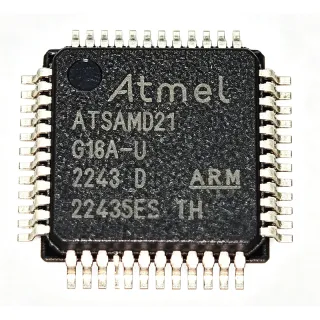
ATSAMA5D2B-XULT - SAMA5D2 Xplained Ultra Kit | Microchip
MPN: ATSAMA5D2B-XULT ✗ End of Life| Qty | Unit Price | Extended |
|---|---|---|
| 1 | $195 | $195.00 |
| 10 | $178.5 | $1,785.00 |
| 50 | $165 | $8,250.00 |
| 100 | $152 | $15,200.00 |
| 250 | $142.5 | $35,625.00 |
ATSAMA5D2B-XULT Overview
An ARM Cortex-A5 MPU is a 32-bit microprocessor IP core targeting industrial IoT gateways, human-machine interfaces, and connected devices. The Cortex-A5 family sits between the Cortex-M microcontroller class and Cortex-A application processors, offering full application-class Linux capability with a smaller die area and lower power than Cortex-A7/A9 parts. Within the MPU hierarchy, SAMA5D2 belongs to Microchip's Cortex-A5 lineup alongside SAMA5D3 (Cortex-A5) and SAMA5D4 (Cortex-A5), and is one generation below the Cortex-A5 SAMA7 family. The SAMA5D2 family targets secure, low-power connected edge nodes with hardware cryptography and advanced audio/display connectivity.
Key features include the SAMA5D27B Cortex-A5 MPU at 500 MHz with hardware AES/SHA/TRNG, 128 MB on-package DDR2, integrated 10/100 Ethernet MAC with on-board PHY, USB 2.0 host and device ports, microSD socket, 4-bit SD/MMC interface, MikroElektronika mikroBUS socket, Arduino R3-compatible headers, Xplained Pro extension headers, two CAN-FD interfaces, and a 24-bit TFT LCD connector. The kit ships pre-flashed with Linux demonstration images from Microchip.
The SAMA5D2 architecture combines a single-issue Cortex-A5 with NEON media engine, a 32 KB L1 instruction cache, 32 KB L1 data cache, and a 128 KB L2 cache. The advanced peripherals include a 12-bit ADC, two CAN-FD controllers, three SD/MMC controllers, and an LCD controller supporting up to 1024 x 768 resolution. The on-package DDR2 reduces board complexity versus discrete DRAM designs.
Typical applications include industrial IoT gateways, human-machine interface (HMI) prototypes, secure connected sensors, Linux-based edge nodes, audio playback/recording systems, and CAN-FD automotive test benches. The kit is also widely used as a hardware reference design for SAMA5D2 layout, power sequencing, and EMI practices.
When designing with this kit, populate only the interfaces required for evaluation to minimize noise coupling into the ADC and CAN-FD buses. Use the on-board 24-pin Xplained Pro extension header to add Wi-Fi modules, sensors, or display boards from the Microchip Xplained Pro family. The SAMA5D27B SiP is footprint-compatible with other SAMA5D2 SoCs, enabling straightforward migration between SAMA5D21, SAMA5D22, SAMA5D23, SAMA5D24, SAMA5D26, and SAMA5D27 derivatives.
This page synthesizes distributor pricing, drop-in alternative boards, and practical Xplained Ultra evaluation guidance not found on a single distributor product page.
Drop-in alternatives for ATSAMA5D2B-XULT — same package, pin-to-pin compatible. Different-package parts requiring PCB rework are excluded.
Variants in this series
Same-series models that are drop-in compatible with ATSAMA5D2B-XULT (same form factor and footprint) — differing in Ethernet, Product Type, USB, Connectivity, Core Architecture.
Quick Comparison Tool — Select alternative parts for side-by-side comparison:
ATSAMA5D2C-XULT
✅ Drop-In✓ In Stock
$184.5 / Unit
View Datasheet →ATSAMA5D2-XULT
✅ Drop-In✓ In Stock
$72 / Unit
View Datasheet →ATSAMA5D27C-D1G-CU
✅ Drop-In✓ In Stock
$19.1 / Unit
View Datasheet →ATSAMA5D27B-CU
✅ Drop-In✓ In Stock
$11.85 / Unit
View Datasheet →ATSAMA5D27C-CUR
✅ Drop-In✓ In Stock
$12.9 / Unit
View Datasheet →ATSAMA5D2B-XULT Specifications (manufacturer-published)
| Product Type | Embedded MPU Evaluation Board / Xplained Ultra Kit |
| Featured MPU | ATSAMA5D27B (SAMA5D2 family, ARM Cortex-A5) |
| MPU Core | ARM Cortex-A5, 32-bit, single-core |
| MPU Clock Speed | Up to 500 MHz |
| MPU Package (SiP) | 289-ball BGA |
| On-Package Memory | 128 MB DDR2 |
| External Flash | QSPI NOR flash (on-board) |
| Ethernet | 10/100 Mbps with on-board PHY |
| USB Interfaces | USB 2.0 host + USB 2.0 device |
| SD/MMC | microSD socket + 4-bit SD/MMC interface |
| CAN Interfaces | 2 x CAN-FD |
| Expansion | Arduino R3, Xplained Pro, mikroBUS |
| Display | 24-bit TFT LCD connector |
| Pre-flashed OS | Linux demonstration image |
| RoHS Status | Compliant |
ATSAMA5D2B-XULT Interfaces & Connectors
ATSAMA5D2B-XULT exposes the following interfaces and connectors as published by the manufacturer: Ethernet, USB, Expansion / Buses. Expansion header pinout, connector pin numbering, and electrical limits are defined in the manufacturer documentation.
| Ethernet | 10/100 Mbps with on-board PHY |
| USB | USB 2.0 host + USB 2.0 device |
| Expansion / Buses | 2 x CAN-FD |
Refer to the manufacturer documentation for the full expansion header pinout and connector pin numbering.
Typical Applications
ATSAMA5D2B-XULT is suitable for 6 applications: Industrial IoT Gateway Prototype, Human-Machine Interface (HMI) Development, Secure Connected Edge Node, Linux Bring-Up and Software Validation, Audio Playback and Recording System, CAN-FD Automotive Test Bench.
Industrial IoT Gateway Prototype
The ATSAMA5D2B-XULT fits industrial IoT gateway prototyping because the SAMA5D27B SiP combines an ARM Cortex-A5 at 500 MHz with hardware AES/SHA/TRNG, 10/100 Ethernet, and two CAN-FD interfaces - exactly the connectivity and security fabric needed to bridge field-bus nodes to MQTT brokers or REST APIs. Engineers typically run mainline Linux4SAM with Buildroot or Yocto, expose CAN-FD through SocketCAN, and terminate TLS sessions via the on-chip crypto accelerators, achieving gateway-class throughput without an external secure element.
Recommended
Human-Machine Interface (HMI) Development
The ATSAMA5D2B-XULT supports HMI prototyping thanks to the on-board 24-bit TFT LCD connector and the SAMA5D27B's built-in LCD controller supporting up to 1024x768. The 500 MHz Cortex-A5 with NEON accelerates Qt and LVDS rendering for control panels, while the integrated 128 MB DDR2 provides enough framebuffer headroom for mid-resolution LVDS displays. Designers typically boot Linux4SAM with the Qt 6 graphics stack and connect LVDS panels through the Xplained Pro extension board.
Recommended
Secure Connected Edge Node
The ATSAMA5D2B-XULT is ideal for secure connected edge nodes because the SAMA5D27B SiP embeds hardware AES-256, SHA-1/2, and a true random number generator (TRNG) alongside secure boot and tamper pins. Running secure-boot Linux4SAM on the kit, engineers can validate TLS 1.3 session handshakes, encrypted firmware updates, and signed application containers - typical requirements for IEC 62443-compliant edge devices. The Cortex-A5 plus crypto accelerators offload TLS RSA/ECDSA from the application CPU.
Recommended
Linux Bring-Up and Software Validation
The ATSAMA5D2B-XULT accelerates Linux bring-up because it ships pre-flashed with a working Linux4SAM demonstration image, exposing all peripherals via standard device-tree bindings. Engineers typically use the kit to validate drivers for GMAC, USB, CAN-FD, LCD, and ADC before committing to a custom PCB layout. The QSPI NOR flash and microSD socket let teams A/B-boot between upstream and downstream kernels during regression testing.
Recommended
Audio Playback and Recording System
The ATSAMA5D2B-XULT suits audio prototyping thanks to the SAMA5D27B's I2S/SAI peripherals plus the kit's mikroBUS socket for connecting audio CODEC click boards, and Xplained Pro extension for SPDIF/I2S daughter cards. The Cortex-A5's NEON engine accelerates MP3/AAC/Opus codecs at low CPU load, and Linux4SAM provides ALSA drivers for SAI. Designers typically pair the kit with a Wolfson/Cirrus CODEC click board for stereo 24-bit playback prototypes.
Recommended
CAN-FD Automotive Test Bench
The ATSAMA5D2B-XULT serves as a CAN-FD automotive test bench because it integrates two MCAN controllers routed through isolated transceivers to DB9 connectors, enabling rapid prototyping of CAN-FD bridges, gateways, and OBD-II interfaces. The Cortex-A5 core runs SocketCAN over Linux4SAM, and engineers typically pair the kit with CANalyzer or PEAK PCAN-View for bus monitoring. Production migration to ATSAMA5D27B-CU retains the same CAN-FD peripheral mapping and driver bindings.
Recommended
Recommended Products Summary
Engineering reference data for ATSAMA5D2B-XULT — comparison, design guidance, and compliance information.
Selection Guide
Comparison with Alternatives
| Parameter | This Product | ATSAMA5D2C-XULT | ATSAMA5D2-XULT | ATSAMA5D27C-D1G-CU | ATSAMA5D28C-LD1G-CUR | ATSAMA5D27B-CU |
|---|---|---|---|---|---|---|
| Brand | Microchip Technology | Microchip Technology | Microchip Technology | Microchip Technology | Microchip Technology | Microchip Technology |
| Package | Xplained Ultra Kit (SAMA5D27B 289-BGA SiP) | Xplained Ultra Kit (same form factor) | Xplained Ultra Kit (same form factor) | 289-ball BGA (SiP) | LFBGA-361 (different SiP package) | 289-ball BGA (SiP) |
| MPU Core | ARM Cortex-A5 500 MHz | ARM Cortex-A5 500 MHz | ARM Cortex-A5 500 MHz | ARM Cortex-A5 500 MHz | ARM Cortex-A5 500 MHz | ARM Cortex-A5 500 MHz |
| On-Package Memory | 128 MB DDR2 | 128 MB DDR2 | 128 MB DDR2 | 128 MB DDR2 | 128 MB LPDDR2 | 128 MB DDR2 |
| Ethernet | 10/100 with on-board PHY | 10/100 with on-board PHY | 10/100 with on-board PHY | 10/100 MAC (no PHY on bare SiP) | 10/100 MAC (no PHY on bare SiP) | 10/100 MAC (no PHY on bare SiP) |
| USB | USB 2.0 host + device | USB 2.0 host + device | USB 2.0 host + device | USB 2.0 host + device | USB 2.0 host + device | USB 2.0 host + device |
| CAN-FD | 2 x CAN-FD | 2 x CAN-FD | 1 x CAN-FD (lower-cost variant) | 2 x CAN-FD | 2 x CAN-FD | 2 x CAN-FD |
| LCD Support | 24-bit TFT connector, up to 1024x768 | 24-bit TFT connector, up to 1024x768 | 24-bit TFT connector, up to 1024x768 | Up to 1024x768 | Up to 1024x768 | Up to 1024x768 |
Key Differentiators
- Full SAMA5D2 Xplained Ultra feature set on a single board (vs ATSAMA5D2-XULT)
- SAMA5D27B SiP includes hardware crypto and tamper pins (vs ATSAMA5D27B-CU)
- Pre-flashed Linux4SAM demonstration image (vs ATSAMA5D2C-XULT)
Design Notes
Estimated: power the ATSAMA5D2B-XULT from the USB micro-B connector (default) or a 5 V DC barrel jack; idle Linux draw is roughly 1.5 W with all peripherals populated. For sustained CPU + Ethernet load, budget 4-5 W from the USB 3.0 host port to avoid brownouts. The on-board 3.3 V LDO supplies the MPU I/O rails; heavy CAN-FD bus traffic plus LCD backlight can push the input supply above 2 A briefly, so use a 2.5 A-capable USB host or an external 5 V/3 A supply.
Estimated: the SAMA5D27B SiP has a typical junction-to-ambient thermal resistance of about 25 C/W in still air on the kit's 4-layer PCB. Under continuous 500 MHz CPU + GMAC + USB load, expect a 30-40 C rise above ambient; the kit's SiP does not require a heatsink for typical room-temperature use, but mount the kit vertically in an enclosure to allow convection. Above 60 C ambient, derate CPU frequency to 400 MHz or add a small adhesive heatsink on the SiP for margin.
If cloning the ATSAMA5D2B-XULT design onto a custom PCB, replicate Microchip's 4-layer stackup: top signal, inner-1 GND, inner-2 power, bottom signal. Keep the SiP BGA escape on the top layer with 0.4 mm-pitch microvias to inner-1 GND, and place the 128 MB DDR2 decoupling caps within 2 mm of the SiP balls. The 24-bit TFT LCD connector must be ESD-protected - the kit includes TVS arrays on D0-D23; copy that pattern to pass IEC 61000-4-2 contact discharge.
Do not populate the mikroBUS socket with a 5 V click board when the kit is powered from a 3.3 V-only source; the mikroBUS 5 V rail must be enabled in software via the on-board LDO. Avoid connecting both the USB micro-B (debug) and the USB-A (host) ports simultaneously to a single USB host PC - use a dedicated USB charger for host ports to prevent enumeration failures.
Compliance Information
RoHS and lead-free per Microchip product page. The kit is a development board and is not AEC-Q100 qualified; for automotive production designs use a qualified SAMA5D2 SiP variant.