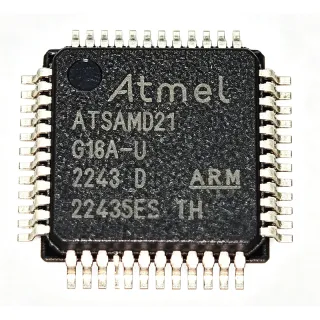
ATSAMA5D35-EK - SAMA5D35 Cortex-A5 536MHz MPU Evaluation Kit
MPN: ATSAMA5D35-EK ✓ Active| Qty | Unit Price | Extended |
|---|---|---|
| 1 | $749 | $749.00 |
| 5 | $719 | $3,595.00 |
| 10 | $689 | $6,890.00 |
| 25 | $659 | $16,475.00 |
| 50 | $629 | $31,450.00 |
ATSAMA5D35-EK Overview
An ARM Cortex-A5 microprocessor (MPU) is a 32-bit application-class processor core with full MMU support, designed for embedded systems that require a rich operating system such as Linux or Android. In the component taxonomy, the Cortex-A5 sits below Cortex-A7/A8/A9 and above Cortex-M7, and the SAMA5D3 series specifically belongs to the high-performance ultra-low-power MPU family, which in turn belongs to the broader 32-bit microprocessor family and the wider category of embedded processing semiconductors. Unlike microcontroller units (MCUs), MPUs require external memory and benefit from dedicated hardware accelerators for multimedia and connectivity.
Key features of the SAMA5D35 silicon on this board include 850 DMIPS performance, hardware cryptography (AES, SHA, TRNG), dual 10/100/1000 Ethernet MACs with IEEE 1588 support, LCD controller up to 1280x860 or 1920x1080 with HDMI support, dual CAN-FD controllers, USB 2.0 high-speed host and device, and a high-speed memory bus supporting DDR2/LPDDR/DDR3. The evaluation kit exposes 512 MB of DDR2, NAND/NOR flash, EEPROM, SPI DataFlash and SD card interfaces through standard headers, allowing immediate access to all major peripherals without additional hardware.
The board architecture provides isolated power rails and a dedicated PMIC path, exposing low-power mode power measurement points. Software support includes free Linux distributions (mainline kernel + Yocto/Buildroot), bare-metal examples, and the SAM-BA bootloader, making it suitable for both production-ready Linux application development and deep power-management research. Industrial operating temperature grade silicon is also supported on compatible SAMA5D3 MPU variants.
Typical applications include industrial HMI panels, smart energy gateways, building automation controllers, portable medical data terminals, wearable computing, point-of-sale terminals, and M2M/IoT edge nodes that require low-power Linux with rich connectivity. Engineers evaluating secure connected devices also use the kit as a reference for hardware cryptography and secure boot implementation.
When designing with the ATSAMA5D35-EK, prioritize signal-integrity for the DDR2 routing, ensure adequate copper area under the BGA to keep junction temperature within the 105 C industrial limit, and use the on-board PMIC current-sense resistors to characterize low-power modes. This page synthesizes distributor pricing, drop-in board-level alternatives, and practical design notes not found in the manufacturer datasheet.
Drop-in alternatives for ATSAMA5D35-EK — same package, pin-to-pin compatible. Different-package parts requiring PCB rework are excluded.
Variants in this series
Same-series models that are drop-in compatible with ATSAMA5D35-EK (same form factor and footprint) — differing in Product Type, Maximum CPU Clock, Core, Debug Interface, Ethernet.
Quick Comparison Tool — Select alternative parts for side-by-side comparison:
ATSAMA5D3-XPLD
✅ Drop-In✓ In Stock
$105.9 / Unit
View Datasheet →ATSAMA5D2-XULT
✅ Drop-In✓ In Stock
$72 / Unit
View Datasheet →ATSAMA5D2B-XULT
✅ Drop-In✓ In Stock
$142.5 / Unit
View Datasheet →ATSAM4S-EK2
✅ Drop-In✓ In Stock
$260 / Unit
View Datasheet →MDKA5D35
✅ Drop-In ⚠️ 参数待验证📋 Reference alternative (not in catalog)
ATSAMA5D35-EK Specifications (manufacturer-published)
| Product Type | MPU Evaluation Board / Development Kit |
| MPU Series | SAMA5D3 (ARM Cortex-A5) |
| Core Processor | ARM Cortex-A5 32-bit |
| Maximum CPU Clock | 536 MHz |
| Performance | 850 DMIPS |
| Internal SRAM | 128 KB |
| L1 Instruction Cache | 32 KB |
| L1 Data Cache | 32 KB |
| Floating Point Unit | Yes (VFPv4 + NEON) |
| On-board DRAM | 512 MB DDR2 |
| Flash Memory | 256 MB NAND + 16 MB NOR + 4 MB SPI DataFlash + 64 KB EEPROM |
| Ethernet | 2x 10/100/1000 Mbps MAC (GMII/RGMII), IEEE 1588 |
| USB | 2x USB 2.0 High-Speed Host + 1x USB 2.0 High-Speed Device |
| CAN | 2x CAN-FD controllers |
| LCD Controller | Integrated, supports up to 1920x1080 (HDMI bridge on board) |
| Cryptography | AES, SHA, TRNG hardware accelerators |
| Low-Power Mode Consumption | < 0.5 mW |
| Operating Temperature (industrial variants) | -40 C to +105 C |
| MPU Package (silicon) | 324-ball BGA, 12 x 12 mm, 0.5 mm pitch |
| Board Form Factor | SAMA5D3-EK baseboard + SAMA5D35 module |
| Software Support | Linux (mainline kernel, Yocto, Buildroot), SAM-BA bootloader, bare-metal |
| Kit Contents | Board, cables, power supply |
| RoHS Status | Compliant |
| Lead-Free | Yes |
ATSAMA5D35-EK Interfaces & Connectors
ATSAMA5D35-EK exposes the following interfaces and connectors as published by the manufacturer: Ethernet, USB, Expansion / Buses. Expansion header pinout, connector pin numbering, and electrical limits are defined in the manufacturer documentation.
| Ethernet | 2x 10/100/1000 Mbps MAC (GMII/RGMII), IEEE 1588 |
| USB | 2x USB 2.0 High-Speed Host + 1x USB 2.0 High-Speed Device |
| Expansion / Buses | 2x CAN-FD controllers |
Refer to the manufacturer documentation for the full expansion header pinout and connector pin numbering.
Power & Thermal Characteristics
| Operating Temperature | -40 C to +105 C |
Power input and thermal parameters for ATSAMA5D35-EK as published by the manufacturer.
Typical Applications
ATSAMA5D35-EK is suitable for 7 applications: Industrial HMI Panels, Smart Energy Gateways, Building Automation Controllers, Portable Medical Data Terminals, Wearable Computing and Mobile Devices, Edge IoT / M2M Gateway, Secure Connected Device Reference.
Industrial HMI Panels
The ATSAMA5D35-EK is one of the most widely adopted reference platforms for industrial HMI prototypes because the SAMA5D35 silicon integrates a 1920x1080 LCD controller, hardware AES/SHA for secure boot, dual CAN-FD for machine-to-machine communication, and dual Gigabit Ethernet for plant network isolation. Placed on the shop floor, an engineer can boot the kit into a Yocto Linux image with Qt/ Weston pre-installed and drive a 7-10 inch LVDS or HDMI panel immediately; the integrated LCD controller and 2D graphics engine remove the need for an external GPU, lowering BOM cost. Industrial temperature silicon rated to -40 to +105 C on the SAMA5D3 family is qualified for the same control cabinet.
Recommended
Smart Energy Gateways
The SAMA5D35 silicon on the ATSAMA5D35-EK provides dual Gigabit Ethernet MACs with IEEE 1588 hardware timestamping, hardware AES/SHA/TRNG for secure protocol termination, and sub-0.5 mW low-power modes that meet smart-meter gateway standby budgets. Placed as a reference design, the kit terminates DLMS/COSEM or Modbus TCP traffic on one Ethernet port while forwarding to a cloud uplink on the second; the integrated cryptography engine accelerates TLS 1.3 handshakes for secure meter reading without loading the Cortex-A5 core. Linux BSP support is mature and mainline-kernel based, simplifying long-term maintenance.
Recommended
Building Automation Controllers
The ATSAMA5D35-EK is a strong fit for BACnet, KNX and Modbus building automation controllers because it offers dual CAN-FD for HVAC and elevator busses, dual Gigabit Ethernet for IP backbone and isolated fieldbus, and enough CPU headroom (850 DMIPS) to run a full Linux stack with building-management user interfaces. The kit also exposes GPIO, I2C and SPI headers for connecting HVAC actuator boards and the integrated LCD controller can drive a wall-mounted 7-inch touch panel for room controllers. Reference Yocto images from Microchip support the openBachi and openhab building-automation frameworks out of the box.
Recommended
Portable Medical Data Terminals
The ATSAMA5D35-EK supports portable medical terminal prototypes where patient data confidentiality (HIPAA-style requirements) and battery operation are mandatory. The SAMA5D35 silicon integrates hardware AES-256 and SHA-256 for secure encrypted data at rest, supports secure boot with on-chip TRNG, and provides sub-0.5 mW low-power retention so a battery-powered terminal can idle for days. The integrated LCD controller drives a medical-grade 10-inch panel directly; engineers can plug in a USB barcode scanner and a Wi-Fi/Bluetooth module to the kit's USB and SD card interfaces for a complete point-of-care prototype.
Recommended
Wearable Computing and Mobile Devices
The SAMA5D3 series - and therefore the ATSAMA5D35-EK - was explicitly designed by Microchip for wearable and mobile applications where low power and small footprint are critical. The silicon consumes less than 0.5 mW in low-power mode while retaining SRAM contents, supports dynamic voltage and frequency scaling, and ships in a compact 12x12 mm 324-ball BGA. Engineers can use the EK to characterize power profiles, validate Linux suspend/resume latency, and prototype small-form-factor wearables such as smart watches, head-mounted displays, and field-service data terminals before committing to a custom PCB.
Recommended
Edge IoT / M2M Gateway
The ATSAMA5D35-EK is a natural fit for edge IoT and M2M gateway prototypes because the SAMA5D35 silicon offers dual Ethernet for WAN/LAN segmentation, dual CAN-FD for industrial sensor aggregation, USB 2.0 HS host for LTE/5G modems, and hardware cryptography for TLS acceleration on constrained uplinks. Yocto Linux support allows containerized workloads (Docker, Podman via mainline kernel) so developers can prototype MQTT brokers, AWS Greengrass nodes, or Azure IoT Edge modules on the same kit. The kit also exposes PMIC current-sense resistors so engineers can characterize gateway standby power and tune Linux cpuidle governors for the deployment scenario.
Recommended
Secure Connected Device Reference
Engineers developing secure connected devices use the ATSAMA5D35-EK as a hardware cryptography reference because the SAMA5D35 silicon includes hardware AES, SHA, TRNG and tamper-detection pins, and Microchip documents a full secure-boot chain in the SAMA5D3 series datasheet. Placed in a reference design, the kit demonstrates encrypted firmware update (FOTA), secure key storage in on-chip SRAM, signed application loading, and ARM TrustZone-style isolation. The Linux BSP integrates OP-TEE so engineers can prototype Trusted Applications and validate them on the EK before taping out production hardware.
Recommended
Recommended Products Summary
Engineering reference data for ATSAMA5D35-EK — comparison, design guidance, and compliance information.
Selection Guide
Comparison with Alternatives
| Parameter | This Product | ATSAMA5D3-XPLD | ATSAMA5D2-XULT | ATSAMA5D2B-XULT | ATSAM4S-EK2 | MDKA5D35 |
|---|---|---|---|---|---|---|
| Brand | Microchip Technology | Microchip Technology | Microchip Technology | Microchip Technology | Microchip Technology | Microchip Technology |
| Package / Form Factor | SAMA5D35 EK baseboard (full kit) | SAMA5D3 EK baseboard (display expansion variant) | SAMA5D2 XULT baseboard | SAMA5D2B XULT baseboard | SAM4S EK2 baseboard | SAMA5D35 SOM/core module |
| Silicon Family | SAMA5D3 (Cortex-A5 MPU) | SAMA5D3 (Cortex-A5 MPU) - same family | SAMA5D2 (Cortex-A5 MPU, lower power) | SAMA5D2B (Cortex-A5 MPU + TrustZone) | SAM4S (Cortex-M4 MCU) | SAMA5D3 (Cortex-A5 MPU) - same silicon |
| CPU Clock | 536 MHz | 536 MHz | 500 MHz (-7%) | 500 MHz (-7%) | 120 MHz (-78%) | 536 MHz (identical) |
| On-board DRAM | 512 MB DDR2 | 512 MB DDR2 | 128 MB DDR2 | 128 MB DDR2 | None (external SDRAM header) | 256 MB DDR2 (module spec) |
| Ethernet | 2x Gigabit (IEEE 1588) | 2x Gigabit | 1x Gigabit | 1x Gigabit | 1x 10/100 | 1x Gigabit (module) |
| Hardware Cryptography | AES + SHA + TRNG | AES + SHA + TRNG | AES + SHA + TRNG | AES + SHA + TRNG + Secure Boot + TrustZone | AES (limited) | AES + SHA + TRNG (identical) |
| Linux BSP | Mainline kernel + Yocto/Buildroot | Mainline kernel + Yocto/Buildroot | Mainline kernel + Yocto/Buildroot | Mainline kernel + Yocto/Buildroot + OP-TEE | No Linux (bare-metal / RTOS only) | Mainline kernel + Yocto/Buildroot (identical) |
Key Differentiators
- Full SAMA5D3 silicon peripheral set including dual Gigabit Ethernet and dual CAN-FD (vs ATSAMA5D2-XULT)
- Industrial -40 to +105 C silicon compatibility and 850 DMIPS performance headroom (vs ATSAM4S-EK2)
- Same SAMA5D35 silicon in a more compact module form factor for volume designs (vs MDKA5D35)
Design Notes
Estimated: at full 536 MHz Linux load, the SAMA5D35 BGA dissipates approximately 1.2 W; with the 12x12 mm 0.5 mm-pitch BGA the junction-to-ambient thermal resistance is roughly 25 C/W on a 4-layer EK baseboard. Maintain at least 2 square inches of unbroken inner copper plane under the MPU to stay within the 105 C industrial limit when running heavy CPU and dual Ethernet workloads.
The DDR2 bus on the SAMA5D35 runs up to 533 MHz with matched-length routing and 50 ohm controlled impedance required; the EK baseboard uses a 4-layer stackup with 50 ohm single-ended and 100 ohm differential Ethernet traces. Production designs must replicate this stackup and use series-termination resistors on DDR2 clock and address lines, otherwise the system will fail memory stress tests.
Do not assume the EK's PMIC current-sense resistors are populated on all revisions - check the schematic for your hardware version before quoting low-power numbers. Also note that the LCD data lanes are multiplexed with the EBI bus; enabling both at the same time will fail to enumerate. Use the SAM-BA bootloader for first-time NAND flash programming, then switch to U-Boot or barebox for production boot chains.
Place the SAMA5D35 BGA decoupling capacitors as close as possible to the power balls; use 0402 100 nF X7R on every VDDCORE, VDDBU and VDDANA pin, plus 10 uF bulk on each voltage rail. The Ethernet PHY crystals and 50 ohm termination resistors must be referenced to a clean ground island isolated from the switching DC-DC converter grounds, otherwise the dual GbE link will fail IEEE 1588 timing compliance.
Compliance Information
RoHS compliant per Microchip product page. Industrial temperature silicon option available on the SAMA5D3 series. Not AEC-Q100 qualified - automotive applications should consider ATSAMA5D3x-CU variants with explicit automotive documentation.