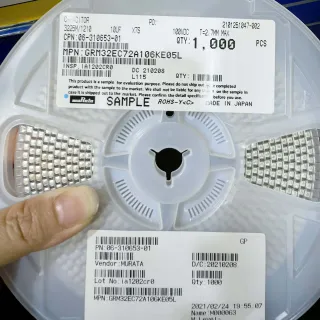
C0805C106K8RACTU - 10uF 10V X7R 0805 MLCC | KEMET
MPN: C0805C106K8RACTU ✓ Active| Qty | Unit Price | Extended |
|---|---|---|
| 1 | $0.1951 | $0.20 |
| 10 | $0.18 | $1.80 |
| 100 | $0.15 | $15.00 |
| 500 | $0.12 | $60.00 |
| 1,000 | $0.1 | $100.00 |
C0805C106K8RACTU Overview
An MLCC is the most widely used capacitor type in modern electronics: alternating layers of ceramic dielectric (here barium-titanate-based Class 2 X7R material) and nickel or precious-metal electrodes are co-fired into a monolithic block, terminated on opposing ends for surface mounting. Within the component hierarchy, the MLCC sits under fixed capacitor, under capacitor, and under passive electronic components. Class 2 dielectrics such as X7R offer high volumetric efficiency at the cost of some capacitance variation with voltage, temperature, and time, in exchange for compact decoupling-grade capacitance.
Key features of this part include 10 uF of capacitance in a compact 2.0 mm x 1.25 mm footprint, an X7R temperature characteristic stable from -55 degrees C to +125 degrees C with a maximum capacitance change of plus or minus 15 percent across that range, and tight plus or minus 10 percent initial tolerance. The C Series construction supports reflow soldering and standard SMT pick-and-place assembly. Typical applications documented by KEMET include decoupling, bypass, filtering, and transient voltage suppression.
Technically, the X7R dielectric provides high dielectric constant (high k), enabling Class 2 MLCCs to reach 10 uF in 0805 without stacking to larger case sizes. Like all X7R parts, its effective capacitance decreases under DC bias, so designers should derate the working voltage relative to the 10 V rating for bias-sensitive circuits such as timing networks; bulk decoupling duties are far more tolerant of this behavior.
Typical use cases include power-rail decoupling for microcontrollers and FPGAs, bypass of analog supply pins on op-amps and data converters, low-pass filter networks in power supplies, and transient voltage suppression at connector entry points in industrial and consumer equipment.
A key design consideration: place this capacitor close to the decoupled IC power pin and account for DC bias derating - at high bias fractions of the 10 V rating, delivered capacitance can fall well below the nominal 10 uF, so verify the effective value with the manufacturer DC bias curves in the KEMET datasheet.
This page adds value beyond the raw datasheet by synthesizing distributor pricing from DigiKey, Mouser, and LCSC, same-package drop-in alternatives, and practical design notes for bias derating and layout.
Drop-in alternatives for C0805C106K8RACTU — same package, pin-to-pin compatible. Different-package parts requiring PCB rework are excluded.
Variants in this series
Same-series models that are drop-in compatible with C0805C106K8RACTU (same form factor and footprint) — differing in Capacitance, Operating Temperature Range, RoHS Status, Termination Style.
Quick Comparison Tool — Select alternative parts for side-by-side comparison:
C0805C106K8PACTU
✅ Drop-In ⚠️ 参数待验证📋 Reference alternative (not in catalog)
C0805C106M8RACTU
✅ Drop-In ⚠️ 参数待验证📋 Reference alternative (not in catalog)
C0805C106J8RACTU
✅ Drop-In ⚠️ 参数待验证📋 Reference alternative (not in catalog)
C0805C106K8RACTU Maximum Ratings & Electrical Characteristics
| Capacitance | 10 uF |
| Capacitance Tolerance | +/-10% |
| Rated Voltage (DC) | 10 V |
| Dielectric | X7R (Class 2) |
| Temperature Coefficient | X7R, +/-15% over -55C to +125C |
| Operating Temperature Range | -55C to +125C |
| Package / Case | 0805 (2012 Metric) |
| Mounting Type | Surface Mount (SMD/SMT) |
| Series | KEMET C Series |
| Termination Style | Pad (SMD terminations) |
| Applications | Decoupling, bypass, filtering, transient voltage suppression |
| Packaging | Tape & Reel (T/R) |
| RoHS Status | unknown |
C0805C106K8RACTU 0805 (2012 metric) Pin Configuration Guide
Pin configuration for C0805C106K8RACTU (0805 (2012 metric) package). Pin numbering, functions, and connection diagrams are defined in the manufacturer datasheet. Refer to it for the exact footprint and soldering guidelines.

No detailed pinout data available for C0805C106K8RACTU.
Refer to the datasheet for full pin configuration.
Typical Applications
C0805C106K8RACTU is suitable for 6 applications: Microcontroller / FPGA Power Decoupling, Analog IC Supply Bypass, DC-DC Converter Output Filtering, Transient Voltage Suppression at Connector Entry, Consumer Electronics Board-Level Decoupling, Industrial Automation Control Boards.
Microcontroller / FPGA Power Decoupling
The C0805C106K8RACTU serves as local decoupling for microcontroller and FPGA supply rails, one of the four applications KEMET documents for the C Series (decoupling, bypass, filtering, transient suppression). Its 10 uF capacitance in a compact 2.0 x 1.25 mm 0805 footprint provides bulk charge storage directly at each VDD pin group, smoothing load-transient currents that upstream regulators cannot respond to quickly. On a 3.3 V rail the DC bias consumes only a third of the 10 V rating, so effective capacitance remains close to nominal. Place one part per power pin cluster with short traces; the X7R dielectric tolerates the wide industrial -55C to +125C ambient range, though a +/-15% temperature coefficient means designers should not rely on the exact 10 uF value for anything beyond decoupling impedance targets.
Recommended
Analog IC Supply Bypass
For op-amps, ADCs, and DACs, the C0805C106K8RACTU provides the 10 uF bulk bypass at analog supply pins while a nearby 100 nF C0G or X7R handles high-frequency content. KEMET lists bypass as a documented application for this part. The X7R dielectric's higher ESR relative to C0G is actually beneficial here, adding natural damping that suppresses resonance between the bypass network and regulator output impedance. On precision analog rails below 5 V, DC bias derating is minimal, so nearly the full nominal 10 uF is delivered. One trade-off: X7R's piezoelectric behavior can couple board vibration into sensitive nodes, so for ultra-low-noise references consider adding a film or tantalum capacitor in parallel rather than relying on the ceramic alone.
Recommended
DC-DC Converter Output Filtering
In point-of-load buck converter outputs, the C0805C106K8RACTU contributes the bulk of output capacitance, setting output ripple and load-transient response. KEMET documents filtering as a typical C Series application. Because the X7R capacitance drops with DC bias, a converter regulating 5 V from a 10 V-rated capacitor should be derated or paralleled - many designs place two of these parts in parallel to achieve the effective capacitance the control loop compensation was designed for. The part's low ESR supports stable loops with modern current-mode controllers, but excessive low ESR combined with long input leads can cause input-rail ringing; a small series resistor or damping capacitor resolves this. Verify the effective capacitance against the DC bias curves in the KEMET specsheet before finalizing loop compensation.
Recommended
Transient Voltage Suppression at Connector Entry
KEMET lists transient voltage suppression among the C Series' typical applications. At connector and cable entry points, the C0805C106K8RACTU absorbs fast, low-energy transients and ESD residual energy, working alongside TVS diodes that clamp the bulk of surge energy. The 10 uF capacitance, while lossy at high frequency compared to smaller capacitors, supplies immediate charge during burst events such as IEC-level ESD contacts on external interfaces. On industrial 24 V-adjacent signals, the 10 V rating limits this part to logic-level or divided-down lines, so apply it after regulation. For harsher environments, choose the flex-terminated C0805C106K8PACTU variant, which resists the mechanical cracking caused by connector insertion forces transmitted through the PCB.
Recommended
Consumer Electronics Board-Level Decoupling
In smartphones, set-top boxes, and IoT devices, the 0805 case size balances placement density and assembly yield: smaller 0603 10 uF parts cost more and crack more easily, while 1206 wastes area. The C0805C106K8RACTU delivers the KEMET-documented decoupling and bypass functions with a tolerance of +/-10% for predictable rail behavior. LCSC pricing from $0.1951 as of 2026-09-05 makes it economical for high-volume consumer BOMs, and availability across DigiKey, Mouser, and LCSC protects against allocation. Designers should note that 3.3 V to 5 V rails bias this 10 V-rated part moderately, preserving usable capacitance, whereas applying it near the full 10 V rating in battery-pack circuits demands derating to the DC bias curve in the official KEMET specsheet.
Recommended
Industrial Automation Control Boards
Industrial PLC I/O and motor-control boards face wide ambient temperatures and mechanical vibration. The C0805C106K8RACTU's -55C to +125C operating range covers industrial requirements, and its X7R dielectric maintains decoupling function across that span within the +/-15% temperature coefficient. KEMET's documented filtering role suits the RC input filtering of analog I/O channels. Because vibration and thermal cycling can crack rigid-termination MLCCs, high-vibration cabinets should favor the flex-terminated C0805C106K8PACTU on the same footprint. The 10 V rating fits the 5 V and 3.3 V logic domains of control boards but not raw 24 V field signals, which need higher-voltage-rated MLCCs or series regulation before local decoupling with this part.
Recommended
Recommended Products Summary
Engineering reference data for C0805C106K8RACTU — comparison, design guidance, and compliance information.
Selection Guide
Comparison with Alternatives
| Parameter | This Product | C0805C106K8PACTU | C0805C106M8RACTU | C0805C106J8RACTU |
|---|---|---|---|---|
| Package | 0805 (2012 Metric) | 0805 (2012 Metric) - same | 0805 (2012 Metric) - same | 0805 (2012 Metric) - same |
| Brand | KEMET | KEMET | KEMET | KEMET |
| Capacitance | 10 uF | 10 uF | 10 uF | 10 uF |
| Capacitance Tolerance | +/-10% | +/-10% | +/-20% | +/-5% |
| Rated Voltage | 10 V | 10 V | 10 V | 10 V |
| Dielectric / Temp Coefficient | X7R | X7R | X7R | X7R |
| Termination | Standard nickel-barrier | Flexible (flex suppression) | Standard nickel-barrier | Standard nickel-barrier |
| Operating Temperature | -55C to +125C | -55C to +125C | -55C to +125C | -55C to +125C |
Key Differentiators
- Tightest tolerance in the C Series 10 uF 0805 family (vs C0805C106M8RACTU)
- Lowest ESR of the same-value family members (vs C0805C106K8PACTU)
- Cost-optimized vs tighter-tolerance variant (vs C0805C106J8RACTU)
Design Notes
DC bias derating is the single most common mistake with 10 uF X7R MLCCs. The 10 uF figure is measured at 0 V bias; under real rail voltage the effective capacitance can drop to a fraction of nominal. For a 5 V rail on this 10 V part, consult the KEMET DC bias curves in the official specsheet and size the number of capacitors based on effective, not nominal, capacitance. This is an estimate-level design consideration, not a datasheet value - the exact derating percentage must be read from the manufacturer curves.
Place the C0805C106K8RACTU within 2-3 mm of the decoupled IC power pin with short, wide traces (0.3 mm width minimum) to minimize loop inductance. Vias to the power plane should be placed immediately adjacent to the pads, not shared as long stubs. The part reflows with standard SAC305 lead-free profiles; the 0805 case tolerates typical pick-and-place handling, but boards subject to flexing near connectors should use the flex-terminated C0805C106K8PACTU on the identical footprint instead.
Do not use this X7R part in timing networks, precision RC filters, or sample-hold circuits: the +/-15% temperature coefficient, DC bias dependence, aging drift, and piezoelectric (microphonic) behavior make it unsuitable where capacitance value accuracy matters. Reserve C0805C106K8RACTU for decoupling, bulk bypass, and suppression roles. For precision analog timing, select a C0G/NP0 dielectric at smaller capacitance or an NPO film capacitor.
Compliance Information
Verified web data retrieved for this page does not state RoHS/REACH/lead-free status; per anti-fabrication rules these are marked unknown. Confirm on the official KEMET specsheet (2016-03-30 publication, per findic.us metadata) before use in regulated products.