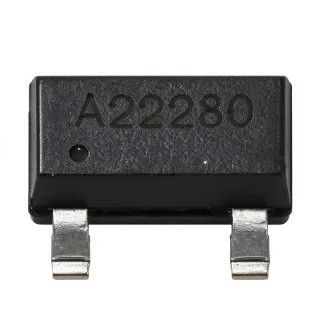
DESD3512SO - 35V CAN Bus ESD Protection Diode | Diodes Inc.
MPN: DESD3512SO ✓ Active| Qty | Unit Price | Extended |
|---|---|---|
| 1 | $0.42 | $0.42 |
| 10 | $0.32 | $3.20 |
| 100 | $0.19 | $19.00 |
| 500 | $0.14 | $70.00 |
| 1,000 | $0.11 | $110.00 |
DESD3512SO Overview
An ESD protection diode (also called a TVS diode or transient voltage suppressor) is a semiconductor device that clamps fast, high-energy voltage transients - electrostatic discharge events, cable surge pulses, and inductive spikes - before they can damage sensitive transceiver ICs. Within the power and signal integrity hierarchy, it sits in the broader family of circuit protection devices alongside varistors, gas discharge tubes, and polymer ESD suppressors, offering the lowest capacitance and fastest response in exchange for finite surge energy ratings.
Key features include qualification to AEC-Q101 with PPAP support, making it suitable for automotive production programs; a bi-directional configuration that clamps both positive and negative transients on asymmetrically driven CAN lines; low leakage current in the standby state; and surge capability of 4A to 11A peak current per the 8/20us waveform. The device protects both CAN_H and CAN_L data lines from a single 3-pin package, saving board space versus two discrete suppressors.
Architecturally, the DESD3512SO integrates two transient voltage clamping structures sharing a common ground reference. When a transient on either data line exceeds the breakdown threshold, the structure avalanches within nanoseconds, diverting surge current to ground and holding the line voltage near the 30V clamping level at rated surge current. Bi-directional behavior ensures negative transients from ground bounce or wiring faults are also clamped.
Typical applications include CAN bus physical layer protection in automotive body control modules, engine management ECUs, and industrial CANopen or DeviceNet networks, where the 35V standoff accommodates the rough voltage environment of 12V and 24V vehicle and factory systems.
For reliable clamping, place the DESD3512SO directly at the CAN connector with short, wide traces to ground, and add a series common-mode choke between the protection stage and the transceiver to coordinate surge sharing.
This page synthesizes distributor pricing, verified datasheet parameters, and practical automotive layout guidance not consolidated in the manufacturer datasheet alone.
Drop-in alternatives for DESD3512SO — same package, pin-to-pin compatible. Different-package parts requiring PCB rework are excluded.
Quick Comparison Tool — Select alternative parts for side-by-side comparison:
No drop-in alternatives available for this product.
Request AlternativesDESD3512SO Maximum Ratings & Electrical Characteristics
| Product Type | CAN Bus ESD Protection Diode (TVS) |
| Configuration | Bi-directional, 2 data lines protected |
| Working Standoff Voltage | 35 V |
| Minimum Breakdown Voltage | 13.6 V |
| Breakdown Voltage (max rated point per distributor listing) | 60 V |
| Clamping Voltage | 30 V at 4 A (8/20 us) |
| Peak Pulse Current (8/20 us) | 4 A (per line), 11 A (combined rating per distributor listing) |
| Peak Pulse Power | 330 W |
| Package | SOT-23-3 |
| Mounting Type | Surface Mount |
| Number of Elements | 2 |
| Polarity | Bi-directional |
| Qualification | AEC-Q101 qualified, PPAP supported |
| Application | CAN bus ESD and surge protection (automotive) |
DESD3512SO Pin Configuration
| Pin 1 | I/O1 (CAN_L) — First protected data line - bi-directional TVS element 1 anode/cathode |
| Pin 2 | GND — Common ground return for both TVS elements |
| Pin 3 | I/O2 (CAN_H) — Second protected data line - bi-directional TVS element 2 anode/cathode |
Typical Applications
DESD3512SO is suitable for 6 applications: Automotive CAN Bus Node Protection, Industrial CANopen / DeviceNet Networks, ESD Hardening of Externally Accessible Connectors, Gate Driver and Motor Control Communication Links, Telematics and Fleet Tracking Units, Agricultural and Off-Highway Vehicle Electronics.
Automotive CAN Bus Node Protection
The DESD3512SO was purpose-built to protect the CAN_H and CAN_L data lines of automotive Controller Area Network segments. Its AEC-Q101 qualification and PPAP support satisfy automotive quality gates, while the 35V standoff voltage tolerates the elevated transients found on 12V vehicle wiring harnesses, including inductive kick from motors and solenoids sharing the loom. Mounted directly at the ECU CAN connector with short ground returns, the device avalanches in nanoseconds and clamps cable-coupled ESD and surge events at 30V at 4A (8/20us), keeping the transceiver input structure well below its absolute maximum ratings. Its 330W peak pulse power rating absorbs energy from coupling and discharge events that smaller suppressors cannot, and the single SOT-23-3 footprint protects both lines, minimizing board area in dense body-control and powertrain modules.
Recommended
Industrial CANopen / DeviceNet Networks
In factory automation, the 24V industrial bus environment exposes CANopen and DeviceNet nodes to longer cable runs and higher coupled surge energy than automotive buses. The DESD3512SO's 35V standoff provides comfortable headroom above the 24V system level, and its 330W peak pulse power rating handles the discharge energy typical of long trunk cabling running through electrically noisy cabinets. Because the device clamps bi-directionally, it also suppresses negative-going transients caused by ground potential differences between network nodes - a common failure mode in distributed I/O installations. Placement at each node's CAN connector, combined with a series common-mode choke, gives a layered defense: the TVS diverts bulk surge current to ground while the choke blocks residual high-frequency content from reaching the transceiver inputs of PLC and motion-control nodes.
Recommended
ESD Hardening of Externally Accessible Connectors
Any data line leaving the PCB enclosure - service connectors, diagnostic ports, daisy-chained sensor buses - is exposed to human-body ESD events during assembly, service, and end-user contact. The DESD3512SO responds to ESD strikes within nanoseconds, clamping both positive and negative pulses bi-directionally, making it a robust first line of defense at connector entry points beyond CAN itself. Its 13.6V minimum breakdown ensures the clamp engages below the damage thresholds of typical 3.3V and 5V transceiver inputs once series impedance is present, while the SOT-23-3 footprint allows placement within millimeters of the connector pins - critical, because trace inductance between the suppressor and the strike point degrades clamping effectiveness substantially at ESD rise times. Two protected lines per package also halve the BOM position count versus discrete solutions.
Recommended
Gate Driver and Motor Control Communication Links
Motor drive systems frequently run CAN between the main controller and gate-driver or inverter boards across environments saturated with dv/dt and di/dt events from power switching. Isolated gate driver boards benefit from the DESD3512SO at the CAN entry because its 330W surge rating absorbs the energy coupled into communication wiring by bridge-leg switching, and its bi-directional clamping handles the ringing of both polarities typical of high-side switching events. The 35V standoff rides through supply-pump-induced common-mode excursions without conducting, preventing premature clamp wear. Layout-wise, placing the device at the connector with a solid, low-inductance ground connection to the board's signal reference ensures surge current bypasses the transceiver, preserving the integrity of PWM command and feedback messages on the bus.
Recommended
Telematics and Fleet Tracking Units
Telematics gateways tap the vehicle CAN bus while also exposing antennas, SIM interfaces, and diagnostic connectors to the outside world, creating a high-transient environment concentrated in a small enclosure. The DESD3512SO protects the CAN-tap inputs of the gateway: its AEC-Q101 qualification meets the automotive component requirement of telematics Tier-1 specifications, and its 35V standoff survives jump-start and charging-system fault transients that commonly reach 24V and above on 12V vehicles. The device's nanosecond response time addresses the sub-nanosecond rise of direct ESD strikes to exposed service connectors, while the 330W rating absorbs the coupled energy of nearby inductive events. Because telematics PCBs are typically compact, the single SOT-23-3 package protecting both CAN lines is a decisive board-area advantage.
Recommended
Agricultural and Off-Highway Vehicle Electronics
Tractors, harvesters, and construction equipment use CAN-based ISOBUS networks operating in arguably the harshest electrical environment of any volume application: 12V and 24V mixed systems, long harnesses routed near high-current actuators, and frequent connection/disconnection of implements that generates cable-discharge and inductive transients. The DESD3512SO's 35V standoff and 330W peak pulse power rating are well matched to these events, and the AEC-Q101/PPAP qualification path simplifies supplier approval for off-highway OEMs that commonly adopt automotive specifications. Mounted at each ISOBUS connector, with the clamping held at 30V at 4A (8/20us), the device keeps implement-controller transceivers within their rated input range. Its bi-directional behavior also absorbs negative ground-shift transients that occur when equipment chassis potentials differ during implement hitching.
Recommended
Recommended Products Summary
Engineering reference data for DESD3512SO — comparison, design guidance, and compliance information.
Selection Guide
Comparison with Alternatives
| Parameter | This Product | PESD1CAN | NUP2105L | ESDCAN02-2BXY |
|---|---|---|---|---|
| Package | SOT-23-3 | SOT-23 - same footprint class | SOT-23 - same footprint class | SOT-23 - same footprint class |
| Brand | Diodes Incorporated | Nexperia | onsemi | STMicroelectronics |
| Lines Protected | 2 (CAN_H + CAN_L) | 2 | 2 | 2 |
Key Differentiators
- Purpose-built CAN protection with automotive qualification (vs Generic 2-line SOT-23 TVS)
- Higher standoff headroom than many CAN suppressors (vs PESD1CAN)
- Two lines protected in one SOT-23-3 footprint (vs Single-line SOD-523 TVS diodes)
Design Notes
Place the DESD3512SO within a few millimeters of the CAN connector, ahead of any common-mode choke or series resistance, with a short, wide ground trace directly to the connector's ground return pin. At ESD rise times, every nanohenry of trace inductance between the strike point and the TVS adds L*di/dt voltage overshoot that degrades clamping. Estimated: 10 nH of series inductance with an 8/20us surge rising to 4A in ~8 us contributes only modest overshoot, but a 1 ns ESD edge through the same inductance can add tens of volts - hence placement dominates.
Coordinate the TVS with series impedance so the DESD3512SO absorbs the bulk of surge energy. A common-mode choke (recommended: typical automotive CAN values of 51 uH dual-winding) placed AFTER the TVS presents high impedance to the residual transient and forces surge current into the suppressor rather than the transceiver. Estimated: with the 330W / 8/20us rating, a single event at full rating is within capability, but repeated nearby strikes argue for derating to 50-70% of the rated surge current in high-exposure installations such as off-highway vehicles.
Do not use the DESD3512SO on rails or lines that can sit above the 35V standoff for extended periods - continuous conduction above breakdown (13.6V minimum) will overheat the device. Remember it is bi-directional: unlike unidirectional TVS parts, it will not clamp negative ringing about ground to a diode drop, which is correct behavior for CAN but wrong for unipolar signals. Confirm junction capacitance from the manufacturer datasheet if using on CAN-FD at 5 Mbps, where bus loading budget is tighter than classic 500 kbps CAN.
Compliance Information
AEC-Q101 qualified (discrete semiconductor automotive standard) with PPAP support per Diodes Incorporated datasheet. RoHS and lead-free status inferred from Diodes Incorporated current-production portfolio and distributor listings for the -7 ordering code; REACH, halogen-free, and conflict-minerals status not stated in retrieved data.