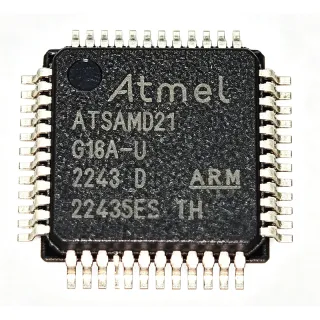
DSPIC33CK64MP206-I/PT - 100MHz 16-bit DSC 64KB Flash | Microchip
MPN: DSPIC33CK64MP206-I/PT ✓ Active| Qty | Unit Price | Extended |
|---|---|---|
| 1 | $6.42 | $6.42 |
| 10 | $5.78 | $57.80 |
| 100 | $5.15 | $515.00 |
| 500 | $4.62 | $2,310.00 |
| 1,000 | $4.18 | $4,180.00 |
DSPIC33CK64MP206-I/PT Overview
A digital signal controller combines the compute throughput of a DSP with the peripheral integration and interrupt responsiveness of a microcontroller. Within the power-management hierarchy, the dsPIC33CK family sits at the intersection of MCUs and dedicated digital-power ASICs: it executes control-loop firmware (PI, PR, predictive controllers) at switching frequencies from tens of kHz to over 1 MHz while simultaneously managing communications, sequencing and fault handling in one chip.
Key features include the 100 MHz (100 MIPS) modified-Harvard dsPIC33CK core with DSP instruction extensions, dual partition Flash supporting live update, high-resolution PWM with sub-nanosecond effective resolution for buck, boost, totem-pole PFC and LLC topologies, CAN FD for automotive and industrial networks, and 12-bit ADCs feeding the on-chip analog front end (3 op-amps, 3 comparators, PTG) that closes control loops without external signal-conditioning ICs.
Architecturally, the single-core dsPIC33CK deterministic interrupt latency and hardware DSP MAC unit allow fixed-point current/voltage loops to run at loop rates well above the audible and control bandwidths required by digital power supplies, motor drives (FOC for PMSM/BLDC) and power-factor-correction stages.
Typical applications include digital SMPS and LLC power supplies, PMSM/BLDC motor control with sensorless FOC, solar micro-inverters and DC-DC converters, and industrial sensing nodes that benefit from CAN FD connectivity.
Design consideration: budget the analog front-end (op-amp bandwidth, comparator propagation delay) against your target switching frequency, and use the dual-partition Flash live-update mechanism carefully so bootloader and control firmware never execute from the partition being programmed.
This page synthesizes distributor availability data, drop-in family alternatives, and practical design notes not found in the manufacturer datasheet.
Drop-in alternatives for DSPIC33CK64MP206-I/PT — same package, pin-to-pin compatible. Different-package parts requiring PCB rework are excluded.
Variants in this series
Same-series models that are drop-in compatible with DSPIC33CK64MP206-I/PT (same form factor and footprint) — differing in Package, Operating Temperature, PWM, CAN Interface, Program Memory (Flash).
Quick Comparison Tool — Select alternative parts for side-by-side comparison:
DSPIC33CK512MP606T-I/PT
✅ Drop-In ⚠️ Specs Unverified✓ In Stock
$4.86 / Unit
View Datasheet →DSPIC33CK512MP305-I/PT
✅ Drop-In ⚠️ Specs Unverified✓ In Stock
$4.36 / Unit
View Datasheet →DSPIC33CK256MP205-I/PT
✅ Drop-In ⚠️ Specs Unverified✓ In Stock
$3.55 / Unit
View Datasheet →DSPIC33CH64MP506T-I/PT
✅ Drop-In ⚠️ Specs Unverified✓ In Stock
$2.74 / Unit
View Datasheet →DSPIC33CH512MP206-I/PT
✅ Drop-In ⚠️ Specs Unverified✓ In Stock
$7.8 / Unit
View Datasheet →DSPIC33CK64MP206-I/PT Maximum Ratings & Electrical Characteristics
| Core Architecture | 16-bit dsPIC33CK modified Harvard, single core |
| Maximum CPU Speed | 100 MHz (100 MIPS) |
| Program Memory (Flash) | 64 KB with ECC and dual-partition live update |
| Data RAM | 8 KB SRAM |
| Operating Voltage | 3.0 V to 3.6 V |
| Operating Temperature | -40C to +85C (I suffix) |
| Package | 64-pin TQFP (10x10 mm), PT suffix |
| Mounting Type | Surface Mount |
| On-chip Operational Amplifiers | 3 |
| On-chip Comparators | 3 |
| PWM | High-Resolution PWM (sub-ns effective resolution) |
| CAN | CAN Flexible Data (CAN FD) |
| PTG | Programmable Trigger Generator included |
| Functional Safety | FuSa-supported variant family (per DigiKey listing) |
| Typical Applications | Digital power, motor control, advanced sensing and control |
DSPIC33CK64MP206-I/PT 64-pin tqfp (10x10 mm), pt suffix Pin Configuration Guide
Pin configuration for DSPIC33CK64MP206-I/PT (64-pin tqfp (10x10 mm), pt suffix package). This digital IC includes GPIO, communication interfaces (UART, SPI, I2C), and power pins. Refer to the manufacturer datasheet for alternate pin functions and configuration options. Essential for embedded system design and PCB layout.

No detailed pinout data available for DSPIC33CK64MP206-I/PT.
Refer to the datasheet for full pin configuration.
Typical Applications
DSPIC33CK64MP206-I/PT is suitable for 6 applications: Digital Switch-Mode Power Supplies (SMPS), PMSM / BLDC Motor Control (Sensorless FOC), Solar Micro-inverters and DC-DC Power Conversion, Industrial Sensing and Control Nodes, Automotive and Functional Safety Subsystems, Wireless-Charging and LLC Resonant Converters.
Digital Switch-Mode Power Supplies (SMPS)
The DSPIC33CK64MP206-I/PT closes voltage and current control loops digitally in buck, boost, LLC and totem-pole PFC converters. Its high-resolution PWM provides sub-nanosecond effective pulse-width resolution, which directly reduces output ripple and jitter at switching frequencies of several hundred kHz where coarse PWM resolution would otherwise limit regulation accuracy. The 100 MHz core executes PI or predictive control laws deterministically, while the 3 on-chip op-amps amplify shunt or divider feedback signals and the 3 comparators implement hardware overcurrent trip with no software latency. The 64KB Flash holds the control firmware, compensation tables and a bootloader in one chip, and CAN FD or UART links report telemetry to a system host. Compared with an analog controller, firmware-based nonlinear control and adaptive dead-time become possible without changing hardware.
Recommended
PMSM / BLDC Motor Control (Sensorless FOC)
For three-phase PMSM and BLDC drives, the DSPIC33CK64MP206-I/PT runs sensorless field-oriented control entirely on-chip. The 100 MIPS DSP core with hardware MAC executes the Clarke/Park transforms and current-loop PI regulators fast enough for servo-grade bandwidth, while the high-resolution PWM drives the inverter with fine duty steps that reduce torque ripple and acoustic noise. On-chip op-amps condition low-side shunt currents and the comparators trigger cycle-by-cycle overcurrent limiting in hardware, protecting MOSFETs faster than any interrupt service routine. The 64-pin TQFP exposes enough PWM, ADC and communication pins for a complete drive plus encoder or CAN FD interface. Sensorless observers (SMO, MRAS, HFI) fit comfortably within the 8KB RAM, making this DSC a single-chip motor control solution for industrial drives, pumps and fans.
Recommended
Solar Micro-inverters and DC-DC Power Conversion
Micro-inverters and high-voltage DC-DC stages demand simultaneous MPPT, grid-synchronized current shaping and safety compliance - workloads the DSPIC33CK64MP206-I/PT handles on one chip. The 100 MHz core performs MPPT algorithms and references the current loop each switching cycle, the high-resolution PWM generates precisely timed complementary gate signals for interleaved boost and unfolder stages, and the integrated analog front end measures panel voltage/current and grid waveforms through the on-chip op-amps without external amplifiers. Comparators provide hardware-level anti-islanding and overcurrent protection paths independent of firmware timing. The 3.0V-3.6V industrial temperature rating and ECC-protected Flash support long-term field reliability, and a CAN FD or UART link exports performance data, enabling fleet monitoring with minimal additional circuitry.
Recommended
Industrial Sensing and Control Nodes
In factory automation, the DSPIC33CK64MP206-I/PT serves as an intelligent sensing and control node combining analog acquisition, local decision-making and networked reporting. The 3 on-chip op-amps amplify bridge and shunt sensor signals, the 12-bit ADCs digitize multiple channels, and the DSP core applies filtering and spectral analysis using its MAC instructions - all without an external analog chain. CAN FD connectivity integrates the node into industrial fieldbus systems at data rates far above classical CAN, while the PTG (Programmable Trigger Generator) sequences ADC sampling autonomously from the CPU, guaranteeing jitter-free measurement timing. The -40C to +85C industrial rating covers unconditioned cabinets and machinery interiors. One 64-pin TQFP replaces what would otherwise require an MCU, an analog front-end IC and a CAN transceiver controller.
Recommended
Automotive and Functional Safety Subsystems
The dsPIC33CK family is positioned by Microchip for automotive and functional-safety (FuSa) segments, and DigiKey classifies this part within the FuSa-supported dsPIC33 product group. In 12V/48V automotive subsystems - auxiliary inverters, on-board charger stages, blower and pump motor drives - the DSPIC33CK64MP206-I/PT provides deterministic control with hardware safety primitives: comparator-based overcurrent trips, ECC on Flash and MBIST-capable RAM across the family. CAN FD matches modern in-vehicle network requirements for higher payload and bandwidth than classical CAN. Designers targeting formal ASIL-classified end products should consult Microchip's functional-safety documentation and may consider dedicated FuSa package variants; the standard -I industrial part suits non-ASIL automotive-adjacent and off-highway equipment where CAN FD and robust control are the primary needs.
Recommended
Wireless-Charging and LLC Resonant Converters
LLC resonant converters and wireless power transmitters require precise, low-jitter frequency and phase control - strengths of the DSPIC33CK64MP206-I/PT's high-resolution PWM, which adjusts effective frequency and phase-shift in sub-nanosecond steps to hold resonant-tank operation at optimal efficiency. The 100 MHz core runs the frequency-tracking control loop each cycle, the op-amps sense tank currents through shunts, and comparators enforce hardware protection against operate-above-resonance faults and foreign-object detection events in wireless power systems. The 64KB Flash stores efficiency maps and adaptive tuning tables; the 8KB RAM holds streaming sample buffers for resonant-current analysis. Because all loop-closing functions are integrated, a complete resonant controller fits in one 64-pin TQFP, simplifying layout of the sensitive analog front end near the switching stage.
Recommended
Recommended Products Summary
Engineering reference data for DSPIC33CK64MP206-I/PT — comparison, design guidance, and compliance information.
Selection Guide
Comparison with Alternatives
| Parameter | This Product | DSPIC33CK512MP606T-I/PT | DSPIC33CK512MP305-I/PT | DSPIC33CK256MP205-I/PT | DSPIC33CH64MP506T-I/PT | DSPIC33CH512MP206-I/PT |
|---|---|---|---|---|---|---|
| Package | 64-TQFP (10x10 mm) | 64-TQFP (10x10 mm) - same | 64-TQFP (10x10 mm) - same | 64-TQFP (10x10 mm) - same | 64-TQFP (10x10 mm) - same | 64-TQFP (10x10 mm) - same |
| Brand | Microchip Technology | Microchip Technology | Microchip Technology | Microchip Technology | Microchip Technology | Microchip Technology |
| Core | Single-core 16-bit dsPIC33CK, 100 MHz | Single-core dsPIC33CK, 100 MHz | Single-core dsPIC33CK, 100 MHz | Single-core dsPIC33CK, 100 MHz | Dual-core dsPIC33CH, 100 MHz master | Dual-core dsPIC33CH, 100 MHz master |
| Flash Memory | 64 KB | 512 KB | 512 KB | 256 KB | 64 KB | 512 KB |
| High-Resolution PWM | Yes | Yes | Yes | Yes | Yes | Yes |
| CAN FD | Yes | Yes | Yes | Yes | Yes | Yes |
| Operating Temperature | -40C to +85C (I) | -40C to +85C (I) | -40C to +85C (I) | -40C to +85C (I) | -40C to +85C (I) | -40C to +85C (I) |
Key Differentiators
- Lowest cost of the 64-pin TQFP dsPIC33CK MP family for code sizes under ~50KB (vs DSPIC33CK512MP606T-I/PT)
- Integrated analog front end vs MC-variant siblings (vs DSPIC33CK64MC105T-I/M4)
- Simpler single-core firmware model (vs DSPIC33CH512MP206-I/PT)
- Trade-off: only 8KB RAM (vs DSPIC33CK512MP606T-I/PT)
Design Notes
Supply the DSPIC33CK64MP206-I/PT from a clean 3.0-3.6V rail with one 0.1uF ceramic capacitor per VDD/VSS pair placed within 2-3 mm of the pins, plus at least one bulk 4.7-10uF capacitor near the device. In digital-power boards where the DSC sits next to a switching stage, separate the analog supply (AVDD) with an RC or ferrite filter so PWM switching noise does not degrade the on-chip op-amp and ADC accuracy. Estimate: at roughly 100 MIPS activity, core current is in the tens of mA range - verify exact figures against the manufacturer datasheet electrical characteristics table before finalizing regulator sizing.
The 64-TQFP (10x10 mm, 0.5 mm pitch) footprint should use the manufacturer-recommended land pattern; keep the PWM output traces to gate drivers short and, for half-bridge topologies, route complementary outputs with matched lengths to minimize dead-time asymmetry. Keep the analog front-end (op-amp inputs, comparator inputs) physically away from PWM and gate-drive traces and reference them to a quiet analog ground island joined to digital ground at a single point. Place shunt-sense filtering (RC at the op-amp inputs) close to the device per Microchip's digital-power reference designs.
Do not treat family alternates as free swaps: MP206 vs MP305 vs MP205 variants differ in peripheral-to-pin mapping and analog integration even though the 64-TQFP footprint is identical - always re-run the pin-mapping check in MPLAB Code Configurator before swapping. Second, the /PT device ships in a tray; confirm the MSL rating and bake requirements before reflow. Third, dual-partition live update requires the linker and bootloader to be configured for the correct partition - a misconfigured live-update build can brick the control loop in the field.
Compliance Information
Compliance status not stated in the provided verified web data; confirm RoHS/REACH status on the Microchip product page or distributor compliance documents before procurement.