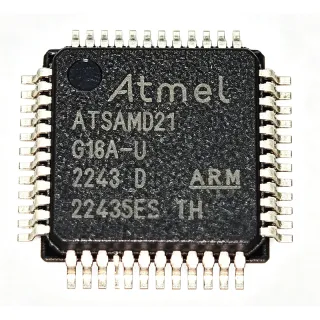
DSPIC33EP128GM304-E/PT - 16-bit 60 MIPS DSC 128KB Flash | Microchip
MPN: DSPIC33EP128GM304-E/PT ✓ Active| Qty | Unit Price | Extended |
|---|---|---|
| 1 | $6.2 | $6.20 |
| 10 | $5.65 | $56.50 |
| 100 | $5.05 | $505.00 |
| 500 | $4.6 | $2,300.00 |
| 1,000 | $4.25 | $4,250.00 |
DSPIC33EP128GM304-E/PT Overview
A digital signal controller combines the compute throughput of a digital signal processor with the peripheral integration and deterministic control of a microcontroller. Within the power-management hierarchy of embedded systems, the DSC sits between general-purpose MCUs and standalone DSPs, making it the preferred device class for closed-loop control loops such as field-oriented motor control, digital power conversion, and sensor signal conditioning.
Key features of this device include twelve Motor Control PWM (MCPWM) channels for three-phase inverter drives, 8 input capture and 8 output compare channels, two quadrature encoder interfaces (QEI) for position feedback, and four integrated operational amplifiers that offload analog front-end gain stages from external components.
On the technical side, the dsPIC33E core supports DSP instructions including barrel shifting, modulo addressing, and dual-fetch MAC operations, plus four DMA channels and five external interrupt sources for responsive real-time behavior. The Charge Time Measurement Unit (CTMU) enables capacitive touch and precision time measurement, while the Programmable Peripheral Generator (PTG) automates simple trigger sequences without CPU intervention. The device operates from a single 3.3V supply in CMOS technology.
Typical applications include brushless DC and permanent-magnet synchronous motor drives, solar inverters and digital power supplies, and industrial sensing nodes where the on-chip op-amps condition signals from shunts and sensors before the internal ADC samples them.
A key design consideration: the 44-TQFP package requires a solid ground plane and 0.1uF decoupling on each VDD pin to keep the analog op-amps quiet; also verify PGECx/PGEDx pairs are routed together for ICSP programming.
This page synthesizes distributor pricing, same-family drop-in alternatives, and practical design notes not found in the manufacturer datasheet.
Drop-in alternatives for DSPIC33EP128GM304-E/PT — same package, pin-to-pin compatible. Different-package parts requiring PCB rework are excluded.
Variants in this series
Same-series models that are drop-in compatible with DSPIC33EP128GM304-E/PT (same form factor and footprint) — differing in Package, Programming Interface, Operating Temperature, Core, Max CPU Speed.
Quick Comparison Tool — Select alternative parts for side-by-side comparison:
DSPIC33EP128GM304-I/PT
✅ Drop-In✓ In Stock
$4.2 / Unit
View Datasheet →DSPIC33EP256GM304-E/PT
✅ Drop-In ⚠️ Specs Unverified✓ In Stock
$5.39 / Unit
View Datasheet →DSPIC33EP64GM304-E/PT
✅ Drop-In ⚠️ Specs Unverified📋 Reference alternative (not in catalog)
DSPIC33EP128GM304-E/PT Maximum Ratings & Electrical Characteristics
| Core Architecture | 16-bit dsPIC33E DSC (Harvard) |
| Maximum Clock / Performance | 60 MHz / 60 MIPS |
| Program Memory (Flash) | 128 KB (43K x 24 instructions) |
| Data SRAM | 16 KB |
| Supply Voltage | 3.3 V |
| Package | 44-TQFP (10x10 mm), 0.8 mm pitch |
| Operating Temperature | -40C to +125C (E grade) |
| Motor Control PWM Channels | 12 |
| Input Capture / Output Compare | 8 / 8 |
| Quadrature Encoder Interfaces | 2 |
| On-chip Operational Amplifiers | 4 |
| Charge Time Measurement Unit (CTMU) | Yes |
| Programmable Trigger Generator (PTG) | Yes |
| DMA Channels | 4 |
| External Interrupts | 5 |
| Programming Interface | ICSP via PGECx/PGEDx pairs |
| Mounting Type | Surface Mount |
| Packaging | Tray |
DSPIC33EP128GM304-E/PT 44-tqfp (10x10 mm), 0.8 mm pitch Pin Configuration Guide
Pin configuration for DSPIC33EP128GM304-E/PT (44-tqfp (10x10 mm), 0.8 mm pitch package). This digital IC includes GPIO, communication interfaces (UART, SPI, I2C), and power pins. Refer to the manufacturer datasheet for alternate pin functions and configuration options. Essential for embedded system design and PCB layout.

No detailed pinout data available for DSPIC33EP128GM304-E/PT.
Refer to the datasheet for full pin configuration.
Typical Applications
DSPIC33EP128GM304-E/PT is suitable for 6 applications: Brushless DC / PMSM Motor Drives, Digital Power Conversion (Solar Inverters, LLC, PFC), Industrial Sensing and Signal Conditioning Nodes, Robotics and Motion Control, Electric Vehicle Auxiliary Systems, Test, Measurement and Instrumentation.
Brushless DC / PMSM Motor Drives
The DSPIC33EP128GM304-E/PT is architected for precision motor control: its 12 MCPWM channels generate center-aligned, complementary outputs with hardware dead-time insertion for a three-phase inverter, while the 2 quadrature encoder interfaces decode encoder feedback for FOC position estimation. The 4 on-chip op-amps amplify shunt-resistor phase currents before ADC sampling, eliminating external amplifier ICs and reducing analog offset errors. Running FOC loops at up to 60 MIPS, the DSC closes current loops in the tens of microseconds regime. The -40C to +125C rating suits industrial drives in sealed enclosures. Design consideration: route PWM outputs away from analog op-amp inputs and use the fault inputs for hardware overcurrent shutdown.
Recommended
Digital Power Conversion (Solar Inverters, LLC, PFC)
In solar micro-inverters, PFC stages, and LLC resonant converters, the DSPIC33EP128GM304-E/PT provides the deterministic PWM resolution and fast interrupt latency needed for peak-current-mode and voltage-mode digital control. The high-resolution MCPWM outputs support constant-current/constant-voltage charging profiles, and the ADC triggers directly from PWM events for cycle-by-cycle current sampling synchronized to the switching instant. The CTMU can assist with precise timing measurements for zero-crossing detection. At 60 MIPS, one DSC can run PFC plus a DC-DC stage concurrently. Use the 128KB Flash for MPPT algorithms, communication stacks, and protection state machines without external memory. The extended temperature range tolerates converter enclosures that regularly exceed 85C ambient.
Recommended
Industrial Sensing and Signal Conditioning Nodes
The integrated 4 operational amplifiers and CTMU let this DSC build complete analog front ends: op-amps provide programmable gain for strain gauges, thermistors, and current shunts, while the CTMU measures capacitance and precise time intervals for capacitive touch or ultrasonic time-of-flight sensing. The PTG automates trigger sequences, freeing CPU cycles for filtering and communication. The -40C to +125C operating range supports nodes mounted inside motors, pumps, and outdoor cabinets. The 16KB RAM buffers waveform captures for diagnostics, and 5 external interrupt pins capture event timestamps. Design note: place RC anti-alias filters at the op-amp inputs and exploit the boundary-scan capability for production test on dense boards.
Recommended
Robotics and Motion Control
Multi-axis robotic joints and CNC-class motion stages benefit from the 2 QEI modules reading two encoders simultaneously and the 12 PWM channels driving two inverter legs or multiple servo channels from one controller. The 60 MIPS DSP engine executes cascaded position/velocity/current loops per axis with scheduling headroom for trajectory planning and fieldbus stacks. Four DMA channels move ADC samples to RAM without CPU intervention, keeping control-loop jitter minimal. The -40C to +125C grade suits joints near heat-generating motors. Use one PGECx/PGEDx pair routed to a production programming header for in-field firmware updates of motion profiles and safety parameters via ICSP or a bootloader.
Recommended
Electric Vehicle Auxiliary Systems
Auxiliary EV systems - coolant pumps, HVAC blowers, window-lift and seat motors, and small onboard chargers - need automotive-adjacent temperature tolerance and robust PWM control without main-domain processor cost. The DSPIC33EP128GM304-E/PT's -40C to +125C rating and 12-channel MCPWM make it a compact motor controller for 12V auxiliary drives, with 2 QEI ports reading position sensors and the op-amps conditioning current feedback for torque limiting. Note this specific part is not AEC-Q100 qualified; select Microchip's automotive-qualified dsPIC33EP variants where formal automotive qualification and PPAP documentation are contractually required. For non-safety auxiliary loads, the extended temperature grade is commonly accepted by tier suppliers.
Recommended
Test, Measurement and Instrumentation
Bench instruments, programmable loads, and sensor simulators use the DSPIC33EP128GM304-E/PT's fast capture/compare peripherals and DSP MAC instructions for waveform generation, DDS-style signal synthesis, and real-time FFT-based analysis. The 8 input-capture channels timestamp events with high resolution, and 8 output-compare channels generate synchronized pulses for stimulus. The barrel shifter and modulo addressing accelerate block-processing algorithms, while 16KB SRAM holds acquisition buffers. Boundary-scan support aids board-level test during production. The extended temperature range allows portable instruments used outdoors or next to power electronics. Recommend dedicating one DMA channel to continuous ADC sampling and implementing an overshoot-protected front end feeding the on-chip op-amps.
Recommended
Recommended Products Summary
Engineering reference data for DSPIC33EP128GM304-E/PT — comparison, design guidance, and compliance information.
Selection Guide
Comparison with Alternatives
| Parameter | This Product | DSPIC33EP128GM304-I/PT | DSPIC33EP256GM304-E/PT | DSPIC33EP64GM304-E/PT |
|---|---|---|---|---|
| Package | 44-TQFP (10x10 mm), 0.8 mm pitch | 44-TQFP (10x10 mm) - same | 44-TQFP (10x10 mm) - same | 44-TQFP (10x10 mm) - same |
| Brand | Microchip Technology | Microchip Technology | Microchip Technology | Microchip Technology |
| Flash Program Memory | 128 KB (43K x 24) | 128 KB (43K x 24) | 256 KB | 64 KB |
| Performance | 60 MIPS | 60 MIPS | 60 MIPS | 60 MIPS |
| Operating Temperature | -40C to +125C (E grade) | -40C to +85C (I grade) | -40C to +125C (E grade) | -40C to +125C (E grade) |
| Peripherals (MCPWM / IC / OC / QEI / OpAmps) | 12 / 8 / 8 / 2 / 4 | 12 / 8 / 8 / 2 / 4 - identical | 12 / 8 / 8 / 2 / 4 - identical | 12 / 8 / 8 / 2 / 4 - identical |
| Supply Voltage | 3.3 V | 3.3 V | 3.3 V | 3.3 V |
Key Differentiators
- Extended -40C to +125C temperature rating at standard-volume price (vs DSPIC33EP128GM304-I/PT)
- Twelve MCPWM channels with hardware dead-time and fault shutdown (vs DSPIC33EP64GM304-E/PT)
- Four integrated op-amps reduce external BOM (vs Generic 16-bit MCUs at similar price)
Design Notes
Power the device from a clean 3.3V rail with 0.1uF ceramic decoupling at every VDD pin pair plus one bulk 4.7uF-10uF capacitor near the supply entry. dsPIC33E cores draw transient current spikes at 60 MIPS that can cause brown-out resets on long, thin power traces. Enable the internal brown-out reset (BOR) in configuration words and add a 10uF reservoir on VDDCORE per the manufacturer datasheet layout guidance. Estimated: at 60 mA typical operating current, keep trace resistance under 50 milliohms to limit rail droop to 3 mV.
For ICSP programming, route each PGECx/PGEDx pair as a matched, short pair to a standard 5-pin programming header; any pair may be used but ICSPCLK and ICSPDAT must come from the same pair (per Northern Software dsPIC33EP128GM304 notes). Keep the pair away from PWM and motor-phase nodes to prevent programming failures from coupled noise. Place a 4.7k-10k pull-up and 100 ohm series resistor on MCLR for robust in-circuit programming.
The 4 on-chip op-amps share the device supply, so their CMRR depends on quiet analog grounding. Use a single solid ground plane rather than split planes, keep shunt sensing traces Kelvin-routed directly to the op-amp input pins, and place RC anti-alias filters (e.g., 1k + 1nF) within 5 mm of the ADC input pins. Estimated: a 1k/1nF filter gives a 159 kHz corner, comfortably above typical motor-control sampling bandwidths of 10-20 kHz while suppressing switching noise.
The 44-TQFP 10x10 mm package with the -E grade supports operation up to +125C ambient/junction per its rating. Estimated: at 60 mA from 3.3V, dissipation is approximately 0.2 W; with a typical TQFP-44 theta_JA of about 60-70 C/W on a standard 4-layer board, junction rise is roughly 12-14 C above ambient - ample margin for sealed industrial drives. Validate with your own stackup for boards with heavy copper or restricted airflow.
Compliance Information
RoHS-compliant lead-free matte-tin TQFP per standard Microchip active-product policy; -E temperature grade is not AEC-Q100 qualified - use Microchip automotive-qualified dsPIC33EP variants where required.