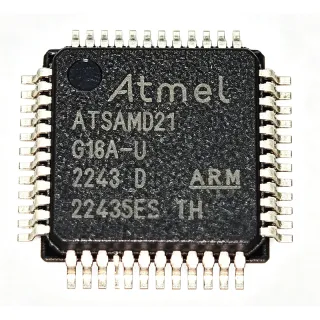
DSPIC33EP128GP504T-I/MV - 16-bit DSC 70 MIPS 128KB UQFN-48 | Microchip
MPN: DSPIC33EP128GP504T-I/MV ✓ Active| Qty | Unit Price | Extended |
|---|---|---|
| 1 | $5.42 | $5.42 |
| 10 | $4.95 | $49.50 |
| 100 | $4.38 | $438.00 |
| 500 | $3.98 | $1,990.00 |
| 1,000 | $3.62 | $3,620.00 |
DSPIC33EP128GP504T-I/MV Overview
A Digital Signal Controller combines the deterministic control of a microcontroller with the mathematical throughput of a DSP. In the power-management hierarchy of an embedded system, the DSC sits above a basic MCU and below a full application processor: it executes real-time control loops (PID, field-oriented control, power-factor correction) while also performing FIR/IIR filtering and fast Fourier transforms on ADC data streams. The dsPIC33EP family is Microchip's second-generation E-core DSC line, evolving from the earlier dsPIC33F with faster 70 MIPS execution and improved code density.
Key differentiating features include on-chip operational amplifiers, high-speed 12-bit ADCs, comparators, a Charge Time Measurement Unit (CTMU) for capacitive touch and precise time measurement, a Peripheral Trigger Generator (PTG) for autonomous peripheral sequencing, and a CAN 2.0B module for automotive and industrial buses. Communication options span CAN, I2C, SPI, UART/USART, IrDA and LIN.
Architecturally, the 16-bit modified Harvard core achieves single-cycle MAC and division support, four DMA channels move data without CPU intervention, and five timers plus multiple PWM outputs enable motor control and digital power conversion. The 60 MHz device clock yields the headline 70 MIPS rating thanks to the family's efficient instruction pipeline.
Typical applications include brushless DC and PMSM motor control, switch-mode power supplies and digital lighting, industrial sensing and data-logging nodes, and CAN-connected automotive body or powertrain-adjacent subsystems. The integrated op amps reduce external component count in current-sense front ends.
Design consideration: the UQFN-48's 0.4 mm pin pitch demands careful PCB land-pattern design, and the internal core regulator requires a stable VCAP capacitor for reliable 70 MIPS operation.
This page synthesizes distributor pricing, same-package drop-in family variants, AEO-optimized FAQs, and practical design notes not found in the manufacturer datasheet alone.
Drop-in alternatives for DSPIC33EP128GP504T-I/MV — same package, pin-to-pin compatible. Different-package parts requiring PCB rework are excluded.
Variants in this series
Same-series models that are drop-in compatible with DSPIC33EP128GP504T-I/MV (same form factor and footprint) — differing in Core, Package, Peripherals.
Quick Comparison Tool — Select alternative parts for side-by-side comparison:
DSPIC33EP128GP504T-E/MV
✅ Drop-In📋 Reference alternative (not in catalog)
DSPIC33EP256GP504T-I/MV
✅ Drop-In ⚠️ Specs Unverified✓ In Stock
Contact for price
View Datasheet →DSPIC33EP64GP504T-I/MV
✅ Drop-In ⚠️ Specs Unverified✓ In Stock
$4.2 / Unit
View Datasheet →DSPIC33EP128GP504-I/MV
✅ Drop-In✓ In Stock
$3.02 / Unit
View Datasheet →DSPIC33EP128GP504T-I/MV Maximum Ratings & Electrical Characteristics
| Core | dsPIC33EP 16-bit DSC core |
| Core Speed | 70 MIPs (60 MHz device clock) |
| Program Memory Size | 128 KB (43K x 24) Flash |
| RAM Size | 16 KB |
| Package | 48-UQFN (6x6 mm), exposed pad |
| Mounting Type | Surface Mount |
| Connectivity | CAN, I2C, SPI, UART/USART, IrDA, LIN |
| Peripherals | Op Amps, Comparators, CTMU, PTG, DMA, PWM, Brown-out Detect/Reset, POR, WDT |
| DMA Channels | 4 |
| Timers | 5 |
| Operating Temperature | -40C to +85C (I grade) |
| Packaging | Tape & Reel (T suffix) |
| RoHS Status | Compliant |
| Programmability / Toolchain | MPLAB X IDE, MPLAB XC16 compiler, ICD 3 / PICkit 3 / REAL ICE |
DSPIC33EP128GP504T-I/MV 48-uqfn (6x6 mm), exposed pad Pin Configuration Guide
Pin configuration for DSPIC33EP128GP504T-I/MV (48-uqfn (6x6 mm), exposed pad package). This digital IC includes GPIO, communication interfaces (UART, SPI, I2C), and power pins. Refer to the manufacturer datasheet for alternate pin functions and configuration options. Essential for embedded system design and PCB layout.

No detailed pinout data available for DSPIC33EP128GP504T-I/MV.
Refer to the datasheet for full pin configuration.
Typical Applications
DSPIC33EP128GP504T-I/MV is suitable for 6 applications: BLDC / PMSM Motor Control, Digital Power Conversion (SMPS / PFC), CAN-Connected Industrial Sensing Nodes, Digital Lighting and HID Ballasts, Portable Instrumentation and Data Logging, Automotive Body and Auxiliary Subsystems.
BLDC / PMSM Motor Control
The DSPIC33EP128GP504T-I/MV fits sensorless and sensored motor control because its 70 MIPS core executes field-oriented control (FOC) inner loops at 10-20 kHz with single-cycle MAC instructions, while the high-speed PWM module generates complementary outputs with dead-time insertion for three-phase inverters. Integrated op amps condition low-side shunt current measurements, and four DMA channels stream ADC samples into RAM without CPU intervention, keeping the control loop jitter minimal. Placed directly on the inverter board in the 6x6 mm UQFN-48, it replaces an MCU-plus-external-amplifier discrete solution, cutting BOM cost. The trade-off is the 3.3 V logic domain requiring level shifting to gate-driver inputs on 12 V or 48 V buses.
Recommended
Digital Power Conversion (SMPS / PFC)
For switch-mode power supplies, power-factor-correction stages and LLC converters, the DSPIC33EP128GP504T-I/MV provides the deterministic control needed for peak-current and voltage-mode loops: the 70 MIPS core closes current loops at hundreds of kHz update rates, and the high-resolution PWM supports phase-shift and interleaved topologies. The on-chip comparators implement hardware cycle-by-cycle current limiting that reacts without software latency, a key safety feature during load transients. The CTMU and PTG peripherals offload housekeeping tasks such as fault sequencing. Designers should budget the VCAP core-regulator capacitor and keep analog grounds star-routed for low-noise ADC sampling of the output voltage divider and current-sense signals.
Recommended
CAN-Connected Industrial Sensing Nodes
Industrial data-logging and condition-monitoring nodes benefit from the DSPIC33EP128GP504T-I/MV's integrated CAN 2.0B module, which handles automotive- and industrial-standard bus communication without an external CAN controller such as the MCP2515, reducing BOM cost and board area. The 128 KB Flash stores protocol stacks (CANopen, J1939-derived) plus the application, while 16 KB RAM buffers sensor data streams. Multiple UART/I2C/SPI ports connect to external ADCs, EEPROM and displays, and the CTMU enables capacitive or precise resistive measurement front ends. In the -40C to +85C industrial grade UQFN-48, the part mounts directly on the sensor PCB; extended-temperature installations should select the -E/MV variant.
Recommended
Digital Lighting and HID Ballasts
The DSPIC33EP128GP504T-I/MV is a proven fit for high-intensity-discharge and LED lighting controllers: the high-speed PWM drives half-bridge and full-bridge resonant stages, the ADC samples lamp voltage and current for closed-loop power regulation, and on-chip op amps amplify shunt signals without external parts. The 70 MIPS rating permits soft-start, fault detection (open/short lamp) and dimming algorithms to run concurrently in a single device, replacing two-chip controller-plus-supervisor architectures. Its industrial temperature grade covers enclosed luminaire environments. Designers must respect the UQFN-48 0.4 mm pitch for assembly yield and provide creepage distance between the controller domain and mains-referenced circuitry per end-product safety requirements.
Recommended
Portable Instrumentation and Data Logging
Battery-powered instrumentation leverages the DSPIC33EP128GP504T-I/MV's DSP capability for on-board signal processing (FIR filtering, FFT-based spectrum analysis) while the PTG autonomously sequences ADC sampling, timer events and conversions during CPU sleep, conserving energy between logging intervals. The 128 KB Flash retains firmware plus calibration tables, and SPI/I2C interfaces connect SD-card or EEPROM storage and display peripherals. The 6x6 mm UQFN-48 with 41 usable I/O suits compact handheld enclosures. Since this is the I-grade (-40C to +85C) version, verify the end-product temperature envelope; the exposed-pad package requires a solid ground plane both for thermal relief and ADC noise performance in precision measurements.
Recommended
Automotive Body and Auxiliary Subsystems
Automotive-adjacent subsystems such as seat controllers, pump drivers and lighting modules use the DSPIC33EP128GP504T-I/MV's CAN interface, LIN-capable UARTs and robust peripheral set. The integrated comparators and PWM support actuator control, while the CTMU handles capacitive touch interfaces for user panels. For assemblies inside the passenger compartment (typically -40C to +85C ambient), the I-grade variant is appropriate; engine-bay or underhood locations demand the -E/MV extended-temperature drop-in variant instead. Note that formal automotive qualification requirements (AEC-Q100 flow) must be verified with Microchip for the specific MPN and date code before use in safety-relevant or production automotive programs.
Recommended
Recommended Products Summary
Engineering reference data for DSPIC33EP128GP504T-I/MV — comparison, design guidance, and compliance information.
Selection Guide
Comparison with Alternatives
| Parameter | This Product | DSPIC33EP128GP504T-E/MV | DSPIC33EP256GP504T-I/MV | DSPIC33EP64GP504T-I/MV | DSPIC33EP128GP504-I/MV |
|---|---|---|---|---|---|
| Package | 48-UQFN (6x6 mm) | 48-UQFN (6x6 mm) - same | 48-UQFN (6x6 mm) - same | 48-UQFN (6x6 mm) - same | 48-UQFN (6x6 mm) - same |
| Brand | Microchip Technology | Microchip Technology | Microchip Technology | Microchip Technology | Microchip Technology |
| Core Speed | 70 MIPs | 70 MIPs | 70 MIPs | 70 MIPs | 70 MIPs |
| Flash Program Memory | 128 KB (43K x 24) | 128 KB (43K x 24) | 256 KB (86K x 24) | 64 KB (22K x 24) | 128 KB (43K x 24) |
| RAM | 16 KB | 16 KB | 16 KB | 16 KB | 16 KB |
| Operating Temperature | -40C to +85C (I grade) | -40C to +125C (E grade) | -40C to +85C (I grade) | -40C to +85C (I grade) | -40C to +85C (I grade) |
| Connectivity | CAN, I2C, SPI, UART/IrDA/LIN | CAN, I2C, SPI, UART/IrDA/LIN | CAN, I2C, SPI, UART/IrDA/LIN | CAN, I2C, SPI, UART/IrDA/LIN | CAN, I2C, SPI, UART/IrDA/LIN |
| Packaging | Tape & Reel (T) | Tape & Reel (T) | Tape & Reel (T) | Tape & Reel (T) | Tray |
Key Differentiators
- Extended temperature option in the same footprint (vs DSPIC33EP128GP504T-E/MV)
- Balanced memory/cost point in the GP504 family (vs DSPIC33EP256GP504T-I/MV)
- Peripheral headroom vs lower-memory family members (vs DSPIC33EP64GP504T-I/MV)
Design Notes
The UQFN-48 (MV) package uses a 0.4 mm lead pitch with a central exposed pad. Solder the exposed pad to a ground array of vias for both thermal dissipation and low-inductance grounding - an unsoldered pad degrades ADC noise performance and increases junction temperature. Follow the IPC land-pattern recommendation from the Microchip packaging datasheet and confirm stencil aperture design (typically ~50% coverage on the exposed pad) with your assembly house to avoid voiding.
The dsPIC33EP core is fed from an internal regulator; the VCAP pin requires a low-ESR ceramic capacitor (approximately 10 uF, value per the latest family datasheet) placed within a few millimeters of the pin. Never load VCAP externally or share its capacitor. Decouple each VDD pair with 100 nF plus bulk capacitance, and keep AVDD fed through an RC or ferrite filter from VDD for clean ADC reference operation at 70 MIPS.
Verify PGC/PGD pin allocation early: ICSP and debugging use PGD1/PGC1 (and PGD3/PGC3), so avoid assigning these pins to critical I/O that must be static during programming. Also check configuration words for oscillator selection (a wrong OSC setting can brick in-system programming) and remember that emulation features consume RAM when debugging - final code size must be validated with the debugger detached.
Compliance Information
RoHS compliant per DigiKey listing for the dsPIC33EP family. REACH, halogen-free and conflict-minerals declarations should be obtained from Microchip's compliance portal for the exact MPN and date code.