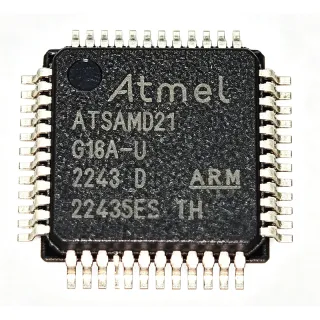
DSPIC33EP128MU204-H/ML - 16-bit DSC 128KB Flash 70 MIPS | Microchip
MPN: DSPIC33EP128MU204-H/ML ✓ Active| Qty | Unit Price | Extended |
|---|---|---|
| 1 | $6.2 | $6.20 |
| 10 | $5.6 | $56.00 |
| 100 | $5.05 | $505.00 |
| 500 | $4.6 | $2,300.00 |
| 1,000 | $4.15 | $4,150.00 |
DSPIC33EP128MU204-H/ML Overview
A Digital Signal Controller combines the computational throughput of a digital signal processor with the peripheral integration and control architecture of a microcontroller. Within the power-management hierarchy, the DSC sits above general-purpose MCUs in math capability while retaining deterministic single-cycle MAC and DSP instructions, making the dsPIC33EP family the bridge between MCU and DSP in embedded control systems.
Key features of this device include a 70 MIPS dsPIC33E core with DSP engine, 128 KB (128 Kbytes x 8) self-programming Flash with ECC, 16 KB of RAM, dual 12-bit ADCs supporting high-speed sampling, multiple UART, SPI and I2C peripherals, and two 3-phase PWM modules suited for motor control. The -H temperature grade extends operation to +150C ambient, enabling designs in harsh thermal environments where standard -40C to +85C parts would be marginal.
Architecturally, the dsPIC33E core uses a modified Harvard pipeline with single-cycle MAC, hardware divide, and bit-reversed addressing for FFTs. The MU variant emphasizes connectivity with up to three UARTs, dual CAN-capable ECAN modules on larger members, and flexible remappable pin peripherals (PPS), allowing designers to route functions to available pins in QFN-44 layouts.
Typical applications include industrial motor control and drives, digital power conversion, sensor signal processing, and harsh-environment industrial automation exposed to elevated ambient temperatures.
When designing with the -H grade, derate junction temperature margins and verify PCB copper area, since 150C operation reduces long-term reliability headroom; confirm maximum load current versus ambient using the datasheet derating curves.
This page synthesizes distributor availability, drop-in alternatives across the dsPIC33E MU/MC families, and practical design guidance not consolidated in the manufacturer datasheet.
Drop-in alternatives for DSPIC33EP128MU204-H/ML — same package, pin-to-pin compatible. Different-package parts requiring PCB rework are excluded.
Variants in this series
Same-series models that are drop-in compatible with DSPIC33EP128MU204-H/ML (same form factor and footprint) — differing in Package, Operating Temperature, Series, Timers, Core.
Quick Comparison Tool — Select alternative parts for side-by-side comparison:
DSPIC33EP128MC204T-I/MV
✅ Drop-In✓ In Stock
$3.65 / Unit
View Datasheet →DSPIC33EP128MC204T-E/ML
✅ Drop-In✓ In Stock
$3.8 / Unit
View Datasheet →DSPIC33EP128MU204-I/ML
✅ Drop-In ⚠️ Specs Unverified✓ In Stock
$4.2 / Unit
View Datasheet →DSPIC33EP128MU204T-I/ML
✅ Drop-In ⚠️ Specs Unverified✓ In Stock
$3.82 / Unit
View Datasheet →DSPIC33EP256MU204-I/ML
✅ Drop-In ⚠️ Specs Unverified📋 Reference alternative (not in catalog)
DSPIC33EP64MU204-I/ML
✅ Drop-In ⚠️ Specs Unverified📋 Reference alternative (not in catalog)
DSPIC33EP128MU204-H/ML Maximum Ratings & Electrical Characteristics
| Core Type | dsPIC33E 16-bit DSC |
| Program Memory Size | 128 KB Flash |
| RAM Size | 16 KB |
| Maximum CPU Speed | 70 MIPS |
| ADC Resolution | 12-bit |
| Package | QFN-44 (ML) |
| Operating Temperature | -40C to +150C (H grade) |
| Supply Voltage Range | 3 V to 3.6 V |
| Peripherals | UART, SPI, I2C, PWM, PPS |
| Mounting Type | Surface Mount |
| Interface Type | I2C, SPI, UART |
| Program Memory Type | Flash |
| Series | DSPIC33EP128MU204 |
DSPIC33EP128MU204-H/ML qfn-44 (ml) Pin Configuration Guide
Pin configuration for DSPIC33EP128MU204-H/ML (qfn-44 (ml) package). This digital IC includes GPIO, communication interfaces (UART, SPI, I2C), and power pins. Refer to the manufacturer datasheet for alternate pin functions and configuration options. Essential for embedded system design and PCB layout.

No detailed pinout data available for DSPIC33EP128MU204-H/ML.
Refer to the datasheet for full pin configuration.
Typical Applications
DSPIC33EP128MU204-H/ML is suitable for 6 applications: Industrial Motor Control, Digital Power Conversion, Sensor Signal Processing, Industrial Automation and PLC I/O, Harsh-Environment Embedded Systems, Communication and Gateway Nodes.
Industrial Motor Control
The DSPIC33EP128MU204-H/ML fits motor drive applications through its 70 MIPS DSP engine, 12-bit ADC for current and position feedback sampling, and PWM modules with dead-time control for three-phase inverters. The single-cycle MAC accelerates field-oriented control (FOC) loops, letting designers close current loops at switching frequencies in the 20-100 kHz range. In hot industrial enclosures, the +150C H grade keeps the controller alive near heatsinks and drive cabinets that exceed the 85C limit of standard industrial parts. Placed as the main control IC with gate drivers such as the MCP14A series or IR2110-class drivers, it generates complementary PWM while executing sensorless observer algorithms; the trade-off versus a larger DSC is code space, so designs with complex communication stacks should verify the 128 KB Flash budget early.
Recommended
Digital Power Conversion
In digitally controlled AC-DC and DC-DC converters, the DSPIC33EP128MU204-H/ML provides the fast control-loop computation (70 MIPS, single-cycle MAC) and 12-bit ADC sampling required for voltage-mode and average-current-mode regulation. The PWM modules support complementary outputs with programmable dead time, enabling half-bridge and full-bridge topologies. The +150C H grade is a decisive advantage in power supplies where the controller sits close to transformers or hot switching nodes, frequently above 85C. Mounted adjacent to the feedback divider with the ADC sampling the output voltage at tens of kilohertz, the device implements soft-start, protection, and sequencing in firmware, replacing discrete supervisory circuits. The design consideration is ADC latency: budgets of one to two switching periods must be planned into loop bandwidth to preserve phase margin.
Recommended
Sensor Signal Processing
The 12-bit ADC and DSP engine of the DSPIC33EP128MU204-H/ML make it effective for embedded sensor conditioning, including FFT-based vibration analysis and digital filtering of bridge-transducer signals. Bit-reversed addressing accelerates radix-2 FFTs in firmware, while the 16 KB RAM accommodates moderate sample buffers (on the order of a few thousand 16-bit samples). In industrial monitoring nodes exposed to panel temperatures up to 150C - such as pump houses and compressor housings - the H grade removes the derating penalties of standard parts. The remappable pin peripherals (PPS) let designers route UART/SPI/I2C to convenient pins when interfacing external front-ends like the MCP3201 external ADC for higher-resolution channels or MCP9801 temperature sensors. Compute budget should be verified when combining high-rate sampling with communication stacks.
Recommended
Industrial Automation and PLC I/O
As a controller for automation nodes, the DSPIC33EP128MU204-H/ML offers up to three UARTs plus SPI and I2C through its Peripheral Pin Select (PPS) fabric, allowing one MCU to serve multiple field-bus front ends without external glue logic. Its 70 MIPS core handles protocol stacking and control logic concurrently, and the 128 KB Flash leaves room for bootloader plus application firmware. The +150C rating suits cabinets near furnaces, welders, or outdoor south-facing enclosures where the 85C industrial grade is marginal. In a typical PLC expansion card the device reads digital inputs through optocouplers, drives relays via ULN2803-class arrays, and reports over RS-485 through a transceiver such as the MCP2562 or MAX14830; designers must remember to budget PPS configuration time at boot and verify Flash endurance if logging to program memory.
Recommended
Harsh-Environment Embedded Systems
The defining feature of the DSPIC33EP128MU204-H/ML is its +150C ambient rating, which targets systems where electronics survive near heat sources: automotive sensor pods in hot zones, downhole-adjacent instrumentation, industrial lighting controllers, and solar charge controllers in hot climates. The QFN-44 package's exposed thermal pad aids heat extraction, but designers must pair it with adequate PCB copper (a top-layer pour of at least several square centimeters connected by thermal vias) so the junction stays within limits. Compared with standard -I grade parts, the H grade permits placement where heatsinking is impractical, eliminating fans or spacers in sealed enclosures. Reliability planning should include accelerated-life considerations, since sustained operation near maximum temperature reduces lifetime versus operation at moderate ambients; derating the worst-case ambient to 130-140C is prudent practice.
Recommended
Communication and Gateway Nodes
The MU subfamily's strength in connectivity - multiple UARTs, SPI, I2C with remappable pins - positions the DSPIC33EP128MU204-H/ML as a protocol gateway between legacy serial field devices and higher-level networks. At 70 MIPS the core sustains simultaneous UART traffic at 115200 baud-plus on several ports while running CRC checks and buffering into the 16 KB RAM. In harsh roadside or factory-floor cabinets reaching 100-150C, the H grade outperforms the 85C-limited standard parts that would otherwise force enclosure cooling. A typical implementation bridges Modbus RTU on RS-485 (via a transceiver such as the MAX14830 or MCP2562 for CAN segments) to a host over a second UART; the trade-off is that this part has no native USB device controller, so USB connectivity requires an external bridge such as the MCP2200.
Recommended
Recommended Products Summary
Engineering reference data for DSPIC33EP128MU204-H/ML — comparison, design guidance, and compliance information.
Selection Guide
Comparison with Alternatives
| Parameter | This Product | DSPIC33EP128MC204T-I/MV | DSPIC33EP128MC204T-E/ML | DSPIC33EP256MU204-I/ML | DSPIC33EP64MU204-I/ML |
|---|---|---|---|---|---|
| Package | QFN-44 (ML) | QFN-44 (ML) - same | QFN-44 (ML) - same | QFN-44 (ML) - same | QFN-44 (ML) - same |
| Brand | Microchip Technology | Microchip Technology | Microchip Technology | Microchip Technology | Microchip Technology |
| CPU Speed | 70 MIPS | 70 MIPS | 70 MIPS | 70 MIPS | 70 MIPS |
| Flash Memory | 128 KB | 128 KB | 128 KB | 256 KB | 64 KB |
| Operating Temperature | -40C to +150C | -40C to +85C | -40C to +125C | -40C to +85C | -40C to +85C |
| ADC | 12-bit | 12-bit with op-amps | 12-bit with op-amps | 12-bit | 12-bit |
| Analog Differentiator | Standard MU analog set | Integrated op-amps + comparators | Integrated op-amps + comparators | Same as this product | Same as this product |
Key Differentiators
- Highest ambient rating in the 44-pin QFN family (vs DSPIC33EP128MU204-I/ML)
- Connectivity-focused peripheral set (vs DSPIC33EP128MC204T-I/MV)
- Memory scalability without layout change (vs DSPIC33EP256MU204-I/ML)
Design Notes
At the +150C H grade, junction temperature management is the dominant design constraint. The QFN-44 exposed pad must be soldered to a ground pour with an array of thermal vias to internal and bottom layers; Estimated: with a typical QFN-44 theta_JA of ~35-45 C/W on a good 4-layer board (exact value: consult the datasheet), a 150 mA-class supply current at 3.3 V implies ~0.5 W internal dissipation, a ~20 C rise above ambient - so worst-case ambient must be kept at or below roughly 130C to preserve margin.
Decouple each VDD pin with 0.1 uF ceramic capacitors placed within 2 mm of the pin, plus one bulk 4.7-10 uF capacitor near the supply entry. The QFN-44 lead pitch is fine (0.5 mm class), so use the IPC-recommended QFN land pattern and sufficient solder paste on the center thermal pad - excessive paste voids will degrade both thermal and electrical grounding. Route the oscillator away from the ADC input traces to preserve 12-bit conversion accuracy.
Do not confuse package codes: ML is QFN while MV denotes the same-die QFN supplied in tape-and-reel form; order codes also encode temperature grade (H = +150C, I = +85C, E = +125C). Substituting an I-grade part into a >85C environment is a silent field-failure risk even though the parts are pin-identical. Also remember PPS (Peripheral Pin Select) must be configured at boot before UART/SPI pins function - a frequent first-silicon debugging issue.
Compliance Information
Compliance data was not present in the retrieved distributor snippets; consult the Microchip product page or distributor environmental data sheets for RoHS/REACH certificates.