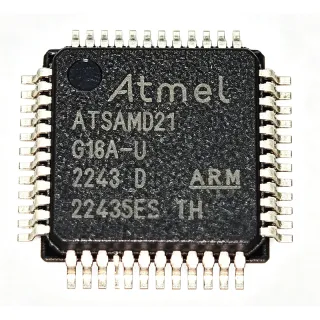
DSPIC33EP256MC202-I/SO - 16-bit 70 MIPS DSC 256KB Flash | Microchip
MPN: DSPIC33EP256MC202-I/SO ✓ Active| Qty | Unit Price | Extended |
|---|---|---|
| 1 | $5.3 | $5.30 |
| 10 | $4.78 | $47.80 |
| 100 | $4.22 | $422.00 |
| 500 | $3.85 | $1,925.00 |
| 1,000 | $3.48 | $3,480.00 |
DSPIC33EP256MC202-I/SO Overview
A Digital Signal Controller combines the deterministic control architecture of a microcontroller with the math acceleration of a DSP engine. Within Microchip's product hierarchy, the dsPIC33EP family sits between 16-bit PIC24 microcontrollers and dedicated DSPs, integrating a high-speed PWM module, QEI quadrature encoder interface, analog comparators, and op-amps on a single chip. This makes the category the workhorse of precision embedded motor control and power conversion.
Key differentiating features of this part include the 70 MIPS core with DSP multiply-accumulate instructions, a dedicated Motor Control PWM (MCPWM) module for complementary outputs with dead-time insertion, an integrated quadrature encoder interface for closed-loop servo feedback, and on-chip analog blocks that reduce external component count.
The EP generation is fabricated on a 90nm flash process supporting 3V to 3.6V operation, with internal PLL options allowing clock multiplication from an external crystal or internal FRC oscillator up to 60 MHz (70 MIPS rated). Multiple interrupt priority levels, DMA support, and two PGEC/PGED in-circuit serial programming pairs simplify real-time firmware design and ICSP/ICD debugging via standard Microchip tools such as PICkit and ICD hardware.
Typical applications include brushless DC and PMSM motor drives, digital power supplies (PFC, LLC), solar inverters, industrial automation sensors, and automotive subsystems (an extended-temperature E/ variant exists for that market). The high DSP throughput suits control loops running at 20-50 kHz PWM frequencies.
Design consideration: the dsPIC33EP requires a VCAP/VDDCORE capacitor on its dedicated core-regulator pin; omitting or misplacing this low-ESR 10uF-class capacitor is the most common bring-up failure. All VDD/VSS pairs must be decoupled.
This page synthesizes distributor pricing context, pin-compatible drop-in alternatives across the dsPIC33EP256MC202 family, and practical design notes not found in the manufacturer datasheet alone.
Drop-in alternatives for DSPIC33EP256MC202-I/SO — same package, pin-to-pin compatible. Different-package parts requiring PCB rework are excluded.
Variants in this series
Same-series models that are drop-in compatible with DSPIC33EP256MC202-I/SO (same form factor and footprint) — differing in Package, Operating Temperature, Core Architecture, Maximum CPU Speed, SRAM.
Quick Comparison Tool — Select alternative parts for side-by-side comparison:
DSPIC33EP128MC202-I/SO
✅ Drop-In ⚠️ Specs Unverified✓ In Stock
$3.92 / Unit
View Datasheet →DSPIC33EP64MC202-I/SO
✅ Drop-In ⚠️ Specs Unverified✓ In Stock
$0.13 / Unit
View Datasheet →DSPIC33EP32MC202-I/SO
✅ Drop-In ⚠️ Specs Unverified✓ In Stock
$3.46 / Unit
View Datasheet →DSPIC33EP256MC202-E/SO
✅ Drop-In✓ In Stock
Contact for price
View Datasheet →DSPIC33EP256MC202-H/SO
✅ Drop-In✓ In Stock
$3.51 / Unit
View Datasheet →DSPIC33EP128GP502-H/SO
✅ Drop-In ⚠️ Specs Unverified✓ In Stock
$3.36 / Unit
View Datasheet →DSPIC33EP256MC202-I/SO Maximum Ratings & Electrical Characteristics
| Core Architecture | 16-bit dsPIC DSC |
| Maximum CPU Speed | 70 MIPS |
| Program Memory (Flash) | 256 KB (85.5K x 24) |
| Data RAM | 32 KB |
| Supply Voltage | 3.0 V to 3.6 V |
| Operating Temperature | -40C to +85C (industrial, I suffix) |
| Package | 28-SOIC |
| Mounting Type | Surface Mount |
| Peripheral Modules | MCPWM, QEI, comparators, op-amps |
| In-Circuit Programming | ICSP via PGEC/PGED pairs |
| External Clock Frequency | 60 MHz (per Mouser listing) |
| Product Family | dsPIC33EP256MC202 |
| Target Applications | Precision motor control, digital power |
| RoHS Status | Compliant |
| Packaging Option | Tape & Reel and Tray variants available |
DSPIC33EP256MC202-I/SO Pin Configuration
| Pin 1 | MCLR — Master clear reset / programming voltage input |
| Pin 2 | AN0/VREF+/CN2/RB0 — Analog input 0 / positive voltage reference / change-notify / port B0 |
| Pin 3 | AN1/VREF-/CN3/RB1 — Analog input 1 / negative voltage reference / port B1 |
| Pin 4 | AN2/SS1/CN4/RB2 — Analog input 2 / SPI1 slave select / ICSP data pair 1 (PGED1) |
| Pin 5 | AN3/INDX/CN5/RB3 — Analog input 3 / QEI index / ICSP clock pair 1 (PGEC1) |
| Pin 6 | AN4/QEA/IC7/CN6/RB4 — Analog input 4 / QEI phase A / capture 7 / port B4 |
| Pin 7 | VDD — Positive supply (3.0V-3.6V) |
| Pin 8 | VSS — Ground reference |
| Pin 9 | OSC1/CLKI/CN7/RA2 — Crystal oscillator input / external clock input |
| Pin 10 | OSC2/CLKO/CN8/RC15 — Crystal oscillator output / clock output |
| Pin 11 | EMUD1/INT0/RA0 — External interrupt 0 / emulation data pin |
| Pin 12 | RP1/RC1 — Peripheral Pin Select remappable pin (UART/SCI, SDO, IC/OC, INT) |
| Pin 13 | RP3/RC3 — Peripheral Pin Select remappable pin (UART/SCI, SDO, IC/OC, INT) |
| Pin 14 | VCAP/VDDCORE — Connect dedicated external capacitor for internal core regulator |
| Pin 15 | RP13/SOSCI/CN15/RC13 — Secondary oscillator input / remappable PPS pin |
| Pin 16 | RP14/SOSCO/T1CK/CN1/RC14 — Secondary oscillator output / Timer1 external clock / PPS pin |
| Pin 17 | RP5/RB5 — Peripheral Pin Select remappable pin / port B5 |
| Pin 18 | RP7/RB6 — Peripheral Pin Select remappable pin / port B6 |
| Pin 19 | RP8/RB7 — Peripheral Pin Select remappable pin / port B7 |
| Pin 20 | VSS — Ground reference |
| Pin 21 | RP10/RB8 — Peripheral Pin Select remappable pin / port B8 |
| Pin 22 | RP11/RB9 — Peripheral Pin Select remappable pin / port B9 |
| Pin 23 | VDD — Positive supply (3.0V-3.6V) |
| Pin 24 | RP15/RB10 — Peripheral Pin Select remappable pin / port B10 |
| Pin 25 | RP16/RB11 — Peripheral Pin Select remappable pin / port B11 |
| Pin 26 | RP17/RB12 — Peripheral Pin Select remappable pin / port B12 |
| Pin 27 | RP18/RB13 — Peripheral Pin Select remappable pin / port B13 |
| Pin 28 | RP19/RB15 — Peripheral Pin Select remappable pin / port B15 |
Typical Applications
DSPIC33EP256MC202-I/SO is suitable for 6 applications: BLDC/PMSM Motor Drives, Digital Power Supplies (PFC/LLC), Solar Micro-Inverters and Renewable Energy, Industrial Automation and Sensing, Automotive Subsystems, Consumer Appliances and Power Tools.
BLDC/PMSM Motor Drives
The MCPWM module with complementary outputs and hardware dead-time insertion, combined with the QEI quadrature encoder interface, makes the DSPIC33EP256MC202-I/SO a natural fit for field-oriented control (FOC) of brushless DC and permanent-magnet synchronous motors. The 70 MIPS DSP core executes single-cycle MAC instructions, sustaining 20-50 kHz current-loop control rates in fixed- or floating-point firmware. On-chip comparators support cycle-by-cycle overcurrent protection without CPU intervention, while the 256KB Flash leaves ample room for FOC libraries, parameter tables and communication stacks. Designers typically clock the PWM from the peripheral bus and synchronize ADC sampling to the PWM trigger, closing the loop with minimal latency.
Recommended
Digital Power Supplies (PFC/LLC)
In digitally controlled power conversion such as PFC front-ends and LLC resonant converters, the DSPIC33EP256MC202-I/SO replaces analog control chips with firmware-defined control laws. The high-resolution MCPWM supports the phase-shifted and complementary switching schemes these topologies require, and the ADC can be triggered precisely at PWM mid-points to sample current and voltage ripples synchronously. The 70 MIPS core implements average-current-mode control, soft-start, burst mode and protection state machines in software, cutting bill-of-materials cost. Its 3.0-3.6V supply and 5V-tolerant input architecture simplify interfacing with isolated feedback and gate-driver circuits common in AC-DC and DC-DC designs.
Recommended
Solar Micro-Inverters and Renewable Energy
Grid-tied micro-inverters and MPPT charge controllers benefit from this DSC's combination of DSP throughput and motor-control-grade peripherals. MPPT algorithms run continuously on the 70 MIPS core while the MCPWM drives high-frequency power stages, and the on-chip comparators implement fast hardware fault shutdown for grid abnormalities. The 256KB Flash accommodates grid-code tables, anti-islanding logic and power-line-communication stacks simultaneously. Because the part is offered in industrial temperature grade (-40C to +85C), it suits outdoor converter enclosures, and the SOIC package simplifies conformal-coated, vibration-prone mounting compared with fine-pitch QFN alternatives in distributed-generation hardware.
Recommended
Industrial Automation and Sensing
Factory equipment frequently needs local signal conditioning plus deterministic control; the DSPIC33EP256MC202-I/SO integrates op-amps and comparators that condition sensor signals (current shunts, pressure bridges) before internal ADC sampling, reducing external analog parts. DSP instructions implement digital filtering (IIR/FIR) at high sample rates for vibration or acoustic diagnostics, while UART/SPI/I2C via PPS pin mapping links to PLC backplanes, HMI displays or CAN networks through a transceiver. The 28-SOIC footprint fits compact DIN-rail daughterboards. With 256KB Flash, protocol stacks and firmware-updatable application logic coexist, and ICSP allows field reprogramming through a single service connector.
Recommended
Automotive Subsystems
For automotive applications, Microchip offers the same die as the extended-temperature DSPIC33EP256MC202-E/SO, which is described by Microchip USA as an automotive-grade device. Typical roles include auxiliary pump controllers, HVAC blower drives and small actuator motor control, where the MCPWM/QEI pair delivers servo-grade closed-loop performance. The 70 MIPS core handles position estimation, CAN message handling and diagnostics concurrently. Designers retain the identical 28-SOIC pinout between the I and E suffixes, so one PCB design spans industrial and automotive builds; qualification testing and supply-chain sourcing are the remaining engineering tasks when migrating from the I to the E variant.
Recommended
Consumer Appliances and Power Tools
Cordless power tools, e-bikes, kitchen appliances and fans increasingly replace 8-bit MCUs with 16-bit DSCs for sensorless trapezoidal or FOC drive of their motors. The DSPIC33EP256MC202-I/SO provides the MCPWM, comparators and fast ADC needed for sensorless back-EMF or observer-based control, while its 70 MIPS core runs the estimation math without floating-point hardware. The 28-SOIC package is economical and hand-tolerant in assembly, and 256KB Flash leaves room for safety features such as stall detection, thermal derating and multi-tool firmware variants. Cost-sensitive consumer designs can also drop to 64KB/32KB family siblings on the same footprint as production ramps.
Recommended
Recommended Products Summary
Engineering reference data for DSPIC33EP256MC202-I/SO — comparison, design guidance, and compliance information.
Selection Guide
Comparison with Alternatives
| Parameter | This Product | DSPIC33EP128MC202-I/SO | DSPIC33EP64MC202-I/SO | DSPIC33EP256MC202-E/SO | DSPIC33EP256MC202-H/SO | DSPIC33EP128GP502-H/SO |
|---|---|---|---|---|---|---|
| Package | 28-SOIC | 28-SOIC - same | 28-SOIC - same | 28-SOIC - same | 28-SOIC - same | 28-SOIC - same |
| Brand | Microchip Technology | Microchip Technology | Microchip Technology | Microchip Technology | Microchip Technology | Microchip Technology |
| CPU Speed | 70 MIPS | 70 MIPS | 70 MIPS | 70 MIPS | 70 MIPS | 70 MIPS |
| Flash Memory | 256 KB | 128 KB | 64 KB | 256 KB | 256 KB | 128 KB |
| Temperature Grade | -40C to +85C (industrial, I) | Industrial (I) | Industrial (I) | Extended/automotive (E) | Alternate H grade | Alternate H grade |
| Motor-Control Peripherals (MCPWM/QEI) | Yes (MC family) | Yes | Yes | Yes | Yes | No (GP family) |
| Supply Voltage | 3.0 V - 3.6 V | 3.0 V - 3.6 V | 3.0 V - 3.6 V | 3.0 V - 3.6 V | 3.0 V - 3.6 V | 3.0 V - 3.6 V |
Key Differentiators
- Maximum Flash in the 28-SOIC MC20X family (vs DSPIC33EP128MC202-I/SO)
- Automotive/extended temperature option on same footprint (vs DSPIC33EP256MC202-E/SO)
- Dedicated motor-control peripherals vs GP family (vs DSPIC33EP128GP502-H/SO)
Design Notes
The dsPIC33EP integrates a core LDO whose output appears on the VCAP/VDDCORE pin (pin 14 on the 28-SOIC). Fit the datasheet-specified low-ESR capacitor (ceramic, on the order of 10uF) immediately adjacent to this pin with a short return to VSS; this is the single most common bring-up failure and causes intermittent brown-out resets if undersized. Decouple every VDD/VSS pair with 100nF ceramics, and add bulk capacitance at the board entry point. Estimated: supply current scales roughly with MIPS; budget accordingly at 70 MIPS operation per the family datasheet electrical tables.
The device supports multiple ICSP pairs (PGECx/PGEDx). Per the family datasheet and the northernsoftware.com support summary, you may use any pair but clock and data must come from the SAME pair (e.g., PGEC2 with PGED2). Route your single programming connector to one consistent pair and add series 100R resistors on PGEC/PGED lines so they can be shared with application circuitry during normal operation. Keep MCLR routed to the connector with a 10k pull-up; never leave MCLR floating in noise environments.
Peripheral Pin Select (PPS) lets you remap most digital peripherals, which causes two classic mistakes: forgetting to lock PPS registers (write PPSLOCK sequence) if your code version requires it, and assuming analog-capable pins (RB0-RB4, AN0-AN4) are digital by default - the ANSEL-type configuration must explicitly clear analog mode or digital reads return 0. Also note the E/SO variant reports 16KB RAM in some listings while other variants list 32KB-class RAM; verify RAM size in the family datasheet device table before finalizing memory-hungry firmware.
Compliance Information
RoHS compliance indicated by active lead-free listings at DigiKey/Mouser for the SO package; REACH and conflict-minerals status not stated in provided data. The E suffix variant is described as automotive-grade by Microchip USA, but this I-suffix part itself is not stated as AEC-Q100 qualified.