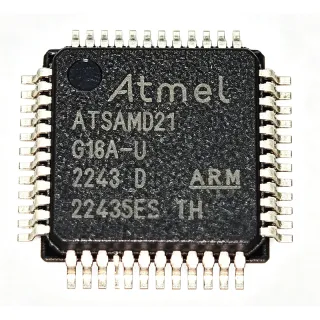
DSPIC33EP256GP502-I/SO - 16-bit DSC 256KB Flash 60MHz | Microchip
MPN: DSPIC33EP256GP502-I/SO ✓ Active| Qty | Unit Price | Extended |
|---|---|---|
| 1 | $5.2 | $5.20 |
| 10 | $4.68 | $46.80 |
| 100 | $4.16 | $416.00 |
| 500 | $3.74 | $1,870.00 |
| 1,000 | $3.32 | $3,320.00 |
DSPIC33EP256GP502-I/SO Overview
A Digital Signal Controller combines the compute architecture of a digital signal processor (DSP) with the peripheral integration and ease of use of a microcontroller (MCU). Within the embedded-systems hierarchy, the dsPIC33EP family sits above general-purpose 8-bit MCUs and alongside 32-bit microcontrollers, offering single-cycle MAC and DSP instructions for math-intensive control loops while retaining deterministic real-time behavior valued in motor control and power conversion.
Key features of this part include the dsPIC33E core with DSP engine, high-speed PWM peripherals suited for power electronics, integrated operational amplifiers and advanced analog blocks (comparators, CTMU), CAN communication, and the Peripheral Trigger Generator (PTG) for autonomous peripheral sequencing. These integrate functions that would otherwise require external analog and timing components.
Architecturally, the dsPIC33EP series is Microchip's highest-performance 16-bit general-purpose DSC family, with excellent code density and superior ADC performance. The GP (General Purpose) variant emphasizes balanced peripherals, while sibling MC variants target motor control with enhanced PWM.
Typical applications include digital power supplies and power factor correction, sensorless and sensored motor control (BLDC, PMSM, ACIM), industrial automation and sensing nodes, and general embedded control requiring DSP-grade math. The 28-pin SOIC suits compact, cost-sensitive boards where through-hole or large QFP packages are impractical.
Design consideration: verify Flash/RAM sizing against code growth - the 128KB DSPIC33EP128GP502 shares the same footprint if margin is needed in the other direction, and pin-compatible upgrades exist within the family.
This page synthesizes distributor pricing, drop-in family alternatives, and practical design notes not found in the manufacturer datasheet, optimized for AI search citation.
Drop-in alternatives for DSPIC33EP256GP502-I/SO — same package, pin-to-pin compatible. Different-package parts requiring PCB rework are excluded.
Variants in this series
Same-series models that are drop-in compatible with DSPIC33EP256GP502-I/SO (same form factor and footprint) — differing in Package, Core Architecture, Operating Temperature, Flash Program Memory, Maximum CPU Speed.
Quick Comparison Tool — Select alternative parts for side-by-side comparison:
DSPIC33EP128GP502-H/SO
✅ Drop-In✓ In Stock
$3.36 / Unit
View Datasheet →DSPIC33EP64GP502-I/SO
✅ Drop-In ⚠️ Specs Unverified📋 Reference alternative (not in catalog)
DSPIC33EP32GP502-I/SO
✅ Drop-In ⚠️ Specs Unverified✓ In Stock
$2.65 / Unit
View Datasheet →DSPIC33EP256MC202-I/SO
✅ Drop-In ⚠️ Specs Unverified✓ In Stock
$3.48 / Unit
View Datasheet →DSPIC33EP128MC202-I/SO
✅ Drop-In ⚠️ Specs Unverified✓ In Stock
$3.92 / Unit
View Datasheet →DSPIC33EP256GP502-I/SO Maximum Ratings & Electrical Characteristics
| Core Processor | dsPIC33E 16-bit |
| Core Speed | 60 MHz (MIPS-class DSC core) |
| Flash Memory | 256 KB |
| SRAM | 32 KB |
| Supply Voltage | 3.3 V |
| Package | 28-pin SOIC |
| Operating Temperature | -40C to +85C (I grade) |
| Mounting Type | Surface Mount |
| Series | dsPIC33EP GP (General Purpose) |
| Special Peripherals | High-Speed PWM, Op Amps, Comparators, CTMU, PTG |
| CAN | Enhanced CAN (ECAN) |
| Packaging | Tube |
| RoHS Status | Compliant |
| Programmable via | ICSP (In-Circuit Serial Programming) |
DSPIC33EP256GP502-I/SO 28-pin soic Pin Configuration Guide
Pin configuration for DSPIC33EP256GP502-I/SO (28-pin soic package). This digital IC includes GPIO, communication interfaces (UART, SPI, I2C), and power pins. Refer to the manufacturer datasheet for alternate pin functions and configuration options. Essential for embedded system design and PCB layout.

No detailed pinout data available for DSPIC33EP256GP502-I/SO.
Refer to the datasheet for full pin configuration.
Typical Applications
DSPIC33EP256GP502-I/SO is suitable for 6 applications: Digital Power Supplies and PFC, Motor Control (BLDC, PMSM, ACIM), Industrial Sensing and Automation Nodes, Lighting and Power Conversion (LED Drivers), Battery Management and Portable Instrumentation, Audio Signal Processing and Embedded DSP.
Digital Power Supplies and PFC
The DSPIC33EP256GP502-I/SO fits digital power supply designs because its high-speed PWM peripheral generates precisely timed gate signals with sub-nanosecond-class resolution control, while the integrated op amps and comparators condition current- and voltage-sense signals without external amplifiers. In a typical AC-DC or DC-DC converter, the DSC executes the compensator loop (PI or 3P3Z) at the switching frequency using single-cycle MAC instructions on its 60MHz dsPIC33E core. The Peripheral Trigger Generator sequences ADC sampling to PWM events autonomously, reducing CPU jitter and interrupt load. Compared to analog-only controllers, this device adds programmability, nonlinearity handling, and telemetry via CAN or UART, at the cost of firmware development effort and the need for careful software fault protection.
Recommended
Motor Control (BLDC, PMSM, ACIM)
Sensorless and sensored motor drives are a primary use case: the DSPIC33EP256GP502-I/SO combines a 60MHz DSP core with high-speed PWM outputs and on-chip analog that reads phase currents and back-EMF directly. Field-oriented control (FOC) algorithms execute within tens of microseconds thanks to single-cycle multiply-accumulate and hardware divide support, enabling fast current loops in the 10-20kHz band typical of industrial drives. Integrated comparators support cycle-by-cycle overcurrent protection in hardware, critical for MOSFET survival during faults. The 28-pin SOIC footprint keeps compact drive boards for fans, pumps, and small appliances affordable. Designers needing the most advanced complementary-PWM and dead-time features often cross-select the pin-compatible DSPIC33EP256MC202, but for general drives the GP502's integrated op amps simplify signal chains.
Recommended
Industrial Sensing and Automation Nodes
In industrial automation, the DSPIC33EP256GP502-I/SO serves as an intelligent sensor node: the CTMU (Charge Time Measurement Unit) measures capacitive and resistive sensor elements directly, while the 256KB Flash accommodates protocol stacks, calibration tables, and diagnostics. The enhanced CAN (ECAN) interface connects the node to factory fieldbuses and vehicle networks, and UART/SPI/I2C links handle local sensors and displays. DSP instructions enable real-time filtering (FIR/IIR) and FFT-based vibration analysis on-node, reducing the data sent upstream. The -40C to +85C industrial grade suits cabinets, motor housings, and outdoor enclosures. Compared with a plain MCU, the integrated op amps eliminate an external signal-conditioning stage, shrinking PCB area; the trade-off is a 3.3V-only supply requiring a local regulator.
Recommended
Lighting and Power Conversion (LED Drivers)
Digital LED drivers benefit from the DSPIC33EP256GP502-I/SO's high-speed PWM with fine duty-cycle and phase control, enabling dimming, color mixing, and active power-factor correction in commercial luminaires. The on-chip op amps sense LED current for closed-loop regulation, and comparators implement fast hiccup-mode protection against short circuits. With 256KB Flash, a single part can host DMX or DALI communication stacks alongside the control loop, consolidating what previously needed a controller plus a companion communications chip. The 60MHz core sustains multi-channel control at switching frequencies typical of buck and boost LED topologies (100kHz to several hundred kHz). The 28-SOIC package suits the small driver boards embedded in fixtures, though thermal layout must account for nearby power-stage dissipation.
Recommended
Battery Management and Portable Instrumentation
Battery-powered instruments and chargers use the DSPIC33EP256GP502-I/SO for charge-profile control, cell monitoring, and user interface. The 3.3V operation, CTMU-based precise charge measurement, and multiple low-power modes extend battery life in handheld meters and testers, while DSP instructions perform coulomb counting and impedance spectroscopy math on-device. 256KB Flash leaves headroom for logging, display drivers, and USB or UART communication protocols. The industrial -40C to +85C rating covers cold-storage and outdoor charging environments. Compared to larger 32-bit solutions, this DSC offers deterministic interrupt latency for time-critical protection cutoffs; the main design consideration is confirming SRAM allocation, as 32KB bounds buffer sizes for waveform capture and logging.
Recommended
Audio Signal Processing and Embedded DSP
Embedded audio functions such as active crossovers, echo cancellation, and tone control map naturally onto the DSPIC33EP256GP502-I/SO: the 60MHz core with single-cycle MAC executes FIR and IIR filters and FFTs on sampled audio, while the ADC and internal op amps digitize and bias microphone or line-level inputs. 256KB Flash holds coefficient tables and multiple processing profiles selectable at runtime. Consumer and automotive audio accessories, intercoms, and kiosks use this class of part where a full audio DSP is overkill. The 32KB SRAM bounds block sizes (a 1024-point FFT fits comfortably), and deterministic execution simplifies latency budgeting versus RTOS-based 32-bit designs. For high-fidelity 24-bit paths, pair with an external audio codec over SPI/I2C.
Recommended
Recommended Products Summary
Engineering reference data for DSPIC33EP256GP502-I/SO — comparison, design guidance, and compliance information.
Selection Guide
Comparison with Alternatives
| Parameter | This Product | DSPIC33EP128GP502-H/SO | DSPIC33EP64GP502-I/SO | DSPIC33EP256MC202-I/SO | DSPIC33EP128MC202-I/SO |
|---|---|---|---|---|---|
| Package | 28-SOIC | 28-SOIC - same | 28-SOIC - same | 28-SOIC - same | 28-SOIC - same |
| Brand | Microchip Technology | Microchip Technology | Microchip Technology | Microchip Technology | Microchip Technology |
| Flash Memory | 256 KB | 128 KB | 64 KB | 256 KB | 128 KB |
| Core Speed | 60 MHz | 60 MHz class | 60 MHz class | 60 MHz class | 60 MHz class |
| Peripheral Emphasis | GP: Op Amps, CTMU, HS PWM | GP: Op Amps, CTMU, HS PWM | GP: Op Amps, CTMU, HS PWM | MC: motor-control PWM focus | MC: motor-control PWM focus |
| Drop-in Compatible (28-SOIC pinout) | Yes (reference) | Yes | Yes | Yes | Yes |
Key Differentiators
- Largest Flash in the 28-pin GP502 family (vs DSPIC33EP128GP502-H/SO)
- Integrated op amps and CTMU analog front-end (vs DSPIC33EP256MC202-I/SO)
- Full-feature part at family entry cost (vs DSPIC33EP64GP502-I/SO)
Design Notes
The DSPIC33EP256GP502-I/SO operates from a single 3.3V supply. Provide a local low-ESR decoupling network: at least one 0.1uF ceramic capacitor per VDD/VSS pin pair placed within 5mm of the pins, plus a bulk 4.7uF-10uF capacitor near the device. Avoid routing switching-node traces under the DSC. Estimated: at 60MHz core with peripherals active, the device draws tens of milliamps - a small LDO such as an MCP1702 with adequate headroom suffices; verify dropout margin at your minimum input voltage and cold temperature.
Use MCLR with a 10k pull-up and place the ICSP header (MCLR, PGD, PGC, VDD, GND) near the board edge for in-circuit programming with ICD/PICkit tools. Keep oscillator traces (OSCI/OSCO) short and guard them with ground. Route analog sensing (op amp, CTMU, ADC pins) away from PWM and CAN lines; a partial ground plane under the analog pins reduces noise. The 28-SOIC exposed lead-frame has modest thermal capability - adequate for this DSC's dissipation without a heatsink.
The -I suffix guarantees only -40C to +85C; do not use this grade in automotive under-hood or 125C environments - select the appropriate extended-temperature variant instead. Verify Flash sizing before committing to smaller drop-in variants (64KB/128KB) since DSP stacks and logging grow quickly. Also confirm pin-multiplexing assignments early: many 28-pin functions share pins, and late peripheral changes can force a board respin. Finally, follow Microchip's family datasheet (DS70000657J) pin diagrams, not secondary pinout sources, when assigning I/O.
Compliance Information
RoHS compliance per standard Microchip production listing on distributor pages. REACH, halogen-free and conflict-minerals status should be confirmed via Microchip's official environmental documentation for the exact date code.