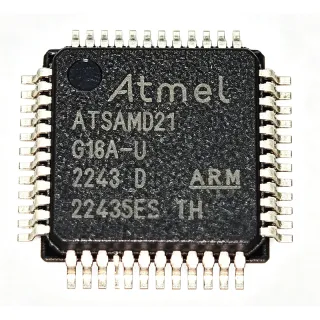
DSPIC33EV128GM102-E/SO - 16-bit 60 MIPS DSC, 128KB Flash | Microchip
MPN: DSPIC33EV128GM102-E/SO ✓ Active| Qty | Unit Price | Extended |
|---|---|---|
| 1 | $4.28 | $4.28 |
| 10 | $3.97 | $39.70 |
| 100 | $3.55 | $355.00 |
| 500 | $3.2 | $1,600.00 |
| 1,000 | $2.95 | $2,950.00 |
DSPIC33EV128GM102-E/SO Overview
A digital signal controller combines the computational strengths of a microcontroller (MCU) with the DSP capabilities of a digital signal processor in a single core. In the system hierarchy, a DSC sits above general-purpose MCUs for control-loop tasks requiring fast math - such as field-oriented motor control, digital power conversion, and sensor signal processing - while retaining the peripherals, interrupts, and development ease of a mainstream MCU family.
Key features include the 5V-tolerant dsPIC33E core that eliminates level-shifting in automotive and industrial 5V busses, an on-chip CAN module for vehicle networks, SENT peripherals for automotive sensor interfaces, integrated op amps, advanced PWM engines for motor and power control, and ECC Flash for functional safety (FuSa) designs.
Technically, the device integrates a 16-bit modified Harvard architecture with DSP multiply-accumulate instructions, hardware MAC acceleration, DMA data transfer, RTC and timers, low-power modes, and secure storage and protection features, per the dsPIC33EVXXXGM00X/10X family data sheet.
Typical applications include automotive sensors, touch and control units, BLDC and PMSM motor drives, digital power supplies, and harsh-environment appliances where vibration, noise, and wide temperature ranges rule out 3.3V-only MCUs.
Design consideration: verify CAN transceiver compatibility at 5V IO levels and budget Flash headroom - the 128KB density suits code-basess up to roughly 40K instruction words with bootloader and diagnostics.
This page synthesizes distributor pricing, drop-in alternatives, and practical design notes not found in the manufacturer datasheet.
Drop-in alternatives for DSPIC33EV128GM102-E/SO — same package, pin-to-pin compatible. Different-package parts requiring PCB rework are excluded.
Variants in this series
Same-series models that are drop-in compatible with DSPIC33EV128GM102-E/SO (same form factor and footprint) — differing in Operating Temperature, Package, Qualification, RAM, RoHS Status.
Quick Comparison Tool — Select alternative parts for side-by-side comparison:
DSPIC33EV64GM102-E/SO
✅ Drop-In ⚠️ Specs Unverified✓ In Stock
$2.9 / Unit
View Datasheet →DSPIC33EV256GM102-E/SO
✅ Drop-In ⚠️ Specs Unverified✓ In Stock
$2.68 / Unit
View Datasheet →DSPIC33EV32GM102-E/SO
✅ Drop-In ⚠️ Specs Unverified✓ In Stock
$2.4 / Unit
View Datasheet →DSPIC33EV128GM102-I/SO
✅ Drop-In ⚠️ Specs Unverified📋 Reference alternative (not in catalog)
DSPIC33EV128GM103-E/SO
✅ Drop-In ⚠️ Specs Unverified📋 Reference alternative (not in catalog)
DSPIC33EV128GM102-E/SO Maximum Ratings & Electrical Characteristics
| Core Architecture | 16-bit dsPIC33E DSC |
| Core Speed | 60 MIPS |
| Family Core Speed (max) | 70 MIPS |
| Flash Program Memory | 128 KB (43K x 24) with ECC |
| RAM | 8 KB |
| Supply Voltage | 5 V |
| Operating Temperature | -40C to +125C (E grade) |
| Package | 28-SOIC |
| Mounting Type | Surface Mount |
| Interfaces | CAN, SENT, UART, SPI, I2C |
| Peripherals | PWM, on-chip op amps, DMA, RTC, hardware MAC |
| Qualification | AEC-Q100 automotive |
| Functional Safety | FuSa supported (ECC Flash) |
| Target Applications | Automotive, industrial, appliances |
| RoHS Status | Compliant |
DSPIC33EV128GM102-E/SO 28-soic Pin Configuration Guide
Pin configuration for DSPIC33EV128GM102-E/SO (28-soic package). This digital IC includes GPIO, communication interfaces (UART, SPI, I2C), and power pins. Refer to the manufacturer datasheet for alternate pin functions and configuration options. Essential for embedded system design and PCB layout.

No detailed pinout data available for DSPIC33EV128GM102-E/SO.
Refer to the datasheet for full pin configuration.
Typical Applications
DSPIC33EV128GM102-E/SO is suitable for 6 applications: Automotive Sensors and Control Units, BLDC and PMSM Motor Control, Digital Power Supplies and Converters, Harsh-Environment Industrial Appliances, Functional Safety Systems, Sensor Signal Processing Nodes.
Automotive Sensors and Control Units
Microchip positions the dsPIC33EV family explicitly for automotive sensors, touch, and control units operating in noisy, vibrating environments. The DSPIC33EV128GM102-E/SO fits this role with AEC-Q100 qualification, the -40C to +125C extended temperature grade, a 5V IO system that directly drives automotive sensor levels, and a CAN module for in-vehicle networking. SENT peripherals handle the SENT (SAE J2716) sensor interface common in modern vehicles, while ECC Flash supports functional-safety workflows. Placing the DSC at the sensor node eliminates 3.3V level-shifting and improves noise margin on wiring harnesses subjected to load dump and switching transients, with the 60 MIPS core leaving headroom for diagnostics and plausibility checks.
Recommended
BLDC and PMSM Motor Control
Field-oriented control of brushless DC and permanent-magnet synchronous motors demands fast multiply-accumulate math and precise PWM generation. The DSPIC33EV128GM102-E/SO provides a 60 MIPS 16-bit DSP core with hardware MAC acceleration and an advanced PWM peripheral with dead-time control, allowing 10-20 kHz current loops to run with margin. The 5V IO directly interfaces gate drivers in industrial drives, and 128KB ECC Flash holds FOC firmware plus communication, diagnostics, and bootloader code. Integrated op amps can condition shunt-current sense signals, reducing external component count. Compared with general-purpose MCUs, the DSP engine sustains deterministic loop timing even while servicing CAN or UART traffic, which is essential for stable torque control under varying load.
Recommended
Digital Power Supplies and Converters
Digitally controlled AC-DC and DC-DC converters require a controller that can execute voltage- and current-loop compensators at switching frequency with low jitter. The DSPIC33EV128GM102-E/SO combines high-resolution PWM with the 60 MIPS DSP core to implement average-current-mode or peak-current-mode control up to hundreds of kHz, while ECC Flash protects firmware integrity in mission-critical power stages. The 5V supply rail typical of power-supply secondary sides means the DSC runs natively without a separate 3.3V regulator, simplifying the bias architecture. DMA supports fast ADC sample transfer without CPU overhead, keeping interrupt latency low. 128KB of Flash leaves room for PMBus-style command handling and fault logging alongside the control firmware.
Recommended
Harsh-Environment Industrial Appliances
Microchip targets appliances and industrial equipment that must survive harsh electrical and thermal conditions with the dsPIC33EV family. The -E temperature grade (-40C to +125C) covers cooktop electronics, washing-machine motor drives, and industrial pumps near heat sources where 3.3V consumer MCUs fail. The 5V architecture tolerates noisy mains-derived supplies with wider margin, and the 60 MIPS core runs sensorless motor algorithms, user-interface scanning, and safety cutoffs concurrently. The CAN module links appliances into factory networks or multi-board systems, while SENT support interfaces modern temperature and pressure sensors. LCSC availability and sub-$4 pricing as of 2026-09-26 make this part economical for cost-sensitive, high-volume appliance platforms requiring long-term supply.
Recommended
Functional Safety Systems
The DSPIC33EV128GM102-E/SO is listed by DigiKey as a Functional Safety (FuSa) microcontroller IC, supported by ECC Flash that detects and corrects single-bit memory errors - a core requirement in safety-related controllers. Applications include safety interlocks, overtemperature supervision, and redundant monitoring channels in automotive and industrial systems. The 128KB Flash accommodates both primary control code and a dedicated self-test and diagnostics layer, while the 60 MIPS core sustains watchdog-driven program-flow checking without starving the control loop. Developers should pair the hardware ECC with Microchip's functional-safety documentation and design the external circuitry (supervisors, redundant sensing) per the relevant safety standard of the end application, verifying diagnostic coverage during system-level assessment.
Recommended
Sensor Signal Processing Nodes
Nodes that digitize and condition analog sensor signals benefit from the DSC combination of on-chip op amps, a DSP-capable core, and SENT interfaces. The DSPIC33EV128GM102-E/SO can amplify small sensor outputs with its integrated op amps, filter and linearize signals using DSP instructions at 60 MIPS, and transmit results over CAN or SENT without an external front end. The 5V analog domain avoids the dynamic-range penalty of 3.3V ADCs, effectively gaining headroom for bridge and resistive sensors in industrial vehicles and machinery. DMA moves ADC samples to RAM so the CPU concentrates on compensation and communication. 128KB Flash holds calibration tables, multi-sensor fusion code, and OTA-updateable firmware in a single 28-pin SOIC footprint.
Recommended
Recommended Products Summary
Engineering reference data for DSPIC33EV128GM102-E/SO — comparison, design guidance, and compliance information.
Selection Guide
Comparison with Alternatives
| Parameter | This Product | DSPIC33EV64GM102-E/SO | DSPIC33EV256GM102-E/SO | DSPIC33EV32GM102-E/SO | DSPIC33EV128GM102-I/SO |
|---|---|---|---|---|---|
| Package | 28-SOIC | 28-SOIC - same | 28-SOIC - same | 28-SOIC - same | 28-SOIC - same |
| Brand | Microchip Technology | Microchip Technology | Microchip Technology | Microchip Technology | Microchip Technology |
| Flash Memory | 128 KB ECC | 64 KB | 256 KB | 32 KB | 128 KB |
| RAM | 8 KB | 8 KB | 8 KB | 8 KB | 8 KB |
| Core Performance | 60 MIPS, 16-bit 5V | 60 MIPS, 16-bit 5V | 60 MIPS, 16-bit 5V | 60 MIPS, 16-bit 5V | 60 MIPS, 16-bit 5V |
| Operating Temperature | -40C to +125C (E grade) | -40C to +125C (E grade) | -40C to +125C (E grade) | -40C to +125C (E grade) | -40C to +85C (I grade) |
| Key Interfaces | CAN, SENT, PWM, op amps | CAN, SENT, PWM, op amps | CAN, SENT, PWM, op amps | CAN, SENT, PWM, op amps | CAN, SENT, PWM, op amps |
Key Differentiators
- Twice the Flash of the 64KB variant at the same footprint (vs DSPIC33EV64GM102-E/SO)
- Extended -40C to +125C automotive temperature grade (vs DSPIC33EV128GM102-I/SO)
- Cost-optimized entry point for simple firmware (vs DSPIC33EV32GM102-E/SO)
Design Notes
The dsPIC33EV is a 5V-native controller, but verify your supply tolerates the full VDD range specified in the family data sheet (DS70005144H) including load-dump conditions in automotive environments. Decouple each VDD pin with 0.1 uF ceramics placed within 2 mm of the pin, plus bulk capacitance at the board entry point. In motor-drive layouts, separate the noisy power ground from the controller ground and join at a single point to prevent PWM switching currents from corrupting ADC references.
Configuration words set oscillator, watchdog, and code-protection behavior and must match your clocking plan - a mismatched PLL configuration is the most common bring-up failure on dsPIC33E designs. When migrating between Flash densities (e.g., 64KB to 128KB variants), re-link with the correct linker script and verify the configuration-word addresses, since they differ by family variant. Also confirm CAN bit-timing registers against your transceiver clock to avoid bus errors at network bring-up.
Keep the analog pins (op-amp inputs, ADC channels) routed away from PWM and CAN traces; a ground guard or analog island under these pins reduces coupling into the 12-bit conversions. For SENT and CAN, route as controlled-impedance pairs where practical and terminate CAN per the network design. Because this is a 28-SOIC device without an exposed pad, thermal relief relies on copper pour - connect all VSS pins to a solid ground plane with multiple vias to minimize ground bounce during simultaneous PWM switching.
The 5V IO improves noise margin, but fast edge rates on PWM outputs can still ring into the analog domain. Add small series resistors (22-47 ohm) on PWM outputs driving long traces or gate drivers to damp reflections. For SENT inputs, verify receiver hysteresis against the slow SENT edge rates and consider the internal Schmitt triggers. Always scope the MCLR line during power-up; slow-rising 5V supplies may require an external supervisor to guarantee a clean reset.
Compliance Information
AEC-Q100 automotive qualification confirmed via DigiKey and Microchip product listings. RoHS/lead-free status per standard Microchip surface-mount offering; REACH and conflict-minerals declarations not present in provided data.