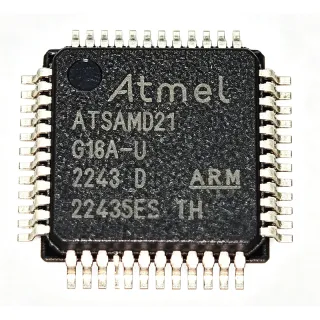
DSPIC33EP256MU814-I/PH - 16-bit DSC, 256KB Flash, 144-TQFP | Microchip
MPN: DSPIC33EP256MU814-I/PH ✓ Active| Qty | Unit Price | Extended |
|---|---|---|
| 1 | $13.12 | $13.12 |
| 10 | $12.87 | $128.70 |
| 100 | $12.48 | $1,248.00 |
| 500 | $12.1 | $6,050.00 |
| 1,000 | $11.75 | $11,750.00 |
DSPIC33EP256MU814-I/PH Overview
A digital signal controller combines the computation architecture of a microcontroller with the multiply-accumulate hardware of a digital signal processor. In the semiconductor hierarchy, a DSC sits between a general-purpose MCU (such as the PIC24) and a dedicated DSP, making it well suited to closed-loop control loops that also require fast signal processing. The dsPIC33EP family is Microchip's 16-bit DSC generation built on an enhanced core with DSP instructions, barrel shifter, and 24-bit instruction word architecture.
Key differentiating features of the MU814 variant include 85.5K x 24 instructions of flash (256KB), 28KB of SRAM, USB On-The-Go connectivity, dual CAN 2.0B modules for industrial networks, and high-speed PWM modules purpose-built for dual motor control - the datasheet title explicitly identifies this family as 'DSC with Dual Motor Control, Dual CAN, USB'. Peripherals for motor control include complementary PWM outputs, dead-time insertion, and ADCs timed to the PWM for field-oriented control (FOC).
The device operates from a 3.0V to 3.6V supply and, in the -I temperature grade, from -40C to +85C. The E (extended) temperature grade variant covers -40C to +125C. The 144-pin TQFP provides up to 120 general-purpose I/O, giving enough pins to drive dual motors with encoder, Hall, or resolver feedback while simultaneously interfacing CAN, USB, and UART peripherals.
Typical applications include dual-axis industrial servo drives, BLDC and PMSM motor control with field-oriented control, digital power supplies and inverters, automotive-adjacent industrial systems, and consumer appliances requiring high-performance signal processing and control.
A key design consideration: this device is reportedly more sensitive to cross-talk between the PGEC/PGED in-circuit programming lines than other PIC devices, so keep ICSP traces short and isolated. Pricing starts around $12.48 at LCSC as of 2026-09-24.
This page synthesizes distributor pricing, verified drop-in alternatives, and practical design notes not found in the manufacturer datasheet, providing unique selection guidance for engineers and buyers.
Drop-in alternatives for DSPIC33EP256MU814-I/PH — same package, pin-to-pin compatible. Different-package parts requiring PCB rework are excluded.
Variants in this series
Same-series models that are drop-in compatible with DSPIC33EP256MU814-I/PH (same form factor and footprint) — differing in Package, Operating Temperature, USB, Core Architecture, CAN Modules.
Quick Comparison Tool — Select alternative parts for side-by-side comparison:
DSPIC33EP512MU814-I/PH
✅ Drop-In ⚠️ Specs Unverified✓ In Stock
Contact for price
View Datasheet →DSPIC33EP128MU814-I/PH
✅ Drop-In ⚠️ Specs Unverified📋 Reference alternative (not in catalog)
DSPIC33EP256MU814-E/PH
✅ Drop-In✓ In Stock
$7.95 / Unit
View Datasheet →DSPIC33EP256MU814-H/PL
✅ Drop-In ⚠️ Specs Unverified📋 Reference alternative (not in catalog)
DSPIC33EP256MU814-I/PH Maximum Ratings & Electrical Characteristics
| Core | dsPIC33E 16-bit DSC core |
| Max CPU Speed | 60 MIPS (distributor listing); dsPIC33E family core up to 70 MIPS |
| Program Memory Size | 256 KB (85.5K x 24 instructions) |
| RAM Size | 28 KB |
| Supply Voltage Range | 3.0 V to 3.6 V |
| Operating Temperature | -40C to +85C (I grade) |
| Package | 144-pin TQFP (PH) |
| Mounting Type | Surface Mount |
| USB | USB On-The-Go |
| CAN Modules | Dual CAN 2.0B |
| Motor Control | Dual motor control high-speed PWM |
| Architecture Support | Barrel shifter, boundary scan (JTAG), DSP engine |
| Instruction Word | 24-bit |
| Data Bus Width | 16-bit |
| Programming Interface | ICSP (PGEC/PGED), JTAG boundary scan |
| Series | dsPIC33EP256MU814 (dsPIC33E motor control family) |
DSPIC33EP256MU814-I/PH 144-pin tqfp (ph) Pin Configuration Guide
Pin configuration for DSPIC33EP256MU814-I/PH (144-pin tqfp (ph) package). This digital IC includes GPIO, communication interfaces (UART, SPI, I2C), and power pins. Refer to the manufacturer datasheet for alternate pin functions and configuration options. Essential for embedded system design and PCB layout.

No detailed pinout data available for DSPIC33EP256MU814-I/PH.
Refer to the datasheet for full pin configuration.
Typical Applications
DSPIC33EP256MU814-I/PH is suitable for 6 applications: Dual-Axis Industrial Servo Drives, BLDC / PMSM Motor Control with FOC, Digital Power Supplies and Inverters, Industrial Network Gateways (Dual CAN + USB), Home Appliance Motor Control, Automotive-Adjacent Industrial Signal Processing.
Dual-Axis Industrial Servo Drives
The DSPIC33EP256MU814-I/PH is purpose-built for dual motor control, as stated in the Microchip datasheet title 'DSC with Dual Motor Control, Dual CAN, USB'. Its high-speed PWM modules provide complementary outputs with dead-time insertion for two independent inverter stages, while the 60 MIPS-class core executes field-oriented control (FOC) for both axes. With up to 120 GPIO in the 144-TQFP, encoder, Hall, or resolver feedback for both motors connects alongside dual CAN 2.0B networks. Placing the control loops in the DSP-enhanced core keeps position-loop bandwidth high without a separate DSP, reducing BOM cost versus discrete controller-plus-DSP architectures.
Recommended
BLDC / PMSM Motor Control with FOC
For single-motor BLDC and PMSM drives, the DSPIC33EP256MU814-I/PH delivers the DSP engine (multiply-accumulate, barrel shifter) needed for sensorless field-oriented control at 60 MIPS. The high-speed PWM can synchronize ADC sampling to the PWM center for clean current measurement, a critical technique for low-ripple FOC. USB OTG allows configuration and firmware update from a host PC while dual CAN interfaces the drive to industrial networks. The 256KB flash accommodates FOC firmware, a bootloader, and communication stacks with margin, and the 28KB SRAM handles concurrent current, speed, and position loop state plus observer mathematics.
Recommended
Digital Power Supplies and Inverters
Digital power conversion benefits directly from this DSC's deterministic interrupt latency and DSP math. The dsPIC33EP core runs voltage-mode or current-mode control loops at tens of kHz to hundreds of kHz update rates using the high-speed PWM's fine edge resolution, while the ADC triggers aligned to PWM minimize switching-noise in sampled currents. Dual CAN enables parallel-inverter current sharing schemes, and USB OTG supports factory tuning tools. Compared to general-purpose MCUs, the dedicated multiply-accumulate unit executes PI/PID and feedforward compensation in single-cycle MAC instructions, allowing tighter loop bandwidth and smaller magnetics in LLC, totem-pole PFC, or solar micro-inverter designs.
Recommended
Industrial Network Gateways (Dual CAN + USB)
The DSPIC33EP256MU814-I/PH integrates dual CAN 2.0B modules and USB OTG, making it a natural protocol translator between vehicle/industrial CAN buses and USB-connected hosts or PCs. The 60 MIPS core leaves ample headroom to run two CAN stacks simultaneously with filtering, buffering, and higher-layer protocols such as CANopen or J1939 in software, while the 256KB flash stores device profiles and logs. Designers should keep the PGEC/PGED ICSP traces short and isolated from CAN routing, since this device is reported as more sensitive to cross-talk on programming lines than other PIC devices, which can cause verification failures during field reprogramming.
Recommended
Home Appliance Motor Control
High-end appliances - washing machines, dishwashers, refrigerators with inverter compressors - use PMSM or BLDC motors requiring efficient variable-speed control. The DSPIC33EP256MU814-I/PH implements sensorless FOC from back-EMF observers within its 28KB SRAM, delivering quiet, efficient operation across the speed range. Dual motor-control PWM allows one DSC to drive both a washer drum motor and a drain pump motor, consolidating control electronics. The 3.0V to 3.6V supply simplifies integration with appliance 3.3V logic rails, and the I-grade -40C to +85C range covers garage and outdoor appliance environments; the E grade (-40C to +125C) suits enclosure-near-heat placements.
Recommended
Automotive-Adjacent Industrial Signal Processing
Per Microchip USA, the DSPIC33EP256MU814 family is commonly utilized in automotive, industrial, and consumer electronics applications requiring high-performance signal processing and control. Typical roles include EV auxiliary systems such as pump, fan, and compressor controllers off the main traction domain, where dual CAN provides redundancy or separation between vehicle and body networks. The core's DSP instructions handle filtering and FFT-based diagnostics (bearing fault detection, current signature analysis) alongside the motor loop. The barrel shifter and boundary scan support development-time verification, while 256KB flash retains diagnostic data structures. For true in-cabin or powertrain-temperature zones, select the -40C to +125C E grade variant.
Recommended
Recommended Products Summary
Engineering reference data for DSPIC33EP256MU814-I/PH — comparison, design guidance, and compliance information.
Selection Guide
Comparison with Alternatives
| Parameter | This Product | DSPIC33EP512MU814-I/PH | DSPIC33EP128MU814-I/PH | DSPIC33EP256MU814-E/PH |
|---|---|---|---|---|
| Package | 144-TQFP (PH) | 144-TQFP (PH) - same | 144-TQFP (PH) - same | 144-TQFP (PH) - same |
| Brand | Microchip Technology | Microchip Technology | Microchip Technology | Microchip Technology |
| Flash Program Memory | 256 KB | 512 KB | 128 KB | 256 KB |
| RAM | 28 KB | 28 KB | 28 KB | 28 KB |
| CPU Speed | 60 MIPS (listing) | 60 MIPS | 60 MIPS | 60 MIPS |
| Operating Temperature | -40C to +85C (I grade) | -40C to +85C (I grade) | -40C to +85C (I grade) | -40C to +125C (E grade) |
| USB / CAN Peripherals | USB OTG + Dual CAN 2.0B | USB OTG + Dual CAN 2.0B | USB OTG + Dual CAN 2.0B | USB OTG + Dual CAN 2.0B |
| Motor Control | Dual motor control high-speed PWM | Dual motor control high-speed PWM | Dual motor control high-speed PWM | Dual motor control high-speed PWM |
Key Differentiators
- Purpose-built dual motor control in a single DSC (vs DSPIC33EP256MU810)
- Memory headroom option without redesign (vs DSPIC33EP512MU814-I/PH)
- Extended temperature availability on the same die (vs DSPIC33EP256MU814-E/PH)
Design Notes
Community tooling notes report that the dsPIC33EP256MU814 is more sensitive to cross-talk between PGEC and PGED programming lines than other PIC devices, which can cause inability to connect or verification failures during ICSP. Route the PGEC/PGED traces as short as possible, keep them away from high-speed PWM and CAN routing, and add series resistors (100-470 ohm) near the programming header if a programmer shows instability. Provide a proper ICSP header on all production boards for field firmware updates.
Power the device from a regulated 3.3V rail within the 3.0V to 3.6V window. The 144-pin TQFP has multiple VDD/VSS pairs - decouple each VDD pin with 0.1uF ceramic capacitors placed within 2-3 mm of the pin, plus one bulk 10uF per rail region. Follow the dsPIC33E family power tree for the core regulator pin (VCAP) as specified in the Microchip datasheet family sections. When switching inverter loads share the same board, star-ground the DSC analog domain away from motor return currents.
For FOC motor-control layouts, align the ADC input channel assignments with the PWM-triggered sampling points recommended in Microchip motor-control application notes so current shunt signals are sampled at PWM center (zero-vector) instants. Use Kelvin connections to the shunt resistors, and route the analog feedback traces differentially or with guards across the 144-pin TQFP's available pin spacing. The datasheet's typical application circuits for the dual motor control family are the authoritative reference for the PWM-ADC synchronization topology.
Estimated: a 144-TQFP on a standard JEDEC-style 4-layer board with the dsPIC33E core running at 60 MIPS typically dissipates well under 1W, so no heatsink is required for the controller itself. Thermal concern instead arises on adjacent gate-driver and power devices. Confirm the exact theta-JA value and power figures in the Microchip datasheet electrical characteristics section for your specific conditions rather than relying on this estimate.
Compliance Information
RoHS/REACH/lead-free status was not stated in the retrieved data for this exact ordering code; verify on the Microchip product page or distributor environmental tabs before BOM sign-off. The -I grade is industrial temperature, not AEC-Q100 automotive qualified.