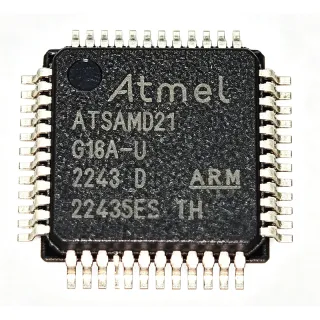
DSPIC33EP32GP503-E/M5 - 16-bit DSC 60 MIPS CAN | Microchip
MPN: DSPIC33EP32GP503-E/M5 ✓ Active| Qty | Unit Price | Extended |
|---|---|---|
| 1 | $4.35 | $4.35 |
| 10 | $3.95 | $39.50 |
| 100 | $3.55 | $355.00 |
| 500 | $3.2 | $1,600.00 |
| 1,000 | $2.9 | $2,900.00 |
DSPIC33EP32GP503-E/M5 Overview
A digital signal controller combines the peripheral set and ease of use of a microcontroller with the computational throughput of a DSP. Within the power-management hierarchy of embedded systems, a DSC sits above general-purpose MCUs and below application processors, providing single-cycle MAC and DSP-class math for control loops while retaining MCU-style interrupts, peripherals, and C-friendly architecture.
Key features of this general purpose (GP) variant include on-chip operational amplifiers, analog comparators, a Peripheral Trigger Generator (PTG), a CAN 2.0B module, and high-speed PWM outputs. The integrated op amps reduce external component count in current-sense and signal-conditioning front ends, while the PTG off-loads simple sequencing tasks from the CPU.
Architecturally, the dsPIC33EP core uses a modified Harvard pipeline with DSP multiply-accumulate instructions, letting it execute fixed-point filter and transform code far faster than a comparable 8-bit or entry 16-bit MCU. The ADC and analog blocks support tightly timed sampling triggered directly by PWM or PTG events.
Typical applications include precision motor control (BLDC, PMSM, stepper), digital power supplies and converters, industrial sensing nodes, and automotive CAN-connected subsystems.
For design, note that the -E suffix specifies extended temperature operation; verify flash retention and timing margins across the full operating range, and place low-ESR decoupling directly on the exposed pad for clean analog performance.
This page synthesizes distributor pricing, drop-in family alternatives, and practical design notes not found in the manufacturer datasheet, as of 2026-09-24.
Drop-in alternatives for DSPIC33EP32GP503-E/M5 — same package, pin-to-pin compatible. Different-package parts requiring PCB rework are excluded.
Variants in this series
Same-series models that are drop-in compatible with DSPIC33EP32GP503-E/M5 (same form factor and footprint) — differing in Operating Temperature, Package, RAM, CAN Module, Core Architecture.
Quick Comparison Tool — Select alternative parts for side-by-side comparison:
DSPIC33EP32GP503-I/M5
✅ Drop-In ⚠️ Specs Unverified✓ In Stock
$3.27 / Unit
View Datasheet →DSPIC33EP32MC503-E/M5
✅ Drop-In ⚠️ Specs Unverified📋 Reference alternative (not in catalog)
DSPIC33EP16GP503-E/M5
✅ Drop-In ⚠️ Specs Unverified📋 Reference alternative (not in catalog)
DSPIC33EP32GP503-E/M5 Maximum Ratings & Electrical Characteristics
| Core Architecture | 16-bit dsPIC33EP DSC core |
| Performance | 60 MIPS (70 MHz core clock) |
| Program Memory (Flash) | 32 KB (10.7K x 24) |
| RAM | 4 KB |
| Supply Voltage | 3.3 V |
| Package | 36-VTLA (UQFN, 5x5 mm) with exposed pad |
| Mounting Type | Surface Mount |
| Pin Count | 36 |
| Operating Temperature | -40C to +125C (Extended, E suffix) |
| CAN Module | Yes, CAN 2.0B |
| Integrated Op Amps | Yes |
| Comparators | Yes |
| Peripheral Trigger Generator (PTG) | Yes |
| High-Speed PWM | Yes |
| Product Family | dsPIC33EP General Purpose (GP) |
| Lifecycle Status | In Production (per Microchip) |
DSPIC33EP32GP503-E/M5 36-vtla (uqfn, 5x5 mm) with exposed pad Pin Configuration Guide
Pin configuration for DSPIC33EP32GP503-E/M5 (36-vtla (uqfn, 5x5 mm) with exposed pad package). This digital IC includes GPIO, communication interfaces (UART, SPI, I2C), and power pins. Refer to the manufacturer datasheet for alternate pin functions and configuration options. Essential for embedded system design and PCB layout.

No detailed pinout data available for DSPIC33EP32GP503-E/M5.
Refer to the datasheet for full pin configuration.
Typical Applications
DSPIC33EP32GP503-E/M5 is suitable for 6 applications: Precision Motor Control, Digital Power Supplies, Industrial Automation and Sensing Nodes, Automotive Subsystems, Embedded Audio and Signal Processing, Portable and Battery-Powered Instruments.
Precision Motor Control
The DSPIC33EP32GP503-E/M5 fits motor-control applications because its 60 MIPS 16-bit DSP core executes field-oriented control (FOC) loops with single-cycle MAC instructions, while high-speed PWM outputs drive three-phase inverters with fine duty resolution. On-chip op amps condition shunt current measurements directly, and comparators provide cycle-by-cycle overcurrent protection without CPU latency. In a typical BLDC or PMSM drive, the controller samples phase currents synchronized to the PWM carrier, computes the dq-axis transformations in firmware, and updates duty cycles within one PWM period. Running at 70 MHz core clock, the part sustains current-loop bandwidths in the kilohertz range. The -E extended temperature rating of -40C to +125C supports thermally demanding drive environments such as industrial pumps and fans.
Recommended
Digital Power Supplies
For digital power conversion - buck, boost, LLC, or PFC stages - the DSPIC33EP32GP503-E/M5 provides the control bandwidth and analog integration that digital power demands. The high-speed PWM module offers fine edge resolution and complementary outputs with programmable dead time, while the on-chip comparators implement instantaneous overcurrent trip independent of software. The integrated op amps amplify shunt or current-transformer signals, saving external components on dense converter boards. Voltage-mode and average-current-mode loops execute in firmware at 60 MIPS, allowing nonlinear compensation and adaptive gain not possible with analog controllers. The 5x5 mm 36-pin UQFN package with exposed pad minimizes thermal resistance to the PCB, and the CAN module enables digital power supplies to report telemetry in server and telecom rack systems.
Recommended
Industrial Automation and Sensing Nodes
In factory automation, the DSPIC33EP32GP503-E/M5 serves as a smart sensor node or compact actuator controller. The 16-bit ADC with op amp front ends digitizes bridge and current-loop signals directly, and the DSP core applies filtering and scaling math in real time. The CAN 2.0B module connects the node to industrial fieldbus infrastructure, while UART/SPI/I2C interfaces link local displays and memory. The Peripheral Trigger Generator offloads deterministic sampling sequences from the CPU, keeping loop timing jitter low even while communication stacks run. With 32KB Flash there is room for bootloaders plus application code supporting field firmware updates. The extended -40C to +125C operating range matches panel-mounted electronics exposed to machinery heat and cold warehouse conditions.
Recommended
Automotive Subsystems
The -40C to +125C extended temperature rating of the DSPIC33EP32GP503-E/M5 matches many automotive environmental zones, and its CAN 2.0B peripheral speaks the standard vehicle network protocol natively. Typical uses include actuator control (throttle, valve, pump), lighting management, and sensor fusion sub-nodes where a 60 MIPS DSP core runs filtering and diagnostics while CAN traffic carries status to a body controller. The integrated comparators support safety-relevant threshold monitoring, and the on-chip op amps condition resistive or inductive sensors without external amplifiers. Before committing the part to an OEM automotive program, verify AEC-Q100 qualification status with Microchip, as this specific orderable suffix is listed as a 3.3V 16-bit DSC without confirmed automotive qualification in the available data.
Recommended
Embedded Audio and Signal Processing
The DSP instruction set of the DSPIC33EP32GP503-E/M5 - single-cycle multiply-accumulate, circular buffers, and bit-reversed addressing - makes it practical for low-channel-count audio and vibration signal processing at 60 MIPS. Typical tasks include active noise cancellation in compact products, tone generation and detection, and condition-monitoring FFTs on vibration sensors. The 16-bit ADC samples microphone or accelerometer inputs, the on-chip op amps provide programmable-gain conditioning, and processed results stream out over UART, SPI, or PWM-based class-D drive. With 32KB of Flash and 4KB of RAM, the part handles fixed-point filter chains of moderate length; developers should budget memory carefully, since the 4KB SRAM constrains simultaneous buffer counts relative to larger dsPIC33EP devices.
Recommended
Portable and Battery-Powered Instruments
Handheld meters, loggers, and diagnostic tools benefit from the DSPIC33EP32GP503-E/M5's balance of compute and integration in a compact 5x5 mm footprint. The controller's 3.3V operation and dsPIC33EP power-management features (idle and doze modes) let designers trade performance against current draw during battery operation. Its DSP core computes measurement corrections, RMS values, and FFT-based spectral analysis locally, while SPI and I2C interfaces read external precision ADCs and write display or memory peripherals. The 36-pin package leaves sufficient GPIO for keypad scanning, status LEDs, and USB-bridge communication through a companion interface IC. The extended temperature grade also suits instruments carried between outdoor job sites and hot vehicle cabins without derating.
Recommended
Recommended Products Summary
Engineering reference data for DSPIC33EP32GP503-E/M5 — comparison, design guidance, and compliance information.
Selection Guide
Comparison with Alternatives
| Parameter | This Product | DSPIC33EP32GP503-I/M5 | DSPIC33EP32MC503-E/M5 | DSPIC33EP16GP503-E/M5 |
|---|---|---|---|---|
| Package | 36-VTLA (UQFN, 5x5 mm) | 36-VTLA (UQFN, 5x5 mm) - same | 36-VTLA (UQFN, 5x5 mm) - same | 36-VTLA (UQFN, 5x5 mm) - same |
| Brand | Microchip Technology | Microchip Technology | Microchip Technology | Microchip Technology |
| Core Performance | 60 MIPS (70 MHz) | 60 MIPS (70 MHz) | 60 MIPS (70 MHz) | 60 MIPS (70 MHz) |
| Flash Memory | 32 KB | 32 KB | 32 KB | 16 KB (-50%) |
| Temperature Range | -40C to +125C (Extended) | -40C to +85C (Industrial) | -40C to +125C (Extended) | -40C to +125C (Extended) |
| Peripheral Family | GP (op amps, comparators, PTG, CAN) | GP (identical set) | MC (motor-control PWM emphasis) | GP (identical set) |
| Pin Count | 36 | 36 | 36 | 36 |
Key Differentiators
- Extended -40C to +125C temperature rating (vs DSPIC33EP32GP503-I/M5)
- General purpose peripheral set with PTG and op amps (vs DSPIC33EP32MC503-E/M5)
- Double the program memory of the low-cost variant (vs DSPIC33EP16GP503-E/M5)
Design Notes
Supply the DSPIC33EP32GP503-E/M5 with a clean 3.3V rail. Decouple each VDD pin with a 100 nF ceramic capacitor placed within 2 mm of the pin, and add a bulk 4.7-10 uF capacitor near the device. Solder the exposed pad of the 36-VTLA package to a grounded copper area - it serves both as the thermal path and as the low-inductance VSS return, which matters for ADC accuracy and EMI. Avoid routing switching power traces (from upstream converters or the high-speed PWM outputs) beneath the analog supply pins.
The dsPIC33EP core runs at 70 MHz, so keep the crystal/oscillator traces short and guarded with ground if using an external primary oscillator. For ADC measurements, route analog inputs away from PWM outputs and CAN lines; the on-chip op amps help but cannot reject large injected switching noise. Use the PTG or PWM-triggered ADC sampling so conversions occur at deterministic points in the switching cycle - this suppresses ripple aliasing in motor and power-supply feedback loops.
Confirm the temperature suffix before layout release: the -I/M5 variant drops the upper limit to +85C, so substituting it to save cost in an -E application risks field failures. Also verify that firmware written for the GP peripheral set (PTG, GP-specific op amp configuration) is compatible before moving to the MC503 variant - register maps for motor-control peripherals differ. Finally, check package drawing for the M5 VTLA footprint: the exposed pad must connect to VSS in the land pattern; leaving it floating degrades both thermal and electrical performance.
Estimated: with typical DSC operation at 3.3V and tens of milliamps of core plus peripheral current, self-heating is modest (tens of mW), so the 5x5 mm UQFN with a solid ground plane keeps junction rise low. The -E grade gives headroom up to +125C ambient. If the design drives high loads on many GPIO pins or fast PWM into capacitive gates, estimate dissipation as P = VDD x IDD (add I/O load current) and verify junction temperature against Microchip's thermal data in the device datasheet.
Compliance Information
Compliance status was not stated in the retrieved distributor or manufacturer data. Verify RoHS/REACH status on the Microchip product page or the certificate of conformance before export-controlled designs.