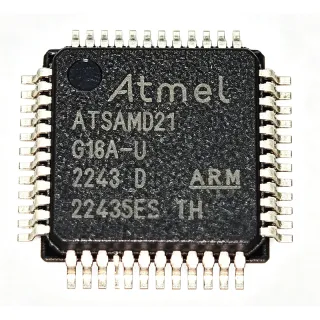
DSPIC33EP32MC504T-I/MV - 16-bit 70 MIPS DSC, 32KB Flash | Microchip
MPN: DSPIC33EP32MC504T-I/MV ✓ Active| Qty | Unit Price | Extended |
|---|---|---|
| 1 | $4.55 | $4.55 |
| 10 | $4.11 | $41.10 |
| 100 | $3.72 | $372.00 |
| 500 | $3.39 | $1,695.00 |
| 1,000 | $3.06 | $3,060.00 |
DSPIC33EP32MC504T-I/MV Overview
A digital signal controller combines the computing architecture of a microcontroller with the mathematical throughput of a digital signal processor. Within the power-management hierarchy of embedded silicon, the DSC sits between a general-purpose MCU and a dedicated DSP: it retains deterministic, interrupt-driven control flow and rich on-chip peripherals while adding a DSP engine for fast multiply-accumulate operations used in filters, transforms, and control loops such as field-oriented control (FOC) of motors.
Key features include the 70 MIPS dsPIC33E CPU core, Motor Control PWM (MCPWM) modules with complementary outputs and dead-time insertion, a CAN 2.0B controller for industrial networking, 4 direct memory access (DMA) channels, and 5 general-purpose timers. These peripherals let a single chip close high-speed current loops and handle communications without external logic.
Technically, the dsPIC33E core operates from a 3V to 3.6V single supply (per distributor electrical data, 60 MHz maximum clock figure, 70 MIPS instruction throughput) and integrates the DSP engine, watchdog, and low-jitter PLL clocking. The industrial temperature grade (-40C to +85C) and compact 6x6 mm UQFN footprint support dense power-electronics layouts where thermal performance of the exposed pad aids heat dissipation.
Typical applications include precision motor control (BLDC, PMSM, ACIM), digital power supplies and LED drivers, sensorless FOC inverters, and industrial automation nodes requiring CAN connectivity. The MCPWM plus 12-bit ADC pipeline is specifically optimized for control loops in the 10-100 kHz range.
Design consideration: the 3.0-3.6V supply window requires a clean LDO or buck-derived 3.3V rail; ensure the exposed thermal pad is soldered to a ground pour for both electrical return and heat removal, and observe the maximum clock frequency figures in the manufacturer datasheet when configuring the PLL.
This page synthesizes distributor pricing context, drop-in same-package alternatives, and practical design notes not found in the manufacturer datasheet, providing one consolidated engineering reference for the DSPIC33EP32MC504T-I/MV.
Drop-in alternatives for DSPIC33EP32MC504T-I/MV — same package, pin-to-pin compatible. Different-package parts requiring PCB rework are excluded.
Variants in this series
Same-series models that are drop-in compatible with DSPIC33EP32MC504T-I/MV (same form factor and footprint) — differing in Package, CAN, Core, Operating Temperature, Program Memory Size.
Quick Comparison Tool — Select alternative parts for side-by-side comparison:
DSPIC33EP32MC504-E/MV
✅ Drop-In✓ In Stock
$3.35 / Unit
View Datasheet →DSPIC33EP64MC504-I/MV
✅ Drop-In ⚠️ Specs Unverified📋 Reference alternative (not in catalog)
DSPIC33EP128MC504-I/MV
✅ Drop-In ⚠️ Specs Unverified📋 Reference alternative (not in catalog)
DSPIC33EP64MC504-E/MV
✅ Drop-In ⚠️ Specs Unverified📋 Reference alternative (not in catalog)
DSPIC33EP32MC504T-I/MV Maximum Ratings & Electrical Characteristics
| Core Processor | dsPIC33E (16-bit DSC) |
| Core Size | 16-bit |
| Instruction Rate | 70 MIPS |
| Maximum Clock Frequency | 60 MHz |
| Program Memory Size | 32KB (10.7K x 24) Flash |
| Data RAM Size | 4KB (4096 words) |
| Operating Supply Voltage | 3 V to 3.6 V |
| Number of Cores | 1 Core |
| DMA Channels | 4 |
| Timers | 5 |
| Special Peripherals | Motor Control PWM (MCPWM), CAN 2.0B |
| Package | 48-UQFN (6x6 mm) with exposed pad |
| Mounting Style | SMD/SMT |
| Operating Temperature Range | -40C to +85C (I grade) |
| Technology | CMOS |
| Packaging Type | Tape and Reel (T suffix) |
DSPIC33EP32MC504T-I/MV 48-uqfn (6x6 mm) with exposed pad Pin Configuration Guide
Pin configuration for DSPIC33EP32MC504T-I/MV (48-uqfn (6x6 mm) with exposed pad package). This digital IC includes GPIO, communication interfaces (UART, SPI, I2C), and power pins. Refer to the manufacturer datasheet for alternate pin functions and configuration options. Essential for embedded system design and PCB layout.

No detailed pinout data available for DSPIC33EP32MC504T-I/MV.
Refer to the datasheet for full pin configuration.
Typical Applications
DSPIC33EP32MC504T-I/MV is suitable for 6 applications: Field-Oriented Motor Control (BLDC/PMSM), Digital Power Supplies and PFC, Industrial Automation and CAN Networking Nodes, Sensorless FOC Inverters, Digital LED Drivers and Lighting Power, Embedded Sensing and Signal Processing Nodes.
Field-Oriented Motor Control (BLDC/PMSM)
The MCPWM module with complementary outputs and hardware dead-time insertion, combined with the 70 MIPS DSP engine, makes the DSPIC33EP32MC504T-I/MV a natural single-chip FOC controller. Current-loop execution at 10-20 kHz with single-cycle MAC operations leaves ample CPU margin for speed observers and startup routines. In a typical 3-shunt inverter, the PWM triggers synchronized ADC sampling of phase currents, the DSP engine runs the Clarke/Park transforms and PI loops, and the CAN controller reports status to a host. The -40C to +85C industrial grade covers drive enclosures, and the 48-UQFN exposed pad conducts inverter-adjacent heat into the PCB ground plane.
Recommended
Digital Power Supplies and PFC
Switched-mode power supplies and power-factor-correction stages benefit from the deterministic control offered by this DSC: the MCPWM module generates phase-shifted or complementary PWM while the DSP engine executes voltage/current compensation loops in the 50-500 kHz PWM-update range. The 4 DMA channels move ADC results to RAM without CPU intervention, keeping loop jitter low, and the 5 timers support housekeeping tasks and fault blanks. Operating from a clean 3.0-3.6V rail, the controller interfaces directly with gate-driver logic level inputs. Firmware-only control also enables adaptive tuning and digital protection that analog control loops cannot offer, at a comparable BOM cost.
Recommended
Industrial Automation and CAN Networking Nodes
The integrated CAN 2.0B controller allows the DSPIC33EP32MC504T-I/MV to join CANopen or proprietary industrial fieldbus networks without an external CAN controller, reducing BOM cost and latency. Typical nodes combine motor or actuator local control (via MCPWM) with network telemetry handled through DMA-buffered message RAM. The 32KB Flash accommodates a compact CANopen stack plus application logic; nodes requiring larger protocol stacks can drop in the 64KB or 128KB Flash family variants on the same 48-UQFN footprint. The -40C to +85C rating and SMD/SMT UQFN package suit sealed control cabinets and compact distributed I/O modules on factory networks.
Recommended
Sensorless FOC Inverters
Sensorless field-oriented control demands heavy DSP throughput for sliding-mode or flux observers running alongside the current loops. The dsPIC33E core's DSP multiply-accumulate engine executes these observers with deterministic worst-case timing at 70 MIPS, while the synchronized MCPWM-ADC pipeline samples phase voltages and currents at PWM frequency. Because no position sensors are used, board space and harness cost drop - matching the compact 6x6 mm UQFN footprint. The 4KB RAM holds observer state, PI history, and a modest coefficient table; designs requiring larger filter buffers should select the same-package 64KB/128KB Flash variants which include proportionally larger RAM.
Recommended
Digital LED Drivers and Lighting Power
High-power LED fixtures use this DSC to implement constant-current regulation, dimming curves, and fault protection in firmware. The MCPWM module provides the switching signals for buck or boost LED stages with programmable dead time, while ADC channels monitor current sense resistors each cycle; the DSP engine filters feedback for stable average-current control and flicker-free dimming down to deep PWM ratios. The 3.0-3.6V operation pairs directly with standard 3.3V supervisory logic, and the small 48-UQFN package fits driver boards mounted inside luminaire housings where ambient temperatures approach the +85C industrial limit, making thermal pad copper pours essential in these designs.
Recommended
Embedded Sensing and Signal Processing Nodes
Beyond power conversion, the DSP engine supports real-time filtering and spectral analysis on sensor streams: vibration monitoring, acoustic analysis, and power-quality metering all fit within the 70 MIPS budget using FIR/IIR routines from Microchip's DSP library. The 4 DMA channels stream ADC results into ping-pong RAM buffers while the CPU processes previous frames, minimizing sample loss. Results export over CAN, UART, or SPI without an additional communications chip. The -40C to +85C industrial rating supports unconditioned field enclosures, and the remappable Peripheral Pin Select feature lets one PCB layout serve multiple sensor front ends with only firmware changes, reducing qualification overhead.
Recommended
Recommended Products Summary
Engineering reference data for DSPIC33EP32MC504T-I/MV — comparison, design guidance, and compliance information.
Selection Guide
Comparison with Alternatives
| Parameter | This Product | DSPIC33EP32MC504-E/MV | DSPIC33EP64MC504-I/MV | DSPIC33EP128MC504-I/MV | DSPIC33EP64MC504-E/MV |
|---|---|---|---|---|---|
| Package | 48-UQFN (6x6 mm) | 48-UQFN (6x6 mm) - same | 48-UQFN (6x6 mm) - same | 48-UQFN (6x6 mm) - same | 48-UQFN (6x6 mm) - same |
| Brand | Microchip Technology | Microchip Technology | Microchip Technology | Microchip Technology | Microchip Technology |
| Core Performance | 16-bit dsPIC33E, 70 MIPS | 16-bit dsPIC33E, 70 MIPS | 16-bit dsPIC33E, 70 MIPS | 16-bit dsPIC33E, 70 MIPS | 16-bit dsPIC33E, 70 MIPS |
| Flash Program Memory | 32KB (10.7K x 24) | 32KB | 64KB | 128KB | 64KB |
| Operating Temperature | -40C to +85C (I) | -40C to +125C (E) | -40C to +85C (I) | -40C to +85C (I) | -40C to +125C (E) |
| Key Peripherals | MCPWM, CAN 2.0B, 4 DMA, 5 timers | MCPWM, CAN, 4 DMA, 5 timers - same | MCPWM, CAN, 4 DMA, 5 timers - same | MCPWM, CAN, 4 DMA, 5 timers - same | MCPWM, CAN, 4 DMA, 5 timers - same |
| Supply Voltage | 3 V to 3.6 V | 3 V to 3.6 V | 3 V to 3.6 V | 3 V to 3.6 V | 3 V to 3.6 V |
Key Differentiators
- Optimized motor-control peripheral set at lowest Flash point (vs DSPIC33EP64MC504-I/MV)
- Extended-temperature option without redesign (vs DSPIC33EP32MC504-E/MV)
- Scalable memory on an unchanged PCB (vs DSPIC33EP128MC504-I/MV)
Design Notes
The dsPIC33EP32MC504T-I/MV requires a tightly regulated 3.0-3.6V supply. Use a low-noise LDO or filtered buck output, and decouple each VDD pin with 100 nF ceramic capacitors placed within 2 mm of the pin, plus 4.7-10 uF of bulk capacitance near the device. Separate AVDD from VDD with an RC or ferrite filter to keep switching noise from the MCPWM and gate drivers out of the ADC reference domain - critical for clean current-loop feedback in motor-control designs.
The exposed thermal pad of the 48-UQFN (6x6 mm) package is the primary heat-removal path and must be soldered to a grounded copper pour with an array of thermal vias. Estimated guidance: in dense inverter layouts the local ambient near the controller can exceed 70C; since the -I grade tops out at +85C, budget junction-to-ambient margin carefully or select the -E/MV variant (+125C) for hot enclosures. Never float or lightly wet the pad - it is also the main ground return.
Many digital functions on this device are assigned through Peripheral Pin Select (PPS); forgetting to lock PPS register writes (via the unlock sequence) or leaving CAN pins unremapped are frequent bring-up failures. Also note the 'T' suffix means tape-and-reel only - order the non-T MPN for cut tape prototyping. Configure the PLL conservatively and verify the resulting Fcy against the 70 MIPS ceiling in the Microchip clock section before committing to production firmware.
Compliance Information
Compliance attributes were not present in the verified web data for this exact ordering code; confirm via the Microchip product page or material declaration request. Microchip standard active DSCs are typically RoHS-compliant, but this must be verified, not assumed.