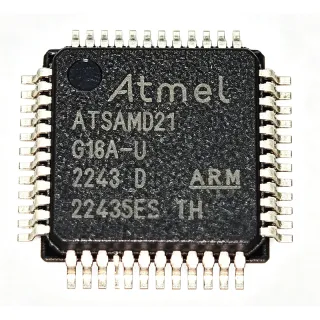
DSPIC33EP512MC204-H/PT - 70 MIPS 16-bit DSC, 512KB Flash | Microchip
MPN: DSPIC33EP512MC204-H/PT ✓ Active| Qty | Unit Price | Extended |
|---|---|---|
| 1 | $6.42 | $6.42 |
| 10 | $5.78 | $57.80 |
| 100 | $5.16 | $516.00 |
| 500 | $4.63 | $2,315.00 |
| 1,000 | $4.18 | $4,180.00 |
DSPIC33EP512MC204-H/PT Overview
A digital signal controller combines the computational capability of a digital signal processor with the peripheral integration and deterministic control of a microcontroller. Within the power-management hierarchy, the DSC sits between a general-purpose MCU and a dedicated DSP: it executes math-intensive control loops (PID, field-oriented control, Park/Clarke transforms) while simultaneously managing timers, PWM generation, and encoder feedback on a single chip. The dsPIC33 family is a widely adopted platform for embedded motor drive and power-conversion products.
Key differentiating specifications include the 60 MHz maximum clock with 70 MIPS throughput enabled by the DSP engine (single-cycle MAC, 40-bit wide accumulator, dual 16-bit working registers), 512 KB of self-programmable Flash supporting field firmware updates, and the MCPWM module providing complementary PWM outputs with dead-time insertion for three-phase inverter control. The QEI module decodes incremental encoder signals in hardware, offloading the CPU for high-speed position feedback.
Architecturally, the dsPIC33E core is a modified Harvard 16-bit pipeline design with dedicated addressing modes for circular buffers and bit-reversed addressing used in FFT filtering. The integrated analog block reduces external component count: the on-chip op-amps can amplify shunt-resistor current-sense signals before the ADC, and comparators support overcurrent protection with fast response in fault conditions.
Typical applications include brushless DC (BLDC) and permanent-magnet synchronous motor (PMSM) drives, servo and stepper control, digital power supplies, solar inverters, and industrial automation nodes where precise, fast closed-loop control is required.
A key design consideration: the dsPIC33EP family is programmed via ICSP using paired PGECx/PGEDx pins - any pair may be used for programming and debugging, but ICSPCLK and ICSPDAT must come from the same selected pair, so PCB routing should reserve one complete pair on a programming header.
This page synthesizes distributor availability data, drop-in alternatives within the same 44-pin TQFP footprint, and practical ICSP design notes not found in the manufacturer datasheet alone.
Drop-in alternatives for DSPIC33EP512MC204-H/PT — same package, pin-to-pin compatible. Different-package parts requiring PCB rework are excluded.
Variants in this series
Same-series models that are drop-in compatible with DSPIC33EP512MC204-H/PT (same form factor and footprint) — differing in Package, Core Architecture, Operating Temperature, RAM, Communication Interfaces.
Quick Comparison Tool — Select alternative parts for side-by-side comparison:
DSPIC33EP512MC204-I/PT
✅ Drop-In ⚠️ Specs Unverified✓ In Stock
$3.45 / Unit
View Datasheet →DSPIC33EP256MC204-I/PT
✅ Drop-In ⚠️ Specs Unverified📋 Reference alternative (not in catalog)
DSPIC33EP128MC204-I/PT
✅ Drop-In ⚠️ Specs Unverified✓ In Stock
$3.67 / Unit
View Datasheet →DSPIC33EP256MC504-I/PT
✅ Drop-In✓ In Stock
$4.6 / Unit
View Datasheet →DSPIC33EP512MC204-H/PT Maximum Ratings & Electrical Characteristics
| Core Processor | dsPIC33E 16-bit DSC core |
| Core Size | 16-bit |
| Program Memory Size | 512 KB (170K x 24) Flash |
| RAM Size | 48 KB |
| Maximum Clock Frequency | 60 MHz |
| Performance | 70 MIPS |
| Number of Pins | 44 |
| Package | 44-pin TQFP (PT), surface mount |
| Motor Control PWM | Yes (MCPWM) |
| Quadrature Encoder Interface | Yes (QEI) |
| On-Chip Op-Amps | Yes |
| On-Chip Comparators | Yes |
| Mounting Type | Surface Mount |
| AEC-Q100 Qualification | Qualified (per distributor product data) |
| Automotive Standard | TS 16949 qualified (per distributor product data) |
DSPIC33EP512MC204-H/PT 44-pin tqfp (pt), surface mount Pin Configuration Guide
Pin configuration for DSPIC33EP512MC204-H/PT (44-pin tqfp (pt), surface mount package). This digital IC includes GPIO, communication interfaces (UART, SPI, I2C), and power pins. Refer to the manufacturer datasheet for alternate pin functions and configuration options. Essential for embedded system design and PCB layout.

No detailed pinout data available for DSPIC33EP512MC204-H/PT.
Refer to the datasheet for full pin configuration.
Typical Applications
DSPIC33EP512MC204-H/PT is suitable for 6 applications: BLDC/PMSM Motor Drives, Digital Power Conversion, Servo and Motion Control, Industrial Automation Nodes, Automotive Auxiliary Motor Control, Embedded Sensing and Signal Processing.
BLDC/PMSM Motor Drives
The DSPIC33EP512MC204-H/PT is engineered for brushless DC and permanent-magnet synchronous motor control. Its MCPWM module generates complementary PWM outputs with hardware dead-time insertion for three-phase inverter bridges, while the QEI module decodes incremental encoder position without CPU overhead. Running at 70 MIPS, the core executes field-oriented control (Clarke/Park transforms plus PI loops) at update rates comfortably above typical commutation frequencies. On-chip op-amps condition shunt-resistor current-sense signals before the ADC, and comparators provide fast overcurrent fault shutdown. The trade-off is added firmware complexity versus dedicated motor-control ASICs, offset by full algorithm flexibility and 512 KB of Flash for observers, diagnostics, and communication stacks.
Recommended
Digital Power Conversion
In digitally controlled AC-DC and DC-DC converters, solar micro-inverters, and PFC stages, this DSC provides the fast deterministic control loop needed for high-switching-frequency power stages. The 70 MIPS DSP engine with single-cycle MAC executes current-loop compensation at PWM-update rate, while the MCPWM module supports complementary and independent PWM modes with precise duty resolution. Integrated comparators implement cycle-by-cycle overcurrent limiting without software latency, and the on-chip op-amps amplify shunt signals, reducing external signal-chain component count. The 512 KB Flash accommodates multiple control laws, efficiency-optimization tables, and communication interfaces in one device, though thermal design must account for the controller's supply and I/O drive dissipation in sealed power electronics enclosures.
Recommended
Servo and Motion Control
For servo drives and multi-axis motion systems, the DSPIC33EP512MC204-H/PT combines hardware QEI position decoding with the DSP throughput to close position, velocity, and current loops in cascade at kilohertz rates. The 48 KB RAM supports trajectory buffers and state observers (Luenberger or disturbance observers) that demand RAM headroom smaller DSCs lack. Complementary MCPWM outputs with dead-time drive the inverter stage, while comparator-based fault protection meets safety requirements for torque-limiting. Multiple PGECx/PGEDx pairs simplify in-system firmware updates on assembled machines. Because 512 KB Flash holds tuning tables, auto-commissioning routines, and fieldbus protocol stacks (CANopen-class) together, one controller serves the complete drive firmware without external memory.
Recommended
Industrial Automation Nodes
As an embedded controller for factory automation I/O, pumps, fans, and actuators, this DSC delivers real-time control and robust peripherals in a compact 44-pin TQFP. The 60 MHz/70 MIPS core handles control loops and protocol processing concurrently; UART and communication peripherals support industrial fieldbuses, and the 16-bit architecture with DSP instructions accelerates sensor filtering and FFT-based condition monitoring. AEC-Q100 and TS 16949 qualification reported in distributor data provide a reliability pedigree suitable for harsh industrial environments. The 512 KB self-programmable Flash enables field firmware updates over the network, an important operational advantage for deployed equipment. Designers should budget supply decoupling on all VDD pins and reserve one complete PGECx/PGEDx pair on a production header for programming.
Recommended
Automotive Auxiliary Motor Control
Distributor product data indicates this device family is AEC-Q100 and TS 16949 qualified, supporting automotive auxiliary drive applications such as HVAC blowers, throttle actuators, pumps, and cooling fans. The MCPWM and QEI peripherals cover the same BLDC/PMSM control tasks required in vehicle subsystems, while on-chip op-amps and comparators implement current sensing and fault protection with minimal external parts - valuable for space-constrained automotive modules. The 44-pin TQFP offers a compact 10x10 mm-class footprint with good thermal performance for under-hood-adjacent enclosures. Firmware can store multiple operating profiles and diagnostics in the 512 KB Flash. Designers must verify the exact -H temperature grade against their location's ambient profile before final qualification.
Recommended
Embedded Sensing and Signal Processing
Beyond motor control, the DSP engine makes this DSC effective for embedded signal-processing nodes: FFT-based vibration monitoring, power-quality metering, and digital filtering of sensor arrays. The modified Harvard core with dual operands, single-cycle MAC, and 40-bit accumulator executes DSP kernels far faster than general-purpose MCUs, while bit-reversed and circular-buffer addressing modes implement FFTs and FIR/IIR filters efficiently. On-chip op-amps provide first-stage analog gain, reducing the external signal chain. The 48 KB RAM buffers substantial sample windows, and 512 KB Flash stores both the application and an in-system upgrade bootloader. For cost-sensitive products needing MCU peripherals plus real DSP throughput in a single 44-pin package, this part avoids a separate DSP chip.
Recommended
Recommended Products Summary
Engineering reference data for DSPIC33EP512MC204-H/PT — comparison, design guidance, and compliance information.
Selection Guide
Comparison with Alternatives
| Parameter | This Product | DSPIC33EP512MC204-I/PT | DSPIC33EP256MC204-I/PT | DSPIC33EP128MC204-I/PT | DSPIC33EP256MC504-I/PT |
|---|---|---|---|---|---|
| Package | 44-pin TQFP (PT) | 44-pin TQFP (PT) - same | 44-pin TQFP (PT) - same | 44-pin TQFP (PT) - same | 44-pin TQFP (PT) - same |
| Brand | Microchip Technology | Microchip Technology | Microchip Technology | Microchip Technology | Microchip Technology |
| Program Memory (Flash) | 512 KB (170K x 24) | 512 KB (170K x 24) | 256 KB | 128 KB | 256 KB |
| Core Performance | 16-bit dsPIC33E, 70 MIPS at 60 MHz | 70 MIPS at 60 MHz | 70 MIPS at 60 MHz | 70 MIPS at 60 MHz | 70 MIPS at 60 MHz |
| Motor Control PWM (MCPWM) | Yes | Yes | Yes | Yes | Yes |
| Quadrature Encoder Interface | Yes | Yes | Yes | Yes | Yes |
| Analog Integration | Op-amps + comparators | Op-amps + comparators | Op-amps + comparators | Op-amps + comparators | Op-amps + comparators |
Key Differentiators
- Maximum Flash density in the 204 family footprint (vs DSPIC33EP256MC204-I/PT)
- Full 512 KB at industrial temperature grade (vs DSPIC33EP128MC204-I/PT)
- Code portability to 504-series motor-control peripherals (vs DSPIC33EP256MC504-I/PT)
Design Notes
ICSP wiring is the most frequent bring-up error on this device. The dsPIC33EP512MC204 offers multiple pairs of PGECx/PGEDx programming pins; any pair can be selected, but ICSPCLK and ICSPDAT MUST come from the same selected pair (e.g., PGEC2 with PGED2 - never mixed across pairs). Additionally, all VSS and VDD pins must be connected during programming and debugging, not just the pair nearest the header. Route one complete pair plus MCLR to a standard 5-pin (or 6-pin) ICSP header on production PCBs to avoid bodge wires.
Provide local decoupling (100 nF ceramic) at every VDD/VSS pin pair, plus bulk capacitance (4.7-10 uF) near the device. When the on-chip op-amps drive ADC sampling, brief current transients occur; inadequate decoupling shows up as ADC noise rather than obvious supply sag. If ADC-based current sensing is used for motor control, consider dedicating a low-noise regulator rail to VDDCORE/VDD analog supplies per the family reference manual, and verify the exact supply voltage range in the current Microchip datasheet before tape-out.
Keep MCPWM outputs routed as tightly matched groups to the gate-driver inputs to preserve dead-time accuracy, and place shunt-current-sense traces to the on-chip op-amp inputs as short differential pairs with ground guarding to reject PWM switching noise. In three-phase inverter layouts, keep the QEI encoder inputs away from PWM switching nodes; QEI counting glitches from crosstalk cause position drift that is difficult to debug in firmware.
Compliance Information
Distributor product data (Microchip USA) states this device family is AEC-Q100 and TS 16949 qualified. RoHS/REACH/lead-free status not stated in provided data.